"What a refreshingly honest blog about listening to music through hi-fi. So happy to see views based upon the enjoyment of music rather than so-called sound 'quality'." - Peter Comeau, Director of Acoustic Design at Mission / Wharfedale
Showing posts with label 4200/1. Show all posts

Sunday, 23 September 2018

The 4th Generation – Can Less Really Be More When You’re Learning To Drive? Linn vs Lejonklou


What makes us interested in hifi?  

I’m sure there are many reasonable responses to that question but for me it goes back to when I was in my early teen years, that time when many of us began to listen to music that captured our imagination or encouraged to think differently or, for some, to be rebellious.  At that time I was fortunate enough that there was a decent stereo system in our house – nothing particularly fancy, it was a Marconiphone branded Thorn EMI radiogram – but it had a Garrard turntable, Goldring cartridge and separate speakers that were big enough to stand on the floor.  My brother and I played lots of stuff on that equipment – Yes, Sabbath, Floyd, Steely Dan and more.  But I didn’t appreciate that the record player made a difference.  Until, one day, I took an album around to my mate’s home where it was played on a Fidelity UA4 – a plastic box with plastic speakers not much bigger than a hardback book, a BSR turntable and probably a ceramic cart.  It sounded terrible.  And so, for me, there was a realization that the kit could make a difference.

So from there, the possibilities became of interest.  There was a mate of my brother’s who had a Sony music centre that did a better job than our Marconi, and so it went on.  In our small town there were 2 hifi shops (no, really!) and it was a simple transition from looking at Hornby trains in toy shop windows to looking at electronics with lots of controls, VU meters, lights etc.  Then I got a part-time job when I was 16 and the saving started.  Enough to one day venture into one of the hifi shops to see what was what.  I went for the smaller shop, which, I was to learn later, was far more focused on music playing systems, the other being focused on the latest shiny far eastern products.  In there was playing a Linn LP12 turntable (I forget the arm and cart, probably something like a Grace 707 and whatever was flavour of the day) feeding into a Nytech amplifier and on to Heybrook HB3s. Wow, that was an ear opening moment when I first realized what was possible, given the budget.

I’ll get to the point.  Soon.  Ish.

But supermarket Saturday jobs don’t feed LP12 and Heybrook habits. So the budget meant looking at Sony / Pioneer turntables, Pioneer / JVC / Technics entry level amps and speakers at that level seemed to be ubiquitously Wharfedale.  But there was also a thriving specialist press at the time, with lots of black and white magazines with glossy covers seeking attention.  And there I discovered a few things about what was available from dealers and how not everything with flashy finishes, impressive sounding technologies and lots of lights were necessarily the best thing around.  Examples from the speaker world were the AR18s and the original Mission 700 – simple designs, but ones with music in mind.  I also began to understand that a used decent turntable might be more worthy than a brand new plastic model from Japan.  So, cutting the long story a little bit shorter, the first system was a used Thorens TD160 with a Mayware arm and a pair of Mission 700s.

So what sat between source and speakers?  Many of you will probably have worked out where this is going.  In the one shop we have JVC shiny amps with slider controls, sat alongside Technics SUV-something-or-others with the Super Class A circuitry.  Amplifiers with 0.0001% distortion, 50 watts per channel, the ability to connect 2 pairs of speakers, lovely needle or fluorescent VU meters.  In the other shop, a dowdy looking, drab little box with just a set of tone controls and a meagre 20 watts per channel.  Yet the magazines were praising this little box so further investigation was necessary.  Well, as it turns out, and I’m not sure that the same can be said very often today, the magazines were right.  The Japanese amplifiers sounded slow, lacking in sparkle, flat, they played notes not music and they didn’t engage you when you listened.  Yet the little NAD 3020, for all its build quality faults, its slightly over-warm upper bass, a mere 20W per channel and dull looks was full of life, got you involved and created the heart of a system that I wanted to listen to for hours.  Fantastic value for money.

And so, eventually we kind of get to the point.  In the above example, the simple, “less is more” amplifier did a great job of playing music rather than being led by technology claims and objective measurements.  Is that relevant today?  After my visit to an audio dealer in Lisburn, NI, I decided to find out in my own system.  Might be worth a quick look at the report from Lisburn, as it’s a kind of prelude to this post.

So where are we today, in the Musings system?

Source is a combination of the following, in order of where the information starts to where it ends up:
-          Dell laptop with Exact Audio Copy creates FLAC rips of CDs OR purchased downloads from sites like Junodownload, Qobuz, etc.
-          This data is loaded on a Melco N1ZH which is the HDD version
-          The database and media server is MinimServer which runs with the 24-bit WAV up conversion
-          Chord Ethernet cable
-          Linn Akurate Exakt DSM pre-amp / streamer (this adds internet radio and Tidal options to the data from the Melco)
-          Meicord Ethernet cable
-          Linn Akurate Exaktbox6/1 DSP/multi-channel Katalyst equipped DAC

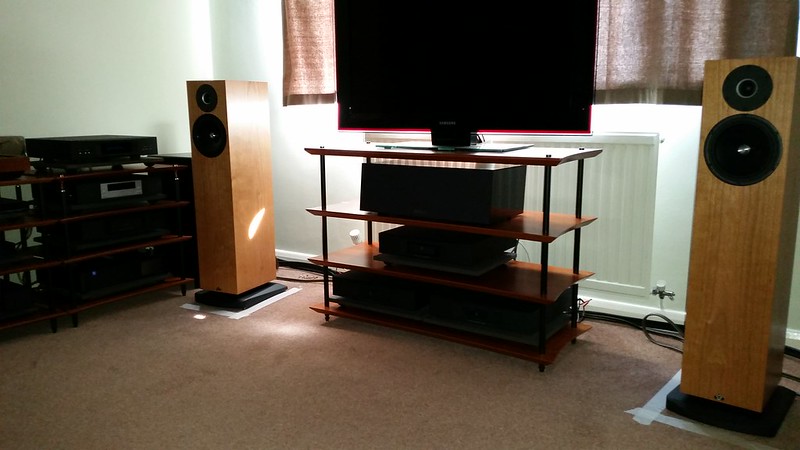
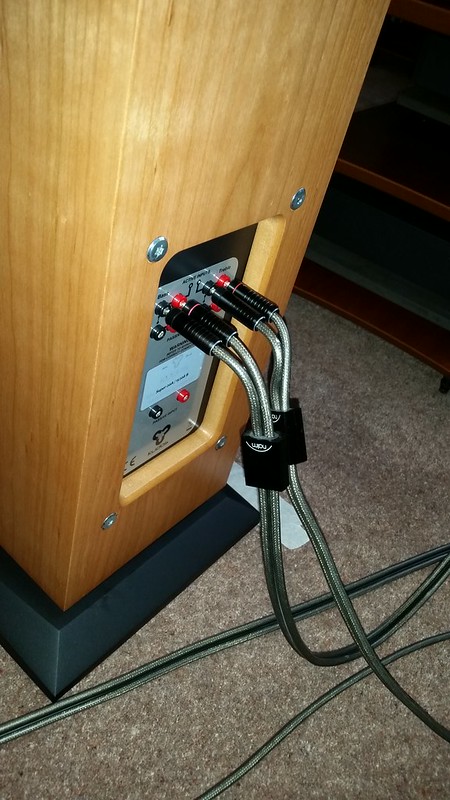
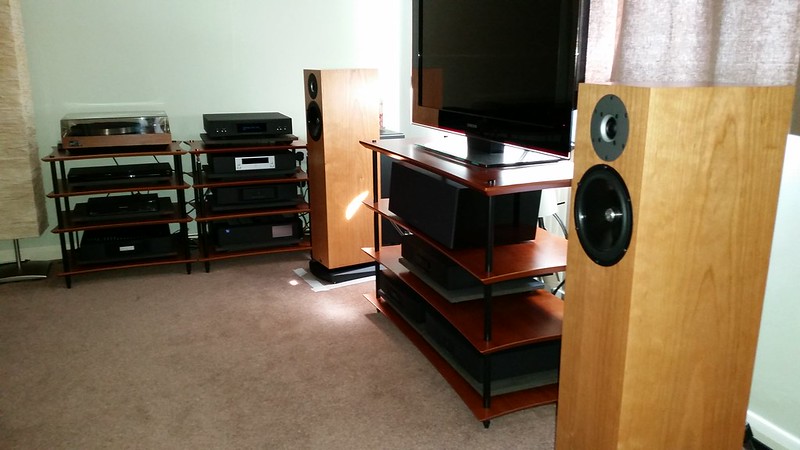
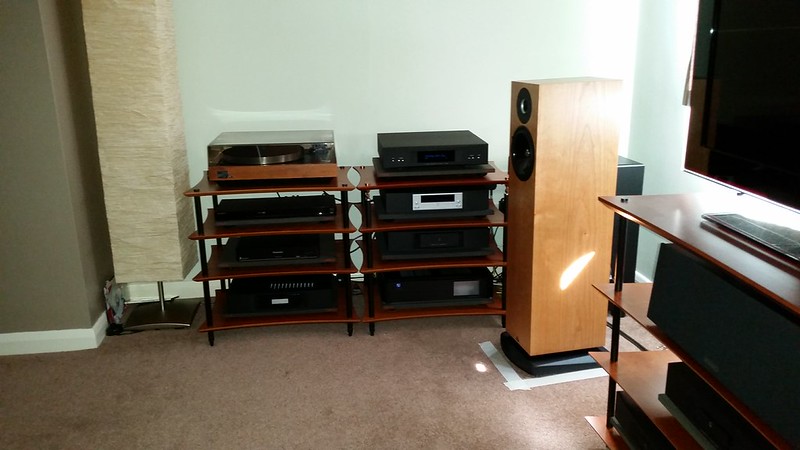
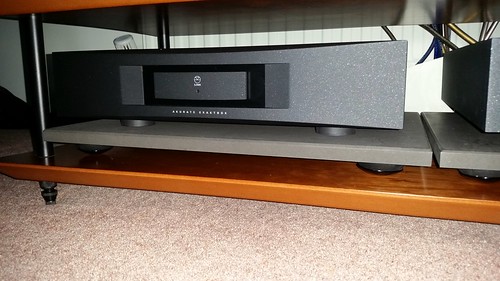
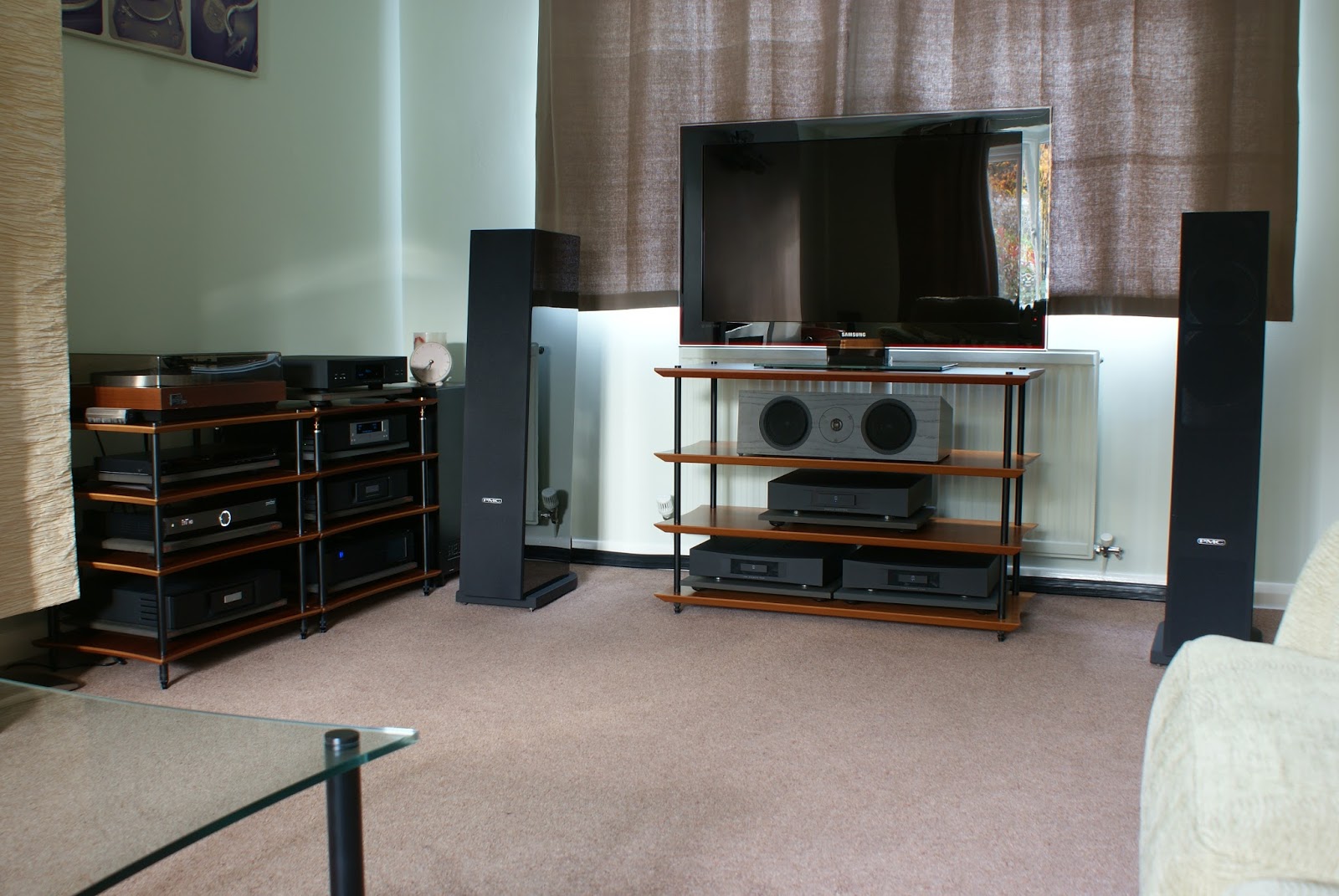
So that lot then sends 3 signals (treble, mid-range and bass) per channel to a pair of Linn Akurate 4200/1 power amps – via Linn Silver interconnects – one channel per driver in the speakers.  Using 6x channels of the 8x available in these amps, I run treble and bass in one amp and mid-range in the other – I’m not sure if this is a general rule, or if its down to the PMCs which have the mid-range at ear height, but I’ve found in this system that any possible improvement should be applied to the mid-range first, hence the amp doing the least work gets to drive the mids. The spare 2x channels then run the centre channel speaker in passive bi-amp mode, which is only used for TV and movies.  A mix of Linn and Naim speaker cables – which will eventually all be Naim - take the signal out to PMC Twenty.26 speakers.  The PMCs have been converted to work in active mode (no passive crossovers in the speakers) and they stand on IsoAcoustics Gaia feet. All equipment is mounted on Mission/Cyrus Isoplats on 2 flavours of Quadraspire.  Linn’s SPACE is used to deal with room modes in a mildly adjusted form, only applied after making sure that the speakers are in their best position in the room to start with.

A while I go I toyed with the idea of trying 3x stereo Naim NAP250DR amps in the system – I’ve heard this amp sound very good in systems that don’t include other Naim stuff and considered it might be worth a try. But what else might be worth a try and would it bring enough improvement without spending very silly money?  Linn’s Klimax Twin would be worth considering, but I’ve been there before and whilst it is a very good amplifier – it does just sound like a more powerful Akurate amp rather than a major step forward.  Linn’s own Solo amps would also be worth a try, but when you need 6 of them, the price and space required becomes a VERY real issue.  I suppose there is a very long list of options, and possibly Audionet should be on that list too.  Finding dealers (or friends) who have 3x amps on demo or available to borrow is a challenge too. One thing I didn’t want to do is leave Exakt behind and go back to a conventional system – I hear too many benefits to think about going in that direction.

So if you’ve read the post about the visitto Lisburn then you’ll have guessed already the path I wanted to explore further.  The Lejonklou (say Lay-on-cloo) Tundra Stereo 2.5 impressed in a Linn Exakt system, with Kudos Titan 707s, but that was just whetting the appetite – there’s no compensation for trying changes in your own system, in your own room.  The room is an intrinsic part of the system, and can’t be ignored.  But 3x amps?  Who was going to be able to help with a demo like that? Well, Kantata-Audio stepped up to the mark – they already have 2x demo amps of their own, but John put the effort in to get a third one lined up and the plan was hatched.  Great service too – amps delivered to home in Wales from over the water in NI.  I guess John would prefer to come along to install the gear, but maybe he felt it was safe enough to let me get on with it on my own, especially this far from base!

Remarkably, despite the best efforts of the couriers, the amps turned up safe and sound, packaged in their very simple, unassuming cardboard boxes.  No box branding as such, just Lejonklou branded sealing tape.  One by one the amps were unboxed and in each box we find an amp, a simple instruction leaflet, a Lejonklou branded box containing the power lead and a multimeter – more of which later.

Simple cartons

A smart box for the power cable

Instructions on setting up using the supplied multimeter


Once all were unboxed, I listened again for a good hour or so to the system as-is (it had being playing quietly for at least 30 mins beforehand), just to get a good feel for what it sounds like, trying to keep that in my most recent memory.  It might not have helped much, but I felt I should try and make the comparison as fair as possible.  Given that it was about to take about 1.5 to 2 hours to disconnect cabling, change over the amps, re-cable, test etc., then this wasn’t a comparison that was going to be of the A to B variety.  In the limitations of the amount of rack space I have, it just wasn’t possible to do this the most ideal way, with all the amps set up ready to just change cables – I don’t have that kind of space.  Even with this last listen, given the set-up procedure for the Tundras, it probably made only a small difference, given it was going to be 30 hours or so before serious listening could be undertaken -  more on set-up soon.

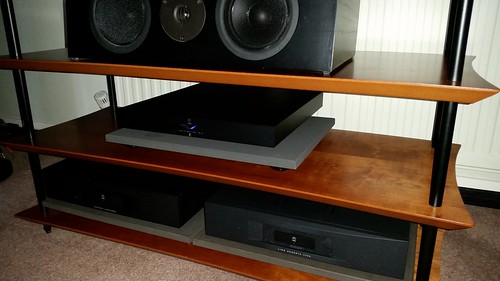
Physically, because 2x 4200s are being swapped out for 3x stereo amps, there was a re-shuffle on the centre rack.  Previously the Exaktbox had a dedicated shelf and sat central with the amps next to each other on the shelf below.  Once done, the Exaktbox was off to one side with a Tundra alongside and two futher Tundras side by side on the shelf below.  Another Isoplat was extracted from the loft too, to keep changes between the systems to a minimum by making sure all the amps were isolated equally.  I normally use ClearerAudio Copper Alpha shielded mains cables for the Linn amps, but stuck with the supplied (very unassuming) mains cables provided with the Tundras, as their designer has strong views on this, so I thought best to stick with the recommendation – if there was any experimenting to be done, that could wait a while.  There’s another significant difference between the Linn and Lejonklou amps – Linn offering 200W per channel (into 4 ohms, but to be fair to the industry norm, most manufacturers would call this 100W into 8 ohms) whereas the Tundra makes do with a seemingly very modest 25W per channel – echoes of those NAD 3020 specs.  In my active system, this means a total of 75W per channel and each amp only has to deal with a direct connection to the speaker drive units with no passive crossover to consume power.

The Exaktbox moved to the left to accomodate the first Tundra.  Linn amps still in place on the bottom shelf

Back to what came out of the boxes.  3x of the latest iteration of the Lejonklou Tundra Stereo 2.5.  v2.5 is probably about the 7th or 8th iteration of the amp, the history of which can be found here.  It was Fredrik Lejonklou’s first amplifier product.  Interestingly it reminds me, at least in the way it looks, of a combination of Linn LK range (the Klout of that range also had twin blue LEDs on the front panel) and the no-nonsense solid engineering of the Naim amps.  These boxes are not heavy (they use SMPS power supplies, not big heavy transformer PSUs like many amps) but they do feel very well built from quality materials.  Everything is black with a nice matt finish that feels like it will be robust – the front features the central company logo flanked by the aforementioned blue LEDs.  One of my favourite non-audio features (probably the amps’ only non-audio feature) is the ability to turn these LEDs off using a simple back panel toggle switch – the less distractions in the room the better when focusing on enjoying the music.

Unassuming, but seems to be well built

 On the underside we find a myriad of allen bolt heads presumably holding boards, components and earth straps in place.  I don’t take a look inside for 2 reasons – first these are not my amps and that would be inappropriate, but secondly because Lejonklou are fastidious about their fasteners – each and every one has been adjusted to a particular torque level where it sounds best to the designer.  I find this fascinating, have no experience of the difference a torque setting for an amp board mounting can make, but I’m quite happy to accept that every little change added up can make for a big change overall.  Other than that there are 4 rubber feet of everyday appearance, each mounted on a metal washer.

Around the back the action doesn’t get any more exciting.  Functional is the approach.  The LED on-off switch, the mains on-off switch, 4 phono socket connections, 4x 4mm speaker output sockets and that’s almost your lot.  Fredrik has tested the amp and signed off on a small label.  The only thing here that’s somewhat unusual is a 3.5mm trim port and a small rubber knob next door. That’s your lot.  The 4x phono connectors are in pairs – a pair for each channel – one is the input, the other an output that can be used to pass the signal along to another amp for passive multi-amping of speakers by duplicating the input signal.  In my system, just the input connections are required. The top plate is even simpler – just a flat panel with a narrow row of cooling vents running just along the back edge.
Connecting up took a while, but I did take the opportunity to do a bit of dusting along the way J.  The usual power-up sequence for an active system was used, music was played and the bass amp powered up first.  Then the mid-range, then the treble.  This sequence means that if, for example, what I expected to be the bass amp was actually outputting treble, the bass driver would have no issue.  Try that the other way around and the tweeters would soon be smoke.  And then was the patient bit.  How patient?  Well, 30 hours or so.  But I managed to do it.  The Tundra has a lower gain compared to the Linn amps – over the weekend it correlated with what I’d read – the pre-amp needs to be 9 or 10 units higher than with the Linn amps to get the same kind of listening level.  So a very quiet 40 volume level with the Akurates is a very quiet 50 with the Tundras.  And so they played for an hour or so before it was time to take a break and get some kip – turning the rig down to a barely audible level 35 to keep things ticking over, but not disturbing the household.

Simple rear panel with the LED toggle far left and the trim port next to that

Underside

Next morning they’re back up to 50 to play away to themselves, apart from the essential break for a cuppa when I’d head back into the room and listen for 30 mins or so, just to hear what was going on.  So back to that trim control and port.  That’s where the multimeter comes in too – each amp is supplied with one which is labelled up on the back with the correct mV reading for the amp.  The idea here is that the amp’s idling current can be adjusted to suit it’s set up to make the best of the temperatures that arise from its working location.  This has to be adjusted after the first 24 hours, then again an hour later, one month after installation and then annually there after.  Unless you re-locate the amp to a new environment, when the 24 hour/1 hour process should be repeated.  An amp for the enthusiast audience rather than the mass-market then.

First amp connected up.  Trim port and trim knob just this side of the speaker cables

Well, I said I managed to be patient – but its confession time!  I actually lasted 20 hours of running before I got down to the first adjustment – I figure these are demo amps and have probably had a good few hours running already.  Turning off the Exaktbox meant there is no signal going into the amps – they’re idling. Plugging in the multi-meter and turning to the mV setting the trim knob is adjusted until the correct value is showing.  Very simple, very straightforward, no specialist knowledge required.  I did one amp, then ran some music again for about 15 minutes before going silent and adjusting the next one – hopefully this kept the temperature closest to normal operating.  I repeated this for the third amp.  Two amps needed just a small tweak, the third quite a bit more – it must have been operating in a fairly different type of rack previously.  So then I put in about 2 hours of listening at a modest 50 to 55 listening level, but didn’t make the second trim adjustment until the next morning – another 9 hours of running.  So after breakfast on the Sunday, the final adjustments were made (just one amp actually needed a tweak) and at last, some proper listening can be done.
Sometimes, when listen to music in order to work out what a component is doing in a system (or a complete system, as is usually the case at hifi shows), its difficult to get the words right to describe what’s being heard. And more often than not, they’re questioned, mis-interpreted, inadequate, or need to describe things in terms of characteristics when you’d rather be talking about the way the music is playing or feeling.  Whilst there are “technical” characteristics to what’s heard, they’re a small part of what matters – its what the music does for you rather than the way its presented that’s key.  If it doesn’t stir emotions, then there seems little point in using anything other than the basics and using music as a background rather than a priority.  I’ll try to give a flavour of both technical and musical here, to try and cover the bases.

All 3 Lejonklous in place.  Here with the LEDs switched on - I prefer them off to reduce distractions

So the technical – well, what I’ve noticed, and I found it a little difficult to understand when reading this elsewhere, these amps need 15 to 20 minutes warm-up time.  And by that I don’t mean switched on, that’s not enough, they need 15 to 20 minutes of actual music playing.  At the start they sound very good, but the imaging is flat and there’s nothing particularly special about them. But then, after that time, they wake up significantly.  The left to right imaging opens up enormously, spreading across the full width of the room, and those phase effects used extensively in electronica, where the sound seems to come from beside and sometimes behind, are very effectively delivered.  Depth front to back comes in too, but perhaps never gets quite as deep as with the Linn amps, even after a full warm up.  Bass lines are just a touch softer on the leading edges than with the Linns, as noted in the Lisburn system, yet it has more believable textures and timing.  Goes just as deep, is just as substantial but yet more stable on the Tundra compared to the Akurate. Running with SPACE in my home system to deal with room modes helps to reveal just how good the timing is on the Tundra, in addition to opening up their mid-range clarity.  The rest of the frequency range is handled extremely well, but it’s the treble that has a delicacy almost absent in the 4200.  Spashiness is much reduced, sibilance takes a further step back and there’s yet another level of detail in terms of hearing how a struck cymbal’s note changes as it decays, or the ability to differentiate between the different areas the instrument has been struck.

In the mid-range, I find that instruments take another step towards being clearly defined as individual sounds.  Some tracks reveal multiple instruments taking the lead where before there had been a single, less well defined, tune line.  Notes also last longer – they decay away convincingly and add to the sense of the venue on live recordings.  Vocals are easier to follow, but also carry so much more emotion and expression.  At the end of tracks as the notes fade away, they do so into a much quieter background.

And what about the music? After the initial 15 to 20 minute running time, this is the area that demonstrates a great deal of superiority to the Dynamik power supplied Linns.  Its also the most difficult to describe in words.  The thing that really stands out for me is their timing.  It seems completely counter-intuitive that timing should be a “thing” that might be a challenge for a modern amplifier.  I mentioned it when listening in Lisburn, its about the musicians playing together. On every beat. Every time.  Of course, the Lejonklou’s probably still don’t get it completely right, but there’s a definite sense of the removal of a layer of complexity in the music – note, I don’t say a layer of detail, that’s something completely different.  For example, the 2 guitars on Dire Straits’ “Six Blade Knife” around 2:30 into the track and onwards – what was previously 2 different instrument lines is now an interplay making a complete tune together, yet the 2 instruments are still clearly distinguished.  Another example being the clicks and tricks on Tunng’s “Jenny Again” – they no longer feel like add-ons, but a part of the music.  This integration of “special effects” into the feel and flow of the music, I notice time and time again – another example would be something that sounds like sheets of metal being tapped on Pitch Black’s “Filtered Senses” – the way they impact into the music and then fade away is no longer rather incongruous to the tune.  This track also has some interesting bass depth that rumbles underneath – but now with a sense of tune and flow, not just a rumble.  The complex percussion (finger cymbals, castanets etc.) contribution to Massive Attack’s “Unfinished Sympathy” as an integrated part, not as a seemingly unnecessary distraction.  The bass line in Leftfield’s “Afro Left” introduction kicks solid and stable, building a sense of anticipation of what might be to come.

Kiki Dee’s live rendition of “Don’t Go Breaking My Heart” from the “Almost Naked” album is a great track.  I’ve enjoyed it on most good systems I’ve had but now we have more emotion in her voice, a greater sense of the venue and something that flows between her vocals and the backing track. Its easier to hear the message Dee wants to put across.  On Yello’s album “Toy”, there are 2 guest female vocalists who have quite a different contribution to make to these tracks.  Malia’s smokey smooth jazz style is contrasted with Fifi Rong’s lighter, mysterious vocals.  Now this contrast is greater still – Malia’s out to convince through gentle persuasion, Rong seems to be out to unsettle, disturb and put doubts in your head.  And talking of unsettling, Mary Gauthier’s seriously unhappy on “Falling Out of Love”, its already pretty obvious really, but here her vocals grab you and almost force you to take notice of just how unhappy she is.  Gripping stuff.

All of this got me thinking about how to describe the effect of the Tundra 2.5s in my Exakt system.  The above kind of tries to get the experience across, but then probably not adequately enough.  So how about comparing the 2 amps to learning to drive?  When you first pass your driving test, its because you are competent and safe on the road.  You know what to do, when to do it and how to do it.  But that’s all.  It still takes a great deal of concentration and it doesn’t come naturally.  You have to think through what you’re doing and you do it sequentially, as per the instructor's directions.  But then, as you get more and more competent as a driver, things start to flow – actions gel together, you start to anticipate traffic, you get smoother with gear changes and clutch engagement, you gradually stop thinking about the mechanics of what you’re doing.  The stuff you have to do all the time almost become subconscious and you can flow into the traffic and start to enjoy the actual journey, perhaps placing the car on the road to get the best out of a corner, to feel the way the car reacts to your inputs etc. Driving is no longer a set of individual motions, actions and set pieces, it becomes a continual flow and blends together as one journey.  Yet you’re still controlling individual functions such as the throttle, steering, gears etc. – they’re still distinct actions.

So that’s what I think the Tundras are doing over and above the Linn Akurate amps.  They give that flow, that sense of an easy to follow musical experience, rather than a set of individually processed notes and voices.  Its also interesting to note, although source first is still true because you can never recover what’s lost at source, there’s a good deal here to learn about how much components further down the line can lose and waste what the source is doing and prevent the musical side getting through to the listener.  A fantastic source can be wasted by not giving it good enough support.

Linn DSM / Exaktbox Source, Lejonklou Amps, PMC Twenty.26 Speakers

So after NAD, Rotel and Linn amplifier generations, a new generation takes over the reins in the system and a seemingly simple amp brings greater enjoyment of the music.  They’re here to stay.

Thursday, 30 March 2017

Linn Exakt and Kudos Super 20: World First Review

There's a bit of a back story, so please bear with me.

First, I'm going to assume a working knowledge of Linn Exakt and what it can do to process the musical signal coming from a DAC, through a set of power amps and on to each driver in a loudspeaker.  If you're not so sure, you can follow these links for some more information:

Also, there's lots on the blog about my current system of Linn Akurate Exakt and PMC Twenty.26 which forms the basis of comparison here, so have a dig around if you need to catch up on the reference point for this review.  But before the PMCs, I tried some different options, one of which was the Kudos Super 20.  At the time, this was with a Linn Klimax system using a more traditional, passively driven, approach.  That review is here, but to summarise on my view of the Super 20s in that system in my room:
"So its a mixed bag.  I really understand why they're a good seller and why their owners enjoy them so much - I get the appeal of the etched instruments, I get the speed, I get the way they do female vocals. If I was in the market for speakers at this price point, I would say that they could be on a short list. But I need to relax into my music.  I like chilled out music to wash into the room and give a warm feeling as I sit back after work and wind down. When a system doesn't let me do this, its not right for me.  Others will have a different view.
As such, these aren't the right speakers for me or my room.  They're different to the M140s, but they're not the right mix of abilities to justify a change to the Super 20s.  I'm looking for a bigger difference, but perhaps, more of what I have, rather than a different direction."
 
So not a ringing endorsement in my system and room, but certainly something to consider in the right size room - they work well in their owner's own listening room which is somewhat smaller in volume than my own room.

Kudos Get Activated
Since then, Kudos have committed to delivering all their "upper" range speakers (at the moment, that's Super 10, Super 20, T-707 and T-808) with the ability to run with active amplification - ie, the passive crossover in the loudspeaker is by-passed, an active crossover is placed in front of the power amplifiers and each power amp channel controls just one driver each. This has been successful for T-808 with both Linn Exakt and Devialet implementations which you can read about at those links. Most recently, I had my first taste of Kudos's newly launched T-707 being partnered with Naim electronics including a SNAXO active crossover. This is a deeply impressive combination, heard at the Chester Hifi Show 2017.

A little while ago, the Super 20 (re-named 20a) has been treated to the Kudos connection panel which allows passive or active use of the speaker. Conversion from passive to active is extremely simple - just pull out 4 jumper hoops and connect your amps to the appropriate driver connections. So simple, in fact, that Kudos don't explain how this is done on their instruction sheet. Perhaps there is an expectation that the dealer is involved in most installations.

New Kudos Super 20a ready for listening
 Review Caveats
There are a couple of caveats to this review to bear in mind. First, and crucially, we had a pretty much brand new demo pair to work with. So new, the Cherry veneer was still very pale indeed - I know this darkens over time to something much deeper and richer. We estimated the speakers had about 50 hours of use on them - this is important to bear in mind as you read the review, as speakers often take a while to settle down or 'break-in' from new and their character can change a surprising amount over this time. Second, we only had a 3 hour window to work within, so there's a chance there may be more to come given more set up time - on this one, we saved a good chunk of time by going straight to the speaker position we'd found had worked best for the speakers in passive form. I think that's a very reasonable approach to take and should result in something pretty close to optimal.

Local friend R has earlier passive Super 20s in a Naim NDS/555, 282/Supercap DR and 250DR system with SuperLumina cables throughout. This lot feed a pair of the earlier Super 20s which don't permit active operation. This means there are 2 of us with experience or extensive experience of the Super 20s in this system. R's Super 20s are the ones reviewed in my previously passive Linn Klimax system. This gave the opportunity to directly compare the brand new speakers against a set with thousands of hours of use. Hence the first caveat - straight out of the box the newer pair were over bright and the bass was 'stiff' and inarticulate in comparison. To the extent that both of us found listening rather tiring. So they were left playing away to themselves, facing each other with one out of phase to reduce the amount of sound they produced. This is how we know they have at least 50 hours of music under their belts.

Set Up
Distinguishing the Super 20a from the Super 20 is the connection panel. At the base are the normal single-wire passive inputs. The second row down are normally vertically linked to the top row by u-shaped links during passive operation.  Here the top row of connections are being fed active treble and bass signals from Naim SuperLumina cables.

So some perspective from the above in the context of a familiar system and a current (very happy) owner.
2 days later and they're set up in the Musings listening room, positioned where the passive pair had sounded best. A quick look at the brief instructions soon told us that we had to work out the active connectivity ourselves, but it is simple. Pull out the 4 connecting loops and hook up the correct speaker cable to their respective 'active treble' or 'active bass' connection.  Linn Konfig was spun up on the laptop and the Exakt filters for the Super 20s were selected from the menu and installed into the Exaktbox whilst the power amps were still switched off. After confirming the Exaktbox connections against the Konfig diagram, it only took 15 minutes or so for everything to be ready to go. As is the way with active systems - care with connecting is critical.  Connect a bass channel to the tweeter and you can expect a short puff of smoke, silence and a bad smell.  So the bass driver is always connected first - if you accidentally send treble information to this driver its no big deal.  So make sure the bass drivers are connected then listen to music at low volume and make sure the bass driver is producing bass.  If its all good, then connect up the treble and listen to it very quietly to make sure its only handling treble.  If all is good, on with the music...

System

Here's the system driving the Super 20a with an Exakt feed, in source to speaker order:

  • 16 bit and 24 bit uncompressed FLAC files
  • QNAP 251 NAS with WD Red drives
  • Minimserver UPnP database
  • Cat 7 ethernet cable
  • Netgear GS-108T network switch with Friwo medical PSU
  • Chord Anthem streaming cable
  • Linn Akurate Exakt DSM streamer / Pre-amp (with power from PS Audio P5 regenerator)
  • Chord C-Stream streaming cable
  • Linn Akurate Exaktbox 10 DAC/processor (with power from PS Audio P5 regenerator)
  • Linn "silver" analogue interconnects
  • 2x Linn Akurate 4200/1 power amps (with power directly from the mains)
  • 2x 3m pairs of Naim SuperLumina speaker cables
  • All electronics supported by Cyrus Isoplats on Quadraspire EVO racks

 Tracks used:
  • Falling Out of Love - Mary Gauthier
  • Six Blade Knife (24 bit from DSD) - Dire Straits
  • Gula - Deadmau5
  • Keith Don't Go - Nils Lofgren
  • Fender Bender - Chris Jones
  • Breathe You In (ft. Laura Hahn) - Ficci
  • Wicked Game - London Grammar
  • Walking With Elephants - Ten Walls

First Impressions


Here you can see how fresh the Cherry veneer is on this pair - contrast with the Quadraspire cherry shelves.  Akurate Exakt DSM is on the far right hand rack, the Exaktbox 10 is on the middle shelf under the TV with the 2x 4-channel 4200/1 power amps on the lowest shelf
 
That brightness noted in R's home system was still in evidence here, making the system difficult to listen to, but bear with me as this isn't the end game here.  One thing we also noticed immediately was the articulation, drive and rhythm in the bass line - although there were some room modes being driven here, leading to a touch of boom - that initial stiffness noted at first listen in R's system isn't evident in the Exakt system - either due to the different system, some benefits of the 50 hours of playing time, or perhaps a combination of both. Vocals immediately stood out as crisp and clear with tone and intonation clear in the expression of the words.  So, some work to do.  I think it would've been good to leave them playing for a couple more days, but time was against us.

SPACE

Turning once again to Linn Konfig, the first thing to address was the room modes which were giving a touch of boom in the room - it wasn't at all excessive, but it was there.  Whilst the room measurements themselves were untouched, the position of the speakers in the room was amended to suit the positions of the Kudos boxes and the optimise button was pressed.  The newer SPACE implementation - where each left / right speaker receives different settings - was evident in the profile graph - much more so than with the PMC 26s.  This brought an immediate improvement to the punchiness, tunefulness and articulation of bass line.  But it was a touch light so we took a couple of dB out of the notch and narrowed it significantly and that worked a treat.  As usual with SPACE this opened out the mid-range and treble too - a mixed blessing.
Sometimes, its possible to tackle some vocal harshness by adding notches in space in the 65 to 74Hz range and whilst these gave some subtle benefit, it just wasn't significant.  So we moved up the range and added a -1.8 then -2.0dB treble shelf which Linn allows you to add from 8kHz upwards - and this was a little helpful, but not the answer.  So that was moved up to 17kHz and then we added a custom filter - a -2dB dip centred around 8.5kHz but with a very high width value which effectively gave us a 3.5kHz to 17kHz wide shelf. And that really hit the spot.  Notching this down to -3dB across the same frequency range got us to the right place.  Everything clicked at that point and we started to settle down into listening to the music rather than to the system and its tendancy to spotlight every single thing in the upper frequencies.  This is the first caveat - it would be great to get the speakers back again soon when they've had a lot more hours of use - to see if this treble attenuation can be dropped over time as the speakers break-in.

Listening to Music

So now we had a very satisfactory sounding system, we cracked on with listening to some tracks.  Bear in mind here that R has been listening to these speakers for around 3 years now and has been through a good few system upgrades during that time, so he's very familiar with their capabilities.  It turns out, whilst they might be familiar, they haven't really reached their full potential in the Naim passive system. What we heard in about 90 minutes of listening with Exakt was a revelation.  These speakers, whilst not carrying the same weight and authority as the PMCs (which have a somewhat larger visual and physical presence in the room), they're no longer out of their depth in my room.  They go astoundingly deep from such a small box, with plenty of drive and give a bass line that, had we not already heard the PMCs, would be thought of as very good indeed - add in their relatively small dimensions and that makes them quite remarkable in this area.  Tunes that needed to boogie along did so, attack is good as is the timing of the tune.
What about detail? Well, its astounding - these speakers really can resolve tiny tiny details that is beyond the capabilities of the PMCs and significantly beyond how they sound at home in the passive system. Both acoustic guitar tracks (Lofgren and Chris Jones) deliver string sounds that are crisp, clear and easy to pick out - delivering initial attack in spades and long long decays into the background. Spitty anger in Mary Gauthier's voice make you feel a bit uncomfortable and pleased that you're not the subject of her aggression. Vocals are superb - a good bit more texture, inflexion and intent than with the PMCs.  Imaging is spot on too - rock solid, easy to place, 3 dimensional and a little unsettling on those tracks (such as Ficci) that use processing to give a wrap-around effect in the room.
Is there a downside? Well, its difficult to find anything to fault but I would prefer a little more subtlety in treble leading edges - R found it just to his taste, for me its still a bit sharp.

But here's the thing - throughout, we could both follow tunes and feet were tapping - and I mean throughout. On top of that, R kept giving little involuntary smiles and shaking his head in disbelief.  These speakers are very much more capable than either of us really knew and Exakt with active amplification has brought that out from under the covers of passive operation.

I'll leave it with some of R's words - stunning, outstanding, and several more that I won't repeat in a public forum.

Post Script

We hope to get the speakers back again in a couple of weeks time to follow up on if they've settled in and need less treble attenuation - if this happens I'll report back here.  Also, after the Super 20s left the building, the SuperLumina speaker cable stayed in the house for a little longer.  Interestingly, using this cable on the treble of the PMCs reduced the gap in detail resolution by about 50%, bringing the PMCs closer to the Kudos boxes in this area.  Would I swap the PMCs for a pair of Super 20s? No, but that's no reflection on the capabilities of the Super 20a, more that there is a different set of priorities from which to choose.  Having lived with the superb bass performance of the PMCs, their relative lower level of detail resolution and lesser capabilities in vocal resolution are a reasonable compromise to live with.  And I'd be looking for a substantial improvement if moving on - not a different compromise.  Roll-on the Kudos T-606 in the summer! 


Thanks to Kudos and Acoustica for the loan of the speakers.

Friday, 10 June 2016

Linn Exakt and PMC Twenty.26. World First Review Part Three - Set Up and Listening

Part Three of a Three Part Review

Part One Here

Part Two Here

If you’ve read the above first 2 parts of this mini-saga, then you’ll be aware that we’re part way through the story of moving Audiophile Musings’ system from passive Klimax electronics into Majik 140 speakers towards Linn Akurate Exakt and PMC Twenty.26 speakers.

The Exakt kit was a mix of new and ex-demo and consists of:
  • Akurate Exakt DSM (an Ethernet connected streamer, digital pre-amp and box of tricks that converts all digital signals into Exaktlink protocol before passing this along to the Exaktbox) – AEDSM; 
  • A Cat 7 cable to connect AEDSM to Akurate Exaktbox 10; 
  • Akurate Exaktbox 10 (a digital crossover which contains 2x Linn Exakt engine processors and 10 independent digital to analogue converters (DACs) and outputs 10 channels of analogue ready to be amplified) – AEBOX10; 
  • 6x Linn Silver analogue interconnects connecting the AEBOX10 to the power amps; 
  • 8x channels of Linn Akurate 4200/1 power maps (4200 has 4 channels so after moving from M140 speakers to PMCs, 2x channels are not used for the stereo parts of the system, the 2 spare channels are used to power the centre speaker of the complete 5.1 set up) – A4200/1;
  • 4x 2.5m of Linn K400 speaker cable to connect the power amps to the speakers (initially for the Majik 140s);
  • 2x 2.5m of Linn K600 speaker cable to connect the power amps to the speakers (later, for the PMC Twenty.26 speakers) 
  • Linn Konfig software running on a Windows laptop.

Trevor of the House of Linn came to set up the system, starting with the Majik 140s. We had to do that as the Linn Exakt software filters for the PMCs weren’t available at the time – see Part One of the story for the thinking behind making the jump to Exakt, even before the PMC filters were available. After all the Klimax gear was disconnected, we started on unpacking all the boxes for the new kit and did a bit of shelf dusting whilst we were able. One of the aspects I really appreciate about Trevor’s work is the attention to detail around taking care of the kit. Everything is handled with care and respect, he removes his watch and nothing is left to chance in terms of laying everything out in a logical order etc.
So the DSM is set up on the rack to replace the KDS/2 streamer and the power amps and Exaktbox are installed on the centre rack between the speakers, under the TV. Of course, all installed on Cyrus Isoplats. The Linn software and documentation give diagrams on connecting up the power amp channels to the back of the Exaktbox. Because there are 10 channels on the Exaktbox and because there are many different speakers supported by the software, the connections to the power amps are very much dependent on the speaker in use. So the back of the Exaktbox is just labelled channels 1 to 10 – it’s the diagrams in Konfig that show you how to connect up. Konfig then needs the speaker serial numbers entering and it downloads the correct filter profiles for that particular make and model of speaker. The filters apply all the correct frequency cut-offs and phase corrections tailored through software for the speakers in use. For the Majik 140, channels 1 to 4 and 6 to 9 are used. These Exaktbox outputs were hooked up to 2x Akurate 4200/1 4 channel power amps using Linn Silver interconnects (these have silver coloured sleeves, but the conductors are copper). One power amp was used per left / right channel.

Akurate Exaktbox 10
 
Linn Konfig is fired up on the laptop and work starts on configuring the system. First up is to select the speakers for the Exaktbox – select the model from the drop-down lists and then enter the serial numbers – choosing which speaker (left or right) will use each set of channels (1 to 4 or 6 to 9). Then all the room information for SPACE room optimisation can be input (dimensions, materials, window positions etc etc), or the existing room information is retained, which is the position we were in. SPACE was left switched off and we spent the best part of an hour re-positioning the speakers in the room. There was only about 10-15mm change in position in the room to get the best sound from their previous position.
At this point, SPACE optimisation was calculated and applied. It was pretty much spot-on – a result which is markedly better than using SPACE in a non-Exakt system. In Exakt, the optimisation is called SPACE+ and is applied in the Exaktbox (rather than in the DS in analogue systems). This uses fewer compromises (for example, the position of individual bass / mid-range drivers and the bass ports are much more accurately modelled in SPACE+) and seems to give a great result. We messed a little with the SPACE settings, but ended up back at those calculated by the system. Impressive.
So the Exakted M140s using Akurate level electronics are a major improvement on the same speakers driven passively by the higher-up-the-range Klimax electronics. Some may find this difficult to take, particularly those heavily invested in Klimax gear. But here we have a system that performs both musically and technically far better and by selling on the Klimax components, actually left me financially better off. Why do I find it better? Well tighter timing, massively better imaging, bass control, a naturalness to the vocals and completely involuntary foot tapping. Given that Linn equipment already sounds very well controlled – to the point where some listeners find them too controlled and lacking in liveliness and wanting them to “let go” more – then its possible to see how Linn have developed Exakt to take this one step further. Did the electronics improve over time? Did they “burn-in”? I’m not sure that they did. Certainly, not enough for me to have noticed. But then it was only the AEDSM that was new – the Exaktbox and power amps were ex-dem and as such would’ve experienced “burn-in”, if such a thing exists with these systems. What is noticeably though, is the warm-up effect. The system sounds great when first switched on, but there’s definitely an improvement at somewhere between 20 and 30 minutes of use. The sound “fills out” and becomes both warmer, deeper in the bass and yet just as controlled. It’s a nice effect, but it would be much better if the system sounded this way from the start. I try to find the time to run the system for a while before sitting down to a focussed music listening session.

What of the PMCs? Well at this point I was kind of thinking the M140s would be around for a while longer whilst saving up for Akubariks. But it wasn’t long (about 3 weeks) and the PMC filters were released. So time to give it a whirl. Some correspondence with Linn suggested that they had found the PMCs a little bright and tiring too and had tailored the Exakt filters to take out a fair amount of treble energy. So the work was done to convert the speakers (see part 2 here), the M140s were replaced by the PMCs.
But its not a straight swap of course – everything was powered down to start with. First, documentation was consulted and the PMC wiring diagram was identified. Now channels 1-3 and 6-8 of the Exaktbox are in action. 2 channels of the power amps were disconnected from the Exaktbox and the speaker cables were changed out from 2x K400 for K600 (3 pairs of cables in one sheath). Next the AEDSM and Exaktbox were powered up (NOT the power amps) – once they were visible on the network then Konfig was opened on the laptop, the correct PMC speakers (curiously, there is choice of 1x Twenty.26 or 2x Twenty.26 available – this is for those who wish to use one Exaktbox per channel – apparently for sound quality purposes, but I doubt that’s something I’m going to consider in the near future – one of the major benefits of the PMCs is the ability to run them off one Exaktbox, including the 6 channel Klimax version). So 2x Twenty.26 was selected and SPACE switched off. I then connected up the bass power amps to the bass drivers and powered up, listened to a couple of minutes of music to check bass information was coming out of the bass drivers. Then the mid-range was added, checked and finally the treble was connected up and checked for treble output. This sequence is important to make sure that drivers are not damaged. The great news was that everything worked as it should. A major relief that the speaker conversion has been a success.
The system was then played and speaker positioning commenced, taking about an hour to start with, then tweaked again after a couple of hours. Like the M140s, the .26s ended up positioned only 10 to 15mm away from their position when using a traditional system.


So a little time was spent listening with SPACE+ turned off, then the position of the PMCs entered into the Konfig room information and SPACE+ optimisation was applied. Like the M140s, the PMCs benefitted from the improved modelling in SPACE+. The room optimisation notches applied by the Linn calculations are excellent, again I found that tweaking them made no improvements, in fact, deviations messing stuff up really. After a few weeks of use, the only change I made at the room optimisation end of things (ie the bass) was to add a 0.9 dB bass “shelf” to add a little weight over the full bass range. What of that sometimes tiring top end? Well the effect of the Linn Exakt filters are easily spotted – with the treble much more in keeping with the rest of the frequency range. A nice change and one I stayed with for a week or so, but eventually dialled in a -1.8dB treble shelf (after much experimenting with values above and below this). Now we have, to my ears at least, a well-balanced frequency range.
One more area that didn’t sound right to me was a harsh edge on vocals – particularly female vocals. There’s nothing to play with here on Linn Konfig so I experimented with a few cables and found something quite astonishing – the supposed perfect digital signal going along the Exaktlinks makes a difference. This doesn’t make much sense, but its probably about noise getting into the Exaktbox – I’m sure its nothing to do with data corruption. So changing from a standard Cat 7 ethernet cable between AEDSM and the Exaktbox to a Chord C-stream (their most basic streaming cable) lost the sharp edge on the vocals and I can’t hear any downsides. Strange but true.

So what of the overall sound of the system? Well at this point, with SPACE+ set up and the cable change above, what we have is a very musical result. The changes I noted going from M140 to PMC in the traditional system are all relevant here, but without any noticeable downsides. The PMCs go deep but are better controlled, vocals really come across with nuances and texture and treble is both full of detail and subtlety. On top of this, Exakt brings a sense of the recording space, speed, masses of information and a step change in the separation between instruments. And I can listen for hours. And hours. And hours, and I do so.
From what I remember of the Exakted Akubariks (at this point about 5 weeks ago in a different room, and about 3 or 4 months ago in Canada), then the PMCs are at least their equal in terms of detail retrieval and subtleties. But they have a different approach to life – they’re very much more lively – they drive a rhythm along with more conviction and a sense of fun, but they do this without being out of control or aggressive. Perhaps the PMCs don’t go quite so deep as the Akubarik, but this is very room dependent so there’s no real direct comparison here. So all was well, but the story doesn’t stop there.
About 3 weeks after Exakt conversion, there was a new software release (for the detail people, it was Exakt compiler version 16). This made no changes to the filter settings for the PMCs, but it changed the way in which the Exaktbox processes and applies those filters. At first, I didn’t quite believe what I was hearing. It took the best part of a day to get past the initial size of the change. That this magnitude of change could happen through software, and to move on to all the little subtle changes that came with this release is an eye-opener. First, and most obviously, was the massive improvement in the sense of imaging and space of the sound. I’m guessing that this is down to much more effective phase alignment processing and it is astonishing in its effect. The speakers truly disappear and instruments and voices are absolutely defined in space – very stable and very believable. The context of the recording is much more obvious – particularly live tracks where the sense of the recording space is portrayed into the listening room. I would liken the size of this software driven improvement being equivalent to moving from ADS/1 to KDS/1. And it was free. Remarkable.
But all this separation, sense of space and believability allows through so much more detail and subtlety. And it’s across the frequency spectrum. Bass lines on Daft Punk’s "Giorgio Moroder" (from the Random Access Memories album) reveal themselves to be even more complex than before and as the crescendo builds at the end, all that complexity remains in control with no tendency towards harshness. Throughout the track there are numerous synth sounds that move from bleeps and blops to being clearly identified sounds that evolve within each note – adding texture and flavour to the track. At the end, the click evolution is much more obviously about a note generated with a very “square” profile. " Get Lucky" (also from Daft Punk's Random Access Memories) is revealed as being much more complex than just a good bit of dance-pop. The lead vocal is clearly more “breathy” with words like spinnin’ now being spinnin-uh, with the uh part only just discernable, but clearly there. Midway through the track the bass line drops out and there’s a buzzy synth underlying the main theme – but it is now audible as a vocoder vocal sample that’s been stretched and twisted. These might seem like minor points, but together they add up to a track that’s much more musically enjoyable – one worth sitting down and concentrating upon rather than being some kind of background or party track.
The echo of the venues on Fink’s live album (entitled "Wheels Turn Beneath The My Feet") is both more obvious and decays away for longer without crashing into or blurring the following notes. The sound of hammer on anvil is right there about 3 feet out from the speakers, just left of centre and about 3ft off the ground in Funkerman’s "Speed Up" (ATFC Remix from the Speed Up EP). Mary Gauthier’s hatred and ire in "Falling Out of Love" (on the "Mercy Now" album) are laid bare whilst the heat pipes hiss. On all of this music, even though there is this very clear separation of individual instruments, there’s no doubt about this being a presentation that still hangs very much together as a joined up performance. Very soon, you get wrapped up in the messaging and mood of the music, enjoying the expressions and flavours, ignoring the hifi, which tends to just disappear.

As you might have gathered, I’m very impressed with the implementation of Linn Exakt with PMC Twenty.26 speakers. The approach Linn has taken to produce digital crossover filters, phase correction between and within drive units and time-aligning the signal has paid massive dividends. The combination of Exakt and PMC really pushes these speakers to compete in a price bracket two or three above where they are as a passive speaker. They sound different to, but very much in the same performance league as Exakt Akubariks. And they’re different in a way that brings more life and fun to the music, but in a way that’s not tiring or wearing – but listenable for hours. And boy do those hours fly past quickly!

 Now we can look forward to Linn releasing this as an official conversion – it’s a pity that the Twenty.26 will be in the shadows a little now that Twenty5.26 is about to hit the market – the gestation time seems too long to have hit the market at the right time. On the flip-side, think of all those traded-in Twenty.26s that will be hitting the market ripe for the transformation that Exakt can bring to them…

For those that heard Exakt in the early days and weren’t impressed, or for those who thought/think that a Klimax badged system MUST be better than an Akurate badged system, I urge you to think again and give Exakt another listen.

Post Script: Since the initial implementation, my Klimax Twin amp has been added into the system – I use this for the mid-range where it seems to bring the best improvements, having tested it across the board. Taking the mid-range from Akurate level to Klimax level amplification has helped at a little more subtlety and detail, but its not a huge uplift – more of a nice to have, given that the amp was already in my possession. If another becomes available at a sensible price I would add it into the bass before the treble.

Now with added Twin
Post Post Script: I'm now wedded to the PMCs for the longer term, so Twenty.21 have replaced the Linn Katans (formerly there were Linn Majik 109s prior to this recent wholesale change) as rear speakers and a Twenty.C has replaced the Linn Tukan (again, formerly a Majik 112 for a number of years) as the centre to complete the 5.1 set up. I must say, the Twenty.C is in a different league to the Majik 112 - a very impressive centre speaker