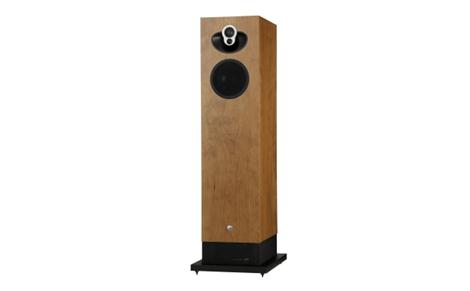
Having launched the
new “lifestyle” series 5 range of speakers in a suitably “lifestyle” location –
The Violin Factory in London - a couple of weeks ago, Linn kindly arranged a
factory event for their more traditional customers. How far do people travel for such an
event? Well I think Vancouver was the
furthest that I know of, so clearly there’s something worth going to Glasgow to
see and hear.
The launch of series 5
has, predictably, caused some debate on the Linn forum about the company’s
focus and direction. Gilad Tiefenbrun’s
presentation(he’s the Linn MD) at the event made it very clear that series 5 is
supplementary to their traditional product range, not a replacement – hence the
naming doesn’t sit in the traditional hierarchy. Within the more traditional range, it’s also
become very clear that the company has bet the future on more and more
integrated solutions – starting with DS/Pre-amp and Exakt built into power amps
and fully integrated Exakt / amp / speaker offerings. There was no mention of more traditional
analogue active either – something that quietly disappeared from integrated
speakers (such as Akubarik and 350A) with the most recent product launches, but
still an option inside Majik and Akurate power amps.
After a successful
night-before-get-together of forum members back at the 40th
Anniversary event in 2013, we again gathered at the Counting House to discuss
the latest products, speculate on the next day’s activities and generally not
take things too seriously. The forum has
been awash with lifestyle product speculation of late, and here, the truth was revealed
with the latest in Linn accessories – the Tea Kloth, exclusive for Forum GTG
members. I don’t think we’ll be seeing a full production run…
INTRODUCTIONS
So what of the event itself? Well, this was extremely well organised,
clearly thought through, and focussed more on the non-lifestyle products,
concentrating on the latest thinking with Exakt and the new Exaktboxes in the
Akurate and Majik ranges. Linn laid on a
coach from Glasgow city centre out to the factory at Waterfoot. I guess a total of about 80 to 90 customers
attended the event. The local dealer was
present, but this was very much a customer event. We kicked off with a buffet lunch at the back
of the ballroom, then gathered for the initial presentations. Gilad welcomed us all and talked about the
new products and how they’re focussed on bringing people into considering a
quality music system for their home, in circumstances where large and more
functional looking equipment is not thought to be acceptable in the home. He spoke about how buyers are now buying as
couples with joint input and how Linn wanted to give them a simple solution
that worked with multiple different interior décor situations. More on the technicalities behind the series
5 speakers below. He referred to the
ever evolving capabilities of Exakt and how it has been an enabler for series
5, for more domestically acceptable speaker positions and every increasing performance
in the Linn range. In addition to Majik
Exaktbox-I, the new Akurate Exaktbox 6 and Exaktbox Sub, Linn are bringing
phase aligned benefits to owners of Linn speakers over 20 years old, thereby
upgrading legacy kit, something other manufacturers don’t offer.
Next to present was
Keith Robertson – Linn’s chief technical lead.
He talked through the virtues of Exakt and the new products, and how the
development of Exakt algorithms continues apace, with a new software release
later this year that will improve the handling of bass roll-off. Also, the achievement of the engineering team
to get 8 channels of 100W power amps, an Exakt engine and 8 channels of Majik
level DACs into a single integrated Exaktbox-i.
I’ll cover these in the individual demo comments below. Worth noting that all Linn speakers are
measured for Exakt, and have been so for the last 2 years – Majik right up to
Klimax level, in anticipation of owners choosing something Exakt either at
purchase or in the future. So for under
2 year old speaker, there’s Exakt data stored in Linn’s systems, ready to apply
Exakt algorithms specifically tailored for that speaker’s serial number. For pre-Exakt speakers, a “generic” set of
measures are used for the speaker model in question, and this is expected to be
within a less than 5% tolerance – typically around 2 to 3%.
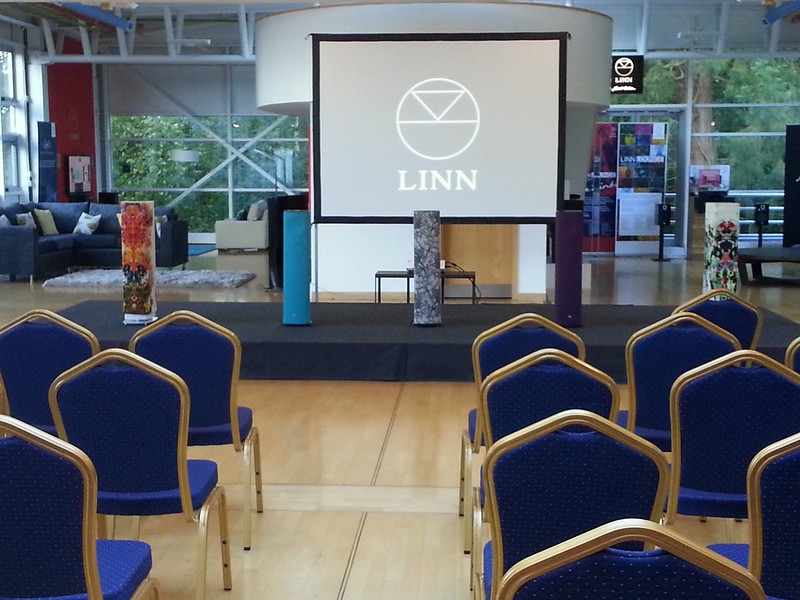 |
| Ballroom and 5x Series 5 |
DEMOS
After the intros, we
were split into 6 groups and then hosted around the various locations around
the factory – this was extremely well organised, timed to fit into the
available slots and offered a good variety of well thought through demos, a
coffee break slotted in part way through the afternoon:
-
Factory
Tour
-
Series 5
-
Akurate /
Klimax Exaktbox & Analogue Active Comparison (and latest thinking on Keltik
Exakt configurations)
-
Exaktbox
Sub
-
Majik
Exaktbox-I vs Majik Passive
DEMOS – Akurate /
Klimax Exaktbox & Analogue Active Comparison (and a bonus for Keltik
owners)
In the back right hand
demo room of Linn Home (a domestic-like environment in a segregated corner of
the factory) we had a 40th Anniversary LP12, Klimax DSM and, a bit
of a surprise this one, a pair of Linn Keltik speakers. Why was this a surprise? Well the Keltik used
to be at the top of the Linn range, but hasn’t been in production for at least
10 years, if not longer. So why are Linn
using a legacy product when inviting customers to a product launch event? Well it’s quite straightforward – they’re
showing that they’re committed to looking after as many of their customers as
possible, by making sure that initial investments can continue to be developed
and new technologies brought to bear.
Here the demo went
through several steps –first using 3x Klimax Twins to drive the Keltiks with
original, analogue Klimax crossovers, using the analogue outputs from the KEDSM. Sounds good – using a 24 bit version of the
theme tune to the Money Programme. We
then get an Akurate Exaktbox version, still using 3x Twins but now the Exakt
outputs from the KDSM. There’s a step
change in focus and timing – it’s pretty convincing. We then step up to the Klimax Exaktbox which
features a higher quality set of DACs and there’s another decent change in
performance.
Many of you will know
that the Keltik uses an isobaric bass system – that is 2 bass drivers, one
behind the other, with the chamber between being sealed. This gives deeper bass from the speaker
without needing massive drivers on a very wide front baffle. The air chamber between the drivers is sealed
so that they act as one. According to
speaker designer Phil Budd, this is what is known within engineering as “an
approximation”. Reality is that a sound
wave passes through the air in the chamber, hitting the back of the front
driver slightly after the front driver has started moving. Exakt now allows for this to be modelled and compensated
for. So the next demo added a further
Klimax Twin power amp so that the bass drivers could be driven independently,
each from their own Exakt DAC channel - which involved adding another Klimax Exaktbox as this is a 6 channel device. It
was a surprise (to me at least) that it added so much more clarity to the rhythm
of the track. It transpired, in the bar
in the evening, that the idea for driving the isobaric drivers separately had
been cooked up by acoustics engineer Phil the day before the event, calculated
and implemented in the morning, then used for the demos in the afternoon. This is an impressive demonstration of the
abilities of Exakt, and the confidence of the Linn team that they’d found a
better solution and successfully implemented it in front of customers. They can sell more amps to customers with
Keltiks too of course…. I expect this
will be coming for original Isobariks, Akubariks and Majik Isobariks in due
course.
DEMOS – Series 5
Moving next door to
the other dem room, we were introduced to the series 5 loudspeakers. Here they are being demonstrated along with
an Akurate DSM – the way they are being marketed and priced, in fact. A little
technical discussion first. The 520 (20
litres internal volume) and 530 (30 litres internal volume) are completely new
loudspeaker designs. They’re built using a laminated construction. Seen on the production line in the factory,
they have a very smooth black satin finish to them, under the covers. They are not designed to be seen or played
without a cover. They use new to Linn
drive units, manufactured elsewhere but to Linn specification. The tweeter is new to Linn and costs
approximately 3x the cost of a 2K array.
It’s in a very shallow waveguide mounted over a very wide iteration of
the scoop that sits behind 2K and 3K arrays seen on other Linn speakers. The mid-bass driver is around 5” and has a
radially cut fibre cone where the cuts are then filled with a damping
compound. Both speakers have these drive
units at the top of the cabinet, with the tweeter below the mid-bass – very
Missionesque. I know that Linn have been
criticised in some quarters in the past for under-investing in the quality of
drive units, so this seems to go some way towards addressing that. The 530 adds a downward firing pair of 6”
drivers in isobaric mode, exiting through the grille / slot at the base of the
cabinet.
The cabinets have very
much rounded corners – this seems to have been driven more by aesthetics rather
than acoustics. The top and base plates
are glass and are available in black, white or mid-grey at the customer’s
choice. Also replaceable later if
required (and Linn still stock them of course).
The covers feature a number of different fabrics from various designer
brands, in addition to Linn’s own Fabrik which has been developed for the
printed versions. Customer defined
prints may become an option at some time in the future. The material is tailored to the speaker and
features a glued in place frame that fits over the mid-bass and tweeter. This allows Linn to stretch the fabric over
this frame to a pre-determined degree, with the glue then holding it in
place. This is to allow for the
acoustics engineers to then compensate for the effect of the fabric on sound
quality – the process making the acoustic properties of the fabric predictable. I do wonder about the acoustic effects of the
cover’s rigid frame which is so close to the drive units.
Each of these speakers
are driven by an integrated Exakt engine / DAC / power amp module that fits into
the rear lower part of the cabinet, hidden under the cloth wrapper. I asked about cooling – apparently the effect
of the cloth on cooling has been allowed for.
I guess with Linn’s SMPS and cool running Chakra amps, it’s not a big
challenge anyway. Each driver in the
speakers has an amp and DAC dedicated to it, rated at 100W. The amp and DAC are “based on Majik” level
products. Not sure if the 530 has one or
2 amps per isobaric woofer, I didn’t ask, but I suspect just the one.
We started with the
520 – which is quite dinky – a bit smaller than a Keilidh. They look OK – the VPL of the driver frame is
very cloth dependent – sometimes it’s obvious (plain, lighter colour fabrics),
sometimes pretty much invisible (heavily patterned, darker coloured
fabrics). I said on the forum that I
didn’t like it at all in the photos, but it’s less offensive “in the cloth”. As for sound, well I don’t think Linn have
thrown the baby out with the bath water, but for £9k with the streamer, I would
say that this was a bit underwhelming.
There is a caveat though – well, a couple really – I don’t like Linn’s
dem rooms, they’re a bit dead sounding, and this is a big room for such dinky
speakers to fill. I did get the
impression that I’d rather have a Naim SuperUniti and a pair of Focal 928s
though. It was all a bit lightweight
which over-emphasised the top end too.
In came the 530, which
is still a very slim and compact speaker.
But this is a much more serious sounding speaker. No doubt set up with all the Exaktness
sorted, room optimisation dialled-in etc. it performed very well. The fuller bass really balanced that top end
nicely. And that bass is very well
controlled, nicely articulated and not over-blown like the Majik Isobarik can
be. I think this speaker could stand
comparison against my own analogue active Majik 140s, it would certainly be an
interesting back-to-back to test out. A
bit more on this later though, because the Majik 140s featured later too. Both 520 and 530 had been placed in what Linn
considers the ideal position for these speakers in this dem room – which seemed
to be pretty much identical for both of them – this makes some sense, as the
530’s additional bass output comes out from the base of the cabinet and as such
probably doesn’t interact with the rear wall any more than the sides.
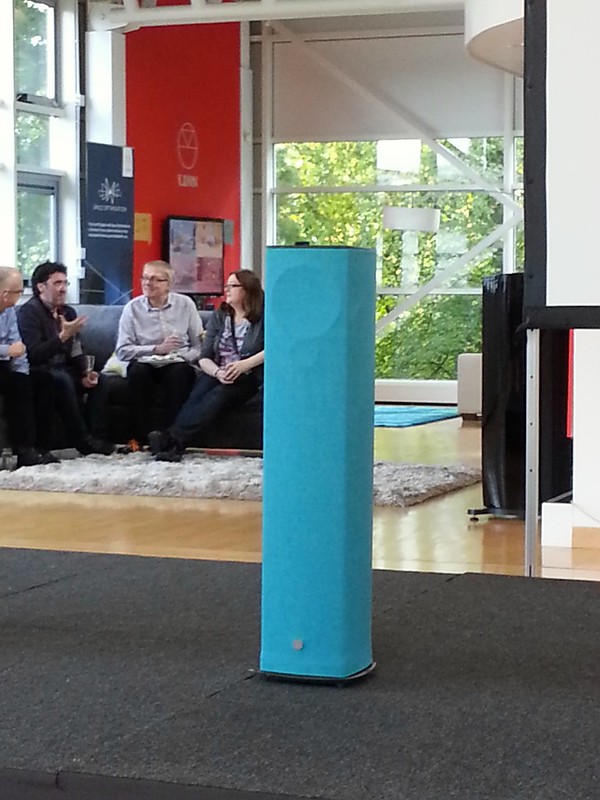 |
| 520 |
DEMOS – Exaktbox Sub
There’s a very large
room in Linn Home – one that the largest Linn speakers, the 350s, can just
about cope with if turned up a fair way.
So Linn chose to demonstrate their current top of the the range
standmount in here, the Akudorik Exakt.
Are they mad? Quite possibly, but
not based on this demo. Some music was
played and the Akudorik did their thing – which is to sound detailed with
decent drive and timing, but I can’t really envisage these at home, trying to
bang out some electronic dance music. No.
But that was the
point. The usual solution to this is to
(other than buying decent floorstanders in the first place) add a
subwoofer. This was done at this point,
but in such a way that demonstrated the effects of bass from a subwoofer
arriving at the listening position, out of time or out of phase (or both), with
the music. And that effect was obvious. The bass was fuller, but was a bit tuneless,
lumpy over the frequency range and slightly out of time with the rest of the
tune. Exakt was then applied using the
Exaktbox Sub (for which you have to measure the subwoofer’s position in the
room) so that the subwoofer’s output arrived both time and phase aligned at the
listening seat. This was a vast
improvement and joined the bass up to the rest of the tune. But the little 226 sub really wasn’t enough
for the massive room. So a second sub,
positioned underneath the very long dining table and a good 5 metres behind the
listening position was added – time and phase aligned of course. At this point the bass really did suit the
room (perhaps a touch too loud for my tastes) but also very well integrated so
that it sounded like this huge amount of bass was coming from the same place as
the rest of the tune. A very impressive
demo. I’m guessing, but just FYI, it
looked like the Akudoriks had been placed in their “ideal” location in the
room, rather than the less obtrusive position that is possible with Exakt
SPACE+ optimisation.
FACTORY TOUR
I’ll not say much
about this, as Linn’s factory, processes, methods etc., have been documented many
times in many places. Not much has
changed in this respect – just the addition of the new cloth / frame stretching
and bonding process, which we didn’t see.
The production line was dominated by series 5 speakers this time –
presumably to build up the dealer network’s demo stocks.
DEMOS – Majik Exaktbox-i
In an unusual move,
Linn set up one of the demos in their R&D inner sanctum – the development
listening room. This has some
interesting room treatment – with what look like absorbent panels on most
walls, but the main speaker positioning area surrounded by hard plastic shapes –
supported out from the wall a couple of inches and angled seemingly and random
angles – this treatment extending a couple of meters or so along the side walls
and ceilings. Perhaps something to do
with first reflection control.
In here we had and
Akurate level LP12 feeding a Majik DSM and a pair of Majik 140 speakers. First up we listened to the turntable and the
streamer using the internal stereo power amps of the Majik DSM. It sounded OK, but not brilliant. The new Majik Exaktbox-I was then added and
it was a revelation. A superb demo of
the benefits of the Exakt technology – much punchier, timing more coherent,
instruments and vocals defined clearly.
The M140s were sounding really great with this Exaktbox. At this point, I was thinking the series 5
530 would really be struggling to keep up with this. The system was then returned back to standard
passive and the change back was equally clear to hear. The difference between standard and Exakt was
much more pronounced on the streamer content than it was with the LP12. Perhaps the Majik level ADC was constraining
the turntable’s output?
Worth noting here that
there was an announcement around Majik DS and DSM product upgrades. It’s going to be possible to get any Majik
DS, DSM or DS-I upgraded to the latest specification, including the addition of
Exakt links. For those with non-HDMI
equipped DS-I and DSM, the HDMI ports will also be added. No news on prices or when, but I would be
very surprised if this existed as a stand-alone upgrade, I suspect it is much
more likely to be offered in conjunction with the purchase of a Majik Exaktbox-I,
Akurate Exaktbox or an integrated Exakt loudspeaker.
The Exaktbox-i is quite an achievement - 8x100W amps, an Exakt engine and 8x DACs in that small space. Plus, interestingly, a set of 8x phono analogue outputs on the back - allowing the Exakt / DAC outputs to be fed to external amplifiers - hence allowing for an amp upgrade path over time - perhaps a Twin for your tweeters then a couple of Solos later for your bass drivers? A nice feature, but why that way around? Surely the traditional "source first" hierarchy says that the Exaktbox DACs should be upgraded before the amplifiers? The phono sockets on the back would seem to be better placed as inputs to the poweramps for those who would like to upgrade to an Akurate Exaktbox later. Better still make them switchable between inputs and outputs.
 |
| Rear of Majik Exaktbox-i: 8 pairs of speaker posts, 2x Exakt links, power input. Interestingly, also 8x phono analogue outputs to allow for an upgrade to external amps later |
Q&A
Throughout the day we
were encouraged to fill out question cards.
After all the demos were done we gathered back in the ballroom and Gilad
hosted a Q&A session with the chief technical officer Keith Robertson. What did we learn from this? Well, the main difference between the
Exaktboxes is all about performance not functionality – basically, the DACs are
aligned to the DACs in the DS products – they get better as you go up the
range. There will be a surround solution
for Exakt coming, but there are no definite dates for this. Later, in the bar, much more was discussed on
this subject – suffice to say, there are lots of options and no certainty on
which way (or even which ways) to do this.
Expect much more from Exakt going forward – including a new way of
dealing with low frequency roll-off later this year. The coverage of all legacy Linn speakers is
underway and will be delivered eventually.
Linn has worked with
Kudos on the Titan T-808, Super 20A and Super 10A speakers by essentially
giving Kudos access to the Exakt development tools. Kudos are using these to build their own
Exakt crossover parameters – Linn have not done any of this development
work. Exakt will also be coming very
soon for PMC Twenty.26, a JBL model popular in Japan and further models to be
announced soon. An Exakt phono stage
closer to or inside the turntable? It’s
possible, and could happen, but isn’t definitively on a timeline yet.
EVENING
So after being bussed
back to central Glasgow, we briefly dispersed to various restaurants and hotels
to eat and freshen up, but were soon re-assembled in the bar of 29. Here there were drinks and lots of
natter. Phil Budd and Keith Robertson
headed up much of the technical discussion, both being open and receptive with
ideas flowing in both directions between Linn and customers. The surround debate was particularly
interesting. A couple of hints of some
small (but possibly helpful) new product news soon, and a bit about next year’s
plans which will, in the main, focus in a different direction. Good discussion about the Linn records label
too – and how busy they are – all 6 of them!
THANKS
I must say, this was
probably the best organised event I’ve been to at the factory – Linn seem to
learn and improve each time. In the
past, I’ve also heard some demos that were obvious, some that were less so, but
this time every demo delivered what was promised by the Linn staff. Still don’t like the over-dull listening
rooms though.
Thanks very much to
all at Linn. An excellent day – covering
their strategy and their latest products, but clearly aimed squarely at their
traditional customer base, rather than the series 5 launch events in London. Appreciate the time and effort they put into
these events, and their excellent hospitality.
Oh, and what great company from fellow forum contributors.
 |
| A Wee Timerous Beastie wrap on the 530. I think they look better in the flesh than they do in pictures |