"What a refreshingly honest blog about listening to music through hi-fi. So happy to see views based upon the enjoyment of music rather than so-called sound 'quality'." - Peter Comeau, Director of Acoustic Design at Mission / Wharfedale
Showing posts with label Exaktbox. Show all posts

Monday, 9 February 2026

On Utopik - Linn's Latest SMPS Power Supply Reviewed

Linn power supplies have evolved over the years, sometimes quietly, sometimes with much fanfare.

Its a bit tricky to say precisely when Linn started to adopt Switched Mode Power Supplies (SMPS) - but it was during the LK era and they appeared in products such as the Kairn pre-amp and Tunebox active crossover.  Initially (and, of course modestly) they were branded as Brilliant, then Slimline, then they were just a PS in a product, gradually adopted across pretty much the full range of Majik, Akurate and Klimax units - pre-amps, streamers, turntable power supplies and power amps.  Until around 2009 these PSUs were pretty much anonymous, but then Linn made a big fuss about a new generation of SMPS - the Dynamik.

This was gradually rolled out across the then current range of products but, crucially, it was also available as a replacement unit across that same product range.  Mostly as a drop-in replacement in Majik and Akurate products, sometimes as a drop-in, sometimes as a return-to-base-for-machining process within the Klimax range.  There was much fanfare about this product but, more tellingly, almost everyone who heard the difference opted for the upgrade.  Linn provided a sticker for the bottom panel of your kit and a new 5 year warranty for the power supply.  It was a big success and probably made a nice contribution to Linn's bottom line.

But hey, a manufacturer offering to make an upgrade available to existing customers is definitely something to be praised.  So many other manufacturers expect you to ditch your existing, perfectly good, equipment and buy a whole brand new box.  I hope Linn continue this service for many years to come.

Which bring us to the (u)topic of this post.  Linn's latest power supply upgrade - the Utopik - was introduced in late 2022, starting with the Selekt (now Selekt Classic) modular streamer / pre-amp / DAC / processor / power amp unit.  Soon it was available for the "next generation" top of the range Klimax DSM/3 then gradually rolled out across the rest of the non-power amplifier products, including integrated loudspeakers, streamers, pre-amps and Akurate level Exaktbox processor / DAC units. I added Utopik to my Klimax System Hub streamer / pre-amp a couple of years ago and thought the improvement worthwhile rather than revolutionary.  That unit is, of course, digital only, do it was almost a surprise to hear any improvement, but there it was for all (who have heard it) to hear.  There are some customers who say they think that it is a bigger upgrade than the Organik DAC, but that's not my perception having heard the 2 separate upgrades in the Klimax DSM which is a streamer, pre-amp and DAC.

So what have Linn got to say for themselves about the Utopik power supply?

Well, here's the blurb, sourced from Ripcaster.co.uk - a Linn Dealer:

"Utopik - the all-new generation of exceptionally efficient and highly responsive Linn switch-mode power supplies.  This exceptionally efficient, highly responsive, and precision-regulated power supply design is Linn's first entirely new topology since 2009. Multiple feedback loops measure output versus input at each stage of the power supply, and persistently filter out mains-borne noise and eliminate 50Hz hum, even at extreme volumes.  Featuring intelligent Valley Switching, Power Factor Correction, and with precision-regulated and isolated power rails – these power supplies are Linn's cleanest and best yet.

Power is nothing without control:  Multiple feedback loops measure output versus input in each stage of the power supply, and persistently filter out mains-borne noise and 50Hz hum, even at extreme volumes. The sophisticated control mechanism at Utopik’s heart is optimised for handling between 90-250Hz mains supply, ensuring that it performs perfectly anywhere in the world without compromise. Utopik is electrically cleaner, and more efficient at higher power than any power supply we’ve ever made. Of course, this is better for the environment and saves on your electricity bill, but efficiency is also a reliable measure of how well a power supply is performing – as energy isn’t being lost as heat or noise. If you improve efficiency, you improve electrical cleanliness.


Intelligent Valley Switching: Utopik is an extremely sophisticated switch-mode power supply. In a sub-optimal switch mode power supply, you have no control over where in the input voltage waveform the switch turns off or on. It would switch anywhere, and randomised noise is generated. With Utopik however, we monitor oscillation at the transformer’s input, and look out for the lowest troughs in the voltage – a technique named Valley Switching. Utopik only throws the switch when at the floor of one of these valleys. With intelligent monitoring and control, we’re therefore keeping voltage as close to the ideal 0V when switching, resulting in dramatically reduced switching noise.


Precision-regulated Rails: Utopik has separate layers of precise regulation on its four power rails. Each has its own feedback loop, so that it is separately controlled, managed and isolated. This improves isolation between the relatively noisy digital power rail – with processors sporadically computing packets of data – and the analogue rails which feed components more sensitive to power fluctuations. Whatever the current demand of any aspect of the whole product, the remaining rails are unflinching.

Power Factor Correction: Switch-mode power supplies are common in modern technology. When in operation, each one of these is intermittently taking short gulps of current from the mains – acute spikes in current draw – which introduces mains-borne noise that affects other products on the grid by producing harmonics in the supply. Utopik modifies its current draw to be proportional to the voltage, and spreads it out over the length of the AC waveform. Instead of taking short gulps, the current draw is spread out to be more consistent over the length of the waveform. This is called Power Factor Correction – and by implementing it in Utopik, we can ensure that the product it’s powering isn’t introducing any distortion to the mains supply in the room, the building, and beyond.
Power Factor Correction is yet another technology in the power supply chain that regulates voltage and ensures that no ripples get through to the output stage of the product as a whole.  
Delivering the cleanest possible power to the rest of the chain. Utopik presents a consistent 400V output – anywhere in the world – regardless of mains supply quality."

So there you go. A lot of claims, although to look at, it's physically very similar to Dynamik.  Some comment on its switching frequency being much lower on Utopik to explain its performance, but I'm not sufficiently knowledgable to confirm or deny this speculation.

At the time of writing, Utopik can be added to the following Linn products:

Klimax DS (all models)
Klimax DSM (all models)
Klimax Renew DS
Klimax System Hub (all models)
Machined Radikal (original, /1, /2)
Klimax Exaktbox
Selekt DSM (all models)
Akurate DS (all models)
Akurate DSM (all models)
Akurate Exaktbox-6 and -10
Akurate Kontrol (all models)
Akurate CD
Kustom DSM Z4 and Z8
Majik DS (all models)
Unidisk (all models)

Two Versions

There is a physically larger version of Utopik that was released first, then there is the Utopik Miniline (the marketing term, as can be seen above, slimline seems to have made it onto the circuit board labelling).  The standard product is available in versions of Selekt and Akurate products and for the Klimax DSM/3.  The older, and physically much slimmer, Klimax products seem to have to make do with the Miniline version.  As there is only one choice to fit the product you might own, there's no way to directly compare the performance of each version against each other. Most new products have Utopik onboard from their release date - examples being Selekt Edition, Klimax Exaktbox/3 and Klimax Solo 500 and Solo 800.  Although the integrated top of the pile 360 loudspeaker is a very recent product, Linn are a little cagey about if it has Utopik or not - there's a fair chance that it is a hybrid product from a PSU point of view, perhaps having Utopik for the lower current areas such as the DACs, and Dynamik for the power amps.  But this is purely me speculating.

Klimax Exaktbox

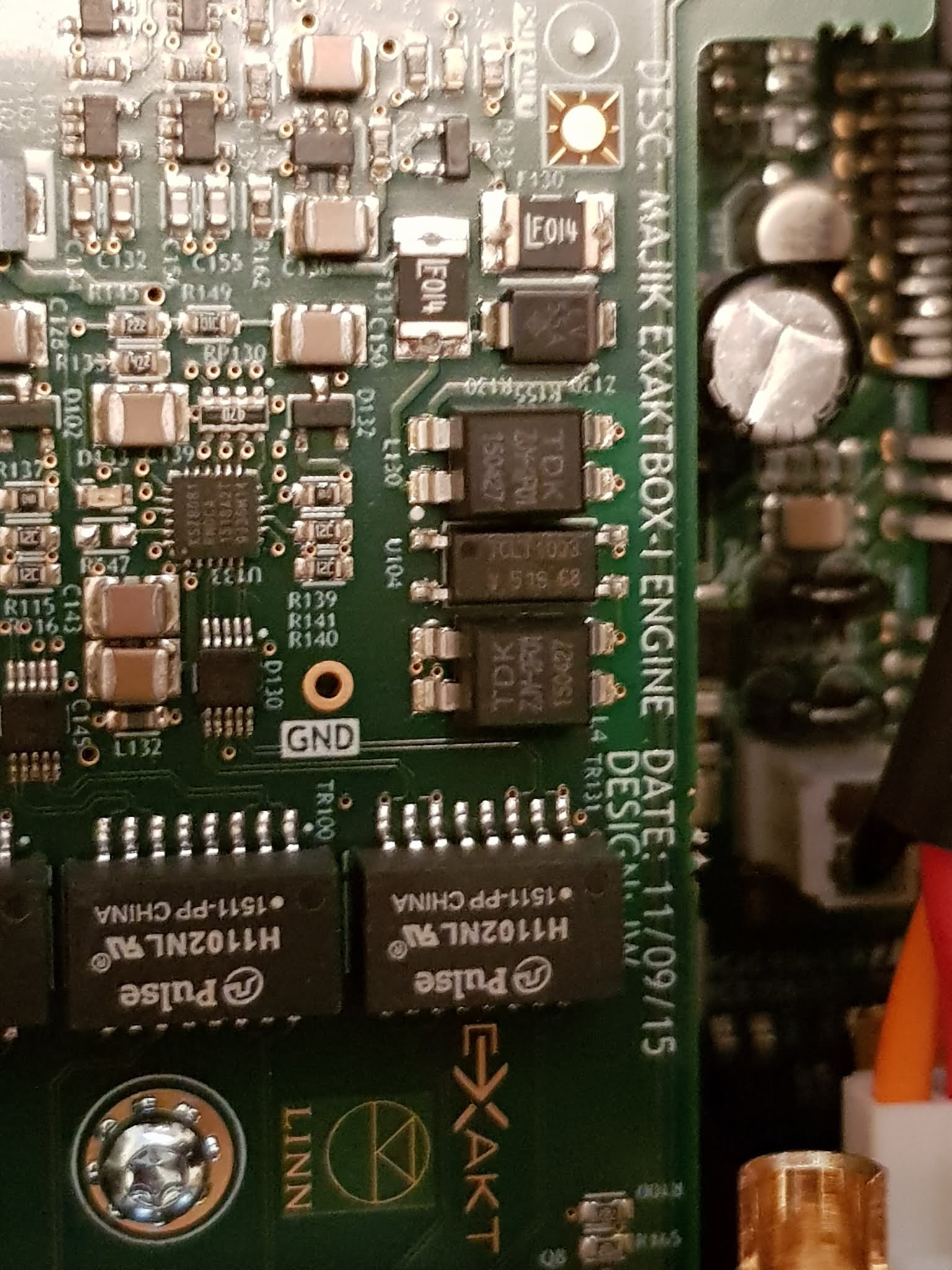
As mentioned previously, Utopik for the streamer / pre-amp Klimax products, such as Klimax DSM, were released early in the Utopik product life.  Those with Klimax Exaktboxes have had to wait just over 3 years to see the retro-fit become an option. Even though it is the Miniline version of the PSU that comes to Exaktbox, its still necessary for a Linn dealer to send the unit back to the factory for some internal machining and the installation of the Utopik.  My UK domiciled unit was away for about 10 days, which is a very decent turnaround.  The PSU upgrade comes with a new 5 year warranty.

Just briefly - Exaktbox is Linn's proprietary multi-channel processor / DAC.  It takes an Exaktlink feed from a Linn digital streamer / pre-amp and does lots of stuff to do with phase correction, time alignment and loudspeaker crossover requirements.  Its a 6-channel box so is good for up to 6 loudspeaker drivers in mono or 3 loudspeaker drivers in stereo.  Its output is fed to multiple power amplifier channels (one channel per speaker driver) and on to speakers which have had their internal passive crossovers by-passed or removed.  Of course nearly all Linn speakers are supported with this digital approach to active crossovers, as are many others from third party provider speakerfilters.


Installed

For your investment, unlike with the Utopik upgrade to the Klimax System Hub, Linn provide you with a sticker for the underside of the Exaktbox to show the upgrade has been installed.  When the unit comes back from the factory (it has to go back there as the internals need to be machined to accommodate the new PSU) a "Utopik" sticker is provided in the box - it also includes the serial number of the Exaktbox.  Its good that this is provided, but its not an ideal solution - the sticker is too shallow and too long to go over the existing "Powered by Linn Dynamik" logo on the base panel, and a bit clumsy looking to sit underneath the existing serial number information.  I guess its generic and not specific to the Exaktbox, but that's a bit disappointing at this price. I opted to squeeze it in under the serial number.


Context

Here's the system context of this review:

Sources: CD rips and 24 bit downloads from Minim Server on Melco N1Z / Qobuz streaming service
The Chord Company Sarum-T ethernet cable
Streamer / pre-amp: Linn Klimax System Hub/0 fitted with Utopik PSU
Meicord Cat 6 Exaktlink
Processor / DACs with analogue outputs: Linn Klimax Exaktbox/2 which has the Organik R2R ladder DAC and a Dynamik PSU - this is the item to which the Utopik power supply has been added. This is has the crossovers from speakerfilters installed for the PMC Fact.12 loudspeakers.
Linn Silver analogue interconnects
3x Lejonklou Tundra Stereo 2.5 power amplifiers
Naim SuperLumina loudspeaker cables
PMC fact.12 loudspeakers on Iso Acoustics Gaia feet
Puritan Audio mains cables
Quadraspire Evo racks with Mission / Cyrus Isoplats

Listening Notes

I ran the system for about 10 hours before I started to do any listening.  I've no idea if Utopik is considered as needing to be "burned in" but I thought I'd give it some time anyway.  At the time of writing the system has been played for around 30 hours - I can't say I've heard any variation over that time period, but obviously can't say that none will happen in the future.  Many, of course, say that there's no such thing as burn-in...
Thoughts here are directly related to how the system sounded when the Exaktbox was powered by Dynamik, they're not intended to be absolutes.

Like Utopik for the Klimax System Hub streamer / pre-amp, the first thing to notice is yet another drop in what's going on in the negative parts of the music and the gaps between the music.  Yep, a tiny layer of noise has gone - and its a weird one because (like an extremely well set up subwoofer), you don't notice it until its not there.  I'd say this was a bigger change to this aspect than the PSU made inside the streamer.

Secondly, it seems that the music has picked up in pace.  Of course it hasn't, because the track still plays for the same length of time, but there is a little more urgency - I would guess this has something to do with the reproduction of transients of each new note - presumably there's a little bit less time lag for them to happen.  Thankfully this has been achieved without any sign of aggression nor harshness, which is the danger with systems that "crack along".  Its a welcome change, not one that should put you off if you like a more laid back kind of presentation - this isn't like a change between warm valves and analytical digital which can be presented as edginess, its just what feels like a timing improvement.

The main change, for me, is in the way that the music interacts with itself, if that makes any sense.
An example is Submotion Orchestra's "Prism" (from "Kites" on SMO Recordings) starts with Wood's floaty vocals underpinned by strings - after about 1m 30s the bass line kicks in.  Now this sudden contrast feels greater, the emotional change has more impact, the contrast between voice and backing is greater. Then as the vocals and bass line work more closely together you get a real feel for a collaborative effort building the crescendo across the rest of the track.  

On Tash Sultana's "Kiss the Sky" (from "Return to the Roots" on Lonely Lands Records) the lilting dubby background flows more convincingly, the kick drum effect has more thump, the initial cymbal crash has more impact and startles that bit more than before. Its an interesting contrast between the crispness of the rimshot, the brass and the flowing easy going nature of the under-currents.  The shimmering guitar part towards the end of the track really adds more lift to the song and makes me wish for a longer version to continue the experience. Overall the track is more fun to listen to and I get into the groove straight away.

Malia and Boris Blank's "Smoldering Ashes" (from "Convergence" on Universal) starts with a tom tom type drum pattern.  Previously this was easy to follow in terms of the pattern and the indivdual drum sounds but now it bounces along which gives a more jaunty feel - the toms that have a bass under pinning them have more punch and drama.  This track is full of tension but the short punctuations of minor chords, using various different instruments, really add more impact and shades of intrigue. The drum pattern is easier to follow through the whole track. 

Bonobo adds a few clicks and twists to the beginning of the track "Brambro Koyo Ganda (featuring Innov Gnawa)"  (from "Migration" on Ninja Tune). They might seem a bit superfluous, but actually they weave in and out of the whole track. This weaving in and out is now more relevant and tends to help tie the intro into the whole track.  Then there's that bass line - now more punchy, more purposeful and again there's that new ability to drive the track along with more energy but without more aggression.

To find out how an improvement to the presentation of individuals and instruments improves with this PSU, Michael Kiwanuka's recent track "The Rest of Me" (from "Small Changes" on Polydor) is a good example. The resonance qualities of the opening acoustic guitar are richer, more nuanced and add to the feel good factor right from the off.  The cymbals are shimmering, adding to the good feeling, not clashing nor jarring - they're full of subtle complexity.  The bass guitar, like the Malia track, bounces along to add feeling and groove.

To summarise, this PSU will give you more of a feel for the rhythm of the music, the contrasts, the emotions and the complexities.  If it is value for money, or not, is a personal choice.  For me its not far off the improvement that the Organik DAC brought to the musical experience.  More believable, more engaging.

Now, just one more track...


Saturday, 16 September 2023

A Tale of Three Amplifiers - Linn, Lejonklou and Naim(ish). GUEST REVIEW BY CLIVE G.

 Something a little different this time - a review of three power amplifier choices by occasional guest contributor Clive, one of the moderators of the popular Linn Hifi and Music Enthusiasts Facebook group.  Over to you Clive...

I'm fairly happy with my system, but, well, there's always room for improvements & I'd been
thinking maybe an amp or speakers upgrade.
 
My system at the time of writing comprises: -
Linn Klimax System Hub (Classic);
Linn Klimax Exaktbox with Organik DACs;
2 x Naim Olive 250s with Avondale HCR200 regulators & Witch Hat Phoenix amplifier boards;
Naim SL2s supplemented with a BK Electronics Double Gem sub;
English Electric 8 Switch & QNAP TS-251+ NAS drive;
Witch Hat Morgana interconnects & Spectre speaker cable;
Dedicated consumer unit with 5 x spurs in 6mm sq twin & earth & 6mm sq equipment leads


Maybe for those not in the know, I should explain the Linn System Hub & Exaktbox. The system hub
is a streamer only - it just controls the playlist from my NAS drive or streaming service (Qobuz or
Tidal) & other inputs (TV Box & Chromecast) and acts as a pre-amp with digital volume control. It has
no DAC and passes a digital stream of music and instructions to the Exaktbox. The Exaktbox is a digital crossover & 6 channel DAC (using the latest Linn Organik DACs). The advantage of having the crossover in the digital domain is that it can be far more accurate that an analogue crossover (I used to have a Naim SNAXO but this set up is far superior). The analogue outputs of the Exaktbox are fed to power amps - one for each speaker drive unit - so 2 x 250s in my case, SL2s being a 2 way speaker design.
 
In the past I've compared an Naim Olive 250 vs Naim Classic 250DR vs Linn Akurate 2200. I felt that the 250DR was more detailed but the Olive 250 more musical. Comparing Linn to Naim - Linn allowed all the separate elements of the music to be followed & analysed whereas Naim felt more like a band
performing. Both good - just a difference of presentation.
 
So I was interested a couple of months ago when I had the opportunity to compare, in passive
configuration, one of my modified 250s vs a new White Logo Naim 250 vs Linn Klimax Chakra Twin at a dealers showroom using a Linn Selekt Edition streamer with dual mono Organic DACs & Kudos 707s. When you consider the price differential Olive 250 with Avondale & Witch Hat boards ~ £1.7-2k vs New Naim 250 £5.7k vs Klimax Twin £9.4k you'd think it would be a fairly uneven contest... But was it?
First up was the New White Logo Naim 250 - bags of detail & pace but I found myself analysing the music rather than enjoying it. My feet stopped tapping! Switching to my modified Olive 250 & the foot tapping was immediately back. Sure it was a marginally less informative, but ultimately more enjoyable. Finally the Linn Klimax Twin. This was somewhere between the two. A bit more detailed than the Olive 250, more musical than the New White 250. But was it worth the £18.8k price tag for the upgrade (remember I need a pair of them)? I didn't think so - maybe a used pair but I would want to hear one in my home system.
So where did this leave me? Neil of Audiophile Musings & Speakerfilters has suggested to me a few
times that I should try Lejonklou Tundra 2.5 amps in place of my Naim 250s. For those of you who
haven't read Neil's previous posts about these amps - Fredrik Lejonklou used to work with Linn beforedeciding that he could build better amplifies for a much lower price. The Tundra Stereo was
first released in 2012 & is now in its ninth iteration in version 2.5 which sells for just under £3.25k.
Neil offered to lend me a spare Tundra he has to try in my system, which coincidently is for sale, so
no hidden agenda there (editor's note: it was a completely above board agenda, as it happens!). At the same time I've borrowed a Klimax Twin to try at home.
 
First thing was to put my system back to passive as I only had one Tundra & one Twin. It's a fairly
straight forward job with SL2s as they have external passive crossovers and put the Exaktbox into
pass through mode so the DACs are being used but not the digital crossover. I then played five of my
favourite test tracks to get a feel for how it sounded passive. The overall character remained
unchanged although a little of the precision of the timing & sound stage was missing but still very
enjoyable.
 
Before putting the Tundra into my system, I'd been warned that:
a. They have less gain ~21dB compared to the Naim/Linn ~29dB so I would have to turn the
volume up +8
b. They take about 20 minutes to warm up - not after being switched on, but 20 minutes actually playing music to come fully on song, not that they are bad initially, they just get better with playing.
So when I first switched to the Tundra, I tuned the volume up & played the five tracks through
before going back to the beginning for a serious listen. The first thing that struck me was how similar
the sound was to that which I was used to. The Tundra has similar PRaT that Naim amps are famous
for. The Naim maybe had a smidge more authority on bass lines, the Tundra maybe a smidge more
transparency in the mid-range… But I would be hard pushed to choose one over the other - both are
very enjoyable.
 
Next up was the Klimax Twin. I was immediately taken by how much better it was than the Akurate
2200 I'd heard a few years ago. Previously I've found Linn amps great if you want to listen to all the
individual strands of the music, whereas Naim amps present the music as a whole performance.
While this is still true, the Twin is much more similar to the sound I am used to from my Naim amps
& more enjoyable for it. The Twin is a maybe smidge more detailed & informative but the Naim has
more swing & induces more foot tapping. Apart from the wallet bending price of a pair, I could
probably live with the Klimax Twin… if I hadn't heard my 250s or the Tundra.
 
I was able to have both the Tundra & the 250 in my system rack at the same time so it was only a
minute or so to swap from one to the other to do a tune dem. So having warmed the Tundra up again, in an effort to differentiate between it & the Naim, I played some tracks that I don't know on
one then the other. Now the differences became a bit more apparent. While the 250 still had a little
more weight & authority in the bass lines, where the Tundra really excels is in conveying the
emotion in the music. It's difficult to explain in words but I feel that I can really hear the musicians
putting their heart & soul into the performance, whether they are vocalists, guitarists or a
saxophonist you just get the feeling that they are giving it that bit extra. The listening experience is
just that bit more… well musical, more fluid although it still wasn't night & day differences.
 
A few days later I had a friend round who has no interest in hifi but enjoys music, particularly to
dance to rather than sitting down listening at home. First I played a couple of tracks she wouldn't
have heard previously using the 250 before switching over to the Tundra. Her initial reaction was
that the presentation of the two was quite different. The 250 was laid back & enjoyable whereas the
Tundra was more up front & in your face. She didn't like the way that the Tundra demanded her
attention, demanded to be listened to. Interesting. Then we played a number of tracks that she
knew from dancing switching back & forth between the two. Now her preference switched to the
Tundra, hearing the additional nuances it brought to the experience, describing it as more engaging
as though the musicians were performing just for her. By the end of the evening she said that both
were enjoyable but on balance although the Tundra is more demanding, she felt it is also (a bit)
more engaging.
 
So am I swapping my modded Olive 250s for Tundras? Hmmm! The 20 minute warm up is a bit of a
downer. Most mornings, I have a listening session that's, at most, ½hr while I have a cup of coffee
after I've done my morning workout & there would be that nagging doubt that the amps are not
performing at their best for the majority of that time. Additionally, I've been in discussions with John
Jackson (ex Naim & Witch Hat) about an further mod to my 250s to add another regulator to power the amplifier board to create a Phoenix Plus board if you like and elevate the performance further.

So the jury is still out.
 
At the end of the day, the Tundra is a very musical amp & should certainly be on your shortlist to
audition if you are in the market for amps at this sort of level. In my view it's considerably more
musical than the latest generation Naim 250 which, to me, is very hifi, which is great if that's what
you are looking for but for me, Naim have lost the PRaT that they were renowned for. I also
preferred the Tundra over the Klimax twin which, considering its ~⅓ of the price, makes the Tundra
something of a bargain. And if you have a standard Naim Olive 250, again the Tundra will be an
upgrade. At the end of the day, you could argue that my Naim 250's are no longer Naim amps - all
that remains of the original amps is the case, transformer & the sockets.
 
Thank you to Neil Hallworth for the loan of the Tundra, & Nigel Moore for the loan of the Klimax
Twin

Wednesday, 27 October 2021

Annerstedt-Hegge Acoustic Launches Brand New Speakers at Norway Show 2021

A new speaker brand will launch at the Horten Hifi Show in Norway on 6/7 November 2021. 

The A-Ha brand is a local blend of Norweigian & Swedish skills and will bring its first model, the A2a to the show. It will be launched as an active ready version designed to work with Linn Exakt electronics using Exakt digital filters developed in Wales by SpeakerFilters.com. Passive and built-in active versions are planned.

More details here: http://www.a-ha.se/a2.html
 
Show information here: http://hifimessen.no/


Wednesday, 15 July 2020

LINN Exaktbox-i: Photo Comparison Between Majik (Pre-Katalyst) and Akurate Katalyst Versions

Linn's carefully hidden Exakt separates system consists of the following key components:

An "Exakt ready" streamer / pre-amp (such as Klimax DSM / Akurate System Hub / Majik DSM amongst others)
A proprietary Exaktlink cable which uses standard Ethernet cables
An Exaktbox which is essentially a digital active crossover and digital signal processor, amongst other things (such as Akurate Exaktbox10 / Klimax Exaktbox)
Power amps, which can be from Linn or any other manufacturer.

However, there is an option to combine the last 2 elements - the Exaktbox and the power amps.  This is called an Exaktbox-i and combines 8 channels of DAC / digital active crossover and 8 channels of power amplifiers in Linn's normal just-a-bit-narrower-than-standard box.  There's really only one of these in the range, but it has evolved in the 4 or 5 years it has been available:

1 - Intitially it was a Majik Exaktbox-i containing Majik level DACs and 100W power amps, all in the Majik level casing
2 - Then it was re-badged the Akurate Exaktbox-i but still contained Majik level DACs and 100W power amps, but now in the more substantial Akurate casing.  This version was very short lived, soon replaced by:
3 - Akurate Exaktbox-i with Akurate level Katalyst architecture DACs but sill with Majik level 100W power amps in Akurate level casing

As is often Linn practice, those who bought the earlier products don't get left behind when there's an upgrade.  So it is possible to have a Majik Exaktbox-i upgraded to Akurate Katalyst Exaktbox-i internals but retaining the Majik casing.  The first Akurate Exaktbox-i can also be upgraded but I expect most of those were done pretty much automatically as there was a deal where the cost to upgrade was only the difference in price between Katalyst and non-Katalyst versions.  It would be very odd to find one of these that hadn't been upgraded, given the small price to do so.

I've been using an original "pre-loved" Majik Exaktbox-i for a while for Exakt filter design activities.  For some reason, now seemed to be the right time to take that up to Katalyst specification.  So that has allowed me to make comparisons between the circuitry of the non-Katalyst and Katalyst versions.

A similar comparison of the Akurate Exaktbox10 (April 2018) is here.

Much has been written about the musical capability of the upgrade from Linn's previous generation DAC to the Katalyst DAC, and I can't think of anyone who has anything but praise.  An example is here regarding the upgrade in Linn's onboard active Akubarik speakers.  So I'll not write about that here as it is well trodden path. With the upgrade being applied to the Exaktbox-i back at the Linn factory, there's no ability to directly compare the 2 products back to back.

To the photos.  Note that every single audio board (DACs are combined with the power amps) and the Exakt processing board are changed in the upgrade - the photos with the green circuit boards are the Majik non-Kat version, the black circuit boards are the upgraded Kat version.  The PSU and the casework is untouched, save for the addition of a Katalyst sticker on the underside.


Externally the box is unchanged


BEFORE AND AFTER UPGRADE COMPARISON PHOTOS:

The most obvious difference from an overall perspective is the change from green to black and gold boards

Each side of the enclosure has 4 channels of power amps (the chips bonded to the heatsink are the obvious components) and 2x stereo DACs.  The DACs above are the cross-shaped cluster of an oblong chip surrounded by 8 smaller chips

Here you can see the difference in the DAC architecture - now we have the 2x stereo DACs which are the 2x flat square chips - the board layout is very different


The "flyover" board down one side of the enclosure is the Exakt processing board.  The above original layout has 3x FPGA processors - the large flat square chips. The one on the left is the "master" processor with the other 2 processing 4 channels each
On the new board there is one more powerful FPGA chip in the centre doing the work formerly done by 3x separate chips


Board labelling for channel 5 to 8 DAC / power amp board has been relocated


Relocated labelling for the Exakt board


The increased complexity and density of the components surrounding the DACs is clear in this comparison.  The Katalyst DAC has multiple different regulated power supplies which probably explains this increase in components


SOME KATALYST ONLY PHOTOS:


Xlinx FPGA that does all the Exakt processing


DACs and power amps for channels 1 to 4 live in the shadow of the Exakt board


Wednesday, 12 February 2020

***POSTPONED*** HIFI WIGWAM SHOW 15 MARCH 2020 @ Kegworth UK - PLAYLIST in Room 120

PLEASE NOTE THE WAM HIFI SHOW AT KEGWORTH ON 15TH MARCH 2020 HAS BEEN POSTPONED.

Please keep an eye on www.thehifishow.com for updates.

Audiophile Musings will be playing the following ACTIVE system at the show this year in Room 120:

Linn Akurate Exakt DSM Streamer
Linn Akurate Exaktbox6/1 Digital Crossover and Multi-Channel DAC
2x Lejonklou Tundra 2.5 Stereo Power Amps
Graham Audio LS5/9 (modified) Loudspeakers

When listening to this system, you can hear the following tracks which will be on auto shuffle, but we'd rather you chose a track of your preference - JUST ASK!


Artist Track Approx Genre Year
Agnes Obel Fuel To Fire Folk 2013
Alberta Cross City Walls Blues/Rock 2009
Alex Kassian Hidden Tropics Electronic 2019
Autograf Dream (Autografas Deep Dub) Deep house 2015
Black Sabbath Planet Caravan Rock 2000
Bob Moses Far From The Tree (from the 2013 'Far From The Tree' EP) Electronica 2015
Bob Moses Tearing Me Up (RAC Mix) Electro 2016
Bonobo Flicker Electronic 2019
Bugge Wesseltoft & Henrik Schwarz Leave My Head Alone Brain Electronic 2011
Calexico Crumble Folk/Rock 2003
Calexico Pepita Folk/Rock 2003
Calexico Woven Birds Pop/Rock 2003
Calexico Man Made Lake Folk/Rock 2008
Cat Power Blue Folk/Rock 2008
Chris Jones Darlin' Cory Folk 2003
Chris Jones No Sanctuary Here Folk/Rock 2003
Chris Jones & Steve Baker Roadhouses & Automobiles Blues 2003
Chris Jones & Steve Baker Damm Good Run Blues 2005
Chris Rea Looking For A Rainbow Rock 1989
Chris Rea Texas Rock 1989
Christine And The Queens 5 Dollars Pop 2018
Christine And The Queens Damn (What Must A Woman Do) Pop 2018
Craig Armstrong Let's Go Out Tonight (feat. Paul Buchanan) Electronic 1997
Craig Armstrong Weather Storm Electronic 1997
Daft Punk Giorgio by Moroder Electronic 2013
Damien Rice Cannonball Folk/Rock 2003
Damien Rice Cold Water Folk/Rock 2003
Damien Rice Delicate Folk/Rock 2003
Damien Rice Volcano Folk/Rock 2003
Daniel Lanois Shine Rock 2003
Dead Can Dance Agape Folk 2012
Dead Can Dance All In Good Time Folk 2012
Deadmau5 Avaritia Dance 2014
Dean Fraser Big Up/Armageddon Time Jazz/Reggae 1997
Death Cab For Cutie Doors Unlocked And Open Folk/Rock 2011
Devon Allman Time Machine Blues 2013
Dire Straits Six Blade Knife Rock 1978
Dire Straits Fade to Black Rock 1991
Dirty Vegas Days Go By (Acoustic Mix) Pop 2003
Dominique Fils-Aimé Birds (24_88) Soul / Funk / R&B 2018
Dominique Fils-Aimé Strange Fruit (24_88) Soul / Funk / R&B 2018
Doug MacLeod Serious Doin' Woman Blues 2015
Doug MacLeod You Got It Good (And That Ain't Bad) Blues 2015
Eddi Reader Hello In There Folk 1992
Eddi Reader Dear John Folk 1994
Elbow Asleep In The Back Indie 2001
Elbow Mirrorball Indie 2008
Elvis Presley Fever Pop Rock 2015
Erykah Badu Next Lifetime R&B 1998
Eva Cassidy Fields Of Gold Folk/Rock
Felix LaBand Black Shoes Electronic
Ficci & Laura Hahn Ficci - Breathe You In (feat. Laura Hahn) Electronica 2014
Fink Perfect Darkness (Live from Union Chapel, London Oct 5 2011) Folk/Rock 2012
Flash And The Pan Walking In The Rain Pop 1990
Fleetwood Mac Go Your Own Way Rock 2011
Fleetwood Mac The Chain Rock 2011
Funkerman Speed Up (ATFC Remix) Dance 2012
Ganga Don't Wake Me Up Electronic 2006
Ganga Down But Up Electronic 2006
Georges-Emmanuel Lazaridis Grandes Etudes de Paganini Etude III Classical 2007
Hue & Cry Makin' Whoopee Jazz
Hugh Masekela Stimela (The Coal Train) World Blues 2006
I Am Kloot Hold Back the Night Rock 2013
I Am Kloot Let Them All In Rock 2013
Ian Shaw A Good And Simple Man Jazz 2008
It's Immaterial Driving Away From Home (Jims Tune) Pop 2008
Jakatta American Dream (Afterlife Mix) Electronica 2001
James Taylor Gaia Folk/Rock 1997
Jay Fisher Old Man McKeensley Folk/Rock
Jennifer Warnes Big Noise, New York Pop 1992
Jenny Lewis Pretty Bird Country 2008
Joan Armatrading Love And Affection R&B 1976
Joan As Police Woman Get Direct Rock 2014
Joe Bonamassa Feelin' Good Blues/Rock 2009
John Lee Hooker The Healer (with Carlos Santana & The Santana Band) Blues 1989
John Martyn A Little Strange Folk/Rock 1996
José González Crosses Acoustic 2003
Justin Currie No, Surrender Rock 2008
k.d. Lang Constant Craving Folk 1992
Keb’ Mo’ For What It's Worth Jazz 2004
Ken Haddock One Woman Folk 2019
Kiasmos Looped Electronic 2014
Kiasmos Thrown Electronic 2014
Kiki Dee Amoureuse Folk
Kiki Dee Don't Go Breaking My Heart Folk
La Roux In For The Kill (Skream's Let's Get Ravey Remix) Electronic 2009
London Grammar Wicked Game Pop
London Grammar Hey Now Rock 2013
Lorde Royals Pop 2013
Lyle Lovett North Dakota Alternative Country 1992
Malia & Boris Blank Magnetic Lies Electronic/Jazz 2013
Malia & Boris Blank Tears Run Dry Jazz 2013
Marta Gomez Lucia Jazz/Classical 2009
Mary Gauthier Falling Out Of Love Country 2005
Massive Attack Three Electronic 1994
Michael Jackson Liberian Girl Pop 2001
Millenia Nova Beautiful Electronica 2000
Nick Drake 'Cello Song Folk 1969
Nils Frahm Ode Alternative 2015
Nils Lofgren Black Books Folk/Rock 1997
Nils Lofgren Wonderland Rock 1997
Nitin Sawhney Letting Go Chill 1999
Pete Alderton (She Said That) Evil Was Her Name Blues 2012
Pete Alderton Jesus In A Bottle Blues 2012
Pete Alderton Passing Ships Blues 2012
Peter Gabriel Don't Give Up Folk/Rock 2012
Peyton Falling (EK's Poolside Mix) Electronica 2008
Pitch Black Dub Smoke Electronica 2016
Ray LaMontagne Be Here Now Pop/Rock 2006
Richard Thompson Easy There, Steady Now Folk 1994
Richard Thompson Mingus Eyes Folk 1994
Royksopp Sparks Drum & Bass 2002
Sam Cooke Chain Gang Blues
Sam Cooke Cupid Blues
Sarah McLachlan Ice Folk/Rock 1994
Sarah McLachlan Wait Folk/Rock 1994
Schiller Das Glockenspiel (Schill Out Mix) Electronica 2004
Seal Kiss From A Rose Soul 1995
Seal Love's Divine (Acoustic) Soul 2004
Seal Prayer For The Dying (Acoustic) Soul 2004
Semisonic Closing Time Rock 1998
Semisonic Secret Smile Rock 1998
Son Little Loser Blues Blues 2016
St Germain Dub Experience II Electronic 1995
St Germain Mary L. Electronica 2015
Steely Dan Babylon Sisters Jazz/Rock 2000
Steely Dan Cousin Dupree (24/96) Jazz/Rock 2001
Stephen Fearing Carsten Folk 1989
Stephen Fearing Out To Sea Folk 1989
Stephen Fearing Welfare Wednesday Folk 1989
Swing Out Sister Breakout Pop 2001
Talking Heads Road To Nowhere Pop 2008
T‐Bone Burnett Fear Country Blues 2006
Tchaikovsky 'Dance Of The Reeds' From The Nutcracker Classical 2003
Tears For Fears Mad World Pop 2007
Ten Walls Walking With Elephants Pop 2014
Tep No Me And My Guitar Electronica 2016
The Black Keys Sister Blues/Rock 2011
The Brand New Heavies Boogie (Eric Kupper Mix) Electronic 2004
The Cardigans Erase/Rewind Pop 1998
The Farm All Together Now Pop 1995
The Jeff Healey Band Blue Jean Blues Blues/Rock 1988
The Killers Human Rock 2008
The Wailin' Jennys All The Stars Country 2011
The Wailin' Jennys Swing Low Sail High Country 2011
The XX Reunion Balearic/Downtempo 2012
Thea Gilmore Bad Moon Rising Folk 2003
Thievery Corporation Amerimacka Electronica 2010
Thievery Corporation The Richest Man In Babylon Electronica 2010
Thom Yorke Black Swan Blues 2006
Thom Yorke Traffic Alt. Rock 2019
Thomas Newman Still Dead Soundtrack 2000
Tom Baxter Night Like This Jazz 2007
Tom Baxter Skybound Jazz 2007
Tom Jones Thunderball Soundtrack 2002
Tom Robinson The End Of The Rainbow Folk/Rock 1993
Tunng Jenny Again Folk 2006
U2 Hold Me, Thrill Me, Kiss Me, Kill Me Rock 1995
U2 In A Little While (N.O.W Remix) Rock 2003
Underworld Banstyle, Sappys Curry Electronic 1996
Underworld Caliban's Dream (feat. Dockhead Choir, Dame Everlyn Glennie, Only Men Alound, Elizabeth Roberts, Esme Smith, Alex Trimble) Electronic 2012
Was (Not Was) Papa Was A Rolling Stone Pop 1992
Willie Nelson What Is It You Wanted Country 1993
Willy Porter Cool Water Folk 1995
Willy Porter Jesus on the Grille Folk 1995
X-Press 2 Lazy (Original) Dance 2002
Yello Friday Smile Electronic 2009
Yello Kiss In Blue (Feat. Heidi Happy) Electronic 2009
Yello X-Race Electronic 2009
Yello Blue Biscuit (24_48) Electronic 2016
Yello Starlight Scene (24_48) Electronic 2016
Zero 7 Destiny Electronica 2001
Zero 7 Give It Away Electronica 2001