"What a refreshingly honest blog about listening to music through hi-fi. So happy to see views based upon the enjoyment of music rather than so-called sound 'quality'." - Peter Comeau, Director of Acoustic Design at Mission / Wharfedale
Showing posts with label KDS/1. Show all posts

Wednesday, 2 September 2015

Digital vs Analogue? But Not Streaming vs Vinyl.

Its already been raised in a couple of posts.

Linn have discontinued their analogue pre-amps.  So its digital volume controls all the way now, with the streamers and pre-amps being combined into the DSM streamer/pre-amp products.

Linn announcement covered here

Initial thoughts on a first listen to a digital volume control (DVC) are here

So how is this relevant to the main system at Audiophile Musings?  Well, it has the following streamer and pre-amp:

Klimax DS/1 (KDS/1) streamer
Klimax Kontrol/1/D (KK/1/D) analogue pre-amp

So Linn are now, effectively, advising customers that combining these 2 products into one Klimax product and using a DVC is an improvement on separates.  They still sell a separate streamer - the Klimax DS/2 (KDS/2) which features a new circuit board layout and an improved clocking system. Said to sound better than the KDS/1, of course.  The alternative, and what Linn seem to be recommending is the combined streamer and pre-amp in one box, the Klimax DSM/1 (KDSM/1) which features a DVC.  Of course, the older, KK1/D separate pre-amp features an analogue volume control.

The analogue vs DVC debate is lengthy on the Linn forum and there's the usual conjecture, assumptions and actual experiences recorded there.  Some are vehemently against, some are accepting, many are still on the fence, probably not having listened yet.  Linn themselves have produced technical information proving that the DVC introduces less distortion into a system, and is therefore, according to them, a good thing.

Why is this currently relevant?  Well, as the KDS/1 has been superceded by the (supposedly) improved KDS/2 streamer, then there's an option to consider upgrading the KDS/1 in the main system.  In typical Linn style, its possible to upgrade an existing KDS/1 to KDS/2 internals.  But it's also possible to upgrade the KDS/1 to the combined streamer and pre-amp, the KDSM/1.  So upgrade to KDS/2 or to KDSM/1 and sell the KK/1/D pre-amp? Or neither and stay as-is, or stay as-is to try and work out what Linn will do next - the myriad changes in the last 18 months or so is probably de-stabilising customers' system development plans, to say the least.  These upgrade options also come with Linn's proprietary Exakt digital outputs which allow the use of Exakt digital crossovers or Exakt enabled Linn active speakers in addition to traditional analogue output. This decision combines the following:

- commit to DVC (or not)
- upgrade the DS (or not)
- upgrade the DS to a DSM (or not)
- open up the option for Exakt at some point in the future (or not, but upgrading doesn't mean this has to be the future)
- are any of the upgrades good value (in the context of a Linn Klimax system)
- consider how any of this works with or without the KK/1/D pre-amp and the multi-channel cinema processor (or not, possibly leading to lots of other considerations / expenditure)

As you can probably see, lots of options for Linn's existing customers (although, as a new customer, things are very much simplified now), and, consequently, lots of confusion.  Change to new Linn? Move to a different manufacturer? Do nothing? Wait and see - for how long?

So, down to the dealer to have a listen, as that's the only way to resolve a few of these questions.  But with the demise of the analogue pre-amps, even that's not so easy now.  In order to listen to the KDS/1 against KDS/2 through a KK/1 pre-amp, its necessary to take along both the DS and the KK. But this does at least allow comparison of the 2 separate products compared to the combined KDSM/1.  A time was sorted out and about 2.5 hours was spent working through the options and making a decision.

At House of Linn, we used a Majik power amp into passive Majik 140s in the upstairs front room - so similar to my own system, but not identical as there weren't enough Majik power amps on hand to run the M140s in active mode.  The shop's pair of Solo power amps were out on demo, so they weren't an option either.  Linn Silver interconnects and one half of K400 speaker cables were used.  All the source and pre-amp components were placed on the top shelf of a Quadraspire Sukono Vent rack with a bamboo top shelf supported by their latest bronze spikes. Control was through Linn Kinsky on iPad and we used volume levels in the 60-65 range. We listened to the following combinations:

KDS/1 and KK/1/D
KDS/2 and KK/1/D
KDSM/1

These were swapped in and out of the system to enable A to B comparisons.  The KDSM/1 was used with the HDMI ports switched off and the KDS streamers with their internal volume controls disabled.  SPACE was disabled and the speakers had been positioned in the room using Tune-Dem by Brian and Trevor of HoL.  We used tracks familiar to me such as Nils Lofgren Live, Malia & Boris Blank, Blues Company, Peter Alderton, Yello and FAC15.  May be a few others over the 2.5 or so hours.

Top Shelf: Left to Right - Shop KDS/2, my KK/1/D and my KDS/1
Second shelf: Majik Power Amp
Rack: Quadraspire Sukono Vent with Bamboo Top Shelf and Bronze Spikes
KSDM/1 not shown in this picture
So first up was the most straightforward option - KDS/1 versus the newly released KDS/2, both playing through the KK/1/D and therefore using analogue volume control. Given that the KDS/1 is the most musical digital source I've heard to date, its surprising to find that Linn have, again, managed to deliver another notable upgrade.  The new clocking and circuit layout has been a spin-off from work done on the Exakt versions of these products, and the changes are more significant in the sound than I was really expecting.  I was thinking (maybe hoping?) that the improvements would be negligible and I could use the cash elsewhere, but no, this is another step forward.  Listen to the KDS/1 and you would think there was no noise floor, no hash in the music, until you hear the same track through the KDS/2 which sounds cleaner - its hard to describe, but there's more definition in the instruments and vocals, there is less "background" for want of a better phrase.  Imaging is more precise (again, I wasn't really aware of a lack of precision in the KDS/1, its still an excellent product) but the biggest change for me was the intonation and expressiveness of vocals.  There's just so much more texture to the way the singer is interpreting the words and providing the feel of the song.  Good stuff.  Is it worth the upgrade price?  No, its not.  However, when factoring in the ability to use the old KDS/1 electronics to create a new streamer (the DS Renew option) and then selling that onwards, then the upgrade becomes much more affordable and worth the extra (IMHO of course).

So, within about 30 minutes it was clear (after discussion around Renew values etc.) that the KDS/2 was something that interested me.  But how will that compare to the KDSM/1?  Will the combined streamer / pre-amp outperform the separates?  The KDS/1 was replaced on the top shelf of the rack with the KDSM/1 and we got started.  Some of the same tracks were used and we swapped between KDS/2 with KK/1/D and then to the KDSM/1 and back.  And here's the thing - its pretty easy to hear the difference between these 2 options, but which you will prefer, I think, will come down to individual choice.  In terms of detail retrieval, then the KDSM/1 is a marginal improvement on the separate boxes.  There's definitely more fine details resolved and there's a little more in terms of the acoustic space of the venue (on live recordings).  So that's it then, choice made?

No, its not that simple.  If I were a new buyer and only heard the KDSM/1, there's every chance that I would enjoy it and want to buy.  It plays tunes, it sounds good.  There are a couple of things I didn't like though - one is a very slight sharp edge to the lead of the notes and vocals - it doesn't sound like distortion, it's just a bit too abrupt.  But more importantly, there's less coherence and flow to the music.  The KDSM/1 plays a tune, but the separates play a more coherent and flowing tune - its easier to follow, to remember and enjoy.  Is the KK/1/D rounding the edges a bit?  Is it softening the spikes to make the music more "comfortable"?  Quite probably.  But when the music needs to shock or excite or thrill, its all there with the KK/1/D - this isn't about slowing the music or softening the impact, its about music sounding like music rather than a hifi.  The KDSM/1 is more hifi, the separates more musical.

So, is the KDSM/1 no good?  Not at all, its very good, and would be fine, and an improvement on the KDS/1, if I hadn't heard the KDS/2 and KK/1/D combination.  Which is superb and sounds like something I can listen to for hours.

KDS/1 is now back at Linn HQ, and a KDS/2 with a Renewed KDS/1 should be back in a couple of weeks.  Really looking forward to the KDS/2 in the system :-)


Saturday, 1 August 2015

Today's TLA Report: KCT, TST, KDS and DVC. Linn and Lejonklou Content.


TLAs?  Three Letter Acronyms.  There's a lot of them about.  Do they sound any good?  I spent an evening chez Whizz to find out.

Here's an itch that's been scratched at last - how does a Lejonklou Tundra Stereo 2 (TST) stack up against the Linn Klimax Chakra Twin (KTC), both in their latest, up to date 2015 configs?

Much has been written on the Linn forum, the Lejonklou forum and probably in other places too, about the giant killing abilities of the £2.5k Tundra Stereo - now in, I think, its fourth iteration - v1, 1.1, 1.2 and now v2.  As is usual, the inside of the Lejonklou and the design science that goes into it is less than accessible than it might be.  Lejonklou put a lot of effort into the design, focussing primarily on sound quality, encompassing all aspects right down to the torque settings for the outer sleeve (you're not supposted to change these, hence there's not much information about what goes inside the box).  The KCT has also evolved over time, the biggest change of note being the Dynamik power supply and a new main board layout - but it is an old design now - based on Chakra circuitry, its a bit like an Linn Akurate amp on steroids.

Previously...

Given that the KCT is based on Akurate design, I need to put some cards on the table - I don't like the current Akurate amps - to me they sound like hifi.  I've had Akurate in my system and went back to Majik as, although Majik amps don't extract as much information from the signal, they do, to me, sound more musical.  To use Linn's terminology, the Majik amps Tune-dem better, at least to me.  And when you can't afford Klimax amps, then its Majik or something non-Linn.  Talking of which, I've heard only one Lejonklou product to date - the original Tundra Stereo (it wasn't called Stereo then, as there wasn't a Mono version) in a system with Linn KDS/0 Renew and Linn Katans (note, no pre-amp in that system).  You can see my notes on that here: http://audiophilemusings.blogspot.co.uk/2012/07/toms-system-linn-klimax-lejonklu-tundra.html   As you will see, it worked well within the limits of physically small speakers, I did appreciate the imaging (a Katan strength) and subtle finess within the music.  Lejonklou doesn't use Tune-dem to evaluate their products, they use Tune-method - subtle eh?

Also in the "previously..." category is the KDS/1 which is the streamer I use in the main system at home.  To date, its the best digital source I've heard, that's why its in the system.  Recently, it was superceded by (imaginatively), the KDS/2 which has a new clock and revised circuit layouts, in addition to Linn's Exakt outputs.  With the launch of KDS/2 (streamer) and the sister KDSM/1 (streamer and pre-amp), Linn also stopped producing analogue pre-amps - they say the Digital Volume Control (DVC) now outperforms the analogue volume control in their previous top-or-the-range pre-amp, the Klimax Kontrol/1/D (also in my system).  This has caused some controversy on the forums (forums like that, don't they?) too, with some pro- (they're the quiet ones, if they exist) and some anti- (they're the vociferous ones) the DVC.  So, is set, the background to the evening's listening.

I suppose that I also ought to say at this point that I'm not a fan of the Linn Klimax 350 speakers - I've yet to really enjoy them either passive (with their active servo bass system of course), internally active nor Exakt internally active.  I find their bass challenging - its deep enough and there's plenty of it, it just sounds a bit detached from the rest of the music, somehow.

Expectation bias - yep, I guess we all suffer from that, in my case, this time, I was expecting it to be very difficult to choose between the amps.  This is based on reviews on forums that claim the Tundra is close to Linn's Klimax Solos, never mind the Klimax Twin.  I was prepared for having to pick out small nuances and to have to think about the character of the sound rather than the musicality or detail presented.

Bistro

I met Whizz in a bistro.  Very nice it was too - decent  food and a glass of wine.  We headed off to Whizz HQ and settled down with a cuppa, looking at the following, very simple looking, system:

Linn KDS/2 (DVC in use)
Linn Silver Interconnect
Lejonklou Tundra Stereo 2
Linn K200 speaker cable
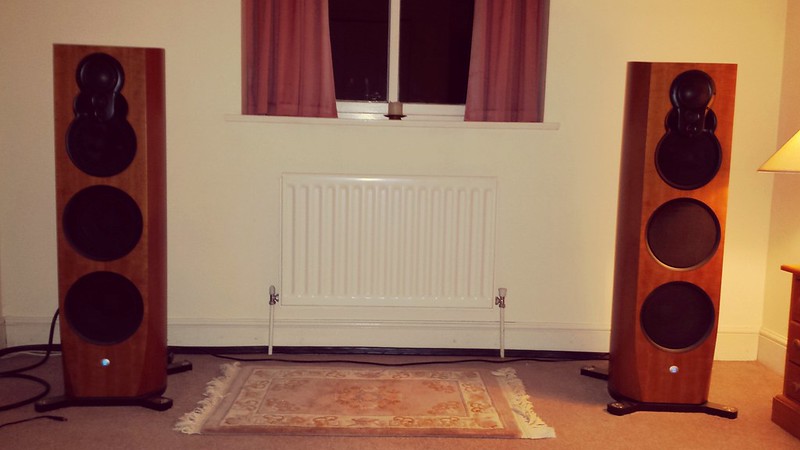
Linn Klimax 350 passive speakers in Cherry with black arrays
Quadraspire Evo rack
No fancy mains treatment, room treatment nor cable lifters in sight...

Most of the music we used came from Tidal (a few tracks from the local laptop) and included Malia, Eagle Eye Cherry, Deadmau5, Ficci, Felix Laband and Tina Doci.  Control was via a laptop running Kinsky (for ease of use) and Kazoo (for access to Tidal).  The KDS/2 was using SPACE room optimization, set up by Whizz when using the KCT power amp.

DVC

Let's get this one out of the way to start with, but first a qualifier.  This is the first KDS/2 I've heard, I've not yet compared it to the KDS/1 back to back in the same system, nor have I had the chance to compare one using the DVC versus feeding it through the analogue volume control of a KK/1 - that's the subject of a near future post.  We used volume levels of between 58 and 62 (for the Linn power amp) and between 66 and 72 (for the Tundra, which has 8dB less gain than the Linn).  So we didn't try the DVC at lower listening levels.
  
Across both the Tundra and Klimax power amps, I can't say that I heard anything that made me think there was any problem at all with the DVC.  With the Klimax amp, there was occasionally an "edge" to the lead of some instruments and voices, but that could be the KDS/2 or the Klimax Twin amp, as I've not heard either of these in their current configs.  Interesting that the Tundra didn't reveal these edges, so maybe it was the amp...  Anyway, at these volume levels, there wasn't even a hint of the "horrendous" nor the "unlistenable" comments I've read elsewhere.

Sweden

So kicking off with the Tundra Stereo 2 - an unassuming little black box - this one being just a few weeks old and only with about 10 hours use.  It was warmed up though, having been switched on and used a couple of hours earlier.  And what a polite little box it is.  Goes plenty loud enough, at least for me, but its really rather soft in its presentation - almost valve-like (and that's not really a complement from me, but I know many will like this kind of presentation).  The top-end doesn't sparkle, the imaging is flat and rather narrow but vocals (particularly female vocals) are sweet and clear.  Not sure why Tori Amos sounded about as wide as the window between the speakers though.  

What of the bass?  Well, it was difficult for me to tell as the 350s were sounding very different when driven with this amp - the usual slightly detached bass issue was not very easy to distinguish because it was all rather loose.  Bass notes started OK, but they don't stop too well.  Its not boomy as such, it just kind of happens then takes its time to stop again. Deadmau5 didn't have me tapping my foot or wanting to dance, which is an usual experience - even on my much more modest Majik amp and speakers, the track we used drives hard and always gets me foot tapping or jigging in the seat (so to speak).  Another favourite is Blues Company's Dark Day - a track full of sparkling cymbals, triangles and snappy rimshots, along with some extremely deep electronic drum effects.  Whilst the vocals were good and the track flowed along, the cymbals, which should be distinct, clear, individually identifiable in space and shimmering as they are struck and fade away, well, they're just underwhelming and ill-defined - some of them being very indistinct.  The electronic bass drums impacted well, but then kind of flapped about a bit - it really had me wondering if developing a power amp through the little Linn Majik 109 standmounts makes sense, or are the 350s just too demanding?  Maybe Lejonklou used other speakers too, but I understand the 109 was the most frequently used in development.  

It was all OK, but we tended to talk over the music, or move onto the next track before the existing one was finished.  I've never heard the Klimax 350 powered by anything less than its internal amps or external Klimax amps before, so I have no idea how they sound when powered with something less exotic and more affordable.  So maybe this is how a £2.5k power amp sounds with these speakers, I just don't know.  And maybe something more expensive doesn't do a better job either?

Scotland

After about 50 minutes of Sweden, we moved onto Scottish power.  The KCT had been switched off for about 3 weeks, so was going to be fired up and used from cold.  Swap over only took a few minutes and the music was up and running pretty quickly - Whizz had the amps back to front on the rack to provide quick access to the connections.  And whoa!  Even from completely cold this amp was a revelation in comparison to the previous hour or so of listening.  The 350 bass timing "characteristics" were back, because now the amp was gripping these speakers much much better - you could hear bass notes starting and stopping.  And the room got bigger - not the actual room, but the room in which music was recorded - Fink were in a proper venue, not the front room.  Tori Amos's voice is now a much more sensible size - and absolutely locked to the centre.  

And detail - there's more coming through from the recording, instruments that were indistinct or not even noticable with the TST are much more obvious and finely etched.  We play Dark Day again, and we listen to the whole track in silence to the end - captivated by what we were hearing.  There is a down side - there is now, an occasional "edge" to some instruments and vocals - but get this into perspective - its a tiny criticism compared with the Tundra's compromises.  As the KCT warmed up, within 20 minutes it was doing a great job.  Tight rhythms, deep bass, clear space between instruments, the atmosphere of the venue much more obvious, sparkly cymbals.  Foot tapping?  Yep, its back - good.  Perhaps this is the best I've heard the 350p, but I can't get away from that slightly weird bass timing issue.

2015-08-01_09-08-53 

Conclusion

DVC - still more investigation to do, but no obvious issues at all tonight, unless its that edginess heard through the KCT, but not through the Lejonklou.  If it is down to the DVC, its a fairly minor issue - not enough to want to listen to something different.

Tundra vs KCT - this was not what I was expecting at all.  Soft, loose and a bit vague, the Tundra was out of its depth here.  Would still like to hear it with other, lets say, more conventional - less challenging, speakers - I'm almost sure that the 350s are not its ideal partner.  No doubt there will be some who say that it needs 6 weeks to be at its best or similar - if that's the case, then they need to play for whatever length of time is required for them to work properly before they leave for their owners. Maybe the Tundra was disadvantaged by the SPACE settings being set up with the KCT - another reason to try to find the opportunity to listen again under different circumstances. I was expecting a difficult choice - to need to swap back and forth between amps to try and fathom subtle differences in presentation or character.  Nope, in this system, in this room, this was an easy, no-contest win for the KCT in my opinion. 

What about the cost - the Tundra is very much cheaper than the KCT. And that's a very important point here, and why I would like to hear the comparison again with more normal speakers - maybe my Majik 140s, maybe some PMC Twenty.26s, or Kudos Super 20s would be a fairer load for it to deal with.  But as a giant killer against the KCT?  No, its just not close on this evidence in this system.  A secondhand KCT would be a better way to go, for me at least.


Thanks to Whizz for his hospitality and the opportunity to listen to this kit, a good way to spend an evening.

Saturday, 12 April 2014

Chester Show 2014 - Kudos, Naim, Bauer and Linn

 
Well, yet again, Kudos provided an excellent sounding system.  Whilst not in the league of the Classe / B&W system in terms of scale and detail retrieval, it was equally musical and very much a room you'd want to sit and spend some time in.
Sources were Bauer DPS turntable / Naim Aro arm / Dynvector XV1 or a Linn KDS/1 into a SuperNait amp and the not yet released Kudos X3 floorstanders.
We listened to Blues Company's Dark Day on the streamer and London Grammar's Hey Now on the turntable.  Both tracks were utterly compelling to listen to and fully enjoyable in all the usual hifi terms, but also on the basis of a musical performance worth paying attention to.  You may know that my local Naimist has the Kudos Super 20 speakers and they're a decent listen, and these X3s are clearly from the same stable and are effectively a baby Super 20 in the way they sound and perform.
Available from July 2014 they're just under £2200 a pair.  Note that the speaker cables feeding them (Chord Sarum Array) were about twice the price of the speakers themselves...

Tuesday, 8 April 2014

Naim NDS / 555PS DR Update - The Three Week Itch

If you remember back to early March 2014, I posted an article on the Linn Klimax DS/1 vs the Naim NDS / 555PS DR streamers, in a mainly Naim system with Kudos speakers.  Here's the link to that story.

Most electronics (and pretty much every pair of speakers) seem to benefit from something referred to as "burn-in".  This is the idea that the components are not working at their ideal when brand new, and some usage allows them to settle down and reach their optimum operating parameters.  Some say that's rubbish (probably based on some theory or skepticism rather than actual experience, or maybe their experience has been with components that don't benefit), some say its essential.  Cyrus electronics have a large print message on the inside of the box lid saying that users should expect the components to burn-in and change their sound quality over the first few weeks of use.  I've heard this with Naim electronics too - certainly Richard's NDX improved over time.

The first NDS listen was a comparison against the Linn on a busy evening on the night before the Scalford show and we were listening to the NDS that had been used as the demo unit for the Naim Statement amplifier at the Bristol Sound & Vision show - so it had about 3 days solid use under its belt.  The 555PS DR was at least 6 months old and has been powering the NDX during that time.

And so, to pick up where the story left off, we had a Linn DS sounding very controlled and considered against an NDS that just wanted to get on with the job, leaving me less than involved because things were too pushy and edgy - I couldn't relax into the emotion or flow of the music.  Great with female vocals though - more texture and colour (not colouration) than the Linn.  And Richard (who has the Naim / Kudos system and the NDS on demo) wondering if it was going to be right for him.

Now we're three weeks on and the NDS is a permanent fixture in Richard's system.  So he's either forgotten the Porsche or the NDS has settled in somewhat.

Using the usual mix of artists such as Eagle Eye Cherry, Blues Company, Ana Brun etc., we had a bottle of Budvar in hand and listening commenced (there was red wine last time, so the alcohol relaxation factor was pretty much balanced across the 2 listening sessions...).  Richard had warned me that things would not be all they seemed last time.  And this was proven to be true.  At first I was very quiet, listening intently, making sure I could take in what was going on.  Subtle this ain't.  And this time I don't mean the way the Naim attacks the music, I mean the change in that 3 week period.  This box has really matured in that time, and maybe there is more to come.  That Naim enthusiasm is still there in spades but the stridency has all but disappeared - the edginess does still happen, but it seems much more related to the quality of the recording being played - its not there as part of the standard mix of attributes.  Imaging has a touch more depth too - not just width now, although from memory I still think the Linn is better in this area.  Another thing that's changed is the clarity of vocals in the mix - male or female singers are now more distinct - less swamped - although, to be fair I hadn't really noted this in the earlier listen, perhaps the other more significant challenges in the sound were overpowering more subtle observations.  There seems to be more subtle details across all the range of music and instruments - there's definitely more layers of detail under detail to be heard.  The system even seems to get some deeper notes than on my own system, which was a suprise given the compact dimensions of those Kudos Super 20 floorstanders.

We come to a concensus - the NDS is a very different beast to 3 weeks previous.  It seems a bit bizarre that the "burn-in" should be so significant.  A replay of the Linn vs Naim bake-off is something we should go back to now, perferrably in my system to try and give us some balance.

There's also concensus on how we should describe the differences between the Linn and Naim streamers.  There's probably little, if anything, to choose between them in terms of detail retreival, but their characters are very different.  We're listening to some studio recordings and the Naim is delivering them much more as though the artists were performing live.  And that's a key part of its character - a live sound, an enthusiastic sound.  By contrast, on those same studio recordings the Linn doesn't add a "live" character to the music, rather it presents a studio session where the musicians seem to have put in that extra couple of rehearsals, as though they are striving for that extra bit of accuracy, more craftsmanship in the way they are playing.  I love that "attention to detail" kind of presentation - as though the musicians care about what they're doing and how it will emotionally impact on the listener.  The Naim, well that's keen to let you know there are human beings involved in producing the music, and it should sound live!

Makes you wonder why Naim would use a brand new out of the box NDS to demo their Statement amp, it could've sounded so much better.  As I said at the time in the Bristol Show report, the Naim Statement room would impress you if you liked to listen to hifi.  If they'd burnt in their streamer, I might've been reporting that it would impress you if you liked listening to live music!

Friday, 21 March 2014

Global Reach

Interesting debate going on at the sondex.ru forum about my Linn vs Naim streamer comparison:

http://soundex.ru/index.php?showtopic=9564&page=99

And here in the Netherlands:

http://www.htforum.nl/yabbse/index.php?topic=126367.800

And pageviews by country in the last 7 days:
United States
2756
United Kingdom
340
Sweden
184
China
120
France
116
Germany
98
Indonesia
77
Canada
63
Netherlands
62
Poland
46

Saturday, 1 March 2014

Photo


with thanks to Gromit at HifiWigwam for the photo tweaking  :-)

Friday, 28 February 2014

Hell Freezes Over?

There's a follow up posting to this story, 3 weeks later here.  Read this post first then check out the follow-up.

As a starter for a weekend of hifi, I guess this is one of the more exotic ways to kick off. 
After the usual week of work, everything was planned and ready to go for the Wigwam hifi show at Scalford with travelling on Saturday and the show itself on Sunday.  Friday evening was supposed to be time at home before disappearing off for a weekend of sonic indulgence and maybe the occasional glass of beer.  But "Richard Is My Naim", my local Naimist and co-conspirator at Scalford dropped a killer call at knocking-off time on Friday evening.  Another black box had arrived.  It needed setting up.  It needed listening to.  Now.  An NDS had landed.
Back Story
In 2 parallel universes, somewhere in North Wales, 2 journeys from CD to streaming have been played out.  Myself predominantly with Linn,  Richard consistently with Naim.
My starting point:  Meridian CD508.20 / Meridian 541 Pre / Rotel power amps / Active Linn Keilidhs.  Via Squeezebox, CA and Cyrus DACs, Cyrus and older Linn power amps, Linn AV5103 pre etc., at the end of 2013 I was at Linn Akurate DS/0/1, Linn Akurate Kontrol/0/D, Linn Majik Dynamik amps and active Majik 140 speakers.  And very happy was I.  Until a "friendly" Linn forum member let me hear a KDSM versus the Klimax Renew (KRDS) streamers.  With the advent of Linn Exakt, a good few Klimax DS/1s (KDS/1) came on the market, the prices fell, and, at the beginning of 2014, a black KDS/1 stepped in to my system and completely re-wrote the rule books.  I could almost see the cogs whirring in Richard's head when he heard how profound a change the KDS/1 brought to my music.
Richard's starting point: Naim CDX2, XPS power supply, NAC252 pre with HiCap PS, NAP180 power and Wilson Benesch Arc standmount speakers.  Then, via the second version of the CDX2, and improved XPS2, NAP250 power amp, NDX with XPS2, he has ended up with NDX / 555PS DR streamer, NAC282 / HiCap pre-amp, NAP250 power amp and Kudos C20 Super floorstanding speakers.  He was also very happy.
So here we have 2 very different ways of getting to a decent quality streaming solution.  And they sound very different too.  Both have bags of detail, but the Linn system is very precise and instruments are really well separated whereas the Naim system sounds more like it wants to get on with everything (like there's not enough time in the day), it has a particularly expansive soundstage and, for me, can occasionally sound a bit strident.  Guess what?  We both think we have the correct answer, but we also seem to respect what the other is enjoying, if that makes sense.
Why Is Hell Freezing Over?
This is a reference to a couple of things.  First, the live album by The Eagles - when they originally split up, one of the band was quoted as saying they would only get back together, "when Hell freezes over", yet there they were, playing live again together.  The second reference is to the relationship between Linn and Naim as companies.  Back in the 1970s, when Linn started out with the LP12 turntable and Naim started out making simple but well engineered amplifiers, the two companies had very similar outlooks - they were out to challenge the establishment and did so very effectively.  When Linn added speakers to their range, and Naim expanded their line of amplifiers, all was well.  The components worked well together and became the "established" route for UK audiophiles.  But when Linn added amplifiers to their range (rumour has it that the Naim MD used one as an office doorstop), then Naim produced a tonearm for the LP12, it all started to go a bit off-kilter.
Despite that, many dealers and customers still work with and enjoy combining the 2 manufacturers' equipment today.
So perhaps this isn't Hell freezing over, but putting the top of the range (almost - more later) Naim streamer on the same rack as the top of the range Linn streamer is probably not something that happens too often.
Naim NDS on a shelf above the Linn KDS/1
Richard's usual streamer solution is Naim NDX with the 555PS DR power supply.  The most recent upgrade step was to swap out the XPS2 for the 555PS DR power supply a good few months ago, and we were both stunned by the improvement this brought in terms of imaging, leading edge attack and more atmosphere to the music.  In source terms, there's only one place its possible to go from there, and that would be to swap out the NDX streamer for Naim's current top of the range NDS streamer.  The NDS can use a single 555PS DR power supply - the one Richard currently uses with his NDX - so its a straight swap, NDX out, NDS in.
Having packed up the KDS/1 into its Linn box, I was round to Richard's house fairly sharpish.  Down to business - get all this stuff up and running to allow us to make the comparison.

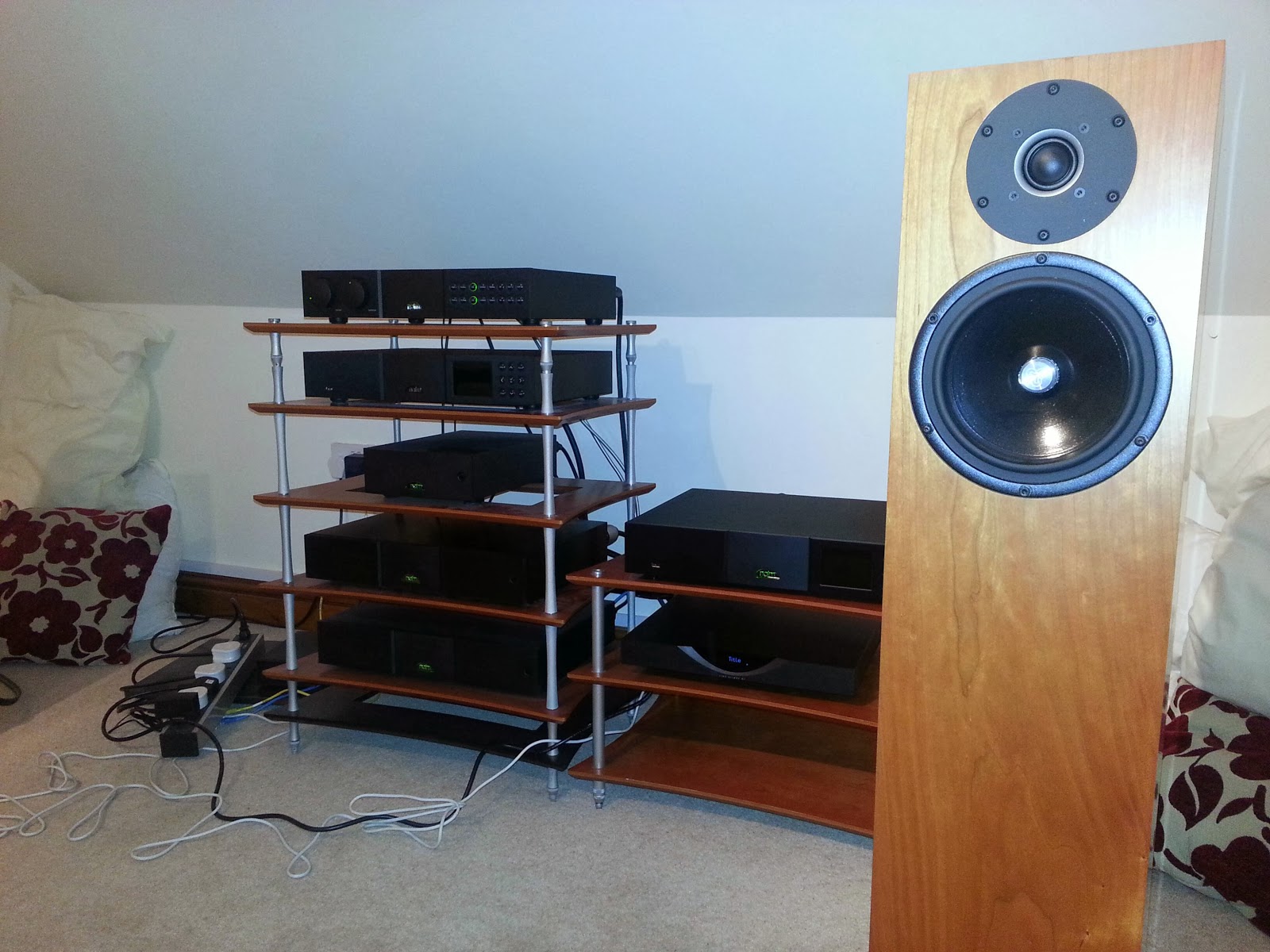
A bit untidy with Ethernet and power cables. Left hand rack consists of Naim NAC282 pre-amp, Naim NDX, Naim HiCap PS for the 282, Naim 555PS DR for the NDS, Naim NAP250 power amp.  In the foreground the Kudos C20 Super (in cherry veneer).  Racks are by Quadraspire.


Get Set, Before Go
An unmanaged switch was connected into the Devolo Ethernet over mains plug to allow 2 x Ethernet connections.  The KDS/1 was hooked up to the network, and with the wifi password sorted out, was pointed at the correct UPnP database from my Android phone (using BubbleDS control point) and that was sorted.  Linn Silver interconnects into the back of the NAC282 (actual phono sockets!) and that was ready to go.
The Naim is a little more complex as it needs two very large ("bundy") cables connecting - both of these are intended to be connected to the 555PS DR power supply.  It took us a while to work out which is which cable - apart from the different arrangement of pins in the plugs, there's not much to go on.  Until we worked out that one cable had a single white band at one end with the other having 2 white bands.  Turns out that this correlates to input 1 and input 2 on the back of the NDS.  Easy when you know how!  One more cable to carry the signal to the NAC282 pre-amp and we're good to go.  The NDS pops up on the iPad and music is available from both sources.
Where Did That Come From?
The previous weekend I'd been at the Bristol show organised by Audio-T and WHF magazine.  Naim had been there, with their first European public demo of the Statement amplifier which you can read about here.  Turns out that what we had there in front of us right now was the NDS streamer that Naim had used in that demo in Bristol.  Surprisingly, they seemed to have used a brand new unit that weekend, so perhaps it got better over the weekend and those who heard the system on Sunday may have heard something more enjoyable than the demo I was lucky to get into, first thing on the Friday.  So it had some burn-in time, but not a great deal.  My KDS/1 has about 15 months use, so no chance of any burn-in issues there.
Worth pointing out, at this point, that the KDS/1 and the NDS with a single 555PS DR are pretty much on a par, price wise.  The KDS/1 is the top of the Linn range at the moment (of the conventional streamers that is, excluding the Klimax Exakt DSM which is a different kettle of deep fried fish in technology approach), but the Naim NDS can be upgraded further by the addition of a second 555 PS DR power supply.  Apparently one serves the analogue circuits, the other the digital circuits, hence separating stuff even further.
Listen Up
Testing my memory a bit now, but I think this is what we listened to:
Steely Dan - Any Major Dude
Fleetwood Mac - Rumours (24 bit)
Ane Brun - Worship
Nirvana - Smells Like Teen Spirit
James Taylor - Gaia
Eagles - Hotel California (Live)
Eagle Eye Cherry - Shooting Up In Vain
Some Radiohead, which I choose not to remember, and some other stuff I can't remember due to advancing age (probably).  Maybe Richard will be along soon to provide an update - although he is one year older than me, so maybe that's unlikely  ;-)
Strangely, for us, Blues Company didn't feature at all.
So What?
Well, that's a very good question.  So what?
I like my Linn system.  Richard likes his (almost all, but thank goodness there are no Ovators in the area) Naim system.  Can you guess where this is going?
I've suggested a "Part 2" where we put the NDS into my Linn system.  The NDS is on demo at the moment, so we're not sure if we'll find a mutually available time to give that a go.  If it happens, you'll read about it here.
Interestingly (maybe?), this bake-off fitted with the Scalford Hifi Wigwam show weekend very well.  How so?  Did it sound like vinyl, played through valves and a set of extreme home made horns?  No.  No.  Not at all.  The alignment is this - Scalford is about variety and variety, with some added variety.  For example, when exhibiting with my budget system and playing a Yello DVD (with a projector too), we had some people who walked out in less than 30 seconds (I think 3 minutes would be a fairer time to decide, but hey, I'm kind of known for being unreasonably reasonable, sometimes), and some who watched the whole video end to end - 40 minutes.  Equally, I like to give every room a try, but some I stay in, others I find 3-5 minutes with a couple of different tracks and I want to move on.  There is a theme with the Wam - there are some systems that do lots of things very well, but there are many systems that do one or two things exceptionally well, but don't do all the other things well at all.  And that's what it seems to be about - enthusiasts playing what they think is right, whether you, dear visitor, like it or not.
Variety.  See?
And whilst I wouldn't accuse either the Linn, nor the Naim, of doggedly pursuing a very narrow set of goals, you can very much hear a house sound from both devices, even in a predominantly Naim system (hence my suggestion we do this again in a Linn system at some point, to get some balance, maybe).
How is it that 2 expensive, highly engineered solutions, using exactly the same source material across exactly the same network, create such a different feel?  What's happening to those bits and, further down the chain, those analogue waves that crunches them out so differently, and yet with some commonality?
What's common?  Detail, layers upon layers of intricate detail.  Tiny nuances in voices, subtle touches of cymbals which are normally hidden underneath other cymbals or percussion on lesser components.    Bass lines that aren't one instrument, but are 2 or 3 that play tunes that intertwine with each other.  That extra level of control that is only stunningly apparent when its there, and then when you step back to a lesser component and notice that the looseness is back.  It amazes me that what sounds great on a system is suddenly put into a perspective of inadequacy when you hear it done "right".  What is "right" anyway?  I wasn't there at the recording so I don't really know, and yet its somehow obvious.  A bit like colour in a photograph - its often obvious what's been changed in Photoshop (other programs are available), yet you weren't there to see the real thing - you just instinctively know its not right, not natural. And rhythm.  Both of these players time superbly.  Tap tap go the toes - its involuntary, its pretty much inevitable.
What's different?  Everything else. 
The Linn sounds so much like its fully in control.  The music will do what the Linn tells it to do.  The instruments are carefully "placed".  The imaging is immaculately controlled.  You can imagine the subtlety with which a string is plucked, a cymbal brushed, a sigh is delivered.  Its precise.  And yet, it flows so smoothly.  There's something about the Linn that makes the music feel crafted by hand with skill and attention by musicians who care. Not lacking in attack, but instrument attack is precisely delivered - starts and stops are there to be heard.  Decay is beautifully extended yet the instruments don't blur together.  Clearly this works brilliantly on material such as James Taylor, the Eagles and Eagle Eye Cherry.  Does this make Nirvana and Radiohead polite and lacking in bite?  No, strangely not, the bite and anger is there, the emotion flows through.
The Naim is clearly a Naim component.  There's very little chance that you would mix up the 2.  It punches, it attacks the music, there's no doubt whatsoever that it means to get on with the job, to tell you that this is the way the music is, get on and enjoy it, or get out of my way.  Its a much more raw experience than the Linn, and I think that's what Richard enjoys - he takes this as being more emotional, more like real life.  For me it gets too much at times - pushing my limits of enjoyment, getting close to the point of aggression and boarding on harsh.  Its not my cup of tea, but I can absolutely hear the appeal.  The Naim has a tiny more expression in the vocals, especially female vocals - just a bit more texture, if you like.  It also has a wider soundstage, filling the room more from left to right, but not quite so much front to back - delivering this as a counterpoint to the precision of the Linn.  Sometimes the decay of instruments is lost a little in the mix, in comparison with the Linn - perhaps that's something that contributes to the need to move on, to deliver the next bit of excitement.
So there it is.  Not much of a conclusion really, is it?  Guess what?  I'm very happy to have chosen the Linn, but that's not a slight at the Naim which I fully respect for what it does and what it achieves.  Put the Naim in a Naim system and you get exactly what you might expect, just more of it, to a finer level of detail and with that extra bit of passion.  I suspect that Richard will also choose the Naim.  He's leaving it playing during the week, so maybe a bit more time on the NDS will change it further.
But I'm left with a bit of a nagging doubt, and we discuss it a number of times over the weekend at Scalford.  Is the NDS worth the asking price over and above the NDX?  On the basis of this session, upgrading the NDX / XPS2 to NDX / 555PS DR delivered a bigger step.  Yes the NDS is better than the NDX, but it hasn't delivered as much as the power supply change.  Seems counter intuitive really doesn't it?  Surely a different DAC, analogue output stage and improved physical isolation makes a bigger change than a better, beefier, tighter power supply change?  Not on this showing it doesn't.
Lets see what the week's extra burn-in brings.  For this test I come away happy with the KDS/1, Richard comes away wondering about that 10 year old Porsche Boxster...
There's a follow up posting to this story, 3 weeks later here.

Thursday, 19 July 2012

TOM'S SYSTEM - LINN KLIMAX, LEJONKLU TUNDRA, LINN KATAN

Rioja when it should've been a claret.

Is this a major faux-pas?  Would this be the end of a fruitful evening before it had begun?  Would it leave a sour taste in the mouth?  How would my host react?  Would I be invited back?  Did I single-handedly save the Spanish economy?

The answer to one of the above was "no", but can you work out which one?

If your host agrees that a red wine fits into the "that'll do nicely" category then, as a visitor when you're trying your best to follow the protocols of polite society, you can't always get it right, but some things are near enough.  And so it turned out on this particular occasion.  The ingredients weren't 100% what was expected, but the result was entirely acceptable, it would seem.  So claret might have been preferred, but rioja can be equally acceptable, but different.

What is he waffling on about this time?  Isn't this supposed to be about music and hifi?  Well, I'm trying to do that clever journalist thing of making parallels.  Maybe I can pull this off, maybe I shouldn't have given the game away so soon in the post!

So we come back to the point.  Tom's system.  First off, I could say that Tom is a very brave man.  Some bloke from a hifi forum sees pictures of your system and identifies the view outside the window.  Same bloke spends a good bit of time in that location for work purposes and thinks listening to some music on someone else's system would be a good way to fill in an evening, perhaps strike up a friendship.  So a message goes out and a complete stranger is invited round for a listen.  So kudos to Tom.


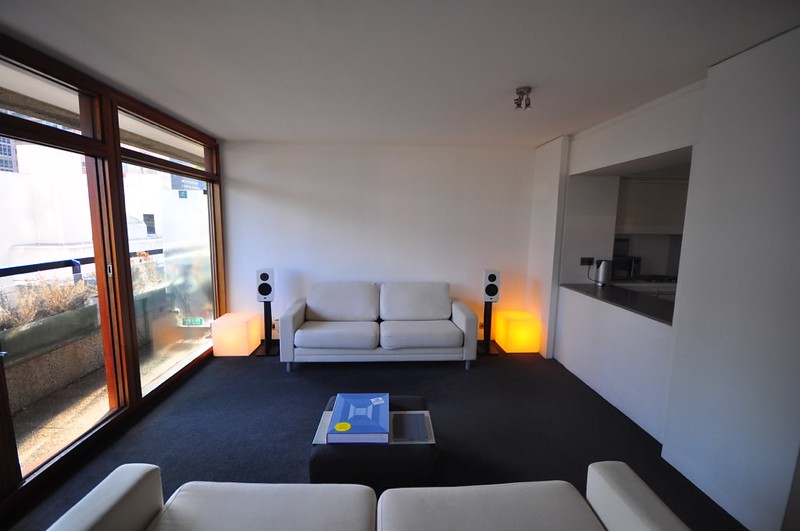
We strike up a discussion on the way to Pizza Express to get sustenance to accompany the rioja.  Suprisingly, we discuss the local area, living in the city etc., rather than diving straight into hifi.  Pizzas ordered we headed back through the inevitable July 2012 (oooh, can I use that phrase without being shut down by LOCOG???) showers.  Tom's flat is modestly sized and carries a minimalist theme - white being the dominant hue and one which means that speaker choice can be somewhat limited, unless a spray can is involved.  The listening room has 2 opposing sofas - one for listening from, the other having the speakers either side.  Speakers are probably a touch further apart than they are distant from the listening position, but the practicalities of living have to be factored in of course.


Being a flat, standmounts are the speakers of choice.  We started out with a test.  Not sure if it was the speakers or me that was being tested, but it turns out that I managed to pass the test, if indeed it was me being tested :-)  A Nick Drake track was fired up to have a listen to a pair of white (inevitably) Linn Majik 109 stand mounts.


These are a recent used purchase by Tom, and they've already been "repaired" after Tom noted they weren't all quite what they should be.  So it took about 60 seconds to decide that one of the mid/bass drivers is less than 100% - sounding muffled and un-dynamic compared to the driver in the other box.  They didn't sound as good as my 109s either.  So they left the room and I believe are on their way back to the dealer to have another crack at fixing them.

The system we listened to for the rest of the evening:

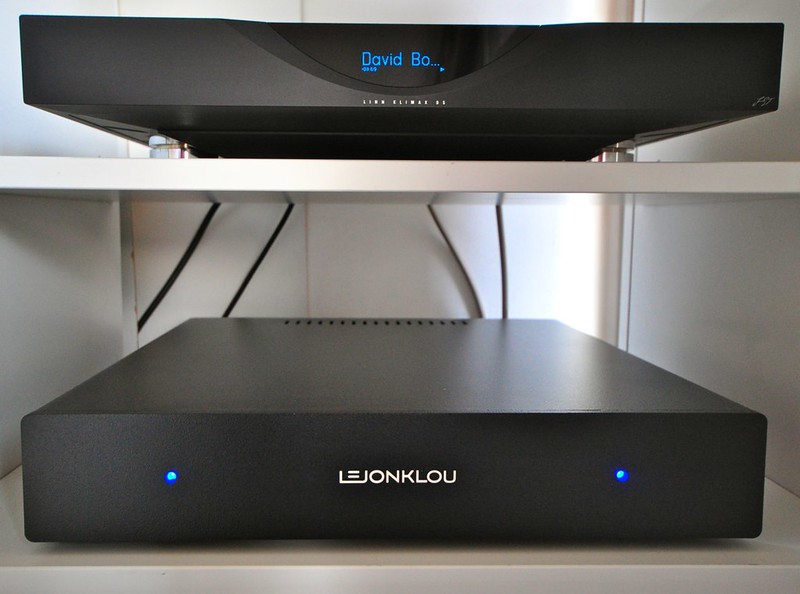
Linn Klimax DS/1 in black (I didn't spend too much time gazing at this as desire can be very unbecoming)
Lejonklou Tundra in black
Linn K400 speaker cable (using one pair of the conductors in single wired mode)
Linn Katans (hey, they're white!)

Some of you will know about the Tundra - essentially this amp seems to have arisen from a Linn enthusiast who decided he could do better than Linn in the power amp area.  As you can imagine, this has been extremely controversial.  There are claims that the £2,800 power amp is equal to or better than Linn's own Klimax Chakra Twin (approx £8,000).  There are counter claims that it's not comparible to the KCT.  And there are lots of claims from people who have never listened to it, to the KCT or to neither.  Hey-ho: as in many hobbies, some people seem to be able to make decisions or pronouncements without the appropriate experience.


Down to the nitty-gritty.  And in some ways there's lots of that - nitty-gritty detail that is.  But none of it is grating nor excessive.  It took me a while to dial into the characteristics of the system.  The main reason for that is the need to re-adjust to a pair of standmounts. My main system and my second system both feature floorstanding speakers and there's no way that the Katans are up to the kind of bass that a floorstander can produce, so it takes a good 30 minutes or so to dial-out that aspect as it tends to be overwhelmingly obvious at first, masking other aspects.  Once you start to put that to one side and start to focus on what the system is actually doing, then you can settle into listening to and enjoying the music (or not of course).

2 glasses of rioja in (it was going down reasonably well with my host too) and time to relax with the music.  We listened to Blues Company, Nick Drake, Hurts, Yello and some other bits and pieces.  Once you get over the lack of really deep bass you can notice that the bass actually goes deeper than you would expect for such small speakers and is definitely tuneful - toe-tapping being involuntary but constantly present.  But moving on to other parts of the spectrum I heard some great vocals - male and female - easily picked out and emotionally charged.  Treble is not the best I've heard - sweeter than my Linn Keilidhs, but not as sweet and smooth as you get from either of Linn's current 2K and 3K higher frequency arrays.

Then you get back to the details, the layers, the tiny tiny details that I've not heard before - slightly more sustain on a cymbal, an extra bit of fizz from a distorted electric guitar string, a high frequency ping that's now a bell, not just a ping.  And this is laid out in front of you across the room - precisely located left to right, but a little 2 dimensional compared to the very best.  Close your eyes and the imaging is still a little shallow and the gaps between instruments feel unrealistically spaced out - we discuss this for a while and agree that the speakers are probably a little to far apart - but needs must when you can't have a fully dedicated listening room.

Is the system musical?  Absolutely.  It's easy to listen to (don't confuse that with an easy listen - its not bland, its not over polite, it just doesn't shove the music down your throat nor does it grate with excessive and synthetic amount of detail), cultured, sweet and drives a rhythm beautifully.

Would I want to live with this system?  Well, it wouldn't be my first choice - I still missed that low bass and the way it can help music (e.g. Yello's Drive/Driven) to fill out into a room and envelope the listener.  But if I had to have a system for a flat, then yes, it would provide many hours of listening fun and I'm sure Tom's enjoying just that.  So perhaps the rioja didn't have quite the depth of a good claret, but it did go down well, much like the music we enjoyed.

We were distracted a little by discussions on classic cars (another shared passion - but very differently focussed), working life, the system at Tom's other house and his plans there, The Australian Pink Floyd and other stuff.  But hey, life isn't just about hifi is it?   Shame we didn't find time to compare Tom's Klimax Renew DS against the KDS/1, but I suspect that the KDS/1 won't be around next time, we'll see what time brings.

So thank you to Tom for such an enjoyable listening session and for being so welcoming and easy to spend time with.  We're hoping to do a Katan vs M109 session sometime in the near future.  I'll get a claret for that one, perhaps there'll be a parallel with the difference in the speakers?  Or would that just be me trying a bit too hard?