"What a refreshingly honest blog about listening to music through hi-fi. So happy to see views based upon the enjoyment of music rather than so-called sound 'quality'." - Peter Comeau, Director of Acoustic Design at Mission / Wharfedale
Showing posts with label Quadraspire. Show all posts

Friday, 15 March 2019

My Tunes at brianandtrevors 14 March 2019

The House of Linn, aka brianandtrevors, is a hifi dealer in Manchester.  The ex-Linn team started out as House of Linn then expanded into a parallel business that stocks non-Linn gear.  I've spent a few evenings there for demos and we've done some business together, on the Linn side of the house.  Its a fine old high ceiling end terrace with 3 dem rooms, a workshop and, perhaps most importantly, a kitchen for brewing tea and dispensing wine.

Most of the evening events have focussed on a product launch, or a manufacturer visit. Quite a few times B&T have mentioned having relaxed music only evenings and finally, they've kicked off a new series dubbed "My Tunes".  The idea is for a customer or other visitor to play some tunes, chat a little about them whilst enjoying the afforementioned tea or wine.  And that was the brief I was given when invited to be the "selector" for the first of these evenings.  Play a few tunes and tell the group a bit about why they were chosen.

I only had one request, that I could choose the system we'd use, and fortunately B&T are now Kudos dealers so it was straightforward to ask for something interesting, but more of that later, there was some planning to do.  What to play?  I do have a collated album of around 450 "favourite" tracks saved on the Melco NAS so I headed there and started to think about what to play and what to say.  It takes a bit of time to whittle it down, try and think of a good variety and then think back to why the track was in the main list, how it came into my life, and how to frame the story.

Eventually there were few enough tracks to put into 2 slots of about 50 minutes each, to allow for a break part way through (to recharge glasses of course!).  The first track was easy - play the first record I bought for myself - and then I remembered that there is a little box of singles in the house, so a quick check and there it was - the original copy of Solid Gold, Easy Action by T-Rex.  Glam rock!  I think it cost me about 35 pence, probably quite a few weeks of pocket money back in 1972.  It then occured to me that it might be worth not only talking about the music, but my hifi journey too, given the location.  So I tried to mix the two things along the way - a bit about the music, a bit about the hifi.

A good size audience of 15 joined the evening.  B&T introduced the idea and myself and that was it, get on with it!  Something I really appreciated, and hoped the audience did too, there was no mention at all of the kit in use, except to answer questions during the break. So no selling as such, a nice relaxed approach.  But we'll cover the system now, because it was something that I'd wanted to hear for a while and something I hoped would work really well.

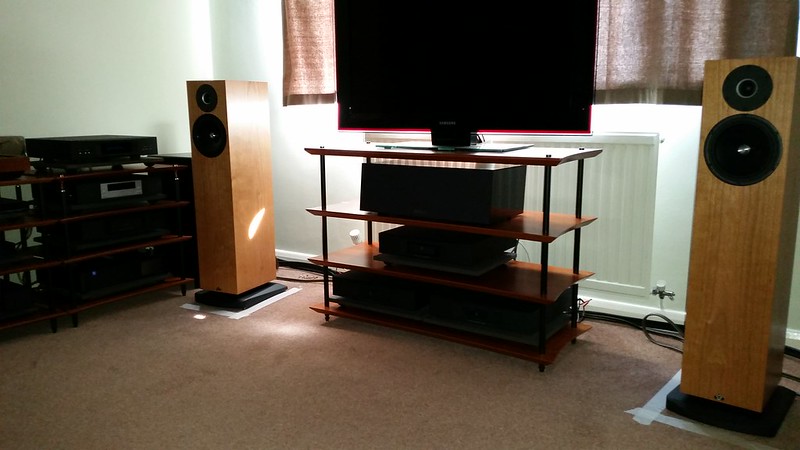
We started the evening with that very old and pretty well worn T-Rex single, running on an almost full Klimax Linn LP12.  So a Radikal motor and PSU, Ekos SE, Keel, Urika II phono stage, Kandid cartridge and the one deviation from Klimax - B&T's own bamboo based booplinth plinth.  Brave of them to let the Kandid track this old single.  It sounded a bit thin, but remarkably free of pops and crackles, but clearly showing signs of stylus damage.  For the rest of the evening we played the tracks from the Innuos Zenith through a Chord Music ethernet cable into a Linn Klimax DSM - but using the Exakt outputs tonight.  The Exakt signal travelled down a Cat 7 ethernet cable to a Klimax Exaktbox/1 (that's the Katalyst version).  This was on a small rack near the speakers which also accommodated three Linn Klimax Twin power amps, each driving one of the 3 drivers in each Kudos Titan T-808 speaker, via Chord Music speaker cables.  So that was the system I'd asked for, but B&T threw in a couple of Exakbox sub boxes and a pair of REL No 25 subs at the back of the room.  All the electronics were supported by Quadraspire racks.

Click on the images for larger versions:


Kudo Titan 808 speaker along with a stack of Linn Klimax ingots - one Exaktbox, 3 Twin power amps, and a couple of boxes not in use tonight


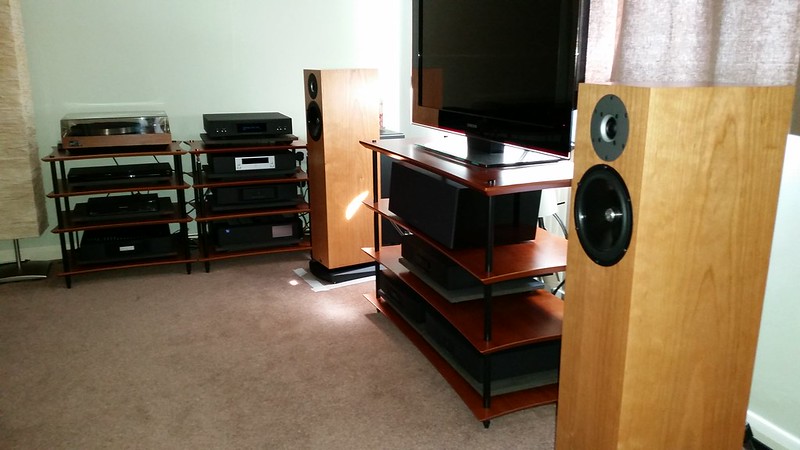
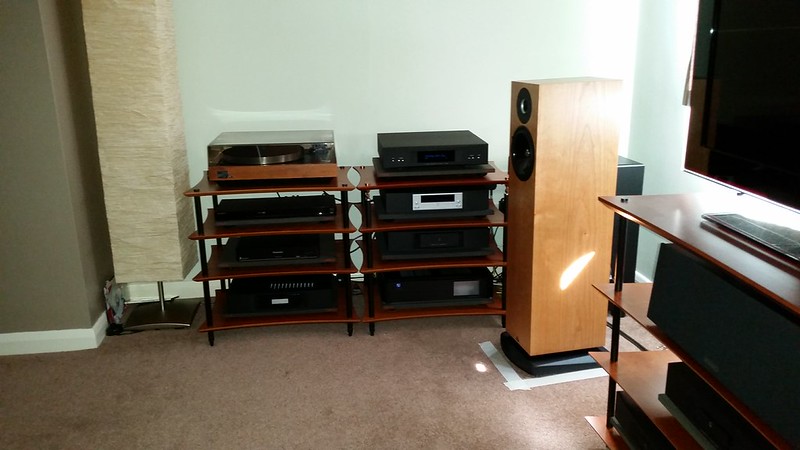
From the top: Linn LP12 turntable in a booplinth, Linn Klimax DSM streamer / pre-amp, Innuos Zenith NAS, Linn Radikal power supply for the LP12 all on a Quadraspire X-Ref rack

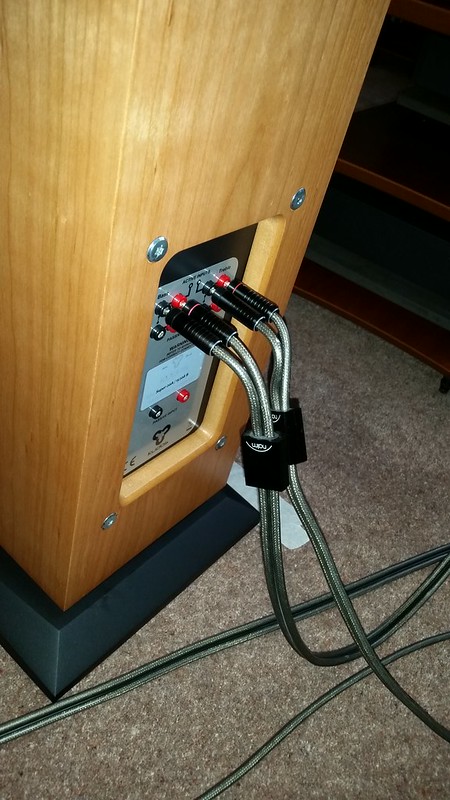
Chord Music Cables
View across the largest of the dem rooms


Before the guests arrive we chewed the fat on the latest in hifi stuff and more, then had a listen to the system - just spending a little time tweaking the volume of the subs down a little to get the best balance.  SPACE is in play on the system and, as is often the case now, with the latest software versions, the default setting in a Exakt system is pretty much spot on.  And the system was sounding fantastic, pleased to say that its probably the best system I've heard in the house.  Full of detail, speed, tuneful bass lines, crisp, clear, beautifully resolved and emotional vocals and slam like I've never heard in the house before.  Fantastic.  I also spent a bit of time listening to a pair of Titan 505s in the smaller upstairs dem room, being driven by Linn Akurate Exakt electronics.  That was a good listen too - the Titan range seems to be a good design.

Below is the list of tracks I went with.  I have to say, I'm not sure its the right list, or the best list, or whatever, but its the one I came up with for the evening.  I did put some time into it but I didn't over think it or spend time putting tracks in and out of the list. Maybe I'll get invited back in a few years time and I can go with a completely different list.  So in there there are some older tracks, some new stuff, electronic music, jazz, americana, folk, covers, punk and rock/pop.

You can click on the image for a larger version:


I was hoping to put together something that some people would know (Teenage Kicks, of course), some tracks known but in new versions (Ever Fallen In Love, Don't Go Breaking My Heart) and something that would be new to most if not all (Pitch Black, perhaps Fink).  During the break it would seem that the balance was OK for most, but I've no doubt there were some genres missing or perhaps too much of one genre for others.

The audience were very attentive, there was some banter during the introductions, hopefully the little stories were interesting, but mainly, I hope that the music was of interest and enjoyable.  Certainly that system did it all justice.  If nothing else, I enjoyed the evening!

I'm looking forward to the next time B&T organise a session - it'll be interesting to be in the audience and hear someone else's selections and stories.

Thanks to B&T for the invitation to "select".


B&T have made the most of this post for their newsletter  :)

Thursday, 30 March 2017

Linn Exakt and Kudos Super 20: World First Review

There's a bit of a back story, so please bear with me.

First, I'm going to assume a working knowledge of Linn Exakt and what it can do to process the musical signal coming from a DAC, through a set of power amps and on to each driver in a loudspeaker.  If you're not so sure, you can follow these links for some more information:

Also, there's lots on the blog about my current system of Linn Akurate Exakt and PMC Twenty.26 which forms the basis of comparison here, so have a dig around if you need to catch up on the reference point for this review.  But before the PMCs, I tried some different options, one of which was the Kudos Super 20.  At the time, this was with a Linn Klimax system using a more traditional, passively driven, approach.  That review is here, but to summarise on my view of the Super 20s in that system in my room:
"So its a mixed bag.  I really understand why they're a good seller and why their owners enjoy them so much - I get the appeal of the etched instruments, I get the speed, I get the way they do female vocals. If I was in the market for speakers at this price point, I would say that they could be on a short list. But I need to relax into my music.  I like chilled out music to wash into the room and give a warm feeling as I sit back after work and wind down. When a system doesn't let me do this, its not right for me.  Others will have a different view.
As such, these aren't the right speakers for me or my room.  They're different to the M140s, but they're not the right mix of abilities to justify a change to the Super 20s.  I'm looking for a bigger difference, but perhaps, more of what I have, rather than a different direction."
 
So not a ringing endorsement in my system and room, but certainly something to consider in the right size room - they work well in their owner's own listening room which is somewhat smaller in volume than my own room.

Kudos Get Activated
Since then, Kudos have committed to delivering all their "upper" range speakers (at the moment, that's Super 10, Super 20, T-707 and T-808) with the ability to run with active amplification - ie, the passive crossover in the loudspeaker is by-passed, an active crossover is placed in front of the power amplifiers and each power amp channel controls just one driver each. This has been successful for T-808 with both Linn Exakt and Devialet implementations which you can read about at those links. Most recently, I had my first taste of Kudos's newly launched T-707 being partnered with Naim electronics including a SNAXO active crossover. This is a deeply impressive combination, heard at the Chester Hifi Show 2017.

A little while ago, the Super 20 (re-named 20a) has been treated to the Kudos connection panel which allows passive or active use of the speaker. Conversion from passive to active is extremely simple - just pull out 4 jumper hoops and connect your amps to the appropriate driver connections. So simple, in fact, that Kudos don't explain how this is done on their instruction sheet. Perhaps there is an expectation that the dealer is involved in most installations.

New Kudos Super 20a ready for listening
 Review Caveats
There are a couple of caveats to this review to bear in mind. First, and crucially, we had a pretty much brand new demo pair to work with. So new, the Cherry veneer was still very pale indeed - I know this darkens over time to something much deeper and richer. We estimated the speakers had about 50 hours of use on them - this is important to bear in mind as you read the review, as speakers often take a while to settle down or 'break-in' from new and their character can change a surprising amount over this time. Second, we only had a 3 hour window to work within, so there's a chance there may be more to come given more set up time - on this one, we saved a good chunk of time by going straight to the speaker position we'd found had worked best for the speakers in passive form. I think that's a very reasonable approach to take and should result in something pretty close to optimal.

Local friend R has earlier passive Super 20s in a Naim NDS/555, 282/Supercap DR and 250DR system with SuperLumina cables throughout. This lot feed a pair of the earlier Super 20s which don't permit active operation. This means there are 2 of us with experience or extensive experience of the Super 20s in this system. R's Super 20s are the ones reviewed in my previously passive Linn Klimax system. This gave the opportunity to directly compare the brand new speakers against a set with thousands of hours of use. Hence the first caveat - straight out of the box the newer pair were over bright and the bass was 'stiff' and inarticulate in comparison. To the extent that both of us found listening rather tiring. So they were left playing away to themselves, facing each other with one out of phase to reduce the amount of sound they produced. This is how we know they have at least 50 hours of music under their belts.

Set Up
Distinguishing the Super 20a from the Super 20 is the connection panel. At the base are the normal single-wire passive inputs. The second row down are normally vertically linked to the top row by u-shaped links during passive operation.  Here the top row of connections are being fed active treble and bass signals from Naim SuperLumina cables.

So some perspective from the above in the context of a familiar system and a current (very happy) owner.
2 days later and they're set up in the Musings listening room, positioned where the passive pair had sounded best. A quick look at the brief instructions soon told us that we had to work out the active connectivity ourselves, but it is simple. Pull out the 4 connecting loops and hook up the correct speaker cable to their respective 'active treble' or 'active bass' connection.  Linn Konfig was spun up on the laptop and the Exakt filters for the Super 20s were selected from the menu and installed into the Exaktbox whilst the power amps were still switched off. After confirming the Exaktbox connections against the Konfig diagram, it only took 15 minutes or so for everything to be ready to go. As is the way with active systems - care with connecting is critical.  Connect a bass channel to the tweeter and you can expect a short puff of smoke, silence and a bad smell.  So the bass driver is always connected first - if you accidentally send treble information to this driver its no big deal.  So make sure the bass drivers are connected then listen to music at low volume and make sure the bass driver is producing bass.  If its all good, then connect up the treble and listen to it very quietly to make sure its only handling treble.  If all is good, on with the music...

System

Here's the system driving the Super 20a with an Exakt feed, in source to speaker order:

  • 16 bit and 24 bit uncompressed FLAC files
  • QNAP 251 NAS with WD Red drives
  • Minimserver UPnP database
  • Cat 7 ethernet cable
  • Netgear GS-108T network switch with Friwo medical PSU
  • Chord Anthem streaming cable
  • Linn Akurate Exakt DSM streamer / Pre-amp (with power from PS Audio P5 regenerator)
  • Chord C-Stream streaming cable
  • Linn Akurate Exaktbox 10 DAC/processor (with power from PS Audio P5 regenerator)
  • Linn "silver" analogue interconnects
  • 2x Linn Akurate 4200/1 power amps (with power directly from the mains)
  • 2x 3m pairs of Naim SuperLumina speaker cables
  • All electronics supported by Cyrus Isoplats on Quadraspire EVO racks

 Tracks used:
  • Falling Out of Love - Mary Gauthier
  • Six Blade Knife (24 bit from DSD) - Dire Straits
  • Gula - Deadmau5
  • Keith Don't Go - Nils Lofgren
  • Fender Bender - Chris Jones
  • Breathe You In (ft. Laura Hahn) - Ficci
  • Wicked Game - London Grammar
  • Walking With Elephants - Ten Walls

First Impressions


Here you can see how fresh the Cherry veneer is on this pair - contrast with the Quadraspire cherry shelves.  Akurate Exakt DSM is on the far right hand rack, the Exaktbox 10 is on the middle shelf under the TV with the 2x 4-channel 4200/1 power amps on the lowest shelf
 
That brightness noted in R's home system was still in evidence here, making the system difficult to listen to, but bear with me as this isn't the end game here.  One thing we also noticed immediately was the articulation, drive and rhythm in the bass line - although there were some room modes being driven here, leading to a touch of boom - that initial stiffness noted at first listen in R's system isn't evident in the Exakt system - either due to the different system, some benefits of the 50 hours of playing time, or perhaps a combination of both. Vocals immediately stood out as crisp and clear with tone and intonation clear in the expression of the words.  So, some work to do.  I think it would've been good to leave them playing for a couple more days, but time was against us.

SPACE

Turning once again to Linn Konfig, the first thing to address was the room modes which were giving a touch of boom in the room - it wasn't at all excessive, but it was there.  Whilst the room measurements themselves were untouched, the position of the speakers in the room was amended to suit the positions of the Kudos boxes and the optimise button was pressed.  The newer SPACE implementation - where each left / right speaker receives different settings - was evident in the profile graph - much more so than with the PMC 26s.  This brought an immediate improvement to the punchiness, tunefulness and articulation of bass line.  But it was a touch light so we took a couple of dB out of the notch and narrowed it significantly and that worked a treat.  As usual with SPACE this opened out the mid-range and treble too - a mixed blessing.
Sometimes, its possible to tackle some vocal harshness by adding notches in space in the 65 to 74Hz range and whilst these gave some subtle benefit, it just wasn't significant.  So we moved up the range and added a -1.8 then -2.0dB treble shelf which Linn allows you to add from 8kHz upwards - and this was a little helpful, but not the answer.  So that was moved up to 17kHz and then we added a custom filter - a -2dB dip centred around 8.5kHz but with a very high width value which effectively gave us a 3.5kHz to 17kHz wide shelf. And that really hit the spot.  Notching this down to -3dB across the same frequency range got us to the right place.  Everything clicked at that point and we started to settle down into listening to the music rather than to the system and its tendancy to spotlight every single thing in the upper frequencies.  This is the first caveat - it would be great to get the speakers back again soon when they've had a lot more hours of use - to see if this treble attenuation can be dropped over time as the speakers break-in.

Listening to Music

So now we had a very satisfactory sounding system, we cracked on with listening to some tracks.  Bear in mind here that R has been listening to these speakers for around 3 years now and has been through a good few system upgrades during that time, so he's very familiar with their capabilities.  It turns out, whilst they might be familiar, they haven't really reached their full potential in the Naim passive system. What we heard in about 90 minutes of listening with Exakt was a revelation.  These speakers, whilst not carrying the same weight and authority as the PMCs (which have a somewhat larger visual and physical presence in the room), they're no longer out of their depth in my room.  They go astoundingly deep from such a small box, with plenty of drive and give a bass line that, had we not already heard the PMCs, would be thought of as very good indeed - add in their relatively small dimensions and that makes them quite remarkable in this area.  Tunes that needed to boogie along did so, attack is good as is the timing of the tune.
What about detail? Well, its astounding - these speakers really can resolve tiny tiny details that is beyond the capabilities of the PMCs and significantly beyond how they sound at home in the passive system. Both acoustic guitar tracks (Lofgren and Chris Jones) deliver string sounds that are crisp, clear and easy to pick out - delivering initial attack in spades and long long decays into the background. Spitty anger in Mary Gauthier's voice make you feel a bit uncomfortable and pleased that you're not the subject of her aggression. Vocals are superb - a good bit more texture, inflexion and intent than with the PMCs.  Imaging is spot on too - rock solid, easy to place, 3 dimensional and a little unsettling on those tracks (such as Ficci) that use processing to give a wrap-around effect in the room.
Is there a downside? Well, its difficult to find anything to fault but I would prefer a little more subtlety in treble leading edges - R found it just to his taste, for me its still a bit sharp.

But here's the thing - throughout, we could both follow tunes and feet were tapping - and I mean throughout. On top of that, R kept giving little involuntary smiles and shaking his head in disbelief.  These speakers are very much more capable than either of us really knew and Exakt with active amplification has brought that out from under the covers of passive operation.

I'll leave it with some of R's words - stunning, outstanding, and several more that I won't repeat in a public forum.

Post Script

We hope to get the speakers back again in a couple of weeks time to follow up on if they've settled in and need less treble attenuation - if this happens I'll report back here.  Also, after the Super 20s left the building, the SuperLumina speaker cable stayed in the house for a little longer.  Interestingly, using this cable on the treble of the PMCs reduced the gap in detail resolution by about 50%, bringing the PMCs closer to the Kudos boxes in this area.  Would I swap the PMCs for a pair of Super 20s? No, but that's no reflection on the capabilities of the Super 20a, more that there is a different set of priorities from which to choose.  Having lived with the superb bass performance of the PMCs, their relative lower level of detail resolution and lesser capabilities in vocal resolution are a reasonable compromise to live with.  And I'd be looking for a substantial improvement if moving on - not a different compromise.  Roll-on the Kudos T-606 in the summer! 


Thanks to Kudos and Acoustica for the loan of the speakers.

Thursday, 19 November 2015

Listening In A Meadow? Exaktly.

I quite like pizza.  And red wine.  Generally, these are consumed indoors – either at home, or in a restaurant.  Occasionally (it would be summertime), it might be on a terrace overlooking the Med, or perched on a stool outside a tent.  It’s not normal to be consuming these treats in a field, but that might’ve been what was happening the other night, accompanied by Dire Straits playing in the background on a pair of Linn Exakt 350s. Maybe I just have an over-fertile imagination.  It’s strange though, as in reality, we seemed to be sat in a large top-floor room which was as real as the pizzas, and the red wine.

What is this opening ramble?  What does it mean? Was the wine too strong?  Were there too many glasses consumed?  Let’s start back at the beginning and work through to what that opening paragraph is all about.  Maybe.

Cards on the table.  I’ve heard lots of Linn 350 speakers.  And Linn Exakt systems.  Some were combined together.  I tend to like Exakt systems, when they’ve been set up properly (not a given), but tend not to like 350s.  When I’ve heard them both together, they’ve been in inappropriate locations, like a massive double storey hard surfaced furniture shop (not a great approach to showing off your systems Linn), or in the factory in a ballroom with 200 people, etc.  So Exakt and 350s have not been a great experience so far, but then they’ve not had much of a chance either, with the best I've heard them being in the main dem room at HoL - my preference still being for the Akubariks or Komris.

One of the more enjoyable systems featuring 350s belong to Linn Forum member (let’s call him “A”) and uses a Renew DS/0, Akurate Kontrol/0 and a non-Dynamik Twin.  That system still features their special feature – a slightly “disconnected” bass.  A and I meet up from time to time with music and hifi always the excuse – be it at shows, dealer demos or in the listening room.  A lives down South, I don’t.  So we get together when it makes sense.  Through A, I met P, also a forum member and living down South, and we tend to meet up at either of their houses when there’s a good excuse to listen to some music, or compare the effects of software changes and other bits n pieces of new kit.

The 2 guys down South have recently added another member into this happily sceptical band of middle aged music listening blokes.  For simplicity, this new bloke, also a forum contributor, will be called N.  This week was the first time I’ve had a chance to join in, with another trip to London being necessary for work purposes.  Logistics sorted, pizza orders confirmed for the 3rd time (sorry P) and all was set for a bit of Exakt 350 listening.  It even all went to plan.  Decent pizzas, great red wine and we settled into the listening room to munch over the background Dire Straits.

And what a listening room.  Perched on the top (2nd floor) of a substantial place, approx. 6m by 4m and with a sloping wall / ceiling down one long side as it tucks under the roofline.  A pair of rather tasty looking Linn Exakt integrated 350s in piano black stand guard either side of powered grey screen on one of the shorter walls, with a TAG MacLaren centre speaker stood on a pedestal stand.  A venerable Linn Melodik and associated Exaktbox sub are in one front corner. That’s all you see from the listening seat – side / rear speakers are multi-driver MK units flush fitted into the side walls.  There’s a large L-shaped sofa for 5 or 6 and a vast footstool big enough for all.  This is a very comfortable place to settle into for tunes and movies.  Across the back wall there are 2 built-in cupboards.  One houses the very large SIM2 projector (watching movies with all the lights on is no problem), the other the equipment rack.


Piano Black Linn 350 Exakt.  Tasty. And old skool Linn Melodik sub


And what a rack this is.  Much of what’s in there will be on the wish list of many an audiophile / music lover.  Perched on traditional Quadraspire are (from top to bottom): an SME 30 turntable equipped with series V arm and Koetsu Red; Linn Klimax Exakt DSM; Tom Evans Audio Design phono stage, Anthem processor and multi-channel TAG MacLaren power amp (for centre and rears).  Music is normally held on a 4 bay QNAP NAS, but with some currently stored on a Melco N1A and some on a Melco N1Z whilst the resident A is being compared to a demo Z.  All connectivity to the main stereo system is with standard Cat 5 ethernet cables.  Exakt links included, with one cable from the KEDSM to each speaker and the sub daisy-chained from the right hand 350.

Main Quadraspire Rack,  Untidy Cables Due to Experimenting with NAS Storage (see later pic below)
SME 30 / Series V / Koetsu Red

It’s gonna be good, right?  

The 350s are stood very close to the front wall, to enable them to be positioned either side of the off-centre screen (off-centre due to the sloping ceiling).  This is possible due to Linn’s SPACE Optimisation+ feature.  During set up, the room is measured, the speakers are manoeuvred until they’re at the point they sound best in the room (the ‘ideal’ position measurement), then their position is also measured.  The speakers are then moved to their practical position and measured in this position, relative to nearby walls.  All this data is then entered into Linn’s Konfig software, algorithms are crunched and the signals sent to each speaker allow for their compromised position in the room.  I’ve heard this demo’d a few times and its very impressive.  It doesn’t perfectly recreate the sound generated in the “ideal” position, but its very close, considering what it allows in terms of much more physically discrete speaker locations.

What about the sub?  Well Linn have just added subwoofers to their Exakt system with the Exaktbox Sub which is designed to take the Exakt signal to a sub with built-in power amps.  N had just hefted the sub into the room a couple of days before (his and his mate’s back are probably still recovering – its not exactly lightweight), and it hadn’t been set up.  We had it powered up to start with, but then chose to shut it down and come back to it later.
Pizzas done, music was loaded up into a playlist on the iPad Mini (or the iPad, or the Macbook!) and we got on with some listening.  It was very quickly clear that there’s only one sweet spot in the room – the intended listening seat.  Being elsewhere in the room was a real compromise – even just one seat to the right of the hotspot.  Not to worry, that’s not at all unusual.  We listened to some classical organ music (vague, sorry about that, it’s not something I know much about), some Clapton on video and some Seal.  We settle into focused listening with something we’re all very familiar with – Daft Punk’s Georgio Moroder from the Random Access Memories album.  It has an interesting opening with a narrative by Georgio, underpinned by background chatter and some bass meanderings.  Then of course it kicks in with some driving bass lines and electronic tuneage.  It’s very good for understanding system resolution and tunefulness.  Tune dem anyone?  We don’t discuss that, as everyone has their own way of listening for what they like, but we all do try to figure out if we’re just enjoying the flow of the music and if it’s causing foot tapping or not.

It was difficult to establish what’s going on away from the hot seat, so we take turns to try it out.  For me the sound was OK, but not overwhelming.  I suppose I was expecting something special, and to hear that from the off.  We mess about a bit more with some more material – including a great scene in the film Fifth Element.  I’d forgotten just how quirky and amusing that film is – must get around to watching it again sometime very soon.  Having got used to the sound, we start thinking about tweaking a few things and start with the QNAP and Melco options.  Various combinations were tried – each Melco on its own, then with the QNAP fed through one of them.  I think I heard some small differences, with a very slight preference for the N1A Melco, but there was nothing there that was making the system sing, nor were any changes (real or imagined) very significant.  Another aspect was a serious lack of imaging – there was no single point for the singer’s voice and London Grammar’s album just didn’t shimmer and fill the space in the room.

To the left, QNAP NAS main storage and a couple of Melco NAS boxes, the N1A being resident, the N1Z being a demo unit

I think it was P who finally bit the bullet and we cranked up Konfig on the Macbook.  We switched SPACE Optimisation on and off a few times, but I really couldn’t hear it making any real difference.  Strange, it’s normally very obvious.  We checked the SPACE filter graph and found a straight line.  Those familiar with looking at what SPACE does, will know that this is unusual.  Essentially, the software calculates where the room is likely to give bass humps (due to the dimensions of the room) and then feeds a signal to the system that has very narrow, often quite deep, notched attenuation filters – the idea being that the deep notches in the signal cancel out the humps created by the room.  Most rooms have 2 to 4 nodes.  Yet here we have a completely flat profile.  And a room map with no speakers or furniture identified.  Now, there have been some recent software updates that have had odd effects in Konfig, such as completely shutting down one speaker, forgetting which speaker models are in use etc., all fixable by restarting the software and the system, although forgetting the speaker model did actually need the model to be re-input.  So maybe a software bug has caused the problem, but it’s not really possible to track down what’s happened here.  The cause of the lack of filtering was soon obvious and I hope it’s been down to an error somewhere along the line as N clarified that there had been notches on the graph previously.  Perhaps a software or hardware change had caused the problem.  One for owners to check back on from time to time (rather like I discovered that my speaker model had been dropped from the standard SPACE config in my own system – noticed one day after a software upgrade seemed to have degraded the sound a bit).

Anyway, thinking back to some stuff I’ve read on the Linn forum, the problem was soon identified.  The room dimensions are supposed to be entered into Konfig in metres.  Here they had been entered in cms.  So a 6.3m long room becomes a 630m long room, as far as the calculations are concerned.  And when that room is also recorded as being 410m wide and 255m high, the speakers imagine they are living in a field.  And when a set of speakers live in a field, they don’t create any bass humps as their field is too big to have bass humps.  So SPACE sets a correctly flat profile.  Except we weren’t in a field, we were definitely in a room.  The measurements were quickly corrected to metres, and we entered a rough position for the subwoofer.  But when we did this by roughly guessing its distance from the room boundaries, the Konfig diagram showed the subwoofer was half outside the room. Hmmm.  Something not right there.  A quick run of the optimisation software delivered 4 notches and we were clearly starting to head in the right direction.

N quickly dug out the laser measure and we got to work stepping through Konfig’s measurement requirements.  Even when converted from cms to metres, some of the dimensions were out – the room width was recorded as 4.1m, but turned out to be 3.66m – an error of 0.5m is quite significant.  About 15 minutes of measuring, checking and entering the data and we had a new optimisation ready, with 3 notched filters – the lowest frequency notched to about -29dB with the other 2 much further up the frequency range and much shallower.  Due to time restrictions, we just converted the speaker’s “ideal” location from the cms already in the system.  With much more time it would be worth revisiting the ideal position data too, but that involves removing speaker spikes and shuffling the speakers about in the room – there wasn’t time this evening.

Daft Punk went back on, Leonard Cohen, Seal and some London Grammar.  Some listening, some small tweaks on the depth of the optimisation notches.  We dial in a +1.5dB treble shelf to compensate for the heavy soft furnishings between speakers and listening position.  I think we ended up with the notches back to the SPACE recommended settings in the end – quite unusual.  This was quite some improvement.  Bass lines are now tuneful, and there’s real imaging going on – still a little shallow front to back (possibly an effect of being so close to the front wall of the room), but very wide left to right and instruments and voices easily pinpointed as individual parts of the whole.  The opening to the Georgio track had a stable, central voice, the background noise was recognisable as chatter and the quiet underlying bass line is playing a clearly distinguishable tune. Excellent.  What a difference a few measurements can make (although, to be fair, changing from cms to metres isn’t exactly a subtle tweak).  Next we mess about with some cables and the system really starts to sing.  Now, we’re listening to the best pair of 350s I’ve heard.  The bass lines are even in time with the rest of the music, which is not a 350 forte – Exakt must be doing its stuff, and perhaps the latest 4th order bass roll-off changes have been really fundamental to getting the best from the 350s.  This system is now really enjoyable – something quite special, given my previous challenge with enjoying 350s.  Sitting position in the room is now much less critical, although still best from the hot seat of course.
N then played Porgy and Bess Summertime, Procol Harum performing A Whiter Shade of Pale with the Danish National Concert Orchestra, Eva Cassidy Fields of Gold and some of his other favourites (he has a very extensive and eclectic music collection) which all sounded very engaging.

There’s probably more to come.  Given that we have relied here upon the “ideal” speaker positions that were existing in Konfig (but converted to metres), there’s probably scope to go right back to the beginning and determine the “ideal” speaker position again.  If that’s not right then the SPACE Optimization+ facility for positioning the speaker into the practical position will be based on some incorrect calculations.  If that is the case, then this system really could move on from excellent to truly stunning.  That’s the work of at least half a day.

Now I’m hoping to get back again soon (probably in early 2016) to spend the evening listening to music, to give that SME a good listen and to put that fantastic screen and projector to good use. Hopefully, over the next few days and weeks, N can enjoy settling into some serious music listening too.  Thanks for your hospitality N, a very enjoyable evening.

(with thanks to P for a contribution on the tracks played and correction of some of the details).

Wednesday, 2 September 2015

Digital vs Analogue? But Not Streaming vs Vinyl.

Its already been raised in a couple of posts.

Linn have discontinued their analogue pre-amps.  So its digital volume controls all the way now, with the streamers and pre-amps being combined into the DSM streamer/pre-amp products.

Linn announcement covered here

Initial thoughts on a first listen to a digital volume control (DVC) are here

So how is this relevant to the main system at Audiophile Musings?  Well, it has the following streamer and pre-amp:

Klimax DS/1 (KDS/1) streamer
Klimax Kontrol/1/D (KK/1/D) analogue pre-amp

So Linn are now, effectively, advising customers that combining these 2 products into one Klimax product and using a DVC is an improvement on separates.  They still sell a separate streamer - the Klimax DS/2 (KDS/2) which features a new circuit board layout and an improved clocking system. Said to sound better than the KDS/1, of course.  The alternative, and what Linn seem to be recommending is the combined streamer and pre-amp in one box, the Klimax DSM/1 (KDSM/1) which features a DVC.  Of course, the older, KK1/D separate pre-amp features an analogue volume control.

The analogue vs DVC debate is lengthy on the Linn forum and there's the usual conjecture, assumptions and actual experiences recorded there.  Some are vehemently against, some are accepting, many are still on the fence, probably not having listened yet.  Linn themselves have produced technical information proving that the DVC introduces less distortion into a system, and is therefore, according to them, a good thing.

Why is this currently relevant?  Well, as the KDS/1 has been superceded by the (supposedly) improved KDS/2 streamer, then there's an option to consider upgrading the KDS/1 in the main system.  In typical Linn style, its possible to upgrade an existing KDS/1 to KDS/2 internals.  But it's also possible to upgrade the KDS/1 to the combined streamer and pre-amp, the KDSM/1.  So upgrade to KDS/2 or to KDSM/1 and sell the KK/1/D pre-amp? Or neither and stay as-is, or stay as-is to try and work out what Linn will do next - the myriad changes in the last 18 months or so is probably de-stabilising customers' system development plans, to say the least.  These upgrade options also come with Linn's proprietary Exakt digital outputs which allow the use of Exakt digital crossovers or Exakt enabled Linn active speakers in addition to traditional analogue output. This decision combines the following:

- commit to DVC (or not)
- upgrade the DS (or not)
- upgrade the DS to a DSM (or not)
- open up the option for Exakt at some point in the future (or not, but upgrading doesn't mean this has to be the future)
- are any of the upgrades good value (in the context of a Linn Klimax system)
- consider how any of this works with or without the KK/1/D pre-amp and the multi-channel cinema processor (or not, possibly leading to lots of other considerations / expenditure)

As you can probably see, lots of options for Linn's existing customers (although, as a new customer, things are very much simplified now), and, consequently, lots of confusion.  Change to new Linn? Move to a different manufacturer? Do nothing? Wait and see - for how long?

So, down to the dealer to have a listen, as that's the only way to resolve a few of these questions.  But with the demise of the analogue pre-amps, even that's not so easy now.  In order to listen to the KDS/1 against KDS/2 through a KK/1 pre-amp, its necessary to take along both the DS and the KK. But this does at least allow comparison of the 2 separate products compared to the combined KDSM/1.  A time was sorted out and about 2.5 hours was spent working through the options and making a decision.

At House of Linn, we used a Majik power amp into passive Majik 140s in the upstairs front room - so similar to my own system, but not identical as there weren't enough Majik power amps on hand to run the M140s in active mode.  The shop's pair of Solo power amps were out on demo, so they weren't an option either.  Linn Silver interconnects and one half of K400 speaker cables were used.  All the source and pre-amp components were placed on the top shelf of a Quadraspire Sukono Vent rack with a bamboo top shelf supported by their latest bronze spikes. Control was through Linn Kinsky on iPad and we used volume levels in the 60-65 range. We listened to the following combinations:

KDS/1 and KK/1/D
KDS/2 and KK/1/D
KDSM/1

These were swapped in and out of the system to enable A to B comparisons.  The KDSM/1 was used with the HDMI ports switched off and the KDS streamers with their internal volume controls disabled.  SPACE was disabled and the speakers had been positioned in the room using Tune-Dem by Brian and Trevor of HoL.  We used tracks familiar to me such as Nils Lofgren Live, Malia & Boris Blank, Blues Company, Peter Alderton, Yello and FAC15.  May be a few others over the 2.5 or so hours.

Top Shelf: Left to Right - Shop KDS/2, my KK/1/D and my KDS/1
Second shelf: Majik Power Amp
Rack: Quadraspire Sukono Vent with Bamboo Top Shelf and Bronze Spikes
KSDM/1 not shown in this picture
So first up was the most straightforward option - KDS/1 versus the newly released KDS/2, both playing through the KK/1/D and therefore using analogue volume control. Given that the KDS/1 is the most musical digital source I've heard to date, its surprising to find that Linn have, again, managed to deliver another notable upgrade.  The new clocking and circuit layout has been a spin-off from work done on the Exakt versions of these products, and the changes are more significant in the sound than I was really expecting.  I was thinking (maybe hoping?) that the improvements would be negligible and I could use the cash elsewhere, but no, this is another step forward.  Listen to the KDS/1 and you would think there was no noise floor, no hash in the music, until you hear the same track through the KDS/2 which sounds cleaner - its hard to describe, but there's more definition in the instruments and vocals, there is less "background" for want of a better phrase.  Imaging is more precise (again, I wasn't really aware of a lack of precision in the KDS/1, its still an excellent product) but the biggest change for me was the intonation and expressiveness of vocals.  There's just so much more texture to the way the singer is interpreting the words and providing the feel of the song.  Good stuff.  Is it worth the upgrade price?  No, its not.  However, when factoring in the ability to use the old KDS/1 electronics to create a new streamer (the DS Renew option) and then selling that onwards, then the upgrade becomes much more affordable and worth the extra (IMHO of course).

So, within about 30 minutes it was clear (after discussion around Renew values etc.) that the KDS/2 was something that interested me.  But how will that compare to the KDSM/1?  Will the combined streamer / pre-amp outperform the separates?  The KDS/1 was replaced on the top shelf of the rack with the KDSM/1 and we got started.  Some of the same tracks were used and we swapped between KDS/2 with KK/1/D and then to the KDSM/1 and back.  And here's the thing - its pretty easy to hear the difference between these 2 options, but which you will prefer, I think, will come down to individual choice.  In terms of detail retrieval, then the KDSM/1 is a marginal improvement on the separate boxes.  There's definitely more fine details resolved and there's a little more in terms of the acoustic space of the venue (on live recordings).  So that's it then, choice made?

No, its not that simple.  If I were a new buyer and only heard the KDSM/1, there's every chance that I would enjoy it and want to buy.  It plays tunes, it sounds good.  There are a couple of things I didn't like though - one is a very slight sharp edge to the lead of the notes and vocals - it doesn't sound like distortion, it's just a bit too abrupt.  But more importantly, there's less coherence and flow to the music.  The KDSM/1 plays a tune, but the separates play a more coherent and flowing tune - its easier to follow, to remember and enjoy.  Is the KK/1/D rounding the edges a bit?  Is it softening the spikes to make the music more "comfortable"?  Quite probably.  But when the music needs to shock or excite or thrill, its all there with the KK/1/D - this isn't about slowing the music or softening the impact, its about music sounding like music rather than a hifi.  The KDSM/1 is more hifi, the separates more musical.

So, is the KDSM/1 no good?  Not at all, its very good, and would be fine, and an improvement on the KDS/1, if I hadn't heard the KDS/2 and KK/1/D combination.  Which is superb and sounds like something I can listen to for hours.

KDS/1 is now back at Linn HQ, and a KDS/2 with a Renewed KDS/1 should be back in a couple of weeks.  Really looking forward to the KDS/2 in the system :-)


Saturday, 7 March 2015

Chester Acoustica Show March 2015: Chord Cables

Here Chord were running step by step cable changes - climbing up the range of streaming network cables and interconnects.

System is:

Naim NDS streamer with 2x 555PS DR power supplies
Naim 252 or 282 pre-amp with Supercap
Naim 250 power amp
Focal Diablo speakers
Melco SSD NAS (with direct connection to the NDS - not using a network switch between the 2
Bennec mains unit
Chord cables (network and interconnects varied, speaker cables are Sarum tuned array throughout)
Quadraspire racks with the new phosphor bronze top shelf spikes

A track is played and the Diablos sound suprisingly good - I've heard these 3 or 4 times before with a variety of electronics and have not enjoyed them - to brittle, edgy etc.  Better sounding today on the first couple of tracks which are being fed music via a standard commodity ethernet cable sitting between the Melco and the NDS.


Focal Diablo with Chord Sarum Tuned Array cables


Naim streamer and pre-amp with the Melco SSD NAS drive.  Quadraspire rack using the new phosphor-bronze spikes

Next up is the removal of the commodity cable and in goes Chord's lowest cost C-Stream cable in its place.  It is worth noting (for the demo police) that the pre-amp was muted for this process, then un-muted.  The point here is that the volume control was not touched.  The C-Stream seems to give better control over the music, with more nuances as voices and instruments decay, imaging stabilises and the band sounds as though they've been practising a bit more.  There are no dissenters in the room.

Then incomes the next up the range, the Anthem and a similar improvement follows, and again with the Sarum.  I think the biggest changes comes from C-Stream to Anthem.

There's some discussion with our room host being disarmingly honest about what's going on.  Its all about rejecting interference which Chord thinks gets into the DAC (probably the clock) and messes stuff up (technical terms!).  They use shielding, but this is not actually connected to any grounding at either end of the cable.  They talk about dialectric properties and the speed and machining quality of the cable extrusion processes.  The smoother the surface of each strand of cable is said to improve flow.  But, and this was the most interesting bit for me, they really don't know what's going on.  They try stuff and decide which sounds better.  Some of it they think they understand the science, but much of it they don't.  They just listen - even to different brands of solder in the plugs.  Its a bit disarming, but there are a good few people in the room that hear the differences, just like last year.  Might have to take this stuff home for a try in the Musings system.

Similar effects with the interconnects, with the new as yet un-named top of the range cable using machined Teflon plug outers and Talon diaelectric.  Apparently Teflon causes frequency dependent phase shifts (dunno, could be true I suppose) but Talon doesn't and that's why its used in military systems that use radar arrays to track incoming missiles where phase shifts would be highly undesirable.  Not sure that £3.8k can ever be said to be good value for a pair of cables though.

But still there were tracks where the Diablos were edgy, brittle and unpleasant to listen to.

First listen to Troy Campbell's song Killing Time In Texas - really enjoyed that, will be investing further.

If you enjoyed this post, please consider Becoming a Musings Patron