"What a refreshingly honest blog about listening to music through hi-fi. So happy to see views based upon the enjoyment of music rather than so-called sound 'quality'." - Peter Comeau, Director of Acoustic Design at Mission / Wharfedale
Showing posts with label KDSM. Show all posts

Wednesday, 15 July 2020

LINN Exaktbox-i: Photo Comparison Between Majik (Pre-Katalyst) and Akurate Katalyst Versions

Linn's carefully hidden Exakt separates system consists of the following key components:

An "Exakt ready" streamer / pre-amp (such as Klimax DSM / Akurate System Hub / Majik DSM amongst others)
A proprietary Exaktlink cable which uses standard Ethernet cables
An Exaktbox which is essentially a digital active crossover and digital signal processor, amongst other things (such as Akurate Exaktbox10 / Klimax Exaktbox)
Power amps, which can be from Linn or any other manufacturer.

However, there is an option to combine the last 2 elements - the Exaktbox and the power amps.  This is called an Exaktbox-i and combines 8 channels of DAC / digital active crossover and 8 channels of power amplifiers in Linn's normal just-a-bit-narrower-than-standard box.  There's really only one of these in the range, but it has evolved in the 4 or 5 years it has been available:

1 - Intitially it was a Majik Exaktbox-i containing Majik level DACs and 100W power amps, all in the Majik level casing
2 - Then it was re-badged the Akurate Exaktbox-i but still contained Majik level DACs and 100W power amps, but now in the more substantial Akurate casing.  This version was very short lived, soon replaced by:
3 - Akurate Exaktbox-i with Akurate level Katalyst architecture DACs but sill with Majik level 100W power amps in Akurate level casing

As is often Linn practice, those who bought the earlier products don't get left behind when there's an upgrade.  So it is possible to have a Majik Exaktbox-i upgraded to Akurate Katalyst Exaktbox-i internals but retaining the Majik casing.  The first Akurate Exaktbox-i can also be upgraded but I expect most of those were done pretty much automatically as there was a deal where the cost to upgrade was only the difference in price between Katalyst and non-Katalyst versions.  It would be very odd to find one of these that hadn't been upgraded, given the small price to do so.

I've been using an original "pre-loved" Majik Exaktbox-i for a while for Exakt filter design activities.  For some reason, now seemed to be the right time to take that up to Katalyst specification.  So that has allowed me to make comparisons between the circuitry of the non-Katalyst and Katalyst versions.

A similar comparison of the Akurate Exaktbox10 (April 2018) is here.

Much has been written about the musical capability of the upgrade from Linn's previous generation DAC to the Katalyst DAC, and I can't think of anyone who has anything but praise.  An example is here regarding the upgrade in Linn's onboard active Akubarik speakers.  So I'll not write about that here as it is well trodden path. With the upgrade being applied to the Exaktbox-i back at the Linn factory, there's no ability to directly compare the 2 products back to back.

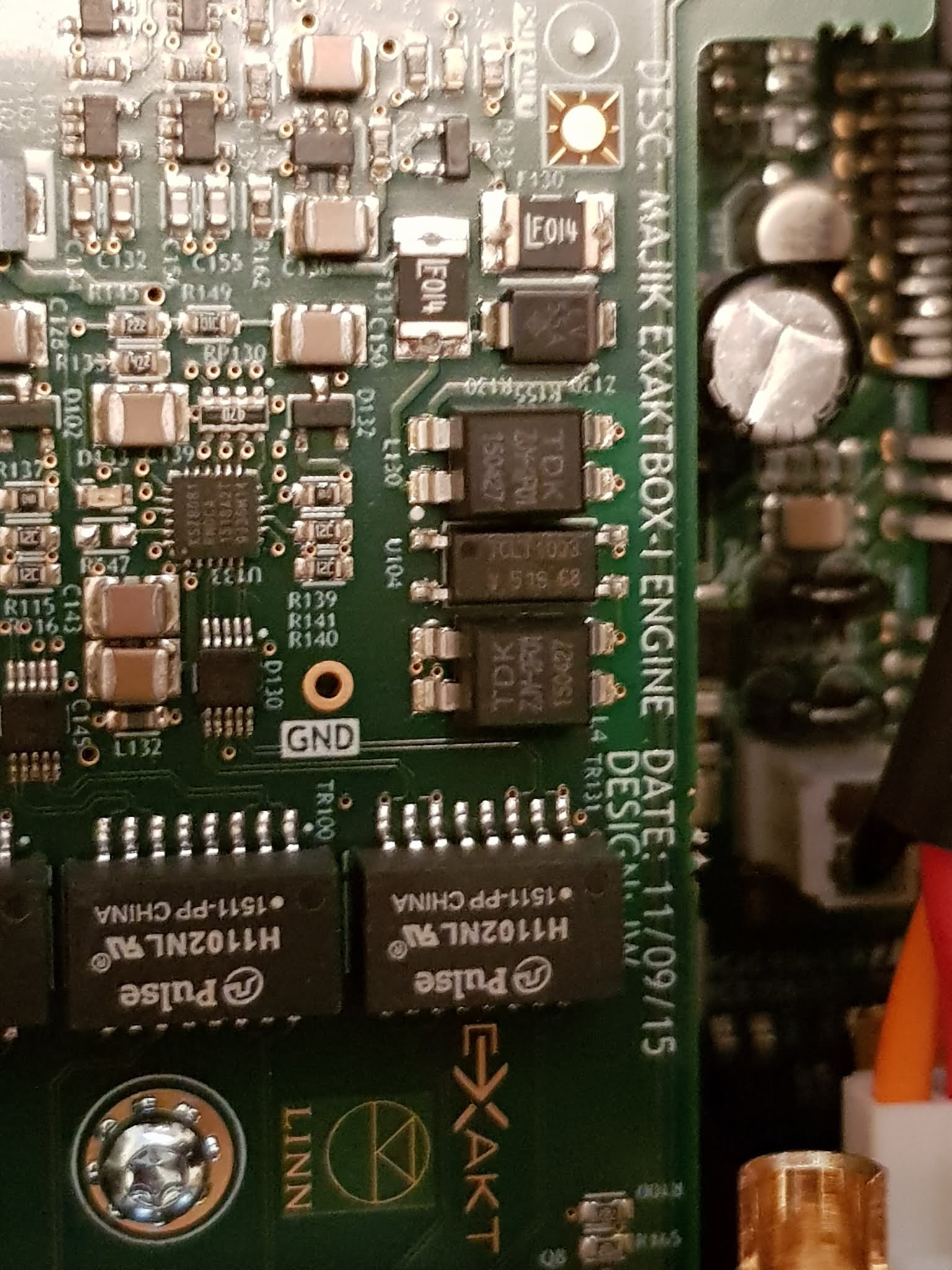
To the photos.  Note that every single audio board (DACs are combined with the power amps) and the Exakt processing board are changed in the upgrade - the photos with the green circuit boards are the Majik non-Kat version, the black circuit boards are the upgraded Kat version.  The PSU and the casework is untouched, save for the addition of a Katalyst sticker on the underside.


Externally the box is unchanged


BEFORE AND AFTER UPGRADE COMPARISON PHOTOS:

The most obvious difference from an overall perspective is the change from green to black and gold boards

Each side of the enclosure has 4 channels of power amps (the chips bonded to the heatsink are the obvious components) and 2x stereo DACs.  The DACs above are the cross-shaped cluster of an oblong chip surrounded by 8 smaller chips

Here you can see the difference in the DAC architecture - now we have the 2x stereo DACs which are the 2x flat square chips - the board layout is very different


The "flyover" board down one side of the enclosure is the Exakt processing board.  The above original layout has 3x FPGA processors - the large flat square chips. The one on the left is the "master" processor with the other 2 processing 4 channels each
On the new board there is one more powerful FPGA chip in the centre doing the work formerly done by 3x separate chips


Board labelling for channel 5 to 8 DAC / power amp board has been relocated


Relocated labelling for the Exakt board


The increased complexity and density of the components surrounding the DACs is clear in this comparison.  The Katalyst DAC has multiple different regulated power supplies which probably explains this increase in components


SOME KATALYST ONLY PHOTOS:


Xlinx FPGA that does all the Exakt processing


DACs and power amps for channels 1 to 4 live in the shadow of the Exakt board


Friday, 15 March 2019

My Tunes at brianandtrevors 14 March 2019

The House of Linn, aka brianandtrevors, is a hifi dealer in Manchester.  The ex-Linn team started out as House of Linn then expanded into a parallel business that stocks non-Linn gear.  I've spent a few evenings there for demos and we've done some business together, on the Linn side of the house.  Its a fine old high ceiling end terrace with 3 dem rooms, a workshop and, perhaps most importantly, a kitchen for brewing tea and dispensing wine.

Most of the evening events have focussed on a product launch, or a manufacturer visit. Quite a few times B&T have mentioned having relaxed music only evenings and finally, they've kicked off a new series dubbed "My Tunes".  The idea is for a customer or other visitor to play some tunes, chat a little about them whilst enjoying the afforementioned tea or wine.  And that was the brief I was given when invited to be the "selector" for the first of these evenings.  Play a few tunes and tell the group a bit about why they were chosen.

I only had one request, that I could choose the system we'd use, and fortunately B&T are now Kudos dealers so it was straightforward to ask for something interesting, but more of that later, there was some planning to do.  What to play?  I do have a collated album of around 450 "favourite" tracks saved on the Melco NAS so I headed there and started to think about what to play and what to say.  It takes a bit of time to whittle it down, try and think of a good variety and then think back to why the track was in the main list, how it came into my life, and how to frame the story.

Eventually there were few enough tracks to put into 2 slots of about 50 minutes each, to allow for a break part way through (to recharge glasses of course!).  The first track was easy - play the first record I bought for myself - and then I remembered that there is a little box of singles in the house, so a quick check and there it was - the original copy of Solid Gold, Easy Action by T-Rex.  Glam rock!  I think it cost me about 35 pence, probably quite a few weeks of pocket money back in 1972.  It then occured to me that it might be worth not only talking about the music, but my hifi journey too, given the location.  So I tried to mix the two things along the way - a bit about the music, a bit about the hifi.

A good size audience of 15 joined the evening.  B&T introduced the idea and myself and that was it, get on with it!  Something I really appreciated, and hoped the audience did too, there was no mention at all of the kit in use, except to answer questions during the break. So no selling as such, a nice relaxed approach.  But we'll cover the system now, because it was something that I'd wanted to hear for a while and something I hoped would work really well.

We started the evening with that very old and pretty well worn T-Rex single, running on an almost full Klimax Linn LP12.  So a Radikal motor and PSU, Ekos SE, Keel, Urika II phono stage, Kandid cartridge and the one deviation from Klimax - B&T's own bamboo based booplinth plinth.  Brave of them to let the Kandid track this old single.  It sounded a bit thin, but remarkably free of pops and crackles, but clearly showing signs of stylus damage.  For the rest of the evening we played the tracks from the Innuos Zenith through a Chord Music ethernet cable into a Linn Klimax DSM - but using the Exakt outputs tonight.  The Exakt signal travelled down a Cat 7 ethernet cable to a Klimax Exaktbox/1 (that's the Katalyst version).  This was on a small rack near the speakers which also accommodated three Linn Klimax Twin power amps, each driving one of the 3 drivers in each Kudos Titan T-808 speaker, via Chord Music speaker cables.  So that was the system I'd asked for, but B&T threw in a couple of Exakbox sub boxes and a pair of REL No 25 subs at the back of the room.  All the electronics were supported by Quadraspire racks.

Click on the images for larger versions:


Kudo Titan 808 speaker along with a stack of Linn Klimax ingots - one Exaktbox, 3 Twin power amps, and a couple of boxes not in use tonight


From the top: Linn LP12 turntable in a booplinth, Linn Klimax DSM streamer / pre-amp, Innuos Zenith NAS, Linn Radikal power supply for the LP12 all on a Quadraspire X-Ref rack

Chord Music Cables
View across the largest of the dem rooms


Before the guests arrive we chewed the fat on the latest in hifi stuff and more, then had a listen to the system - just spending a little time tweaking the volume of the subs down a little to get the best balance.  SPACE is in play on the system and, as is often the case now, with the latest software versions, the default setting in a Exakt system is pretty much spot on.  And the system was sounding fantastic, pleased to say that its probably the best system I've heard in the house.  Full of detail, speed, tuneful bass lines, crisp, clear, beautifully resolved and emotional vocals and slam like I've never heard in the house before.  Fantastic.  I also spent a bit of time listening to a pair of Titan 505s in the smaller upstairs dem room, being driven by Linn Akurate Exakt electronics.  That was a good listen too - the Titan range seems to be a good design.

Below is the list of tracks I went with.  I have to say, I'm not sure its the right list, or the best list, or whatever, but its the one I came up with for the evening.  I did put some time into it but I didn't over think it or spend time putting tracks in and out of the list. Maybe I'll get invited back in a few years time and I can go with a completely different list.  So in there there are some older tracks, some new stuff, electronic music, jazz, americana, folk, covers, punk and rock/pop.

You can click on the image for a larger version:


I was hoping to put together something that some people would know (Teenage Kicks, of course), some tracks known but in new versions (Ever Fallen In Love, Don't Go Breaking My Heart) and something that would be new to most if not all (Pitch Black, perhaps Fink).  During the break it would seem that the balance was OK for most, but I've no doubt there were some genres missing or perhaps too much of one genre for others.

The audience were very attentive, there was some banter during the introductions, hopefully the little stories were interesting, but mainly, I hope that the music was of interest and enjoyable.  Certainly that system did it all justice.  If nothing else, I enjoyed the evening!

I'm looking forward to the next time B&T organise a session - it'll be interesting to be in the audience and hear someone else's selections and stories.

Thanks to B&T for the invitation to "select".


B&T have made the most of this post for their newsletter  :)

Wednesday, 14 December 2016

Klimbing The Produkt Ladder at Linn

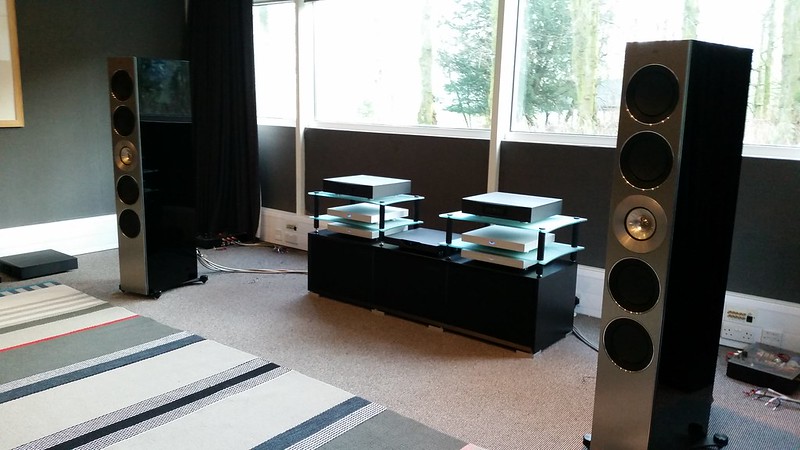
December 2016 - and its 12 degrees C in Waterfoot, the location of the Linn factory near Glasgow - the locals are confused by the soaring Summer temperature.  Its also grey and damp outside, but dry and lifestylie in the Linn Home demonstration suite. Alloy ingots and folded aluminium boxes are arranged on shelving, but there's too many to fit so they're decorating the floor too.  We're faced (literally) with a pair of rather imposing and "high tech" looking KEF Reference 5 loudspeakers - the competition are in the house. This is probably the best place to hear the Linn hierarchy above Majik - the factory being able to supply such goodies as 8 Solo power amplifiers, several different streamers and speakers that allow conversion from passive to active in less than a minute.

So we'll come to that lot a bit later. This year, Linn didn't have a "factory event" arranged for the autumn / early Winter like they sometimes do - even though they've just launched Katalyst on the public - a major DAC architecture upgrade for the Klimax DS and DSM streamers. So a group of forum members built a demo wishlist and asked Linn very politely if we could come and have a listen. Which was the loose basis upon which an "annual event" was created for those invited along. In other words, a bunch of mates getting together to catch up, drink beer and listen to stuff they aspire to owning.

Whilst most of the group were local (meaning UK), we did have a forum member from Canada joining us on his personal crusade across Europe, so there was an international flavour to the group (being Scottish, English, Irish and Canadian). The night before was a curry followed by beer and lots of natter about what we might hear, what people have done to their music listening gear recently, what they might do next, a bit of politics around the forum etc. etc. In other words, geeky, alcohol fuelled natter. Our Canadian friend's recent tour of Linn systems in Europe was a constant thread returned to throughout the evening and how Linn can make their SPACE Optimisation tool easier for customers to get the best from - when done well it takes a Linn system several levels of performance higher, but sadly it is not often done well.

Visitors' Book

After reasonable restraint in the pub the night before, we gathered at the factory ready for a 10:00 start - with everyone looking healthy enough to handle reasonably loud music. And here its worth mentioning Linn's choice of speaker for this event - the KEF Reference 5 floorstanders.  A decent bit of kit, but not exactly big on bass, or at least not on this experience. Perhaps Linn had heard about the pub the night before and had selected these speakers in deference to delicate heads, or they'd deliberately set up SPACE to take bass energy out. But no, apparently not.  As usual the welcome at Linn was warm, friendly and informal. Craig of marketing was looking after us, clearly now somewhat more confident meeting a bunch of forum diehards compared to last year, having got over a year of experience in the meantime. Teas / coffees and then off into one of the dem rooms (for those who know the place, the one on the right at the back of Linn Home).

A vast array of kit was laid out in the room, some on the equipment rack (extended by an extra 4 shelves for today) and some on the floor waiting its turn to perform.  We had suggested some ideas on demos in advance and Linn had set up all of them for us, except the cheeky requests to hear products yet to be announced. Of course. A printed list of demos and list prices of each demo were made available to us. Probably not good to look at the list prices on the second page! We were hosted by a couple of senior guys from R&D - Ian who looks after circuit design and layout and Phil who takes the lead on speaker design. So why no Linn speakers? It was explained that there are only 2 pairs of speakers in the factory with externalised passive crossovers - something that helps with speedy system configuration changes. As all of us in the room are already at Akurate or Klimax level in the Linn hierarchy, Ian and Phil had decided that one of those pairs of speakers - Majik 140s - probably wasn't going to give us the insight into the upgrades we were hoping for, and the other pair - the KEFs - would be more appropriate in terms of price and performance. I guess there's also benefit in reminding the audience that Exakt filters are available for non-Linn speakers, in addition to those from Linn. Anyway, the KEFs did an admirable job during the morning to give a clear insight on the upgrades in the electronics. The KEF's passive crossovers have been removed from the cabinets and are housed in Akurate size cases with perspex tops.  Consistency of speaker throughout the demo was appreciated by the group.

Dem Room


DEMO 1:

Klimax DSM/1 (KDSM/1)  which has a pre-Katalyst DAC and was, up until 6 weeks ago, Linn's top performing streamer/pre-amp against Klimax DSM/2 (KDSM/2) which is the newest version and includes the Katalyst DAC architecture. The Katalyst is a new DAC from a different manufacturer which allows for multiple separate power supplies to different functional parts of the DAC (e.g. clock, digital circuits, analogue circuits etc.). In addition to this, Linn altered some of the other areas of the circuit board layout whilst they had the opportunity to improve these too.  The rest of the system was a Klimax Twin/Dynamik power amp and the KEFs in passive configuration. Interconnects throughout the day were Linn silvers, speaker cables the recently released K200. Ethernet cables and Exaktlink cables were not declared - but Linn likes to use pretty standard stuff here.

First a couple of tracks were played on the KDSM/1 and sounded very enjoyable, until we then heard them on the Katalyst equipped KDSM/2. Which is a very significant step forward. The music seems more joined up in terms of timing - instruments, voices etc., seeming better aligned. There's more texture and believability in vocals - they're more expressive. At first it seems a little bass light, but really its just a tightening up of control, perhaps the removal of some harmonics that shouldn't be there. In more hifi related terms there's more detail in the treble and imaging is sharper, but still not up there with the kind of imaging provided by an Exakt system. Going back to the KDSM/1 (which is still a very fine player) is like going from a full fat FLAC file down to a 192 MP3 - the difference is quite stark. A great achievement.

DEMO 2:

So is this new Klimax Katalyst equipped DSM with Klimax amplification better than an Akurate level Exakt system? This, for me, was probably one of the more significant demos of the day, and one that we'd eagerly anticipated and discussed at length in the pub the night before (and, strangely enough, the evening after).
The comparison was between the KDSM/2 (i.e. Katalyst equipped) with Klimax Twin versus Akurate Exakt DSM (AEDSM) with Akurate Exaktbox 10 DAC/Processor (AEBOX10) and 2x Akurate 4200/1 power amps. So a step down in hierarchy in Linn terms and a significantly lower overall cost of the electronics feeding the KEFs.

And this was quite some contrast. I felt that the presentation of the 2 systems was very different. But let's get one thing out of the way first - both of these options are very musical indeed, with, for me, little to differentiate them in musicality - ie the ability to play the tune and carry the emotion. However, in almost every other way, the Exakt system was better. Better separation of instruments and therefore clarity of the contribution from each, vastly better imaging, tighter more controlled bass lines and therefore ability to follow these lines and real coherence in the timing. The one area where I felt the Katalyst might just edge ahead was the expressiveness and "reality" of the vocals. But an easy choice - the cheaper Exakt system would be my choice without hesitation. For those who like vinyl, I can see the Katalyst passive might be very attractive - relative to Exakt it has that less precise, more smoothed together kind of sound.

Its interesting that, for me, the magnitude of the end to end system errors corrected by Exakt are more fundamental than the DAC architecture itsself. Given the step change going from Klimax DSM to Klimax DSM with Katalyst, I really didn't expect the non-Katalyst DACs in the Exaktboxes to give a better result. But they do, and its significant.

Katalyst is on the way for Exakt - first at Klimax level - and I suspect that is going to be astonishing. The Klimax Tunebox circuitry has been squeezed into the box and is going through final revisions just now. Katalyst for Akurate level is at the design stage and will be available in 6 and 10 channel versions.  One of the benefits of the upgrade to Katalyst in the Klimax range is that the Exakt engine will be more powerful than the current version and will allow the running of dual-mono Exakt filters inside the 6 channel Klimax Exaktbox - great news indeed for those with only 3 drivers per speaker as it will be possible to get Linn's best performance from one KEBOX rather than needing 2. So the impossible for many could become aspirational for some.

DEMO 3:

Akurate Exakt DSM with Akurate Exaktbox 10 into Akurate 4200/1 amps and the KEFs versus exactly the same system but with the Exaktbox 10 swapped for 2x Akurate Exaktbox 6s.  What's the difference? Well not a lot - except to say that the Exaktbox 6 has a better optimised circuit layout on the boards (which also allows a slightly different approach to the power supplies to the DACs). But the same circuit topographies.

I think all would agree that this was a bigger upgrade than we were expecting. It is more significant that you'd think was reasonable or even logical.  I don't think there were only one or two parameters that improved - rather there was an all-round improvement in everything be that musicality or any of the more hifi-like terms you care to mention. A nice one this, and worth having, particularly if you have speakers that have better dual-mono Exakt filters than the stereo filters.

DEMO 4:

Replacing the 2x Akurate 4200/1 amplifiers with 8x Klimax Solo/Dynamiks.

Gulp.  The single biggest price jump of today's demos - 60,000 gbp.  Was it the single biggest difference?  Probably not. That was either from non-Katalyst DSM to Katalyst DSM, or possibly from Akurate Exaktbox to Klimax Exaktbox (see below). But what do the Solos bring?  Well, this is always one I feel is difficult to describe. What does the Solo do?  Well there's this whole kind of feeling of effortlessness to the sound.  The amps just flow the music through and make it louder.  Sure, there's more detail, more slam / control in the bass and better image stability. But its the way it does what it does rather than the what. And that's hard to describe - perhaps its the difference between a piece of tech that sounds like its responding to the incoming signal, and one that works with that signal? More fluid, more organic, more believable.  Very nice indeed.

DEMO 5:

Replacing the 2x Akurate Exaktbox 6s replaced by their (not yet Katalyst) Klimax equivalents. The rest of the system remaining as AEDSM streamer/pre-amp, 8x Solo amps and the KEFs.

Unlike the move from Klimax to Klimax with Katalyst in the DSMs - which made the former sound rather less than satisfactory - upgrading an Exaktbox from Akurate to Klimax level (and back again), didn't give that same type of difference. Rather the Klimax is a refinement and improvement on what the Akurate box was doing - its just all-round better on detail / resolution, separation of instruments and emotional content of the vocals. It will be interesting to hear the Klimax Exaktbox when it gets the Katalyst upgrade in the Spring.

DEMO 6:

As above, but the AEDSM was replaced by a Klimax Exakt DSM (KEDSM).

A small difference in the sound here - a touch more detail, a little more space between instruments.  Really, this is just a very thin layer of icing on the cake and only really something to do if the aesthetics of the kit is important, or if you've done everything else possible in terms of the rest of the Exakt / amplification equipment. Nice but not necessary and really emphasises how good the AEDSM is in terms of price / performance.  Just one caveat on that - if you're heavily into playing vinyl then the KEDSM has a better ADC stage which would possibly be important to you, and justify the extra cost.  We didn't have the ADC comparison in the demos today.

DEMO 7:

Is a Klimax DS/2 a better source for an Exakt system than an AEDSM?

So these sources were swapped back and forth - and rather like the AEDSM vs KEDSM comparison above - not much in it - perhaps the KDS/2 edged it a little, but this is really about where are you starting from in terms of your current kit - if you have a KDS/2 and don't need the inputs of a DSM, then it works very well.  However, if you need inputs and want to go Exakt, then moving from KDS/2 to AEDSM is not really an issue.

DEMO 8:

Klimax DS/3 (ie Katalyst equipped) vs KEDSM as an Exakt source - here there's an even smaller difference and really not much to discuss.  Either is good, but it would be strange to choose KDS/3 and then shortly afterwards move to Exakt.

DEMO 9:

Akurate Exaktbox 10 vs 2x Klimax Exaktboxes.

See DEMO 5 above - exactly this, but slightly more so.

So overall, what did we learn?

- Katalyst is a fantastic step forward
- Katalyst in Exakt is likely to be something extraordinary
- Katalyst in Akurate (and the Exaktbox) is very much anticipated
- For me, the sweet spot in terms of price vs performance is currently with AEDSM and 2x Akurate Exaktbox 6 and 4200/1 amplifiers (possibly with Twins rather than 4200/1, but we didn't hear that exact combination)

With many thanks to Ian and Philbo who put so much effort into putting these demos together and running through them all - there are very few (if any) other places we could've had such a comprehensive set of demos - the team built exactly what was asked for by the attendees. All these changes went extremely smoothly with no gitches with any of the kit and that helps to demonstrate that this streaming, networking and Exakt stuff is now very mature indeed.

Wednesday, 2 September 2015

Digital vs Analogue? But Not Streaming vs Vinyl.

Its already been raised in a couple of posts.

Linn have discontinued their analogue pre-amps.  So its digital volume controls all the way now, with the streamers and pre-amps being combined into the DSM streamer/pre-amp products.

Linn announcement covered here

Initial thoughts on a first listen to a digital volume control (DVC) are here

So how is this relevant to the main system at Audiophile Musings?  Well, it has the following streamer and pre-amp:

Klimax DS/1 (KDS/1) streamer
Klimax Kontrol/1/D (KK/1/D) analogue pre-amp

So Linn are now, effectively, advising customers that combining these 2 products into one Klimax product and using a DVC is an improvement on separates.  They still sell a separate streamer - the Klimax DS/2 (KDS/2) which features a new circuit board layout and an improved clocking system. Said to sound better than the KDS/1, of course.  The alternative, and what Linn seem to be recommending is the combined streamer and pre-amp in one box, the Klimax DSM/1 (KDSM/1) which features a DVC.  Of course, the older, KK1/D separate pre-amp features an analogue volume control.

The analogue vs DVC debate is lengthy on the Linn forum and there's the usual conjecture, assumptions and actual experiences recorded there.  Some are vehemently against, some are accepting, many are still on the fence, probably not having listened yet.  Linn themselves have produced technical information proving that the DVC introduces less distortion into a system, and is therefore, according to them, a good thing.

Why is this currently relevant?  Well, as the KDS/1 has been superceded by the (supposedly) improved KDS/2 streamer, then there's an option to consider upgrading the KDS/1 in the main system.  In typical Linn style, its possible to upgrade an existing KDS/1 to KDS/2 internals.  But it's also possible to upgrade the KDS/1 to the combined streamer and pre-amp, the KDSM/1.  So upgrade to KDS/2 or to KDSM/1 and sell the KK/1/D pre-amp? Or neither and stay as-is, or stay as-is to try and work out what Linn will do next - the myriad changes in the last 18 months or so is probably de-stabilising customers' system development plans, to say the least.  These upgrade options also come with Linn's proprietary Exakt digital outputs which allow the use of Exakt digital crossovers or Exakt enabled Linn active speakers in addition to traditional analogue output. This decision combines the following:

- commit to DVC (or not)
- upgrade the DS (or not)
- upgrade the DS to a DSM (or not)
- open up the option for Exakt at some point in the future (or not, but upgrading doesn't mean this has to be the future)
- are any of the upgrades good value (in the context of a Linn Klimax system)
- consider how any of this works with or without the KK/1/D pre-amp and the multi-channel cinema processor (or not, possibly leading to lots of other considerations / expenditure)

As you can probably see, lots of options for Linn's existing customers (although, as a new customer, things are very much simplified now), and, consequently, lots of confusion.  Change to new Linn? Move to a different manufacturer? Do nothing? Wait and see - for how long?

So, down to the dealer to have a listen, as that's the only way to resolve a few of these questions.  But with the demise of the analogue pre-amps, even that's not so easy now.  In order to listen to the KDS/1 against KDS/2 through a KK/1 pre-amp, its necessary to take along both the DS and the KK. But this does at least allow comparison of the 2 separate products compared to the combined KDSM/1.  A time was sorted out and about 2.5 hours was spent working through the options and making a decision.

At House of Linn, we used a Majik power amp into passive Majik 140s in the upstairs front room - so similar to my own system, but not identical as there weren't enough Majik power amps on hand to run the M140s in active mode.  The shop's pair of Solo power amps were out on demo, so they weren't an option either.  Linn Silver interconnects and one half of K400 speaker cables were used.  All the source and pre-amp components were placed on the top shelf of a Quadraspire Sukono Vent rack with a bamboo top shelf supported by their latest bronze spikes. Control was through Linn Kinsky on iPad and we used volume levels in the 60-65 range. We listened to the following combinations:

KDS/1 and KK/1/D
KDS/2 and KK/1/D
KDSM/1

These were swapped in and out of the system to enable A to B comparisons.  The KDSM/1 was used with the HDMI ports switched off and the KDS streamers with their internal volume controls disabled.  SPACE was disabled and the speakers had been positioned in the room using Tune-Dem by Brian and Trevor of HoL.  We used tracks familiar to me such as Nils Lofgren Live, Malia & Boris Blank, Blues Company, Peter Alderton, Yello and FAC15.  May be a few others over the 2.5 or so hours.

Top Shelf: Left to Right - Shop KDS/2, my KK/1/D and my KDS/1
Second shelf: Majik Power Amp
Rack: Quadraspire Sukono Vent with Bamboo Top Shelf and Bronze Spikes
KSDM/1 not shown in this picture
So first up was the most straightforward option - KDS/1 versus the newly released KDS/2, both playing through the KK/1/D and therefore using analogue volume control. Given that the KDS/1 is the most musical digital source I've heard to date, its surprising to find that Linn have, again, managed to deliver another notable upgrade.  The new clocking and circuit layout has been a spin-off from work done on the Exakt versions of these products, and the changes are more significant in the sound than I was really expecting.  I was thinking (maybe hoping?) that the improvements would be negligible and I could use the cash elsewhere, but no, this is another step forward.  Listen to the KDS/1 and you would think there was no noise floor, no hash in the music, until you hear the same track through the KDS/2 which sounds cleaner - its hard to describe, but there's more definition in the instruments and vocals, there is less "background" for want of a better phrase.  Imaging is more precise (again, I wasn't really aware of a lack of precision in the KDS/1, its still an excellent product) but the biggest change for me was the intonation and expressiveness of vocals.  There's just so much more texture to the way the singer is interpreting the words and providing the feel of the song.  Good stuff.  Is it worth the upgrade price?  No, its not.  However, when factoring in the ability to use the old KDS/1 electronics to create a new streamer (the DS Renew option) and then selling that onwards, then the upgrade becomes much more affordable and worth the extra (IMHO of course).

So, within about 30 minutes it was clear (after discussion around Renew values etc.) that the KDS/2 was something that interested me.  But how will that compare to the KDSM/1?  Will the combined streamer / pre-amp outperform the separates?  The KDS/1 was replaced on the top shelf of the rack with the KDSM/1 and we got started.  Some of the same tracks were used and we swapped between KDS/2 with KK/1/D and then to the KDSM/1 and back.  And here's the thing - its pretty easy to hear the difference between these 2 options, but which you will prefer, I think, will come down to individual choice.  In terms of detail retrieval, then the KDSM/1 is a marginal improvement on the separate boxes.  There's definitely more fine details resolved and there's a little more in terms of the acoustic space of the venue (on live recordings).  So that's it then, choice made?

No, its not that simple.  If I were a new buyer and only heard the KDSM/1, there's every chance that I would enjoy it and want to buy.  It plays tunes, it sounds good.  There are a couple of things I didn't like though - one is a very slight sharp edge to the lead of the notes and vocals - it doesn't sound like distortion, it's just a bit too abrupt.  But more importantly, there's less coherence and flow to the music.  The KDSM/1 plays a tune, but the separates play a more coherent and flowing tune - its easier to follow, to remember and enjoy.  Is the KK/1/D rounding the edges a bit?  Is it softening the spikes to make the music more "comfortable"?  Quite probably.  But when the music needs to shock or excite or thrill, its all there with the KK/1/D - this isn't about slowing the music or softening the impact, its about music sounding like music rather than a hifi.  The KDSM/1 is more hifi, the separates more musical.

So, is the KDSM/1 no good?  Not at all, its very good, and would be fine, and an improvement on the KDS/1, if I hadn't heard the KDS/2 and KK/1/D combination.  Which is superb and sounds like something I can listen to for hours.

KDS/1 is now back at Linn HQ, and a KDS/2 with a Renewed KDS/1 should be back in a couple of weeks.  Really looking forward to the KDS/2 in the system :-)


Saturday, 7 December 2013

Renewed Listening Experience

Long suffering Audiophile Musings readers might remember this post when I went for a listen to another forum member's system in the South East of England:

Akurately Kontrolled Klimax

Have a quick read through to refresh yourself of the system and my thoughts from that first visit.  One of the best non-Exakt 350 systems I've heard (when the subwoofer was off), but still having that 350 bass that I don't get on with 100%.  Since then, Andrew (system owner) has been to my home to listen to my somewhat more modest system and we keep in touch regularly through the forum.

Disclaimer:  all my opinion, no double-blind testing, just some A-B-A comparisons which the reader may find informative
KRDS = Linn Klimax Renew DS - a Klimax DS/0 in a lower cost box
KDSM = Linn Klimax DS/1 with a built-in pre-amp

Contants in the system tonight:
Linn Klimax Chakra Twin (non-Dynamik) power amp
Linn K400 speaker cables
Linn Klimax 350 passive speakers

Stuff we messed about with:
Klimax Renew DS vs KDSM
With and without an Akurate Kontrol/0/D pre-amp
Without the pre-amp: unbalanced versus balanced interconnects

So I was down South again recently and got in touch with Andrew to see if he was around to listen to some choones.  Despite the short notice, everything was sorted and planned very quickly, but with knobs on!  Andrew arranged for Peter (forum member peter@57m) to meet up with us to make an evening of it.  And Peter was planning to bring his KDSM along to the party which made it that bit more interesting.  I headed out of Town late afternoon and Andrew kindly picked me up at the station.  We didn't go straight to the 350s, but diverted around to the home of another of Andrew's friends for a quick (very loud) blast on his home cinema system.  This is based around some B&O dalek speakers which can pump out some volume.  They're hidden away behind a massive screen which also doubles as a golf game screen - a real man cave!  I think this system is good for the whizz bang of movies and concerts, but it didn't feel musically engaging to me.  Great fun, but not threatening Andrew's system for and engaging listen.

We then had a tour around the rest of the house.  Underground garage and workshop with cars and motorbikes, a swimming pool, snooker room and the piece de resistance - the wine cellar.  The content of this room was beyond my limited knowledge, but its impressively laid out, including a little bar and all the wine is labelled by year of production and the range of years in which they should be drunk.  Of course, we had to sample some too...

Unfortunately, Andrew's friend was too busy to join us for the rest of the evening so we moved on all too soon, but onward to the main course.  Thanks to Andrew's friend - a very friendly guy who is much more down to earth than his house!

Soon we're facing the 340 centre speaker again and comfortably settled in to the listening room.  We start with a few tracks on the Klimax Renew and switch the sub woofer on and off a couple of times to decide which way to have the system configured.  Andrew loves his bass, Peter and I preferred the system without the sub - from where I was sitting there was less bass without the sub, yet strangely it went deeper.  And I'd worn jeans this time to try and avoid trouser flapping!  The sub stayed off for the rest of the evening.  A couple of minor changes to the system since I was last there - K20 has been replaced by K400 speaker cable and some kind of Russ Andrews filter mains cable now feeds the Renew DS.

We listened to some Blues Company, Seal, and some other stuff that slips my mind (maybe Andrew or Peter will be along soon to help me out here).  Then we picked a track and listened to the first 90 seconds or so 3 times.  Then Peter got to work behind the Hutter rack with the KDSM and cables.  Konfig was spun up and the volume control disabled on the KDSM as we kept the Akurate Kontrol/0/D in the system and used unbalanced silver interconnects from both streamers.  Then we went back to the track we'd listened to three times.  It took about 3 or 4 bars for us to be convinced.  We all looked at each other with a look of surprise.  This wasn't slightly better, it was significantly better.  Using the usual hifi terms then the separation between instruments was massively better and the noise floor had fallen again, enough to hear instruments you didn't notice with the Renew.  The acoustic of the recording venue (or maybe the effect of the acoustic of the recording venue added in production) opened out - for example on the Seal track it sounded like he'd moved from a living room into a concert hall. Going back revealed the closing in of the sound stage and now we could hear those instruments we hadn't heard before, but they're in the distance and they're muffled in comparison with the KDSM.  Vocals loose some richness and texture, the bass is that bit less tuneful and more difficult to follow.

We swap back, using a different track for before and after.  We're all agreed - the difference is quite distinct and much bigger than I think all of us were expecting.  Also interesting is that the Akurate Kontrol/0/D pre-amp was clearly capable of revealing these differences which is good for those of us who like to have a Linn processor for our movies.  But how much is it hiding?

Peter leaps into action again, Konfig is booted up and the volume control is enabled again on the KDSM.  The KDSM is then connected directly to the Klimax Twin power amp using balanced silver interconnects and no pre-amp.  Yet another layer of detail is revealed, along with yet further differentiation between the instruments.  However, a touch of harshness has come into the system - perhaps a hint of graininess.  I almost feel like it there is a little more "hifi" to the sound rather than just the music.  We go back to the unbalanced cables into the Akurate Kontrol with the KDSM volume control disabled.  Sure enough, the sound is a little less distinct and there's a much warmer feel to the sound - the graininess disappears.  Its one of those changes that really is more about personal taste rather than one being distinctly better or worse.  Hmmm, interesting.

Poor old Peter was again pressed into cable swapping duty (to be honest, I'm usually the one doing all this stuff so it was good to kick back and let someone else take the strain).  What now?  Well, how about taking the pre-amp out of the system again, re-enabling the KDSM volume control and using unbalanced silvers into the power amp?  So that's what we did.  Interestingly this was, for me, the best sounding the system had been all evening - this configuration sat neatly between the system with the pre-amp (warmer, friendlier, no harshness, no grain) and the system with the KDSM connected directly to the power amp using balanced cables (more detail, more separation, some grain /  harshness).  So we get more detail and separation (but not quite as much as with the balanced connection) but some of the warmer, less challenging sound of the system with the pre-amp.

So what did we learn (and, it must be said, very much agreed upon):
KDSM is significantly ahead of the KRDS - a much bigger difference than I think any of us were expecting
The Akurate Kontrol/0/D is a decent pre-amp, it clearly shows the difference between the DS products
The Akurate Kontrol/0/D is not transparent - it adds a warmth and a little haziness to the sound
The KDSM without a pre-amp is a mixed blessing - choose your method of connection to the power amp with care

We briefly listened to the KDSM with the HDMI switched on and with it switched off.  At this point, I was sitting to one side of the room so I found it difficult to hear a major difference.  Peter was finding it easy to hear and preferred the sound with HDMI switched off, as it had been through the earlier listening comparisons.

So a very revealing and entertaining evening (I know, some will find this a bit sad!) with excellent hospitality from Andrew (and his friend earlier in the evening), and generous support from Peter - great of him to bring over his KDSM, doing all the cable work and dropping me back at the station.

p.s. received a note from Peter the following day - his Klimax Twin Dynamik and Wilson Benesch standmounts and a sub is a very different system to Andrew's set up.  He doesn't use a pre-amp and had spent a little while the following day re-checking balanced vs unbalanced cables in his own system.  This allowed him to confirm that he still prefers the balanced cables in his own system.  The previous evening must've created some doubt in his mind, so good to hear that he's confirmed his original choice as working well in that system.


Wednesday, 6 November 2013

First UK Dealer Exakt Demo

See below about the date and location of the first dealer Exakt demo evening:

http://audiophilemusings.blogspot.co.uk/2013/10/house-of-linn-demo-of-exakt-will-there.html

And here's the report on activities.  How exact is Exakt?  I deliberately didn't comment on the sound of Exakt heard at the 40th Anniversary event at the factory as the conditions just weren't suitable to make a sensible evaluation.  Tonight's event wasn't perfect as most of us won't be listening to a system with 18 other people, but it was much more realistic than the factory event, and later in the evening when the room emptied out, even better conditions were experienced.

As usual, Brian and Trevor were excellent hosts - drinks (including an excellent Malbec from Morissons, a bottle was seen in the hands of one Managing Director on his way out at the end of the evening...) and snacks made available and a relaxed atmosphere as the gathering built momentum from about 19:45 onwards.  For those who don't know House of Linn, it is just that - a very large substantially built end terrace house.  So the rooms are much more "domestic" than most dealers, including the kitchen / diner at the back of the house where we gathered - in the case of HoL the party starts in the kitchen, but usually ends with ears glued to the music in the large listening room at the ground floor front of the house.

Gilad Tiefenbrun, Susan and Andy represented Linn this time around and they were running the first dealer version of the Exakt demo for the UK, being an evolution of some demos done during the 40th Anniversary weekend at the factory.

Gilad kicked off the evening with about 18 customers in attendance (many happily making the best of the Malbec) explaining the basics of the Exakt technology (see here: http://audiophilemusings.blogspot.co.uk/2013/09/more-exakt-info.html  and here: http://audiophilemusings.blogspot.co.uk/2013/09/exakt-photos.html  for the salient points) and introducing some nicely produced animated videos to help with the explanation.  If anyone was still confused about what the technology is, the Q&A session didn't reveal any fundamental mis-understandings.

Andy from Linn (standing) and Gilad Tiefenbrun (sitting) and Some Abstract Art (hanging). Note the Dark Wood  Non-Exakt 350a Speakers in Place At This Point
 
Disclaimer:  I'm not the biggest fan of Linn's 350 speakers.  So please bear that in mind here - I prefer the Akubariks and Komris.  Having heard 350s in a number of different system configs and locations, I've never really got on with them.  However, its also worth saying that they sound much better at HoL than the did in the Linn Home dem rooms at the factory...  I mention this as I won't be able to say that what I heard was the best system I've ever heard (which I would expect Linn to be hoping customers to be saying), as there are compromises with these speakers that don't suit me, whereas the compromises in the Akubariks (for example) are easier for me to put to one side given how well they do pretty much everything else - particularly their ability to be difficult to listen to as a hifi component, because there's just so much music to listen to.  Anyway, I digress - so back to the 350 speakers used tonight - I'll not describe what I heard in absolute terms (other than setting a baseline from the non-Exakt system), but just in terms of the way they changed as the demos progressed.  Hope that makes some sense - trying to evaluate the effect of Exakt, rather than the basics of the system.   As usual, these notes are only my opinion and thoughts, based on the experience of the evening - its not definitive!

With the system feeding from PS Audio power re-generation products all evening, Andy then stepped us through the demo process as follows:

Starting System: KDSM, maxed out Klimax LP12, 350a in "tune-dem" determined position
2 x 30-45 seconds of track 1 - 24 bit FLAC
2 x 30-45 seconds of track 2 - vinyl

Audiophile Musings thoughts: the usual sound here - very tuneful, bags of detail in the treble and mid, sparkling smooth top end, something not quite right about imaging and the integration of the upper mid and lower mid drivers (exhibited, for me, as the vocals being clear, but strangely recessed in the mix, but moving forward and back in the mix, depending on the singer and even which part of the tune is being sung) and deep, powerful, but somewhat (struggling for the right phrase here) less than detailed bass.  I know this is not the KDSM electronics as it sounds great with other speakers in the Linn range.  So a very good sound, but not the ultimate sound, for me at least - but remember this is in context of a very expensive system - I suppose I just expect a bit more at this level of spend, but in terms of the complete hifi spectrum, this is still a very good sounding system.


Changed system to: KEDSM, maxed out Klimax LP12, Exakt 350 in the same location as the 350a - room optimization settings off, speaker position optimzation settings off
2 x 30-45 seconds of track 1 - 24 bit FLAC
2 x 30-45 seconds of track 2 - vinyl

Discussion on the differences
Audiophile Musings thoughts:  The tune is just as easy, if not easier to follow.  Timing of the bass lines improves dramatically, snapping into line with the rest of the music.  Instruments much more separated, much more stability in the vocals in terms of front to back in the mix and in terms of left to right image stability.  350s much easier to listen to.  Generally the room agrees it can here a significant difference but not all are fully convinced that everything is unequivocally better.  There is no disagreement about the effects being just as dramatic on vinyl as it is on the digital source.


Changed system back to KDSM, maxed out Klimax LP12, 350a in "tune-dem" determined position
1 x 30-45 seconds of track 1 - 24 bit FLAC
1 x 30-45 seconds of track 2 - vinyl

Discussion on the differences
Audiophile Musings thoughts: Going backwards in the upgrade path for me is usually easier to hear than an upgrade.  And so it proves here.  In the upgrade, what I've described above as much greater separation of instruments, in the step back, is much more discernible muddling (remember, this is all relative and the system is still very good in absolute terms - I think the reference point has been moved by Exakt, up a couple of steps on the ladder).  The vocals are much easier to identify as changing position over the pitch range to the point where its now clear that they are wandering around quite distinctly.  That lack of detail in the bass is back too.


2 x 30-45 seconds of track 3 - 24 bit FLAC
2 x 30-45 seconds of track 4 - vinyl

Changed system back to: KEDSM, maxed out Klimax LP12, Exakt 350 in the same location as the 350a - room optimization settings off, speaker position optimization settings off

1 x 30-45 seconds of track 3 - 24 bit FLAC
1 x 30-45 seconds of track 4 - vinyl

Discussion on the differences
Audiophile Musings thoughts: unsuprisingly all the Exakt changes are back.

Changed system to: KEDSM, maxed out Klimax LP12, Exakt 350 in the same location as the 350a - with room optimization settings on (determined earlier in the day), speaker position optimization settings off

1 x 30-45 seconds of track 3 - 24 bit FLAC
1 x 30-45 seconds of track 4 - vinyl

Discussion on the differences
Audiophile Musings thoughts: Bass much more tuneful.  At first it sounded less extended, but this is often the effect heard when bass is brought under greater control.  This also freed up the mid-range somewhat to let vocals be rock solid in the image now, and to really breath freely and flow in a very natural and fluid way.  Given that this software works based on the physical measurements of the room, I found the effect more profound than expected.  Was it a complete success?  May be not - I thought the music lost a touch of liveliness or impact, so its a different set of compromises.  On balance on the evidence of the evening, I preferred the music with the optimisation on, but I think its something that would have to go through a more thorough comparison in your own home to be absolutely sure.

Changed system to: KEDSM, maxed out Klimax LP12, Exakt 350 moved back into either side of the large bay window - with room optimization settings on, speaker position optimization settings off

1 x 30-45 seconds of track 3 - 24 bit FLAC
1 x 30-45 seconds of track 4 - vinyl

Discussion on the differences
Audiophile Musings thoughts:  Disastrously bad positioning of the speakers in this room.  Image collapsed and the tune was dragging its feet through mud.  A clearer demonstration of the benefits of placing speakers in the correct place in a room as I've ever heard.  And its amazing how you can pick this out in the first 3 or 4 bars of a very simply constructed acoustic track such as Emily Barker.   The idea here is that the speaker placement optimisation software is supposed to allow for a more "domestically acceptable" positioning of speakers, but only when the ideal position is not tenable.  To configure the speaker optimisation software, first the dealer will identify the best place for the speakers in the room using "tune dem" and record the measurements (from back and side walls), then tell the software the domestically acceptable position in the room and the optimisation is then applied to the signal by the Exakt engine in each speaker.  Interestingly, the distance to the side walls became the distance to the edges of the bay window, not to the edge of the room.

Changed system to: KEDSM, maxed out Klimax LP12, Exakt 350 moved back into either side of the large bay window - with room optimization settings on, speaker position optimization settings on (determined earlier in the day)

1 x 30-45 seconds of track 3 - 24 bit FLAC
1 x 30-45 seconds of track 4 - vinyl

Discussion on the differences
Audiophile Musings thoughts: The tune comes back, imaging somewhat improved, but its not a complete success - having the speakers in the correct position in the room is still clearly better.  But its an impressive result.  If 350s are too big for the room and you would need to apply speaker position optimisation, I think it would be worth trying some smaller speakers in the correct room position before making a decision.


Throughout, the TV in the room displayed the configuration in use and the track being played, to help us remember what was going on!  Also worth noting is that the speakers not in use were wheeled out of the room, so Brian and Trevor had a good deal of (heavy) box shifting to do through the evening.  So particular thanks to them for the hard work on this.

Brian Installing the Exakt 350 (again!) in Oak Finish

A Q&A session followed with Gilad which covered a number of topics.
Will there be an Akurate Exakt DSM? Nothing definite yet, but probably.
Will there be a Majik Exakt DSM?  Highly unlikely.
Will there be an Akurate Exakt Tunebox - probably and like the Klimax Exakt Tunebox it will eventually cover most, if not all, of Linn's current and previous speakers.
Including the Keilidh?  Yes, as there are around 27k Keilidhs out there, it would seem to make sense to do so, but it might not be an economically sensible way to spend a system upgrade budget, particularly with the Klimax Exakt Tunebox.
Akubarik the next to have an Exakt module?  Very likely, given that it was developed in parallel with Exakt and it has the ideal amp module format. As an aside, Gilad shared that there is no such thing as an "Aktiv Akubarik".  There is only "Akubarik" and "Akubarik Passive" as Linn now see active as the norm at Akurate and above, not the exception.
Will there be Exakt modules for the rear of Majik speakers and older Akurates such as the 242?  No, Exakt Tunebox will be the approach for these - the speaker cabinets are not designed for a built-in or built-on module.
Gilad confirmed that the Klimax (and Akurate, should there be one) Tunebox will be the same for all Linn speakers, with only the software for the digital crossovers being different for each speaker model - these will be downloadable from "the cloud" as the Internet seems to be referred to these days.
Confirmation that Exakt Tunebox and the relevant settings for Komri and Keltik will be next and soon.
Will there be a Urika Exakt version?  Unlikely.
Which is Linn's top system - is it KEDSM and Exakt 350a, or is it KEDSM, Exakt Tunebox, lots of Solos and 350p?  Gilad's answer was very revealling of Linn's thinking - they're both seen as the Linn reference system.  With KEDSM and Exakt 350 being the reference simple solution and the KEDSM / Tunebox / Solos / 350p being the reference enthusiast system.  They meet different demands and exhibit different compromises so are different references. So Audiophile Musing's take on this is that there is a "tidy reference" and a "geek reference".
Questions about pricing - no change here.  KEDSM with Exakt 350 is £50k.  KEDSM and Exakt upgrade for 350a / 350p / Artikulat priced at £25k (in this case you retain your KDS or KDSM to re-use elsewhere or sell on.
Will the optimisation software improve over time?  Yes, as more and more data is collected from installations, then the algorithms will be amended to improve the capability of the optimisation software - and these will be downloadable to be applied to their systems.

We then went back to KEDSM, maxed out Klimax LP12 (interestingly, not used for the rest of the evening), Exakt 350 in the same location as the 350a - with room optimization settings on (determined earlier in the day), speaker position optimization settings off and some really great tracks (I have to say this, they were from my own playlist!) were enjoyed as folks came and went - music in the demo room, chatter in the kitchen.  As usual, I came away with an introduction to some new music that I'll be buying.  In this instance it was Rachelle Ferrell's Individuality album.  Give it a try on Spotify - particularly the track "Sista".  Incredible voice.  Stayed until after midnight, just to be sure I'd given the system a good listen in a quiet room and with some very familiar music.  Overall the system at the end of the evening (I wasn't on the Malbec by the way, so I hadn't mellowed through the evening!) was significantly better in pure hifi terms and in sheer musicality - but my prejudices about the 350 remain - I just don't get lost in the music the way some systems can take me. 

Came away with a positive impression of Exakt - can't wait to hear KEDSM / Exakt Akubarik!  Best start saving, or buy a lottery ticket.  Probably both.