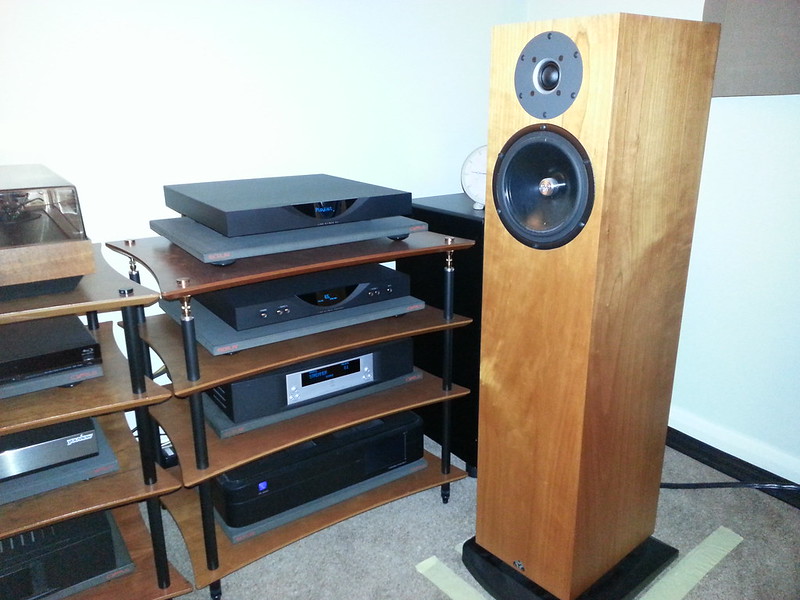
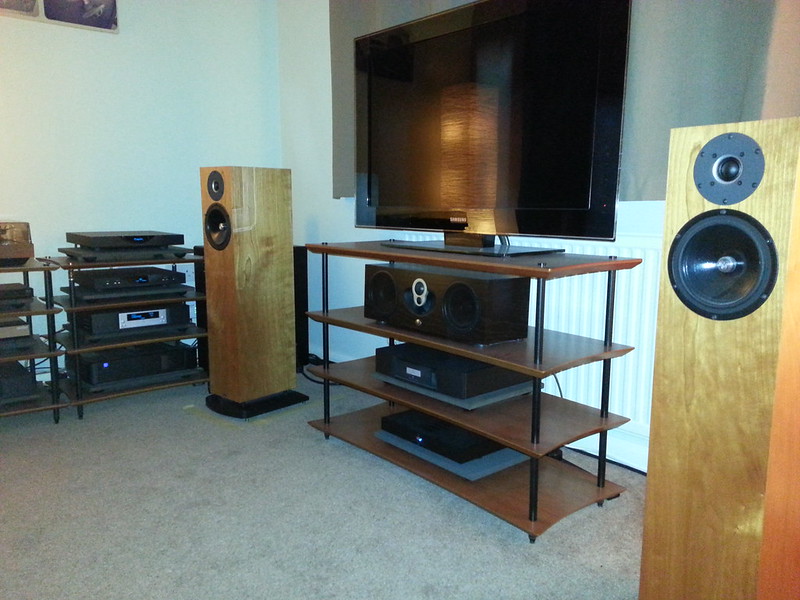
I know there are those who thing a bit of wire 'twixt amp and speaker is just that - a bit of wire, and that nothing other than something is enough.
But I've heard enough cables to know that, within a system context, they can make a difference. This doesn't mean all cables make an appreciable difference in all systems. Nor does it mean that all systems benefit from changing cables.
Plus, there seems to be no direct relationship between the price of a cable, and its performance in a particular system. So the best approach is to try a few - if you like what you hear, keep them. If you don't like what you hear don't keep them. If you think there is no difference in what you hear, keep the cheapest one.
And that about sums up my views on cables. I don't rant about them making no difference. I don't swear blind that they can make a seismic change in a system. I don't extrapolate the experience in one system to all systems. Just try it and make up your own mind.
The 'musings system, in the last 15 years or so, has relied upon various flavours of Linn's heavy gauge multi-channel speaker cables. So that's K400 for bi-amp / bi-active scenarios, K600 for tri-amp / tri-active scenarios and 2x K400 for quad-active for the Majik 140s. And its just got on with its job and although I tried a number of different cables in the system over that period, the K stuff just seemed even handed and decent enough VFM. For other systems I've found vanDamme blue in 2.5mm and 4mm gives great VFM and is even handed in the same way that the K cables behave.
A few years ago, local Naimist R tried out some SuperLumina cable against his existing NACA 5 (a cable I never liked in my system, but a great favourite for many years amongst Naimists). In his Naim / Kudos Super 20 system it was a revelation - the whole thing sounded much more grown up. Lots of the over edgy presentation went away and the music flowed better. In Naim terms it was like upgrading an XPS to a 555DR power supply - so pretty significant. This was supported by hearing the same comparison in a dealer's place with a variety of speakers. In every combination the SuperLumina was a step up from whatever cables were in place at or below the same kind of price.
So it had to be tried in the 'musings system and it brought similar benefit, but here its worth bearing in mind that one run of SuperLumina was only replacing 1/3 of the cables in use in a tri-active system. As is often the case with the PMC Twenty.26, after trying the cable across all the drivers, one at a time, it was the mid-range that benefited most from the cable improvement. This closely followed by the treble and last the bass. All sounded better with SL over K400/600.
Unfortunately its pretty expensive, and once in a system it tends to stay there as buyers are unlikely to have any reason to move on, so used examples are both infrequently available and snapped up very quickly. So this would have to be a gradual process, which was probably a good thing so the spend could be spread over time too. The first length I purchased was negotiated in with the PMC purchase, the second pair obtained about 9 months later was secondhand and a few weeks ago the third pair entered the system, being "ex-dem" from a dealer. It has been, therefore, a 20 month process to gradually replace 3x K lengths with 3x SL. To make upgrades of this magnitude in an active system isn't something I can afford to do in one big lump, one of the downsides of the more complex approach. The good thing though, is that feeling of getting a couple more improvements along the way...
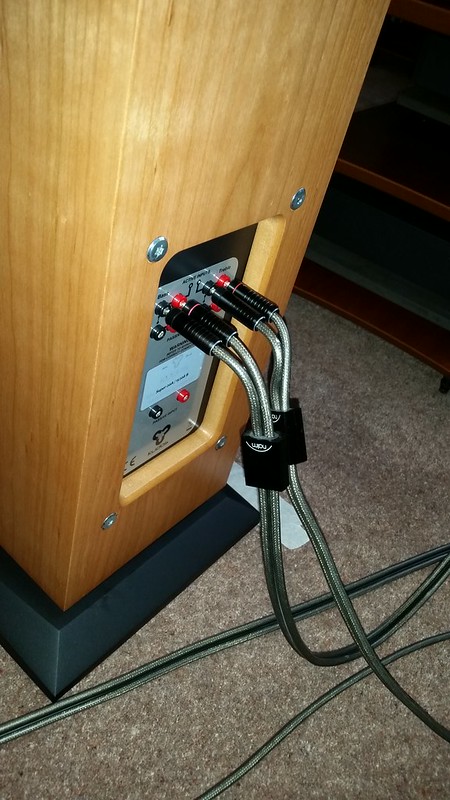
Here's a picture of the full stack of cables behind the left hand speaker, for those who like that kind of thing :)
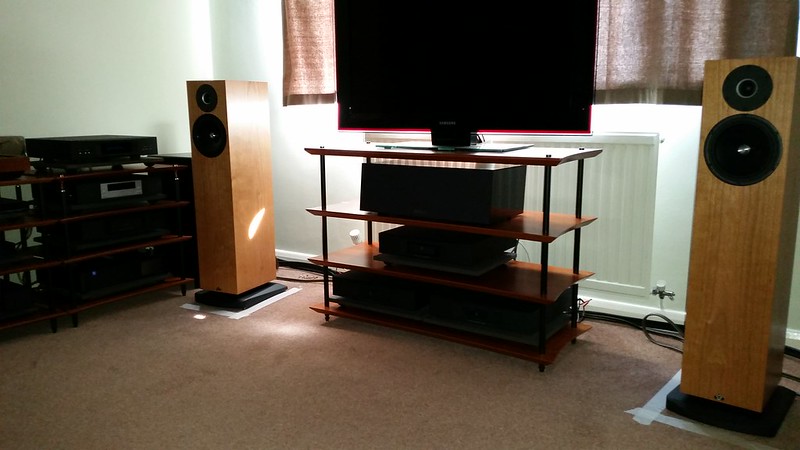
So now the system is
"What a refreshingly honest blog about listening to music through hi-fi. So happy to see views based upon the enjoyment of music rather than so-called sound 'quality'." - Peter Comeau, Director of Acoustic Design at Mission / Wharfedale
Showing posts with label Superlumia. Show all posts
Saturday, 26 October 2019
Friday, 15 June 2018
Naim ND555 - New Top of the Range Streamer - First Listen
System was Core / NAC552 / 300DR into B&W 803D3 with SuperLumina throughout. NDS / 555DR vs ND555 / 555DR swapping the interconnect between the sources (hence keeping the same input on the pre). All electronics on Fraim. Chord C-Stream for ethernet. Nice to see the continuation of the green logo. The ND555 and its 555DR PS are on the top shelves in the picture above. Thankfully, we didn't have to suffer more of the upper range of Focal speakers today.
The ND555 is an evolution of the NDS. It uses the same B-B DAC but with a different power supply design. In fact, as you might expect from Naim, there are a number of power supply changes inside the ND555. Each "stage" (digital, analogue, clock) has its own dedicated and DR fed power supply inside the box (in addition to DR in the physically separate 555PS of course). The digital section is similar to the new platform in the Uniti range and therefore supports the latest stuff such as Roon. It is housed in its own dedicated metal box which "floats" inside the ND555's main case - it is mechanically and electrically isolated from the DAC and analogue stages which themselves sit on suspended thick brass plates. The screen is also shielded internally. There was also an explanation about how there are two clocks - an input clock that can vary its timing to match the incoming data feed and a second clock to time the DAC. Not sure about this and how that's a benefit when there's a buffer involved, but there you go. "Normal" Naim Burndy cables are provided with the ND555 for connection to the power supply (or supplies as there is an option to use 2x 555PS units with the ND555).
Although I'm not a big fan of the B&Ws, this was probably the best I've heard from them. They have a slightly un-natural treble and a squidgy bass that doesn't appeal to me. A little boom caused by the room too, but it wasn't excessive nor overwhelming. NDS first of course, then we swapped between the 2 sources a few times before settling in to a longer listen to the ND555. Jason from Naim was looking after the demo.
First thing to say is that the NDS doesn't "sound broken". It does a great job, just as it has done for a long while now. We started with an acoustic guitar track then onto a trio of female folk singers listening to the NDS. The trio was then played again for 40 seconds or so before switching over to the ND555 and listening to the same track again. We selected some Shelby Lynne and repeated the process.
Its not a "gob smacking" change for me - its more subtle than that, but that shouldn't de-value the size of the upgrade, its just that you have to think about it rather than have it fed to you on a plate. The instruments most definitely separate more clearly, the edges of notes are better defined without being edgy, you can hear more of the way in which a note is plucked on a string or how a bass line starts and stops more clearly. Yet these more clearly defined instruments don't stand alone as the timing seems more coherent, enabling them to make better sense of the "whole" of the tune. But the biggest impact for me was the added emotional element, particularly in Shelby Lynne's voice. That was what stood out for me, once we'd settled into the changes.
Worth a longer audition at home, whilst the VFM, as ever, continues to be a personal choice of course.
Thursday, 30 March 2017
Linn Exakt and Kudos Super 20: World First Review
There's a bit of a back story, so please bear with me.
First, I'm going to assume a working knowledge of Linn Exakt and what it can do to process the musical signal coming from a DAC, through a set of power amps and on to each driver in a loudspeaker. If you're not so sure, you can follow these links for some more information:
http://audiophilemusings.blogspot.co.uk/2016/06/linn-exakt-and-pmc-twenty26-world-first.html
https://linn.co.uk/technology/exakt
Also, there's lots on the blog about my current system of Linn Akurate Exakt and PMC Twenty.26 which forms the basis of comparison here, so have a dig around if you need to catch up on the reference point for this review. But before the PMCs, I tried some different options, one of which was the Kudos Super 20. At the time, this was with a Linn Klimax system using a more traditional, passively driven, approach. That review is here, but to summarise on my view of the Super 20s in that system in my room:
"So its a mixed bag. I really understand why they're a good seller and why their owners enjoy them so much - I get the appeal of the etched instruments, I get the speed, I get the way they do female vocals. If I was in the market for speakers at this price point, I would say that they could be on a short list. But I need to relax into my music. I like chilled out music to wash into the room and give a warm feeling as I sit back after work and wind down. When a system doesn't let me do this, its not right for me. Others will have a different view.
As such, these aren't the right speakers for me or my room. They're different to the M140s, but they're not the right mix of abilities to justify a change to the Super 20s. I'm looking for a bigger difference, but perhaps, more of what I have, rather than a different direction."
So not a ringing endorsement in my system and room, but certainly something to consider in the right size room - they work well in their owner's own listening room which is somewhat smaller in volume than my own room.
Kudos Get Activated
Since then, Kudos have committed to delivering all their "upper" range speakers (at the moment, that's Super 10, Super 20, T-707 and T-808) with the ability to run with active amplification - ie, the passive crossover in the loudspeaker is by-passed, an active crossover is placed in front of the power amplifiers and each power amp channel controls just one driver each. This has been successful for T-808 with both Linn Exakt and Devialet implementations which you can read about at those links. Most recently, I had my first taste of Kudos's newly launched T-707 being partnered with Naim electronics including a SNAXO active crossover. This is a deeply impressive combination, heard at the Chester Hifi Show 2017.
A little while ago, the Super 20 (re-named 20a) has been treated to the Kudos connection panel which allows passive or active use of the speaker. Conversion from passive to active is extremely simple - just pull out 4 jumper hoops and connect your amps to the appropriate driver connections. So simple, in fact, that Kudos don't explain how this is done on their instruction sheet. Perhaps there is an expectation that the dealer is involved in most installations.
![]() |
| New Kudos Super 20a ready for listening |
Review Caveats
There are a couple of caveats to this review to bear in mind. First, and crucially, we had a pretty much brand new demo pair to work with. So new, the Cherry veneer was still very pale indeed - I know this darkens over time to something much deeper and richer. We estimated the speakers had about 50 hours of use on them - this is important to bear in mind as you read the review, as speakers often take a while to settle down or 'break-in' from new and their character can change a surprising amount over this time. Second, we only had a 3 hour window to work within, so there's a chance there may be more to come given more set up time - on this one, we saved a good chunk of time by going straight to the speaker position we'd found had worked best for the speakers in passive form. I think that's a very reasonable approach to take and should result in something pretty close to optimal.
Local friend R has earlier passive Super 20s in a Naim NDS/555, 282/Supercap DR and 250DR system with SuperLumina cables throughout. This lot feed a pair of the earlier Super 20s which don't permit active operation. This means there are 2 of us with experience or extensive experience of the Super 20s in this system. R's Super 20s are the ones reviewed in my previously passive Linn Klimax system. This gave the opportunity to directly compare the brand new speakers against a set with thousands of hours of use. Hence the first caveat - straight out of the box the newer pair were over bright and the bass was 'stiff' and inarticulate in comparison. To the extent that both of us found listening rather tiring. So they were left playing away to themselves, facing each other with one out of phase to reduce the amount of sound they produced. This is how we know they have at least 50 hours of music under their belts.
Set Up
So some perspective from the above in the context of a familiar system and a current (very happy) owner.
2 days later and they're set up in the Musings listening room, positioned where the passive pair had sounded best. A quick look at the brief instructions soon told us that we had to work out the active connectivity ourselves, but it is simple. Pull out the 4 connecting loops and hook up the correct speaker cable to their respective 'active treble' or 'active bass' connection. Linn Konfig was spun up on the laptop and the Exakt filters for the Super 20s were selected from the menu and installed into the Exaktbox whilst the power amps were still switched off. After confirming the Exaktbox connections against the Konfig diagram, it only took 15 minutes or so for everything to be ready to go. As is the way with active systems - care with connecting is critical. Connect a bass channel to the tweeter and you can expect a short puff of smoke, silence and a bad smell. So the bass driver is always connected first - if you accidentally send treble information to this driver its no big deal. So make sure the bass drivers are connected then listen to music at low volume and make sure the bass driver is producing bass. If its all good, then connect up the treble and listen to it very quietly to make sure its only handling treble. If all is good, on with the music...
System
Here's the system driving the Super 20a with an Exakt feed, in source to speaker order:
- 16 bit and 24 bit uncompressed FLAC files
- QNAP 251 NAS with WD Red drives
- Minimserver UPnP database
- Cat 7 ethernet cable
- Netgear GS-108T network switch with Friwo medical PSU
- Chord Anthem streaming cable
- Linn Akurate Exakt DSM streamer / Pre-amp (with power from PS Audio P5 regenerator)
- Chord C-Stream streaming cable
- Linn Akurate Exaktbox 10 DAC/processor (with power from PS Audio P5 regenerator)
- Linn "silver" analogue interconnects
- 2x Linn Akurate 4200/1 power amps (with power directly from the mains)
- 2x 3m pairs of Naim SuperLumina speaker cables
- All electronics supported by Cyrus Isoplats on Quadraspire EVO racks
Tracks used:
- Falling Out of Love - Mary Gauthier
- Six Blade Knife (24 bit from DSD) - Dire Straits
- Gula - Deadmau5
- Keith Don't Go - Nils Lofgren
- Fender Bender - Chris Jones
- Breathe You In (ft. Laura Hahn) - Ficci
- Wicked Game - London Grammar
- Walking With Elephants - Ten Walls
First Impressions
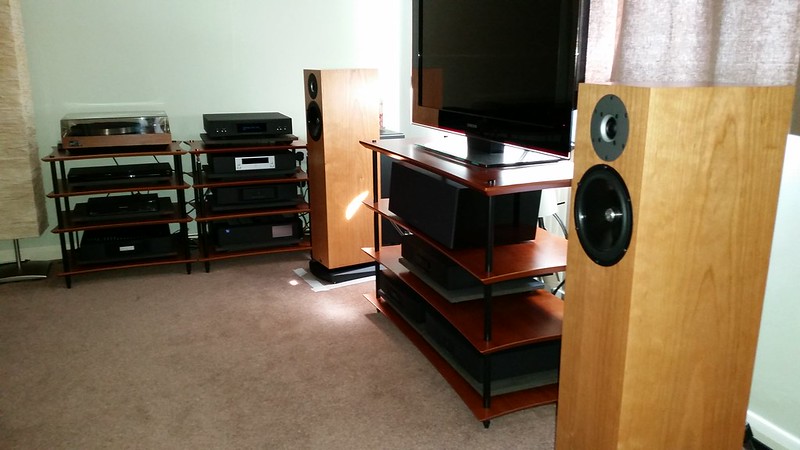
That brightness noted in R's home system was still in evidence here, making the system difficult to listen to, but bear with me as this isn't the end game here. One thing we also noticed immediately was the articulation, drive and rhythm in the bass line - although there were some room modes being driven here, leading to a touch of boom - that initial stiffness noted at first listen in R's system isn't evident in the Exakt system - either due to the different system, some benefits of the 50 hours of playing time, or perhaps a combination of both. Vocals immediately stood out as crisp and clear with tone and intonation clear in the expression of the words. So, some work to do. I think it would've been good to leave them playing for a couple more days, but time was against us.
SPACE
Turning once again to Linn Konfig, the first thing to address was the room modes which were giving a touch of boom in the room - it wasn't at all excessive, but it was there. Whilst the room measurements themselves were untouched, the position of the speakers in the room was amended to suit the positions of the Kudos boxes and the optimise button was pressed. The newer SPACE implementation - where each left / right speaker receives different settings - was evident in the profile graph - much more so than with the PMC 26s. This brought an immediate improvement to the punchiness, tunefulness and articulation of bass line. But it was a touch light so we took a couple of dB out of the notch and narrowed it significantly and that worked a treat. As usual with SPACE this opened out the mid-range and treble too - a mixed blessing.
Sometimes, its possible to tackle some vocal harshness by adding notches in space in the 65 to 74Hz range and whilst these gave some subtle benefit, it just wasn't significant. So we moved up the range and added a -1.8 then -2.0dB treble shelf which Linn allows you to add from 8kHz upwards - and this was a little helpful, but not the answer. So that was moved up to 17kHz and then we added a custom filter - a -2dB dip centred around 8.5kHz but with a very high width value which effectively gave us a 3.5kHz to 17kHz wide shelf. And that really hit the spot. Notching this down to -3dB across the same frequency range got us to the right place. Everything clicked at that point and we started to settle down into listening to the music rather than to the system and its tendancy to spotlight every single thing in the upper frequencies. This is the first caveat - it would be great to get the speakers back again soon when they've had a lot more hours of use - to see if this treble attenuation can be dropped over time as the speakers break-in.
Listening to Music
So now we had a very satisfactory sounding system, we cracked on with listening to some tracks. Bear in mind here that R has been listening to these speakers for around 3 years now and has been through a good few system upgrades during that time, so he's very familiar with their capabilities. It turns out, whilst they might be familiar, they haven't really reached their full potential in the Naim passive system. What we heard in about 90 minutes of listening with Exakt was a revelation. These speakers, whilst not carrying the same weight and authority as the PMCs (which have a somewhat larger visual and physical presence in the room), they're no longer out of their depth in my room. They go astoundingly deep from such a small box, with plenty of drive and give a bass line that, had we not already heard the PMCs, would be thought of as very good indeed - add in their relatively small dimensions and that makes them quite remarkable in this area. Tunes that needed to boogie along did so, attack is good as is the timing of the tune.
What about detail? Well, its astounding - these speakers really can resolve tiny tiny details that is beyond the capabilities of the PMCs and significantly beyond how they sound at home in the passive system. Both acoustic guitar tracks (Lofgren and Chris Jones) deliver string sounds that are crisp, clear and easy to pick out - delivering initial attack in spades and long long decays into the background. Spitty anger in Mary Gauthier's voice make you feel a bit uncomfortable and pleased that you're not the subject of her aggression. Vocals are superb - a good bit more texture, inflexion and intent than with the PMCs. Imaging is spot on too - rock solid, easy to place, 3 dimensional and a little unsettling on those tracks (such as Ficci) that use processing to give a wrap-around effect in the room.
Is there a downside? Well, its difficult to find anything to fault but I would prefer a little more subtlety in treble leading edges - R found it just to his taste, for me its still a bit sharp.
But here's the thing - throughout, we could both follow tunes and feet were tapping - and I mean throughout. On top of that, R kept giving little involuntary smiles and shaking his head in disbelief. These speakers are very much more capable than either of us really knew and Exakt with active amplification has brought that out from under the covers of passive operation.
I'll leave it with some of R's words - stunning, outstanding, and several more that I won't repeat in a public forum.
Post Script
We hope to get the speakers back again in a couple of weeks time to follow up on if they've settled in and need less treble attenuation - if this happens I'll report back here. Also, after the Super 20s left the building, the SuperLumina speaker cable stayed in the house for a little longer. Interestingly, using this cable on the treble of the PMCs reduced the gap in detail resolution by about 50%, bringing the PMCs closer to the Kudos boxes in this area. Would I swap the PMCs for a pair of Super 20s? No, but that's no reflection on the capabilities of the Super 20a, more that there is a different set of priorities from which to choose. Having lived with the superb bass performance of the PMCs, their relative lower level of detail resolution and lesser capabilities in vocal resolution are a reasonable compromise to live with. And I'd be looking for a substantial improvement if moving on - not a different compromise. Roll-on the Kudos T-606 in the summer!
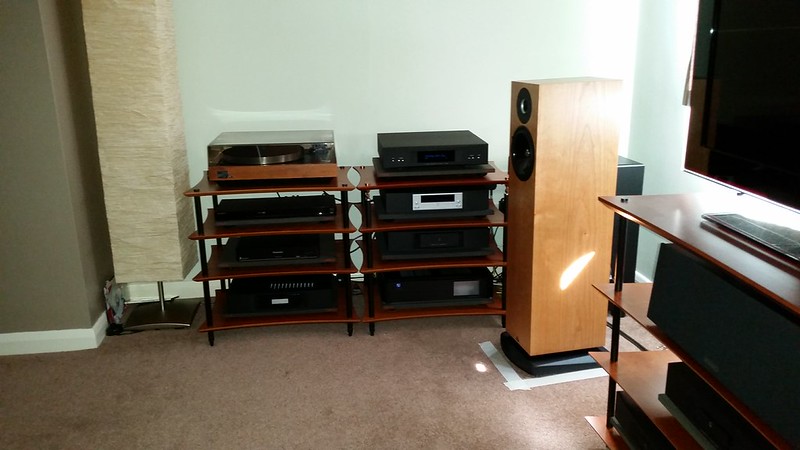
Thanks to Kudos and Acoustica for the loan of the speakers.
Labels:
250DR,
4200/1,
555DR,
Akurate,
Exakt,
Kudos,
Linn,
Naim,
NDS,
PMC,
Quadraspire,
Review,
Super 20,
Super 20a,
Superlumia,
Twenty.26
Saturday, 9 January 2016
Is The Kudos Super 20 a Neat Solution?
Audiophile Musing's system has been "active" for about 18 years. In Linn style, this means a set of active crossover cards - one per speaker drive unit and one power amp channel to deliver to that drive unit. This was how the Keilidhs were when they retired and were replaced by an actively powered pair of Majik 140s.
About 8 months ago, I heard a comparison of active 140s using Majik power amps (Linn's lowest rung), just like my own set up, against the same pair of speakers returned to passive crossovers and a pair of Linn's top of the range Klimax Solo/Dynamik mono power amps. There was no comparison. The passive Solos were not streets ahead, more of a complete city ahead. They remain an ambition. However, about 4 months ago one of Linn's top of the range stereo power amps (the Klimax 500 Chakra Twin/Dynamik) came available ex-dem and at a very attractive price. And it was black. So the Majik 140 speakers were converted back to passive and in came the Twin. Its not at Solo level, but it is a significant step up from active Majik.
So what has this got to do with the Kudos Super 20? Well, its quite straightforward really. Once the system is no longer active, then the range of speaker choices opens up to pretty much everything out there. No longer "limited" to Linn. Of course, Linn speakers are still of interest (particularly the Akubarik, my favourite of the current range), but why not listen around to see what else is possible? My local Naimist, Richard (you'll have read about him before in some of the comparison tests and for his help at Scalford etc), has a pair of Kudos Super 20s. In an act of some considerable generosity, Richard offered up the loan of the Kudos speakers for a week (which turned into 2 weeks, due to schedules and an extremely long period of wet weather when it wouldn't have been good to be moving the speakers between houses).
Let the fun begin.
Well, it wasn't too much fun to begin with. The Kudos's had to come down the narrow tight cornered stairs from the loft conversion and then into the car. To make sure the 140s went back in their correct place (and the Super 20s back in their home), positions were marked on the floors with masking tape. Then there was the lifting of the M140s out of the room - I'd forgotten how heavy they are with their solid metal bases. The Kudos stands slightly shorter, is slightly more shallow and somewhat lighter. They're beautifully built and finished, a real credit to the team from the North East. I had high expectations for these as they do work well for Richard and I've found Kudos's T-808s a thoroughly enjoyable (if rather expensive) pair of boxes.
Starting with the 20s in the exact same position as the M140s, Linn SPACE was disabled (due to the need to start from scratch) and the messing about with speaker positions began. Listened for about 30 mins in this position and then shuffled the speakers about, playing tracks for 10-15 mins between each position. Ended up with the speakers about 15cms further out from the wall. Toe-in was best at the same angle as the 140s.
Then the tuning using SPACE began, and that proved to be much more of a faff than I was expecting. SPACE comes with the Super 20 as one of the listed speakers, so that was easy enough. Measurements were taken of where the speakers are in the room and SPACE calculation run. It was awful. All life sucked out of everything, speakers sounding over bright. I re-checked all the measures. I then worked through the SPACE instructions on how to tweak the deep notches. It took a long time before something came back to the system. I left it like this for a few days, found the system difficult to listen to. It was edge of the seat stuff all the time, even with music that's supposed to be chilled and relaxing.
I reported back to Richard and he suggested we swap out the speaker cables. I'm using Linn K200 (which is split K400). Richard is using Naim SuperLumina. This had a marked effect on the system - it brings a level of refinement and "care" to the sound. Its not over smooth, but it removes some rough edges and brings an extra level of tiny details. Bass got a little tighter and much more subtley textured. A quite remarkable bit of wire. Tried it later with the M140s and it did similar things there too. Impressive. Enough of a change to necessitate switching SPACE off and to mess about with positioning again. This resulted in the speakers being about 12-13cms further from the wall compared to the Linns. A small change from the initial 15cms, but worthwhile.
And then all the messing with SPACE again. This time I ended up taking nearly all of the SPACE notches out. The lowest frequency notch went from -29dB to -6dB and the other 2 smaller notches dropped from around -9dB to -2dB. I also let in -1dB of treble shelf to tame the top end. This was another 2 or 3 days of messing about to get to this position. So that was the set up done. At last.
So how did it sound with the SuperLumina and with SPACE dialled in to its best? Well I'm going to write about this in reference back to the Linns I'm afraid - a comparative review rather than in absolute terms. I think that's because that's what I'm looking for - something that's an improvement on the 140s. Its worth saying, at this point, that they didn't work well with the Linn speaker cable and therefore something different would be a requirement. SuperLumina might be the thing, but others might be as good or better (or worse of course).
Here's what the Kudos Super 20s do better than the Linns - instrument separation, speed (they sound like they respond to inputs from the amp a little quicker) and they image better too - not so much left to right, but certainly back behind the speakers. So they're an exciting listen. Attack is great, the music is pacey and the instruments are easily picked out. The Linns are good at instrument differentiation, but the Kudos moves this on a notch. They go reasonably deep too, when the content is there in the music. Female vocals are a particular forte, just as they are in their home Naim system.
What do they not do so well? There's a few things really. I still never really relaxed into any music whilst they were in the house for 2 weeks (although it was so much better with the SuperLumina in place). The speed I found a little distracting. I notched the treble shelf down another 0.5dB and that helped a little, but I didn't really get settled with them. This, and they sound a little out of breath in my room. Back in their home system, they're in a 12ft x12ft (ish) area of an L shaped loft room, which has part sloping roofs. The listening seat is closer to the speakers too. In my room they're in a 19ft x 12ft full ceiling height room and that might be just a touch too big for them.
So its a mixed bag. I really understand why they're a good seller and why their owners enjoy them so much - I get the appeal of the etched instruments, I get the speed, I get the way they do female vocals. If I was in the market for speakers at this price point, I would say that they could be on a short list. But I need to relax into my music. I like chilled out music to wash into the room and give a warm feeling as I sit back after work and wind down. When a system doesn't let me do this, its not right for me. Others will have a different view.
As such, these aren't the right speakers for me or my room. They're different to the M140s, but they're not the right mix of abilities to justify a change to the Super 20s. I'm looking for a bigger difference, but perhaps, more of what I have, rather than a different direction.
Must get around to trying the SuperLumina again and compare it with other options. Its capabilities are impressive - far more of a change than a bit of wire has any right to deliver.
A huge thanks to Richard for trusting me with his expensive and highly valued speakers. They're back in their home now, and the brand new Naim 250DR is probably warmed up enough now for him to get thoroughly back into enjoying his music.
About 8 months ago, I heard a comparison of active 140s using Majik power amps (Linn's lowest rung), just like my own set up, against the same pair of speakers returned to passive crossovers and a pair of Linn's top of the range Klimax Solo/Dynamik mono power amps. There was no comparison. The passive Solos were not streets ahead, more of a complete city ahead. They remain an ambition. However, about 4 months ago one of Linn's top of the range stereo power amps (the Klimax 500 Chakra Twin/Dynamik) came available ex-dem and at a very attractive price. And it was black. So the Majik 140 speakers were converted back to passive and in came the Twin. Its not at Solo level, but it is a significant step up from active Majik.
So what has this got to do with the Kudos Super 20? Well, its quite straightforward really. Once the system is no longer active, then the range of speaker choices opens up to pretty much everything out there. No longer "limited" to Linn. Of course, Linn speakers are still of interest (particularly the Akubarik, my favourite of the current range), but why not listen around to see what else is possible? My local Naimist, Richard (you'll have read about him before in some of the comparison tests and for his help at Scalford etc), has a pair of Kudos Super 20s. In an act of some considerable generosity, Richard offered up the loan of the Kudos speakers for a week (which turned into 2 weeks, due to schedules and an extremely long period of wet weather when it wouldn't have been good to be moving the speakers between houses).
Let the fun begin.
Well, it wasn't too much fun to begin with. The Kudos's had to come down the narrow tight cornered stairs from the loft conversion and then into the car. To make sure the 140s went back in their correct place (and the Super 20s back in their home), positions were marked on the floors with masking tape. Then there was the lifting of the M140s out of the room - I'd forgotten how heavy they are with their solid metal bases. The Kudos stands slightly shorter, is slightly more shallow and somewhat lighter. They're beautifully built and finished, a real credit to the team from the North East. I had high expectations for these as they do work well for Richard and I've found Kudos's T-808s a thoroughly enjoyable (if rather expensive) pair of boxes.
![]() |
| Left speaker installed. Masking tape showing position of the M140s |
Then the tuning using SPACE began, and that proved to be much more of a faff than I was expecting. SPACE comes with the Super 20 as one of the listed speakers, so that was easy enough. Measurements were taken of where the speakers are in the room and SPACE calculation run. It was awful. All life sucked out of everything, speakers sounding over bright. I re-checked all the measures. I then worked through the SPACE instructions on how to tweak the deep notches. It took a long time before something came back to the system. I left it like this for a few days, found the system difficult to listen to. It was edge of the seat stuff all the time, even with music that's supposed to be chilled and relaxing.
I reported back to Richard and he suggested we swap out the speaker cables. I'm using Linn K200 (which is split K400). Richard is using Naim SuperLumina. This had a marked effect on the system - it brings a level of refinement and "care" to the sound. Its not over smooth, but it removes some rough edges and brings an extra level of tiny details. Bass got a little tighter and much more subtley textured. A quite remarkable bit of wire. Tried it later with the M140s and it did similar things there too. Impressive. Enough of a change to necessitate switching SPACE off and to mess about with positioning again. This resulted in the speakers being about 12-13cms further from the wall compared to the Linns. A small change from the initial 15cms, but worthwhile.
And then all the messing with SPACE again. This time I ended up taking nearly all of the SPACE notches out. The lowest frequency notch went from -29dB to -6dB and the other 2 smaller notches dropped from around -9dB to -2dB. I also let in -1dB of treble shelf to tame the top end. This was another 2 or 3 days of messing about to get to this position. So that was the set up done. At last.
![]() |
| General view, but before the speakers were moved to their best position |
Here's what the Kudos Super 20s do better than the Linns - instrument separation, speed (they sound like they respond to inputs from the amp a little quicker) and they image better too - not so much left to right, but certainly back behind the speakers. So they're an exciting listen. Attack is great, the music is pacey and the instruments are easily picked out. The Linns are good at instrument differentiation, but the Kudos moves this on a notch. They go reasonably deep too, when the content is there in the music. Female vocals are a particular forte, just as they are in their home Naim system.
What do they not do so well? There's a few things really. I still never really relaxed into any music whilst they were in the house for 2 weeks (although it was so much better with the SuperLumina in place). The speed I found a little distracting. I notched the treble shelf down another 0.5dB and that helped a little, but I didn't really get settled with them. This, and they sound a little out of breath in my room. Back in their home system, they're in a 12ft x12ft (ish) area of an L shaped loft room, which has part sloping roofs. The listening seat is closer to the speakers too. In my room they're in a 19ft x 12ft full ceiling height room and that might be just a touch too big for them.
So its a mixed bag. I really understand why they're a good seller and why their owners enjoy them so much - I get the appeal of the etched instruments, I get the speed, I get the way they do female vocals. If I was in the market for speakers at this price point, I would say that they could be on a short list. But I need to relax into my music. I like chilled out music to wash into the room and give a warm feeling as I sit back after work and wind down. When a system doesn't let me do this, its not right for me. Others will have a different view.
As such, these aren't the right speakers for me or my room. They're different to the M140s, but they're not the right mix of abilities to justify a change to the Super 20s. I'm looking for a bigger difference, but perhaps, more of what I have, rather than a different direction.
Must get around to trying the SuperLumina again and compare it with other options. Its capabilities are impressive - far more of a change than a bit of wire has any right to deliver.
A huge thanks to Richard for trusting me with his expensive and highly valued speakers. They're back in their home now, and the brand new Naim 250DR is probably warmed up enough now for him to get thoroughly back into enjoying his music.
Saturday, 7 March 2015
Chester Acoustica Show March 2015: Naim Statement and Focal Utopia Stella
This small but nicely formed show was again running in the Double Tree at Chester in the North West of England. About 15 rooms which thankfully did not include the massively vaulted barn which was always disasterous!
Being a free show, it really out to be very busy indeed, but as the previous 2 years, there's just a steady flow of visitors this particular Saturday morning / early afternoon. This makes it very easy to get around the rooms and be able to pick and choose a seating position within those rooms.
We headed straight to the Naim Statement / Focal Utopia Stella room as we hoped it would be fairly quiet early in the day. It was in the biggest room of the show, which in the past has hosted the highest end Naim system with top end Focal and Audiovector speakers. Neither have really moved me. Last year the Focals were pointing towards the door, this year they were back to the paired windows with the entrance door on the left - rather like the Audiovectors of 2 years ago. The room was busy and we had to take up the front row of 5 rows of seats.
Naim NDS streamer with 2x 555PS DR power supplies
Naim Statement pre-amp
Naim Statement mono power amps
Naim Powerline mains cables
Focal Utopia Stella speakers
Naim Superlumia cables throughout
This was the first time I've seen / heard a system containing Naim's new top of the range cables. After years of saying the existing cables were good enough, they now think they've found a better way of connecting up the kit. I expect Chord will be the main loser, if these prove to be a better solution. No chance to hear the impact they have on the system today.
The room had a set of tall bass traps in each corner behind the speakers and the crossover choice was flat except the bass was set to the minimum setting. The room treatment and crossover choices suggest some time had been spent on setting the system up.
We heard a few tracks such as rock and jazz rock such as Jeff Beck and Supertramp, followed by a classical piece. Well, this was all just too much in the front row, but as soon as space allowed we moved back to the 4th and 5th rows and it all made a lot more sense. This system was better than the one featuring Statement at the Bristol show back in Feb 2014. Much better. It allowed some of the emotion in the music to come through, which the Bristol combination with the Grand Utopia speakers just didn't achieve at all. This system still has that signature sound that comes from both Naim and Focal - its up front, dynamic and forceful. Here, there is just more of everything in terms of detail, power, speed etc. It took me until the 3rd track and sitting further back in the room to settle into what was going on. This system has that insistent timing and causes foot tapping, but like before, the combination of the up front Naim with up front Focal means that leading edges can be a bit abrasive, even at this level. The sound is massive in scale - and some ways that makes for a "wow" factor - but I do struggle with acoustic guitars that sound about 4 feet tall. Whilst side to side imaging and clarity of where the instruments are in the mix is very good and very stable, we didn't get a sense of much depth. I still think that the Naim electronics work better with more mellow sounding speakers, but this is the best I've heard this combination of these manufacturers to date.
SUNDAY UPDATE:
We revisited on Sunday, to give the Statement some time to settle in (if that was required).
Well, some large orchestral music really conveyed the sense of space of the venue and the scale of the orchestra, and with little percussion and hard edged instruments, was quite enjoyable to listen to. Then on came Frankie Goes To Hollywood's Relax. And it was horrendous. Harsh, brittle, grating and painful to listen to. We had to leave the room. Suspect the Focals - can Naim afford to keep using these speakers? The 2 brands just don't seem to be compatible.
If you enjoyed this article, consider supporting Audiophile Musings: Become A Patron
Thanks!
Being a free show, it really out to be very busy indeed, but as the previous 2 years, there's just a steady flow of visitors this particular Saturday morning / early afternoon. This makes it very easy to get around the rooms and be able to pick and choose a seating position within those rooms.
We headed straight to the Naim Statement / Focal Utopia Stella room as we hoped it would be fairly quiet early in the day. It was in the biggest room of the show, which in the past has hosted the highest end Naim system with top end Focal and Audiovector speakers. Neither have really moved me. Last year the Focals were pointing towards the door, this year they were back to the paired windows with the entrance door on the left - rather like the Audiovectors of 2 years ago. The room was busy and we had to take up the front row of 5 rows of seats.
Naim NDS streamer with 2x 555PS DR power supplies
Naim Statement pre-amp
Naim Statement mono power amps
Naim Powerline mains cables
Focal Utopia Stella speakers
Naim Superlumia cables throughout
![]() |
| Naim Statement - 2 mono 750W power amps with the pre-amp in the centre |
![]() |
| Top view showing the machined-from-solid cooling fins on the amp ends and the volume control on the pre-amp |
This was the first time I've seen / heard a system containing Naim's new top of the range cables. After years of saying the existing cables were good enough, they now think they've found a better way of connecting up the kit. I expect Chord will be the main loser, if these prove to be a better solution. No chance to hear the impact they have on the system today.
![]() |
| The new Superlumia cables. Given that there was no demo of their capabilities, I'll just have to say that they look very well constructed and they were in a nice box. |
The room had a set of tall bass traps in each corner behind the speakers and the crossover choice was flat except the bass was set to the minimum setting. The room treatment and crossover choices suggest some time had been spent on setting the system up.
We heard a few tracks such as rock and jazz rock such as Jeff Beck and Supertramp, followed by a classical piece. Well, this was all just too much in the front row, but as soon as space allowed we moved back to the 4th and 5th rows and it all made a lot more sense. This system was better than the one featuring Statement at the Bristol show back in Feb 2014. Much better. It allowed some of the emotion in the music to come through, which the Bristol combination with the Grand Utopia speakers just didn't achieve at all. This system still has that signature sound that comes from both Naim and Focal - its up front, dynamic and forceful. Here, there is just more of everything in terms of detail, power, speed etc. It took me until the 3rd track and sitting further back in the room to settle into what was going on. This system has that insistent timing and causes foot tapping, but like before, the combination of the up front Naim with up front Focal means that leading edges can be a bit abrasive, even at this level. The sound is massive in scale - and some ways that makes for a "wow" factor - but I do struggle with acoustic guitars that sound about 4 feet tall. Whilst side to side imaging and clarity of where the instruments are in the mix is very good and very stable, we didn't get a sense of much depth. I still think that the Naim electronics work better with more mellow sounding speakers, but this is the best I've heard this combination of these manufacturers to date.
![]() |
| Focal Utopia Stella in white gloss |
![]() |
| The Focals have a servo drive for the bass units |
![]() |
| Designer and builder details on the Focal's drop-down panel |
We revisited on Sunday, to give the Statement some time to settle in (if that was required).
Well, some large orchestral music really conveyed the sense of space of the venue and the scale of the orchestra, and with little percussion and hard edged instruments, was quite enjoyable to listen to. Then on came Frankie Goes To Hollywood's Relax. And it was horrendous. Harsh, brittle, grating and painful to listen to. We had to leave the room. Suspect the Focals - can Naim afford to keep using these speakers? The 2 brands just don't seem to be compatible.
If you enjoyed this article, consider supporting Audiophile Musings: Become A Patron
Thanks!
Labels:
555PS DR,
Acoustica,
Chester,
Focal,
Naim,
NDS,
Review,
Show,
Statement,
Stella,
Superlumia,
Utopia
Subscribe to:
Posts (Atom)