"What a refreshingly honest blog about listening to music through hi-fi. So happy to see views based upon the enjoyment of music rather than so-called sound 'quality'." - Peter Comeau, Director of Acoustic Design at Mission / Wharfedale
Showing posts with label LP12. Show all posts

Thursday, 30 April 2026

LINN Upgrade Their Flagship 360 Loudspeaker - World First Demo

Linn's 360 speaker was introduced in 2023, heralded as their best ever speaker product. It was certainly a huge step in the right direction after the somewhat long in the tooth 350. It features some interesting technology, particularly in the fully active version - such as Organik DAC / power amp modules with adaptive bias amplifiers, Exakt phase correction / time alignment and the cabinet that features no flat panels - improving dispersion and imaging.

Within about 6 months of its introduction Linn quietly dropped the beryllium tweeter in favour of a less toxic material - other than that little has changed in the 3 years since.

However, today, Linn launched an upgraded version with new upper bass and bass drivers - Audiophile Musings was invited along to the product launch at House of Linn in Manchester for the first ever demonstration of the product outside the Linn factory. 

Those of you who know a little about the 360 will also notice another change - the availability of a full cabinet walnut veneer - a no cost option alongside the existing paint finishes.

Talking of cost - this new version has upped the list price of the fully integrated active version from £87.5k to £99.5k.  The passive with active bass version sees a similar uplift of around £12k.  Existing owners can upgrade for £16k but if you bought within the last 6 months the upgrade is the same as the uplift in the list price - £12k.


Linn's ambassador Paul was on hand to explain the differences in the drivers between the original version of the 360 and this latest iteration.  In brief:

- the original used "off the shelf modified" drivers from a well-known driver provider

- the new version uses all-new Linn designed drivers built exclusively for them

- these are the first ever "designed from scratch" Linn drivers

- they're dubbed Pistonik - the design features in the upper bass and bass drivers

- they feature a large motor structure, an aluminium cone which is almost flat, a double layer suspension system and enormous linear (front to back) excursion

- they are claimed to reduce distortion

- are said to be designed to suit the 360 cabinet

More information and pictures on Linn's website here: https://www.linn.co.uk/uk/speakers/upgrades/linn-drive-units

DEMO

Audiophile Musings was invited to the first ever demo of these upgraded speakers outside the Linn factory.  Thanks to Brian and Trevor at House of Linn for hosting the session.

The system tonight:

Turntable: Linn LP12 with Bedrock plinth, Keel SE subchassis, Ekos SE arm, Ekstatic cartridge, Urika II phono stage

Streamer / Pre-amp: Linn Klimax DSM/3 with Utopik PSU

Loudspeakers: fully integrated Exakt active original 360 with Utopik PSU and fully integrated Exakt active upgraded 360 with Utopik PSU

We started with a couple of tracks from Qobuz - which included some electronic, jazz and female vocals.  As ever with the 360, I get a feeling of clarity and technical accomplishment, but not so much feeling nor emotion from the music.  Good to get familar with the product again.

"This Is What You Are" by Mario Biondi And The High Five Quintet

"I Can't Stand the Rain" by Beverley Knight

"End of the Road" by Infected Mushroom

We then had a 10-15 minute break whist the team swapped over the 360s to the upgraded version.  When going back into the dem room there was a 3 or 4 minute video explaining the driver upgrades and the technology within them - some nice graphics etc.

Then we went back to the same tracks and the difference in the bass was immediate and obvious - the new drivers clearly exposed the old drivers as somewhat woolly and vague (in absolute terms) -  not just in terms of articulating the sounds of the instruments, but more obviously in the clarity of when the note(s) start and when they stop.  This was not a subtle upgrade, but something quite clearly worthwhile.  The solidity and punch on the Infected Mushroom track was a particularly good way to bring out the capabilities of the new drivers.  There's also more texture and detail in the bass lines, more insight is perhaps a good way to describe this.

A few more tracks were selected by Linn including some on the LP12:

"What I Am (Album Version)" by Edie Brickell & New Bohemians

"You Look Good To Me" by Oscar Peterson (on the LP12)

"Satisfied Mind" by Mavis Staples

"Shostakovich Symphony No. 10 in E Minor, Op. 93: II. Allegro" by Philharmonia Orchestra - The Simon Rattle Album (on the LP12)

"Secret Heart (Album Version)" by Ron Sexsmith

"Penpals" by The Stan Tracey Quartet

"Who'll Stop The Rain (John's Version)" by John Fogerty


Then the track choice was handed over to the attendees at which point we enjoyed the following:

"Kiss the Sky" by Tash Sultana

"Waiting on the World to Change" by John Mayer

"Yamore (feat. Cesaria Evora, Benja (NL)" by Moblack and Salif Keita

"A Plea" by Flea

"Counting (Remastered)" by The Motels

"And They All Came Marching Out of the Woods" by Jakob Bro, Thomas Morgan & Jon Christensen

"Mahler Symphony No. 5 in C-Sharp Minor: I. Trauermarsch. In gemessenen Schritt. Streng. Wie ein Kondukt" Sir John Barbirolli


All of the above cemented the initial impressions - great tightly controlled bass (possibly one of the bess bass performances of any system I've heard) and that extremely clear but unemotional overall presentation.  If you have 360 and the wherewithal to have the upgrade, its pretty obvious that its something worth considering.  If you have mostly liked the 360 but you felt the bass could be tighter, punchier, more revealing or all 3, now's the time to go take another listen.  It will be interesting to see if Pistonik (3 years in the making) will filter down to the by-now-inevitable 2nn series speakers from Linn - that's the gap that needs plugging as soon as possible.


Monday, 18 August 2014

Musings Goes Analogue Part 3 - RD11s Build

See Part 1 here
Part 2 here

Having had some experience messing about with set up several times on a Thorens TD160BC MkII with different arms and platter mats (very successfully), and with an LP12 (not so successfully - got it close but ended up at a Linn dealer for a full service and set up), I approached the RD11s reasonably confidently, but also in the knowledge that if set up was a problem I'd just do a bit more research and then go back to it.  This is a project for fun and experience building, not as a serious source for my system.

So here's the starting point, a several decades old plinth, suspension and motor unit, sourced through the classifieds at hifiwigwam.com:

Starting point - an Ariston Audio RD11s

Sitting on the workbench in the garage, I started by giving it a quick clean, which wasn't too hard as its in such great condition and came packed with copious amounts of bubble wrap and with the bearing plugged, inner platter and main platter removed, as it should be.

The underside of the deck has no base plate - its lost this somewhere in its no doubt long and varied life.  Still, I think this could be a good thing on 2 counts - first it means easy access to all the relevant suspension adjustment options, secondly, because it is no longer effectively a box, there should be less chance of resonances building up inside which may affect the sound quality.

First was to check the alignment and fitment of the newly arrived soundsupports.com SME to Rega armboard adapter.

Armboard adapter offered up to the existing SME mount

ISOkinetic (Rega) RB202 tonearm, unpacked from its box. Note the low cost "captive" arm lead to carry the signal to the pre-amp
The RB202 is reasonably well made - its very recognisably part of the Rega RB250 family.  The arm tube is nicely cast, the bearings are super smooth with no discernable play and the cueing mechanism is smoothly damped and feels much more expensive than some I've used.  Looks like the main compromises to save money are the plastic moulded thread counterweight mounting and the basic looking captive signal output lead, which looks to be no better than the kind of freebie interconnects you tend to get inside Japanese hifi component boxes.

Armboard fitted to the three-point mounting with countersunk bolts
In order to reduce stress on the tonearm bearings, once the armboard was mounted to the arm, the cartridge was unpacked and installed to the arm, with the mounting bolts only tightened enough to hold the cartridge in roughly the right place.  The stylus guard and stylus were removed prior to fitting the cartridge body to the arm.  The bolts that came with the cartridge were used for this - they're metal, unlike some budget cartridges that come with very flimsy plastic bolts.  The signal cables were connected too, using the correct colour matching of each cable to the each pin on the back of the cart.

Unboxing the Goldring Elektra Cartridge
Stylus removed from cartridge body prior to mounting

Cart  loosely mounted in the headshell and connected up

Armboard adapter then mounted onto the SME armboard using the 4 supplied countersunk self tapping screws.  Note how the arm sits nicely parallel with the side of the deck.  Despite the optical illusion of the photo, the arm isn't too long for the deck and the lid closes with plenty of clearance


Next up, using ISOkinetic supplied oil, I ensured that all the existing oil was soaked up into kitchen towel and then refilled with the new oil.  Before fitting the inner platter I laid a small amount of kitchen towel around the bearing to catch any overflow - of which there wasn't any.


Having given the inner platter edges, outer platter engagement surface and the spindle a clean with alcohol and then a polish with a dry lint-free cloth, the inner platter was gently lowered into the bearing shaft - being careful not to "drop" it into the hole which could damage the bearing surfaces.  The last few mm of travel took about 10 seconds or so as the oil was pushed out of the way.  No excess oil at this point, so I'll remove it again later and put a little more oil in there.

Inner platter installed
The belt was then installed - fitting around the smaller part of the stepped pulley for 33rpm, then wrapping around the outer edge of the inner platter.  Unlike every belt driven turntable I've worked on / owned in the past which had flat ground belts, the RD11s uses a very narrow (2-3mm) square section belt, which is extremely easy to twist during fitting.  I took care not to touch the belt and inner platter surfaces to avoid getting finger grease in there.  Then on went the outer platter (which weighs around 2.5 kg).

Arm and complete platter installed - note the huge gap between platter and top plate
The outer platter should force the suspension down and allow the platter / bearing / subchassis / armboard / tonearm assembly to "float" freely whilst hanging from the suspension springs.  However, the previous owner had diligently wound up the suspension springs pretty tightly to avoid any movement in transit, so although the assembly did drop a little, it was still a long way up above the top plate of the deck.

Setting up and first play is in Part 4.
Part 3 is here
Part 2 is here
Part 1 is here

Wednesday, 13 August 2014

Musings Goes Analogue - Part One

Regular readers will know that the Musings home system is dominated by streaming, using a Linn Klimax DS as the main source.  Prior to streaming the main sources were a mix of CD using a Meridian 508.20 and vinyl on a Linn Sondek LP12 / Ittok / Dynavector 20HX.  Both of these primary sources were sold to fund the Linn streamer as it offered a far better musical experience than either CD or vinyl.

Linn LP12 on the left and Meridian 508.20 on the right - the peak of vinyl and CD in Musings' home system approx 3 years ago
Current main source - Linn Klimax DS streamer

I then sold the majority of vinyl to fund the purchase of the Majik 140 speakers, but retained a few albums that are either of sentimental value or are part of a small collection which took a while to build.  So a turntable was still required for those very rare occasions when I wanted to play one of those albums, or someone else brought some vinyl along to sample some music.  Besides, any decent system needs a turntable or it just doesn't seem complete to me (now, pass me the pipe and slippers please...).  So a few weeks of browsing on ebay netted a very dusty but fully functional Thorens TD280 MkII which I cleaned up and fitted with a brand new Goldring Elektra MM cartridge.  The cart cost nearly 3 times what I paid for the deck, even though its very much a budget cart!  There's a bit more information on the Thorens in this post.  So Thorens is the current state of vinyl replay in the system.  Its very much a plastic, low cost, functional piece of kit that makes a reasonable sound and nothing more.

Current state of vinyl replay - Thorens TD280 MkII and Goldring Elektra MM cartridge
The Thorens is very much plug and play - you put it on the table, hook up the belt, set up the cartridge and away you go.  It even has auto lift / stop at the end of play.  It looks respectable and descreet, so I suppose it fulfils my needs for a turntable pretty well.  And yet...

Although the streamer is an amazing piece of kit - producing the best SQ I've heard in several systems, once you've spent time (around 18 months of elapsed time in my case) ripping CDs, correcting metadata, sourcing good quality album art etc. etc., its a pretty uninteresting bit of hifi.  There's nothing to mess about with, it just gets on with the job of playing music superbly, and looking pretty (to my eyes at least).  Turntables are more interactive and involving (I mean physically, not necessarily musically).

Here's the premise then:  is there a low cost way to mess about with a "proper" turntable for a while, something that is more in keeping with the rest of the system, that doesn't break the bank and offers the opportunity to "mess about a bit" with it as a piece of kit?  And how will it compare to the super budget priced Thorens?

Some will know about the controversy that surrounds the birth of the Sondek LP12 turntable.  I think there's less doubt that Ivor Tiefenbrun really lead the "source first" campaign in the hifi World in the mid 1970s and his LP12 turntable definitely contributed to that message.  But there is more controversy about how original the LP12 design is, when it looks so conceptually and mechanically similar to the original AR turntable.  And the Thorens turntables.  And the Ariston turntables.  Now I wasn't interested in hifi at the time (I was more interested in riding my bike, playing cops and robbers and avoiding kids who wanted to play football at the time) so I wasn't there and I don't know the whole story, but it adds a bit of context.

What happened next was the availability on the market of a couple of very reasonably priced turntables that just happened to come from the same manufacturer.  Both are suspended sub-chassis designs with precision bearings, a wood plinth and a stainless steel top plate.  Both also have high mass platters and belt drive from an AC motor.  But given that the LP12 retains its value ridiculously well, neither of these turntables are from Linn.  In fact, they are from Ariston Audio.

So I now have an RD11S turntable with no arm, and an RD80SL fitted with a Linn LVX (Basik) tonearm.  I've sourced another 2 new Goldring Elektra cartridges, a Rega RB202 arm and some enthusiasm to build them up and to compare them against the Thorens.

I'll document in posts here about the builds of each turntable, then the comparisons between the 3 decks.

Part 2 here
Part 3 here
Part 4 here

Monday, 16 June 2014

CRANAGE HALL AUDIO SHOW JUNE 2014 - Linn at Brian and Trevor's

Showcasing the latest iteration of Linn's Exakt digital crossover / room optimisation system with the Akubarik Exact loudspeakers,  These accept an Exakt digital signal, digitally splits this into 5 different frequency bands, corrects for phase and timing distortions between and within each speaker drive unit, corrects for the actual measured manufacturing variances in each driver and then feeds each of the 5 bands to a dedicated power amplifier for each driver.  This is all housed in the aluminium extruded housing down the back of the cabinet.  Connections in the back are just a mains lead and an Exakt Cat 5 cable (its not ethernet, its proprietary). The speakers are reasonably compact and use a pair of isobaric loaded bass drivers facing downwards, helping to make the speakers less room boundary dependent.  They're good looking, but I prefer the darker satin colours to the glossy examples on display today.


The electronics feeding the speakers is the Klimax Exakt DSM - its a streamer and pre-amp with mostly digital inputs.  There is one analogue input which uses a very high quality 32 bit analogue to digital converter, so even the LP12 signal is digitised so the Exakt software can do its stuff with analogue too. By measuring the room dimensions the software can also reduce the appropriate low frequencies in the signal to help reduce boom.

Music was being played using the KEDSM as a streamer and from a top spec LP12 turntable.  All the components were being fed by mains from PS Audio Perfect Wave power regenerators.  These are not conditioners, they take the incoming distorted AC mains, turn it to DC, then regenerate a 240V 50Hz mains output without the distortion.

Left Top Down: LP12, KEDSM, Uphorik Phono Stage, but not sure what's on the lowest shelf.  On the right is a PS Audio Perfect Wave P10 sitting on a PS Audio Power Base
So how did all of this sound?  Very Linn.  Understated, controlled, detailed, musical and very tuneful.  It doesn't leap out at you, but you can listen to it for hours.  Occasionally it was a touch too loud and the LP12 was sounding suprisingly lightweight - very unusual.  When playing at a sensible volume you could hear the benefits of Exakt with excellent imaging and no obvious timing issues.  I did think that it would be a bigger improvement than it seems to deliver over the standard active Akubariks.  This is probably due to the limitations of Akurate level DACs and amps that are somewhere between Majik and Akurate level all built into the back of the speakers.  I'm thinking Klimax Exakt crossovers, external amps and passive Akubariks might bring a better (but even more expensive) result.

Decent sounds here, much better than the Linn sound at the Manchester airport show last year, and in the top 5 of rooms I heard at Cranage.

Monday, 10 March 2014

Scalford 2014 - The Wigwam Hifi Show Report

IT'S DIFFERENT

The Hifi Wigwam Hifi show is like no other.  50 rooms of systems set up by enthusiasts in an hotel in the UK Midlands to play music for other enthusiasts.

What's the point of that?  Well variety seems to be the watchword.  There's nowhere else where you'll be able to hear so many different approaches to music playing in one day.  And all of it is independent of the manufacturers.  Don't take that to mean impartial - its far from that as the Wam is famous for the views of its members, and their enthusiasm to express those views.

Every room is very different (although you'll hear lots of ways of hanging vinyl, valves and horn speakers together), and tackles what the exhibitor thinks is a good way of playing music at home.  Some of the rooms are very challenging (think hard walls with no furniture, or tiny hotel bedrooms with bouncy chipboard floorboards and sound bleeding through from the next room), and getting a system working even slightly close to its potential is often many hours of setting up work.  Its a lot of work going to exhibit, lots of kit to be transported across the country, carried up stairs, positioned, re-positioned and then re-positioned again, take it all apart, transport it again.

WHY?

Its a strange thing, trying to figure out why anyone does this.  There's no money in it for the exhibitors, in fact it costs money - as a minimum for the liability insurance, and for those in the larger rooms, the additional fee for a large room plus the cost of getting there, staying in the hotel and, the inevitable, beer money.  Is it the community?  Possibly - despite the outward appearances on the Wigwam forum, they're just a bunch of enthusiasts trying to get the best out of their (perhaps I should be saying "our", being a Wammer myself) music playing kit, and to learn from each other.  Is it to gather affirmation of their ability to build / assemble and excellent solution?  Also a possibility, but given the opportunity to produce a rubbish sound in some of these challenging rooms, it hardly seems likely.  Is it altruism, offering to help others decide how to build a good music playing system?  More possibilities here.  What about just extending the idea of the Wammer gathering when a few get together and compare various bits of kit in one of their homes?  There are probably more reasons too, but I suspect it is mainly a combination of the above for most, with other reasons thrown in (such as an excuse to get away for the weekend with like minded folk and drink beer whilst having a good old natter.  There's certainly a community atmosphere about the place, and there's certainly a chance to help others (e.g. one year there was a Wammer there offering to test valves for correct operation).

TAKING PART

This year was my 3rd pie-fi show (it's near Melton Mowbray).  The first year I attended with Richard and John as visitors.  Some systems we enjoyed, some we hated, some were so-so.  And so it will be every year and for every visitor - but every visitor will have a different list of systems in each of those categories.  In every room, joy for one visitor may well be apathy for the next.  What is a constant is the effort put in by exhibitors, and the risk of a disappointing sound.  So even in the rooms where you're less then enamoured by the sound you hear, its always good to remember all that hard work, and acknowledge or thank each and every exhibitor you encounter.

Last year was the first time exhibiting.  Richard and I took my all-Linn active streamer based system.  Partially this was because I thought there would be interest in this as something different (there had been no all-Linn systems at any of the previous 4 iterations of the show) and partially because I really think that system has a lot to offer in terms of musical enjoyment.  To be fair, there was also the fun part of taking something that many Wammers think has very little to no merit as a solution, nor as a brand.  You can read about the results here.

So what to do this year?  It didn't take long to decide to exhibit again, but with the over-riding attraction of Scalford being variety, it seemed appropriate to do something different to last year.  Having more than one system around the house makes this possible.  So this time I wanted to go for something less expensive, yet something again that was new or different for the show.  What would it be?  In the late Summer of 2013 and idea started to form and it was based around taking a Yello "virtual concert" DVD with me to a fellow Linn forum member's house to watch / listen to on his Linn system.  This DVD is excellent sound quality, superb imagery and Yello is a perennial favourite at hifi shows.  The idea was off and running.  A post up on the Wam indicated that there was some interest in a visual presentation, but it wasn't exactly an overwhelmingly positive response.

Sticking with the cost effective route, I put together the following system, after a bit of a test session (read about it here), and the application for a room went in.  As new exhibitors get preference, and that I was proposing something a little unusual, I kind of expected to not be offered a room this year.  Selection is by a very small committee - its not a democracy, and that's fine.  If it turns into a democracy we'd never see a show happen at all.

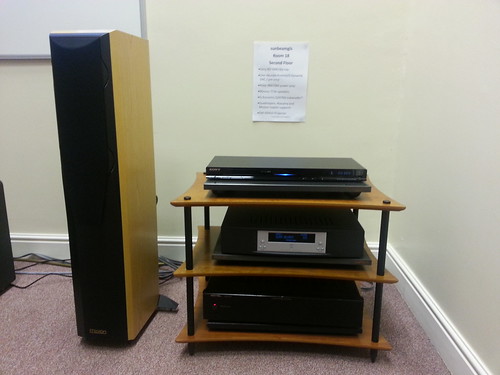
Sony BD-S480 Blu-ray as transport
Linn Akurate Kontrol/0 Dynamik as DAC and pre-amp
Rotel RB970BX power amp
Mission 773e speakers
Q Acoustics 2070Si sub
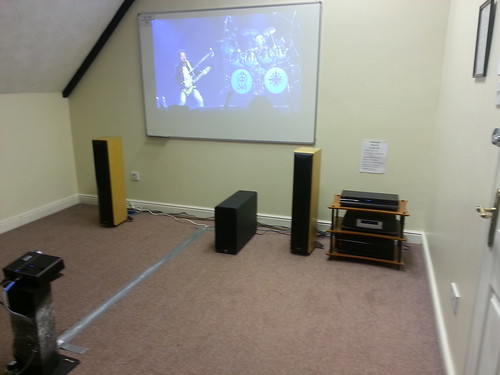
Dell M410HD projector & room whiteboard
Chord Prodac Pro Gold digital coax interconnect
Linn Silver analogue interconnect
Linn K20 speaker cable
Clearer Audio Copper Alpha HDMI cable
Clearer Audio Copper Alpha distribution block and mains cables
Quadraspire and Cyrus / Mission Isoplat system support
Atacama SE20 speaker stand for the projector

I also had a projector screen on stand by, but was hoping to get a room with a large flat wall or a whiteboard to work with.  The Linn DAC / pre-amp probably doesn't qualify as cost effective, but you can't have it all ways when putting something together just for a weekend.

The music choice was easy - we would play the Touch Yello Virtual Concert on a loop all day - it plays for about 40 minutes, but most people only stay in the rooms for 5 minutes or so, so that's not a problem.  Well, at least I thought it was an easy choice, but Richard was a bit less confident, which made me less confident, but it was kind of too late, as the application had gone in.

Having exhibited the previous year, this year was somewhat easier.  Dig out last year's spreadsheet and swap out the kit names etc. Make sure the right spares reflected the system in use and make sure there are adequate boxes to protect the kit in transit.  Having lighter speakers this year seemed to be a good thing - carrying last year's up the 2 staircases was hard work.  Hadn't factored in that they're boxed as a pair though...  We were successful in getting a room (again up on the 2nd floor in the main hotel building), so down to work.  Accommodation booked, Saturday night curry booked and pork pies ordered for my room assistants.

THE WEEKEND ARRIVES

All boxed up by Thursday night before the show, signs printed (room door, kit list in the room, and signs to help visitors actually find the 2nd floor in the main building), stuff like biscuits and water for the room sorted and other sundry practicalities to deal with.  Yet again it all looked like an huge amount of kit, stacked up in the hallway and our lounge.  Was it all going to fit into the car?  Saturday arrived - decent weather and all the kit squeezed into the car at the second attempt.  Actually a bit more space left than last year, Richard came over and we set off on the 2.5 hours cross-country.

When you get to Scalford it all gets a bit surreal.  There's folks and boxes and vans and trollies everywhere.  Its all very purposeful.  There are also plenty of folks already at the bar...  We take about an hour to get everything up to the room and out of its boxes, with the help of brother John and fellow Wammer Rick who happened to be passing and offered to lift n shift - all part of the community spirit.  We spent about 10 minutes discussing the layout of the room then got to setting up.  About 30 minutes later we had music playing and a picture on the very conveniently located whiteboard.  Speakers were moved around several times until they balanced well in the room, then we added a very subtle assistance from the subwoofer - again a few adjustments and we were done in under 2.5 hours.  Still seemed a long time, but worth the effort.  With cables taped down and signs up on the walls we were off to the bar to get refreshments.

On the Saturday evening there's a really relaxed atmosphere about the place as Wammers (with beer in hand) wander around to see who's set up yet and drop in for a listen.  The surreal vibe continues - you don't know which rooms will be ready, where they are (the place is a rabbit warren) and what they'll be playing.  Unlike Sunday when everything is very very busy, Saturday is chilled and easy going.  There's good banter and the occasionally panicking Wammer trying to fix a problem or borrow a bit of cable from somewhere.  Just meander around and drop in - you're always welcome.  Bizarre though - who would ever think of running a pair of Quad ESL 63s in a bedroom for example?  With the bed still in there!  Everyone is both opinionated and friendly at the same time.  Then there's the curry buffet and more beers with more listening to be done.  As an exhibitor this is the best time to get around and hear some music.  Sunday will be a bit manic in comparison.

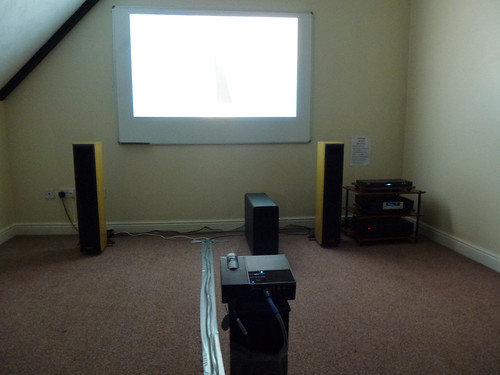
A few pics of our very simple set up this year:

The kit
Setting Up: Playing Toto
During Sunday (photo courtesy of a Wammer - see the link to the gallery below)
Audience (and sophisticated black-out arrangement!)
All the show pictures posted by Wammers are here:
http://www.flickr.com/photos/thehifishow/with/12912104184

SUNDAY

Up around 8am, showered and down for breakfast.  The bedrooms at Scalford are functional.  There's a new owner now (must've been a bit of a shell-shock, taking over the reins on Friday then touring around the rooms over the weekend, seeing what goes on over the Hifi Show weekend) - lets hope it doesn't get too posh.  Whilst a refurb would be a good thing, if it gets too posh it'll get too expensive for many exhibitors and perhaps the economics of the show will no longer stack up.  Lets hope a good balance is maintained.

Breakfast is busy and there's lots more boxes of kit making their way into the hotel.  More helping going on.  There are lots of volunteers about the place - running the show, manning the ticket table, setting up the raffle, handing out the exhibitor badges, just running the whole thing or mucking in wherever required.  And the ever tolerant and helpful hotel staff who probably wonder what's hit them.  We finish off putting a few more signs up on doors and as directions then check out of the bedroom and prepare for the day.  Our first visitors are in at 9:40 (the show opens at 10!) whilst we're still taping up some extra materials to help black-out the windows.

We take turns to look after the room and advise visitors on the kit and the artist (surprisingly, a good number are new to Yello), how much it cost, who makes the projector etc. etc.  We get some good feedback, we get polite nods and we get folk who don't acknowledge that you exist (grrr, you don't have to like what we're playing but you could at least be polite).  We get a few moments of a completely empty room, but that's few and far between.  Most of the time there are between 6 and 10 visitors in the room.  Some put their heads around the door and don't come in, some stay for 5-15 minutes (this is the majority) and some stay for a full cycle of 40 minutes.  We have a good 10 or so who come back for more later in the day (or maybe more, I wasn't in the room all day to know who was a re-visit and who wasn't, in some cases).

Having 2 assistants to look after the room during the day meant a good amount of time to get about the other rooms too, which was really appreciated.  There were many interesting exhibits such as Serge's quadraphonics, the professional reel-to-reel tape decks, fantastic DIY kit, some amazing workmanship in wood etc.  I didn't get around to all the rooms but I particularly enjoyed the Jolida / Muhlidine system, Myrman's Zingalis (suffering from the boominess in the room, but cutting through that), the Wadia / Krell / Wilson Audio system making the best of a very large and reverberant room and the LP12 / Naim / Neat MF7 system.  Hearingisbelieving (Chris) was getting exceptional results in what must be one of the worst excuses for a room ever - the T+A speakers coping well in what is effectively a wide corridor.  I'm sure there were other highlights, but I either missed them, or they've slipped my mind for the moment.

Its amazing how quickly the 7 hours goes by.  But by 16:45 we had an empty room and decided to start packing up.  About 10 minutes in we had to disappoint some visitors who were still making their rounds, so apologies to them.  Took us one hour (6 hands make light work) to get everything into boxes and packed into the car.  Stirling work by Richard and John after a long day, they made the weekend much more enjoyable in terms of a shared experience, good banter, company when touring the rooms etc. - thanks very much to both of them (although I have a sneaking suspicion they had a good time too).  Also many thanks to all the Wammers who make this happen, and to the hotel staff for their cheerfulness and tolerance.  And to the raffle organisers - I came away with a SIM2 projector, so very pleased with that, but also for them raising approx. £2000 for cancer charities.  Excellent.

Another 2.5 hours in the car in torrential rain saw us home again safely, boxes out of the car, then collapse and ready for sleep.  A very exhausting weekend, but somehow very enjoyable.

One final thanks - and the most important one for me - to my wife and kids for letting me spend such valuable weekend time doing something quite so off-beat as the Wam show.

Now, what's the plan for 2015?   :-)

AND FINALLY, SOME FEEDBACK FROM AROUND THE FORUMS

From Cyrusunofficial.co.uk :

abozo: TBH Yello isn't my taste in music but I have to admit that the sound in sunbeamgls's room was startlingly good.  A very nice setup and those Mission speakers were outdoing themselves. 

Moz: I think you got a great sound out of those Missions. Enjoyed my time listening and viewing. Thanks for exhibiting.

callen24: +1 so good where those missions that in the dark I thought they were £15k linn actives, yello isn't my cup of tea, but stop make sense, or some other classic concert film would float my boat.
the whole idea improved the show, still hifi , and not AV

hifinutt: I think sunbeams system was a real hit with many , it was so enjoyable and sounded better for knowing it was such a reasonable cost

Brumjam: The room showing Yello through a Mission system was another highlight.

From forums.linn.co.uk :

Slackboy: Sunbeam's room was cool; nothing like anything else there, which was great in itself. I was surprised at how crisp that Rotel/Mission pairing was, especially on percussion - very nice. I'm not all that much of a Yello fan, but I did enjoy something to look at other than a load of (other) middle-aged blokes with beer bellies. Great idea and well done. Very inspiring!

Dasher: I enjoyed your AV too even though I too am to a great Yello fan.

From hifiwigwam.com :

cobbler: great fun and loved the concept of a themed room.

petethefeet: Loved the setup in there, inspired. A real experience.

Turn It Up!: I think my Yello days are long behind me but fair play to you for the all out Yello only playback. Nice to see some visuals, be good to have a few other exhibitors get some screens running.

Beobloke: Fine sounding setup and I loved the Yello concert – a very novel idea.

sligolad: Met Niall(Neill), John and Friend at the saturday night curry. Great lads and fellow bikers as well but when Niall explained the system I though this is a bit ridiculous why bother doing it. Changed my mind when I saw the quality of picture and sound achieved with a small budget.

JANDL100: Sunbeamgls's Yello Touch virtual DVD concert on permanent repeat. A great idea. Fab.

themadlatvian: Actually I greatly enjoyed your Linn system the previous year, so I wasn't surprised when you came up with a musically pleasing room this time. I know the limitations of the 773es from personal experience, but you got far more out of them than I expected.


Wednesday, 6 November 2013

First UK Dealer Exakt Demo

See below about the date and location of the first dealer Exakt demo evening:

http://audiophilemusings.blogspot.co.uk/2013/10/house-of-linn-demo-of-exakt-will-there.html

And here's the report on activities.  How exact is Exakt?  I deliberately didn't comment on the sound of Exakt heard at the 40th Anniversary event at the factory as the conditions just weren't suitable to make a sensible evaluation.  Tonight's event wasn't perfect as most of us won't be listening to a system with 18 other people, but it was much more realistic than the factory event, and later in the evening when the room emptied out, even better conditions were experienced.

As usual, Brian and Trevor were excellent hosts - drinks (including an excellent Malbec from Morissons, a bottle was seen in the hands of one Managing Director on his way out at the end of the evening...) and snacks made available and a relaxed atmosphere as the gathering built momentum from about 19:45 onwards.  For those who don't know House of Linn, it is just that - a very large substantially built end terrace house.  So the rooms are much more "domestic" than most dealers, including the kitchen / diner at the back of the house where we gathered - in the case of HoL the party starts in the kitchen, but usually ends with ears glued to the music in the large listening room at the ground floor front of the house.

Gilad Tiefenbrun, Susan and Andy represented Linn this time around and they were running the first dealer version of the Exakt demo for the UK, being an evolution of some demos done during the 40th Anniversary weekend at the factory.

Gilad kicked off the evening with about 18 customers in attendance (many happily making the best of the Malbec) explaining the basics of the Exakt technology (see here: http://audiophilemusings.blogspot.co.uk/2013/09/more-exakt-info.html  and here: http://audiophilemusings.blogspot.co.uk/2013/09/exakt-photos.html  for the salient points) and introducing some nicely produced animated videos to help with the explanation.  If anyone was still confused about what the technology is, the Q&A session didn't reveal any fundamental mis-understandings.

Andy from Linn (standing) and Gilad Tiefenbrun (sitting) and Some Abstract Art (hanging). Note the Dark Wood  Non-Exakt 350a Speakers in Place At This Point
 
Disclaimer:  I'm not the biggest fan of Linn's 350 speakers.  So please bear that in mind here - I prefer the Akubariks and Komris.  Having heard 350s in a number of different system configs and locations, I've never really got on with them.  However, its also worth saying that they sound much better at HoL than the did in the Linn Home dem rooms at the factory...  I mention this as I won't be able to say that what I heard was the best system I've ever heard (which I would expect Linn to be hoping customers to be saying), as there are compromises with these speakers that don't suit me, whereas the compromises in the Akubariks (for example) are easier for me to put to one side given how well they do pretty much everything else - particularly their ability to be difficult to listen to as a hifi component, because there's just so much music to listen to.  Anyway, I digress - so back to the 350 speakers used tonight - I'll not describe what I heard in absolute terms (other than setting a baseline from the non-Exakt system), but just in terms of the way they changed as the demos progressed.  Hope that makes some sense - trying to evaluate the effect of Exakt, rather than the basics of the system.   As usual, these notes are only my opinion and thoughts, based on the experience of the evening - its not definitive!

With the system feeding from PS Audio power re-generation products all evening, Andy then stepped us through the demo process as follows:

Starting System: KDSM, maxed out Klimax LP12, 350a in "tune-dem" determined position
2 x 30-45 seconds of track 1 - 24 bit FLAC
2 x 30-45 seconds of track 2 - vinyl

Audiophile Musings thoughts: the usual sound here - very tuneful, bags of detail in the treble and mid, sparkling smooth top end, something not quite right about imaging and the integration of the upper mid and lower mid drivers (exhibited, for me, as the vocals being clear, but strangely recessed in the mix, but moving forward and back in the mix, depending on the singer and even which part of the tune is being sung) and deep, powerful, but somewhat (struggling for the right phrase here) less than detailed bass.  I know this is not the KDSM electronics as it sounds great with other speakers in the Linn range.  So a very good sound, but not the ultimate sound, for me at least - but remember this is in context of a very expensive system - I suppose I just expect a bit more at this level of spend, but in terms of the complete hifi spectrum, this is still a very good sounding system.


Changed system to: KEDSM, maxed out Klimax LP12, Exakt 350 in the same location as the 350a - room optimization settings off, speaker position optimzation settings off
2 x 30-45 seconds of track 1 - 24 bit FLAC
2 x 30-45 seconds of track 2 - vinyl

Discussion on the differences
Audiophile Musings thoughts:  The tune is just as easy, if not easier to follow.  Timing of the bass lines improves dramatically, snapping into line with the rest of the music.  Instruments much more separated, much more stability in the vocals in terms of front to back in the mix and in terms of left to right image stability.  350s much easier to listen to.  Generally the room agrees it can here a significant difference but not all are fully convinced that everything is unequivocally better.  There is no disagreement about the effects being just as dramatic on vinyl as it is on the digital source.


Changed system back to KDSM, maxed out Klimax LP12, 350a in "tune-dem" determined position
1 x 30-45 seconds of track 1 - 24 bit FLAC
1 x 30-45 seconds of track 2 - vinyl

Discussion on the differences
Audiophile Musings thoughts: Going backwards in the upgrade path for me is usually easier to hear than an upgrade.  And so it proves here.  In the upgrade, what I've described above as much greater separation of instruments, in the step back, is much more discernible muddling (remember, this is all relative and the system is still very good in absolute terms - I think the reference point has been moved by Exakt, up a couple of steps on the ladder).  The vocals are much easier to identify as changing position over the pitch range to the point where its now clear that they are wandering around quite distinctly.  That lack of detail in the bass is back too.


2 x 30-45 seconds of track 3 - 24 bit FLAC
2 x 30-45 seconds of track 4 - vinyl

Changed system back to: KEDSM, maxed out Klimax LP12, Exakt 350 in the same location as the 350a - room optimization settings off, speaker position optimization settings off

1 x 30-45 seconds of track 3 - 24 bit FLAC
1 x 30-45 seconds of track 4 - vinyl

Discussion on the differences
Audiophile Musings thoughts: unsuprisingly all the Exakt changes are back.

Changed system to: KEDSM, maxed out Klimax LP12, Exakt 350 in the same location as the 350a - with room optimization settings on (determined earlier in the day), speaker position optimization settings off

1 x 30-45 seconds of track 3 - 24 bit FLAC
1 x 30-45 seconds of track 4 - vinyl

Discussion on the differences
Audiophile Musings thoughts: Bass much more tuneful.  At first it sounded less extended, but this is often the effect heard when bass is brought under greater control.  This also freed up the mid-range somewhat to let vocals be rock solid in the image now, and to really breath freely and flow in a very natural and fluid way.  Given that this software works based on the physical measurements of the room, I found the effect more profound than expected.  Was it a complete success?  May be not - I thought the music lost a touch of liveliness or impact, so its a different set of compromises.  On balance on the evidence of the evening, I preferred the music with the optimisation on, but I think its something that would have to go through a more thorough comparison in your own home to be absolutely sure.

Changed system to: KEDSM, maxed out Klimax LP12, Exakt 350 moved back into either side of the large bay window - with room optimization settings on, speaker position optimization settings off

1 x 30-45 seconds of track 3 - 24 bit FLAC
1 x 30-45 seconds of track 4 - vinyl

Discussion on the differences
Audiophile Musings thoughts:  Disastrously bad positioning of the speakers in this room.  Image collapsed and the tune was dragging its feet through mud.  A clearer demonstration of the benefits of placing speakers in the correct place in a room as I've ever heard.  And its amazing how you can pick this out in the first 3 or 4 bars of a very simply constructed acoustic track such as Emily Barker.   The idea here is that the speaker placement optimisation software is supposed to allow for a more "domestically acceptable" positioning of speakers, but only when the ideal position is not tenable.  To configure the speaker optimisation software, first the dealer will identify the best place for the speakers in the room using "tune dem" and record the measurements (from back and side walls), then tell the software the domestically acceptable position in the room and the optimisation is then applied to the signal by the Exakt engine in each speaker.  Interestingly, the distance to the side walls became the distance to the edges of the bay window, not to the edge of the room.

Changed system to: KEDSM, maxed out Klimax LP12, Exakt 350 moved back into either side of the large bay window - with room optimization settings on, speaker position optimization settings on (determined earlier in the day)

1 x 30-45 seconds of track 3 - 24 bit FLAC
1 x 30-45 seconds of track 4 - vinyl

Discussion on the differences
Audiophile Musings thoughts: The tune comes back, imaging somewhat improved, but its not a complete success - having the speakers in the correct position in the room is still clearly better.  But its an impressive result.  If 350s are too big for the room and you would need to apply speaker position optimisation, I think it would be worth trying some smaller speakers in the correct room position before making a decision.


Throughout, the TV in the room displayed the configuration in use and the track being played, to help us remember what was going on!  Also worth noting is that the speakers not in use were wheeled out of the room, so Brian and Trevor had a good deal of (heavy) box shifting to do through the evening.  So particular thanks to them for the hard work on this.

Brian Installing the Exakt 350 (again!) in Oak Finish

A Q&A session followed with Gilad which covered a number of topics.
Will there be an Akurate Exakt DSM? Nothing definite yet, but probably.
Will there be a Majik Exakt DSM?  Highly unlikely.
Will there be an Akurate Exakt Tunebox - probably and like the Klimax Exakt Tunebox it will eventually cover most, if not all, of Linn's current and previous speakers.
Including the Keilidh?  Yes, as there are around 27k Keilidhs out there, it would seem to make sense to do so, but it might not be an economically sensible way to spend a system upgrade budget, particularly with the Klimax Exakt Tunebox.
Akubarik the next to have an Exakt module?  Very likely, given that it was developed in parallel with Exakt and it has the ideal amp module format. As an aside, Gilad shared that there is no such thing as an "Aktiv Akubarik".  There is only "Akubarik" and "Akubarik Passive" as Linn now see active as the norm at Akurate and above, not the exception.
Will there be Exakt modules for the rear of Majik speakers and older Akurates such as the 242?  No, Exakt Tunebox will be the approach for these - the speaker cabinets are not designed for a built-in or built-on module.
Gilad confirmed that the Klimax (and Akurate, should there be one) Tunebox will be the same for all Linn speakers, with only the software for the digital crossovers being different for each speaker model - these will be downloadable from "the cloud" as the Internet seems to be referred to these days.
Confirmation that Exakt Tunebox and the relevant settings for Komri and Keltik will be next and soon.
Will there be a Urika Exakt version?  Unlikely.
Which is Linn's top system - is it KEDSM and Exakt 350a, or is it KEDSM, Exakt Tunebox, lots of Solos and 350p?  Gilad's answer was very revealling of Linn's thinking - they're both seen as the Linn reference system.  With KEDSM and Exakt 350 being the reference simple solution and the KEDSM / Tunebox / Solos / 350p being the reference enthusiast system.  They meet different demands and exhibit different compromises so are different references. So Audiophile Musing's take on this is that there is a "tidy reference" and a "geek reference".
Questions about pricing - no change here.  KEDSM with Exakt 350 is £50k.  KEDSM and Exakt upgrade for 350a / 350p / Artikulat priced at £25k (in this case you retain your KDS or KDSM to re-use elsewhere or sell on.
Will the optimisation software improve over time?  Yes, as more and more data is collected from installations, then the algorithms will be amended to improve the capability of the optimisation software - and these will be downloadable to be applied to their systems.

We then went back to KEDSM, maxed out Klimax LP12 (interestingly, not used for the rest of the evening), Exakt 350 in the same location as the 350a - with room optimization settings on (determined earlier in the day), speaker position optimization settings off and some really great tracks (I have to say this, they were from my own playlist!) were enjoyed as folks came and went - music in the demo room, chatter in the kitchen.  As usual, I came away with an introduction to some new music that I'll be buying.  In this instance it was Rachelle Ferrell's Individuality album.  Give it a try on Spotify - particularly the track "Sista".  Incredible voice.  Stayed until after midnight, just to be sure I'd given the system a good listen in a quiet room and with some very familiar music.  Overall the system at the end of the evening (I wasn't on the Malbec by the way, so I hadn't mellowed through the evening!) was significantly better in pure hifi terms and in sheer musicality - but my prejudices about the 350 remain - I just don't get lost in the music the way some systems can take me. 

Came away with a positive impression of Exakt - can't wait to hear KEDSM / Exakt Akubarik!  Best start saving, or buy a lottery ticket.  Probably both.

Saturday, 21 September 2013

Linn's 40th Birthday Party

Established in 1973, Linn is celebrating its 40th Anniversary at the factory this weekend.  Via some communications on the Linn forum I was fortunate enough to secure a couple of tickets (thanks very much Dan Steel).  Here are some notes and pictures from the event.

Around 300 visitors had a choice of various presentations and listening sessions through the day.  An opening address by Ivor Tiefenbrun at 11:00 and a major product launch (see the above posts about Exakt) at 14:00 were "compulsory" attendance events.  Throughout the day there were presentations on the history of Linn Records, how Linn Records records an orchestra, meet the engineers (speakers, control software, LP12 and DS sessions available) and various music playing sessions in the Linn Home dem rooms.  Tours of the factory were also bookable.

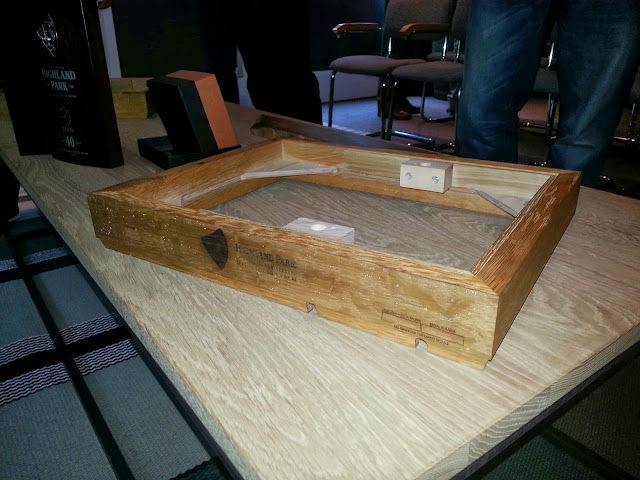
For us the party started with a listen to the Highland Park LP12. The plinth is made from lids of oak whisky barrels which could be up to 200 years old.
Due to the different material the plinth is made from 4 separate pieces of wood rather than being assemled from 4 pieces cut from a single piece.

Highland Park 40th Anniversary LP12
Listening Through Fully Active Solo Driven 350ps in the Linn Home
Example Plinth with Branding Literally Branded Onto the Wood
Over The Barrel
Only 40 produced.
Includes all the top end kit such as Ekos SE, Uphorik, Radical etc.  Also includes a bottle of 40 year old Highland Park in a presentation case.
Rumour has it that they sold out over the weekend (although, as dealers have to buy their kit from Linn, not all may have found a final home yet).

Sounded nice enough, but still vinyl with its inherent surface noise problems (although, of course, at this level surface noise is very much reduced).

Of all the dems in the Linn Home (main room and the 2 lounge size rooms at the back of the building) were less than brilliant - I don't think this facility does the systems any favours - the Akurate room with the Emily Barker demonstration was the most enjoyable.

Monday, 24 December 2012

Merry Christmas From An Enthusiast

At last, a long awaited addition to the Linn Brochures collection.  This time it's the "An Enthusiast Explains" edition which features Ivor Tiefenbrun peering around the side of a Keltik loudspeaker.
This brochure is from the time when Linn were essentially in the cut over point between their first gen products (e.g. Isobarik, Kan, Intek etc.) and estabilishing their next generation built around more common drivers across the speaker range and the now well known monolithic, minimalist black box industrial design.


Products featured:

Isobarik (orignal PMS / DMS)
Keltik
Kan
Kaber
Nexus
Helix
Index
LP12 Lingo
LP12 Valhalla
LP12 Basik

Basik
Axis
Ekos
Ittok
Akito
Troika
Asaka
K18
K9
K5
Karik
Numerik
Kremlin
Kairn
Pretek
Intek
Active crossover for Keltik
Active crossover for Isobarik
Active crossover for Kaber
Klout
LK280
LK100
Powertek
Lingo
Dirak
Spark


Find the brochure images here:

Linn Brochures & Ads

Enjoy, and seasons greetings to you all.


Thursday, 24 November 2011

The King Is Dead...

.. long live the king (kind of).

No more Linn LP12 means no more playing vinyl discs.  So on sorting them out and valuing them, I really found myself not wanting to part with about 20 of them.  What's the point?  Well its mainly sentimental - there are some that are just too good to part with, in terms of their quality such as the Mobile Fidelity Sound Labs Studio Masters and there is the Sniff n the Tears collection that took some putting together then there are a few that were gifts and therefore have some meaning for me.

So a few weeks of hunting on ebay and missing a few near bargains and missing lots of nowhere near bargains I've ended up with a "new" turntable.  Its a late 80s / early 90s simple deck from Thorens - a TD280 MkII.  Belt drive, lightish alloy platter, two speed via an arm that lifts the belt up and down the pulleys, a lightweight very plastic looking arm and three bouncy feet for isolation.  I put on a new belt (£7.50), and a Goldring Elektra cartridge (it came with an Audio Technica of some sort of unknown origin and condition) and all for the princely sum of £24.  The photos on ebay showed the deck as being very dusty, but as can be seen below, its cleaned up remarkably well and plays tunes nicely.

Result.


Wednesday, 31 August 2011

Linn Streaming Evening, Chris Brooks Audio

Late summer and Chris Brooks Audio in Warrington has a streaming open evening (A Mid-Summer Night's Stream, but we'll forgive that one!) to launch the new Linn Akurate DS/1 and Klimax DS/1.  The local debut of the new Isobarik speaker was quite and interesting addition.

Chris did lots of talking about the technologies and why they were so much better than CD etc. etc.  As is often the case with this kind of evening, there was a bit too much talking rather than letting the music do that by itsself, but I guess us punters need to pay for our glass of wine / orange juice!  It was a very warm evening which gave the guys in the shop a bit of a problem as the main upstairs listening room was rather stuffy with 10 or so bods and some heat producing hifi gear.  Windows open to cool the room was just too noisy so it was a constant swing between noise then heat then noise then heat.  A shame, but a bit beyond the control of the shop.

In the upstairs room, the comparisons were performed - and very well too, it must be said.  Constantly swapping between different streaming devices could've been a problem as the iThingy control devices could've easily suffered from user error and be pointing to the wrong source at the wrong time. The system was an interesting mix of amps (all from Linn of course), and I can't remember if the speakers were being driven actively or bi-amped.  I think the Isobariks were being driven by the power section of a Majik DSi (that's a Majik DS and integrated amp all in one mid-sized case) and an Akurate amp of some description - probably a 4200.

Firstly, impressions of the new Majik Isobarik speakers.  They're about £3,500, so that makes them low mid-range in Linn terms and top of the Majik speaker range.  The shop had only had them for a few days so they might not've been run-in properly, I wasn't convinced that the Majik DSi amp would be really grunty enough for a speaker of this size and quality and I would imagine that the shop guys would need to experiment some more to get the best positioning for them.  There was a Linn guy on hand from the factory, so they had a reasonable chance of being about right.  I found them extremely dry but really rather superb on the detail front.  Bass, for an Isobarik, is not as deep and extended as I imagined it would be, but as expected from Linn, timing felt very accurate and enjoyable.  They were great for hearing the differences in the sources - but they didn't really give that sense of excitement that I look for in a system - just a bit to restrained.  Amps?  Not run-in? Or is that just the way they are?  Perhaps we'll see them in the press soon and find out what the "experts" think.


So to the sources.  All the following were demonstrated through this system:

Majik DSi (no recent changes to this, save the addition of the Dynamik power supply about 12 months ago) - the standalone streamer version of this (without the integrated amp section) is £1,900

Akurate DS/1 - the new version @ £4,500


Klimax DS/1 - also a new version @ £10,000 (top centre in this mouth-watering stack of music playing technology drool-fest)


How was the sound?  Well the Majik was very impressive as a starting point - lots of detail, good timing, clear vocals, good imaging.  Bringing in the Akruate was a big step up, much larger than any of the audience were expecting - the imaging filled the room, timing was stunningly better, separation of the instruments very clear and the pace of the music seemed to pick up somewhat.  Those in the audience with a Majik DS were either reaching for their cheque book, or looking a bit glum.  Then comes the Klimax.  If you look at the pictures of the Klimax circuit board vs that of the Akurate that can be found on the internet then there doesn't seem to be that much difference until just before the final analogue output stages.  Of course, the box is significantly different too.  However, it is clearly different to listen to.  I remember from the first generation of DS products that there was a big difference from Majik to Akurate, then a smaller difference from Akurate to Klimax, meaning that the Akurate was the price / performance sweet spot.  Now though, when you listen to the new Akurate DS/1, you're probably going to think "good grief, how can the Klimax be better than this?".  But it is, and significantly so.  The step from Majik to Akurate described above is delivered again in the next step.  Very, very impressive.

So those with Majiks and Akurates where then concerned that they were going to be disappointed when they got home, and those who have yet to go streaming were thinking that they would have to save up for the Klimax, or give up now if that was unlikely to be attainable.  However, Chris had another trick up his sleeve.

Bear in mind that I have a Meridian CD player and chose this over and above players from Linn and Naim - albeit about 10 years ago.  I've never really been convinced about Linn's CD players - they've always been somewhat underwhelming.  However, Chris rolled out a Linn CD12 - no longer in production now, but a £12k machine in its day.  Lets cut to the chase - the Majik DSi completely wiped the floor with this CD player.  Period.  I hope there was no one there who'd bought one of these...  This made the Majik DS or DSi owners and those who can't aspire to anything further up the range much happier!

Elsewhere in the shop, the back room downstairs was running a Klimax DS/1, Klimax Control, and indeterminate Klimax power amp and a pair of 350A speakers.  Outside the dem room, this system was attracting the most attention.  It was sounding very detailed and bass was stonkingly deep but extremely well controlled.  But for me, there was something missing.  Its a bit difficult to put into words, but I would describe it as a coolness - and I don't mean a lack of warmth, I mean a lack of emotion in the music - for me this makes it a bit pointless as its the emotional content that's most important.  Technically very very impressive, but overall just not something I wanted to sit down and listen to attentively.  It doesn't help on evenings like this that folk like to chatter when there's music playing, so its not a truly fair position to take, and I won't write off this system on the basis of this event.

Fortunately, no-one was interested in the downstairs front room, given that there was lots of loverly Klimatic Kit to listen to in the bacK.  Here in the front room I discovered something rather wonderful - the opportunity to listen to a complete "as good as it gets within the Akurate range" fully active system, all on my own, with no interruptions from chatter.  Akurate DS/1, Akurate Kontrol, 3 x Akurate 4200 power amps and fully active Akurate 242 loudspeakers.  Once the guys got this powered up for me, initial impressions weren't all that good - good, but not stunning.  A quick look down the back of the source / control components an "ah!" and off went my attentive shop assistant.  Approx 30 seconds later, he returned to the room clutching a pair of Linn silver analogue interconnects.  Off went the system, out came the balanced XLR leads from DS to pre-amp and in went the unbalanced Linn sliver interconnects.  Once powered up again, this change was absolutely stunning.  I've read lots about balanced connections outperforming unbalanced - this is the conventional wisdom.  However,  I would suggest its a matter of the combination of kit in use and the cables in use too.  This was not a subtle change, in this system, the unbalanced Linn interconnects were clearly superior.  Never assume without listening!  At last I was hearing something truly great.  Track after track (16 bit CD rips and 24/96 high res) had me glued to the music, often staggered by the scale and depth of the soundstage, shaking my head at the resolution of female vocals and actually gasping at the lowest of low notes, slamming out in a controlled way, or rumbling - deeply underpinning the rest of the music.  I spent a good hour browsing through the tracks available on the shop's NAS via an iPad - this is a great interface and very intuitive to use.  This system is the top end of Linn's mid-range range.  But that's not mid-range in traditional hifi terms, its a Linn perspective.  This system is knocking on the door of £30,000 without cabling, so its truly in the aspirational class for most of us.  However, I'd have no hesitation in recommending this system as a must listen to anyone fortunate enough to be able to consider spending that kind of cash on music.

It gets me thinking though...how long will it be before you can pick up this system for under £5k on ebay?  I'd give it 5 years or so.  Hopefully the DS tech will still be relevant then!

There was no LP12 vs DS comparison at this event, I'm sure that would be an interesting one, but a top end LP12 is North of £10k now, and I doubt it would get close to the Akurate DS/1, never mind the new Klimax DS.

P.S.  There's a lot of debate in the bloggosphere and the forumosphere (?!) about what Linn's doing for owners of the existing Klimax DS (now known as the DS/0).  If you take your Klimax DS/0 to your Linn dealer they'll upgrade it to a DS/1.  I'm not sure how much this costs, but the key thing here is that they don't just throw out the old DS/0 innards.  In fact, they re-box them into a case that's somewhat simpler and more cost effective than that of the Klimax - they call it the Renew DS.  The idea is that it gives customers and "almost" Klimax DS/0 to use in a second system in their homes.  Some customers think this is a great idea, others seem to think Linn are exploiting them by charging them for a Renew box to put their old innards into.  For me, this sounds like a great solution - you get a lower cost Klimax DS/1 through the upgrade and then you get a brilliant DS player for another room, meaning that the old electronics don't go on the scrapheap.  Its optional.  What's not to like - it would be good if other hifi manufacturers could follow this lead - re-boxing older kit when an upgrade is applied to the main system, great idea.