"What a refreshingly honest blog about listening to music through hi-fi. So happy to see views based upon the enjoyment of music rather than so-called sound 'quality'." - Peter Comeau, Director of Acoustic Design at Mission / Wharfedale
Showing posts with label DAC. Show all posts

Monday, 9 February 2026

On Utopik - Linn's Latest SMPS Power Supply Reviewed

Linn power supplies have evolved over the years, sometimes quietly, sometimes with much fanfare.

Its a bit tricky to say precisely when Linn started to adopt Switched Mode Power Supplies (SMPS) - but it was during the LK era and they appeared in products such as the Kairn pre-amp and Tunebox active crossover.  Initially (and, of course modestly) they were branded as Brilliant, then Slimline, then they were just a PS in a product, gradually adopted across pretty much the full range of Majik, Akurate and Klimax units - pre-amps, streamers, turntable power supplies and power amps.  Until around 2009 these PSUs were pretty much anonymous, but then Linn made a big fuss about a new generation of SMPS - the Dynamik.

This was gradually rolled out across the then current range of products but, crucially, it was also available as a replacement unit across that same product range.  Mostly as a drop-in replacement in Majik and Akurate products, sometimes as a drop-in, sometimes as a return-to-base-for-machining process within the Klimax range.  There was much fanfare about this product but, more tellingly, almost everyone who heard the difference opted for the upgrade.  Linn provided a sticker for the bottom panel of your kit and a new 5 year warranty for the power supply.  It was a big success and probably made a nice contribution to Linn's bottom line.

But hey, a manufacturer offering to make an upgrade available to existing customers is definitely something to be praised.  So many other manufacturers expect you to ditch your existing, perfectly good, equipment and buy a whole brand new box.  I hope Linn continue this service for many years to come.

Which bring us to the (u)topic of this post.  Linn's latest power supply upgrade - the Utopik - was introduced in late 2022, starting with the Selekt (now Selekt Classic) modular streamer / pre-amp / DAC / processor / power amp unit.  Soon it was available for the "next generation" top of the range Klimax DSM/3 then gradually rolled out across the rest of the non-power amplifier products, including integrated loudspeakers, streamers, pre-amps and Akurate level Exaktbox processor / DAC units. I added Utopik to my Klimax System Hub streamer / pre-amp a couple of years ago and thought the improvement worthwhile rather than revolutionary.  That unit is, of course, digital only, do it was almost a surprise to hear any improvement, but there it was for all (who have heard it) to hear.  There are some customers who say they think that it is a bigger upgrade than the Organik DAC, but that's not my perception having heard the 2 separate upgrades in the Klimax DSM which is a streamer, pre-amp and DAC.

So what have Linn got to say for themselves about the Utopik power supply?

Well, here's the blurb, sourced from Ripcaster.co.uk - a Linn Dealer:

"Utopik - the all-new generation of exceptionally efficient and highly responsive Linn switch-mode power supplies.  This exceptionally efficient, highly responsive, and precision-regulated power supply design is Linn's first entirely new topology since 2009. Multiple feedback loops measure output versus input at each stage of the power supply, and persistently filter out mains-borne noise and eliminate 50Hz hum, even at extreme volumes.  Featuring intelligent Valley Switching, Power Factor Correction, and with precision-regulated and isolated power rails – these power supplies are Linn's cleanest and best yet.

Power is nothing without control:  Multiple feedback loops measure output versus input in each stage of the power supply, and persistently filter out mains-borne noise and 50Hz hum, even at extreme volumes. The sophisticated control mechanism at Utopik’s heart is optimised for handling between 90-250Hz mains supply, ensuring that it performs perfectly anywhere in the world without compromise. Utopik is electrically cleaner, and more efficient at higher power than any power supply we’ve ever made. Of course, this is better for the environment and saves on your electricity bill, but efficiency is also a reliable measure of how well a power supply is performing – as energy isn’t being lost as heat or noise. If you improve efficiency, you improve electrical cleanliness.


Intelligent Valley Switching: Utopik is an extremely sophisticated switch-mode power supply. In a sub-optimal switch mode power supply, you have no control over where in the input voltage waveform the switch turns off or on. It would switch anywhere, and randomised noise is generated. With Utopik however, we monitor oscillation at the transformer’s input, and look out for the lowest troughs in the voltage – a technique named Valley Switching. Utopik only throws the switch when at the floor of one of these valleys. With intelligent monitoring and control, we’re therefore keeping voltage as close to the ideal 0V when switching, resulting in dramatically reduced switching noise.


Precision-regulated Rails: Utopik has separate layers of precise regulation on its four power rails. Each has its own feedback loop, so that it is separately controlled, managed and isolated. This improves isolation between the relatively noisy digital power rail – with processors sporadically computing packets of data – and the analogue rails which feed components more sensitive to power fluctuations. Whatever the current demand of any aspect of the whole product, the remaining rails are unflinching.

Power Factor Correction: Switch-mode power supplies are common in modern technology. When in operation, each one of these is intermittently taking short gulps of current from the mains – acute spikes in current draw – which introduces mains-borne noise that affects other products on the grid by producing harmonics in the supply. Utopik modifies its current draw to be proportional to the voltage, and spreads it out over the length of the AC waveform. Instead of taking short gulps, the current draw is spread out to be more consistent over the length of the waveform. This is called Power Factor Correction – and by implementing it in Utopik, we can ensure that the product it’s powering isn’t introducing any distortion to the mains supply in the room, the building, and beyond.
Power Factor Correction is yet another technology in the power supply chain that regulates voltage and ensures that no ripples get through to the output stage of the product as a whole.  
Delivering the cleanest possible power to the rest of the chain. Utopik presents a consistent 400V output – anywhere in the world – regardless of mains supply quality."

So there you go. A lot of claims, although to look at, it's physically very similar to Dynamik.  Some comment on its switching frequency being much lower on Utopik to explain its performance, but I'm not sufficiently knowledgable to confirm or deny this speculation.

At the time of writing, Utopik can be added to the following Linn products:

Klimax DS (all models)
Klimax DSM (all models)
Klimax Renew DS
Klimax System Hub (all models)
Machined Radikal (original, /1, /2)
Klimax Exaktbox
Selekt DSM (all models)
Akurate DS (all models)
Akurate DSM (all models)
Akurate Exaktbox-6 and -10
Akurate Kontrol (all models)
Akurate CD
Kustom DSM Z4 and Z8
Majik DS (all models)
Unidisk (all models)

Two Versions

There is a physically larger version of Utopik that was released first, then there is the Utopik Miniline (the marketing term, as can be seen above, slimline seems to have made it onto the circuit board labelling).  The standard product is available in versions of Selekt and Akurate products and for the Klimax DSM/3.  The older, and physically much slimmer, Klimax products seem to have to make do with the Miniline version.  As there is only one choice to fit the product you might own, there's no way to directly compare the performance of each version against each other. Most new products have Utopik onboard from their release date - examples being Selekt Edition, Klimax Exaktbox/3 and Klimax Solo 500 and Solo 800.  Although the integrated top of the pile 360 loudspeaker is a very recent product, Linn are a little cagey about if it has Utopik or not - there's a fair chance that it is a hybrid product from a PSU point of view, perhaps having Utopik for the lower current areas such as the DACs, and Dynamik for the power amps.  But this is purely me speculating.

Klimax Exaktbox

As mentioned previously, Utopik for the streamer / pre-amp Klimax products, such as Klimax DSM, were released early in the Utopik product life.  Those with Klimax Exaktboxes have had to wait just over 3 years to see the retro-fit become an option. Even though it is the Miniline version of the PSU that comes to Exaktbox, its still necessary for a Linn dealer to send the unit back to the factory for some internal machining and the installation of the Utopik.  My UK domiciled unit was away for about 10 days, which is a very decent turnaround.  The PSU upgrade comes with a new 5 year warranty.

Just briefly - Exaktbox is Linn's proprietary multi-channel processor / DAC.  It takes an Exaktlink feed from a Linn digital streamer / pre-amp and does lots of stuff to do with phase correction, time alignment and loudspeaker crossover requirements.  Its a 6-channel box so is good for up to 6 loudspeaker drivers in mono or 3 loudspeaker drivers in stereo.  Its output is fed to multiple power amplifier channels (one channel per speaker driver) and on to speakers which have had their internal passive crossovers by-passed or removed.  Of course nearly all Linn speakers are supported with this digital approach to active crossovers, as are many others from third party provider speakerfilters.


Installed

For your investment, unlike with the Utopik upgrade to the Klimax System Hub, Linn provide you with a sticker for the underside of the Exaktbox to show the upgrade has been installed.  When the unit comes back from the factory (it has to go back there as the internals need to be machined to accommodate the new PSU) a "Utopik" sticker is provided in the box - it also includes the serial number of the Exaktbox.  Its good that this is provided, but its not an ideal solution - the sticker is too shallow and too long to go over the existing "Powered by Linn Dynamik" logo on the base panel, and a bit clumsy looking to sit underneath the existing serial number information.  I guess its generic and not specific to the Exaktbox, but that's a bit disappointing at this price. I opted to squeeze it in under the serial number.


Context

Here's the system context of this review:

Sources: CD rips and 24 bit downloads from Minim Server on Melco N1Z / Qobuz streaming service
The Chord Company Sarum-T ethernet cable
Streamer / pre-amp: Linn Klimax System Hub/0 fitted with Utopik PSU
Meicord Cat 6 Exaktlink
Processor / DACs with analogue outputs: Linn Klimax Exaktbox/2 which has the Organik R2R ladder DAC and a Dynamik PSU - this is the item to which the Utopik power supply has been added. This is has the crossovers from speakerfilters installed for the PMC Fact.12 loudspeakers.
Linn Silver analogue interconnects
3x Lejonklou Tundra Stereo 2.5 power amplifiers
Naim SuperLumina loudspeaker cables
PMC fact.12 loudspeakers on Iso Acoustics Gaia feet
Puritan Audio mains cables
Quadraspire Evo racks with Mission / Cyrus Isoplats

Listening Notes

I ran the system for about 10 hours before I started to do any listening.  I've no idea if Utopik is considered as needing to be "burned in" but I thought I'd give it some time anyway.  At the time of writing the system has been played for around 30 hours - I can't say I've heard any variation over that time period, but obviously can't say that none will happen in the future.  Many, of course, say that there's no such thing as burn-in...
Thoughts here are directly related to how the system sounded when the Exaktbox was powered by Dynamik, they're not intended to be absolutes.

Like Utopik for the Klimax System Hub streamer / pre-amp, the first thing to notice is yet another drop in what's going on in the negative parts of the music and the gaps between the music.  Yep, a tiny layer of noise has gone - and its a weird one because (like an extremely well set up subwoofer), you don't notice it until its not there.  I'd say this was a bigger change to this aspect than the PSU made inside the streamer.

Secondly, it seems that the music has picked up in pace.  Of course it hasn't, because the track still plays for the same length of time, but there is a little more urgency - I would guess this has something to do with the reproduction of transients of each new note - presumably there's a little bit less time lag for them to happen.  Thankfully this has been achieved without any sign of aggression nor harshness, which is the danger with systems that "crack along".  Its a welcome change, not one that should put you off if you like a more laid back kind of presentation - this isn't like a change between warm valves and analytical digital which can be presented as edginess, its just what feels like a timing improvement.

The main change, for me, is in the way that the music interacts with itself, if that makes any sense.
An example is Submotion Orchestra's "Prism" (from "Kites" on SMO Recordings) starts with Wood's floaty vocals underpinned by strings - after about 1m 30s the bass line kicks in.  Now this sudden contrast feels greater, the emotional change has more impact, the contrast between voice and backing is greater. Then as the vocals and bass line work more closely together you get a real feel for a collaborative effort building the crescendo across the rest of the track.  

On Tash Sultana's "Kiss the Sky" (from "Return to the Roots" on Lonely Lands Records) the lilting dubby background flows more convincingly, the kick drum effect has more thump, the initial cymbal crash has more impact and startles that bit more than before. Its an interesting contrast between the crispness of the rimshot, the brass and the flowing easy going nature of the under-currents.  The shimmering guitar part towards the end of the track really adds more lift to the song and makes me wish for a longer version to continue the experience. Overall the track is more fun to listen to and I get into the groove straight away.

Malia and Boris Blank's "Smoldering Ashes" (from "Convergence" on Universal) starts with a tom tom type drum pattern.  Previously this was easy to follow in terms of the pattern and the indivdual drum sounds but now it bounces along which gives a more jaunty feel - the toms that have a bass under pinning them have more punch and drama.  This track is full of tension but the short punctuations of minor chords, using various different instruments, really add more impact and shades of intrigue. The drum pattern is easier to follow through the whole track. 

Bonobo adds a few clicks and twists to the beginning of the track "Brambro Koyo Ganda (featuring Innov Gnawa)"  (from "Migration" on Ninja Tune). They might seem a bit superfluous, but actually they weave in and out of the whole track. This weaving in and out is now more relevant and tends to help tie the intro into the whole track.  Then there's that bass line - now more punchy, more purposeful and again there's that new ability to drive the track along with more energy but without more aggression.

To find out how an improvement to the presentation of individuals and instruments improves with this PSU, Michael Kiwanuka's recent track "The Rest of Me" (from "Small Changes" on Polydor) is a good example. The resonance qualities of the opening acoustic guitar are richer, more nuanced and add to the feel good factor right from the off.  The cymbals are shimmering, adding to the good feeling, not clashing nor jarring - they're full of subtle complexity.  The bass guitar, like the Malia track, bounces along to add feeling and groove.

To summarise, this PSU will give you more of a feel for the rhythm of the music, the contrasts, the emotions and the complexities.  If it is value for money, or not, is a personal choice.  For me its not far off the improvement that the Organik DAC brought to the musical experience.  More believable, more engaging.

Now, just one more track...


Wednesday, 15 July 2020

LINN Exaktbox-i: Photo Comparison Between Majik (Pre-Katalyst) and Akurate Katalyst Versions

Linn's carefully hidden Exakt separates system consists of the following key components:

An "Exakt ready" streamer / pre-amp (such as Klimax DSM / Akurate System Hub / Majik DSM amongst others)
A proprietary Exaktlink cable which uses standard Ethernet cables
An Exaktbox which is essentially a digital active crossover and digital signal processor, amongst other things (such as Akurate Exaktbox10 / Klimax Exaktbox)
Power amps, which can be from Linn or any other manufacturer.

However, there is an option to combine the last 2 elements - the Exaktbox and the power amps.  This is called an Exaktbox-i and combines 8 channels of DAC / digital active crossover and 8 channels of power amplifiers in Linn's normal just-a-bit-narrower-than-standard box.  There's really only one of these in the range, but it has evolved in the 4 or 5 years it has been available:

1 - Intitially it was a Majik Exaktbox-i containing Majik level DACs and 100W power amps, all in the Majik level casing
2 - Then it was re-badged the Akurate Exaktbox-i but still contained Majik level DACs and 100W power amps, but now in the more substantial Akurate casing.  This version was very short lived, soon replaced by:
3 - Akurate Exaktbox-i with Akurate level Katalyst architecture DACs but sill with Majik level 100W power amps in Akurate level casing

As is often Linn practice, those who bought the earlier products don't get left behind when there's an upgrade.  So it is possible to have a Majik Exaktbox-i upgraded to Akurate Katalyst Exaktbox-i internals but retaining the Majik casing.  The first Akurate Exaktbox-i can also be upgraded but I expect most of those were done pretty much automatically as there was a deal where the cost to upgrade was only the difference in price between Katalyst and non-Katalyst versions.  It would be very odd to find one of these that hadn't been upgraded, given the small price to do so.

I've been using an original "pre-loved" Majik Exaktbox-i for a while for Exakt filter design activities.  For some reason, now seemed to be the right time to take that up to Katalyst specification.  So that has allowed me to make comparisons between the circuitry of the non-Katalyst and Katalyst versions.

A similar comparison of the Akurate Exaktbox10 (April 2018) is here.

Much has been written about the musical capability of the upgrade from Linn's previous generation DAC to the Katalyst DAC, and I can't think of anyone who has anything but praise.  An example is here regarding the upgrade in Linn's onboard active Akubarik speakers.  So I'll not write about that here as it is well trodden path. With the upgrade being applied to the Exaktbox-i back at the Linn factory, there's no ability to directly compare the 2 products back to back.

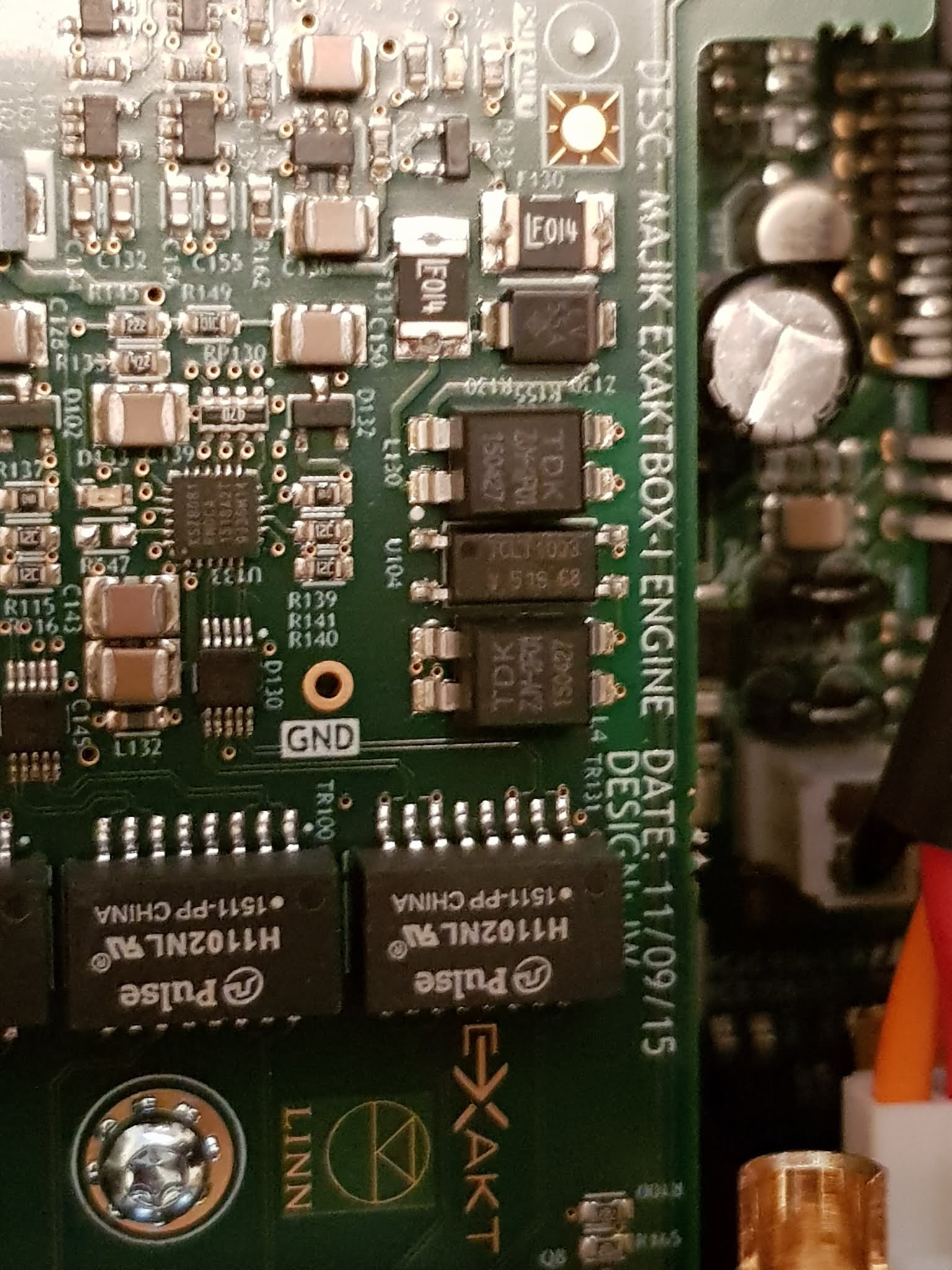
To the photos.  Note that every single audio board (DACs are combined with the power amps) and the Exakt processing board are changed in the upgrade - the photos with the green circuit boards are the Majik non-Kat version, the black circuit boards are the upgraded Kat version.  The PSU and the casework is untouched, save for the addition of a Katalyst sticker on the underside.


Externally the box is unchanged


BEFORE AND AFTER UPGRADE COMPARISON PHOTOS:

The most obvious difference from an overall perspective is the change from green to black and gold boards

Each side of the enclosure has 4 channels of power amps (the chips bonded to the heatsink are the obvious components) and 2x stereo DACs.  The DACs above are the cross-shaped cluster of an oblong chip surrounded by 8 smaller chips

Here you can see the difference in the DAC architecture - now we have the 2x stereo DACs which are the 2x flat square chips - the board layout is very different


The "flyover" board down one side of the enclosure is the Exakt processing board.  The above original layout has 3x FPGA processors - the large flat square chips. The one on the left is the "master" processor with the other 2 processing 4 channels each
On the new board there is one more powerful FPGA chip in the centre doing the work formerly done by 3x separate chips


Board labelling for channel 5 to 8 DAC / power amp board has been relocated


Relocated labelling for the Exakt board


The increased complexity and density of the components surrounding the DACs is clear in this comparison.  The Katalyst DAC has multiple different regulated power supplies which probably explains this increase in components


SOME KATALYST ONLY PHOTOS:


Xlinx FPGA that does all the Exakt processing


DACs and power amps for channels 1 to 4 live in the shadow of the Exakt board


Tuesday, 13 September 2016

Exaktbox Comparison. Something to Consider When Choosing Which Exaktbox To Use: Stereo or Dual-Mono?


EDIT, 2018:  PLEASE NOTE THAT THIS POST WAS WRITTEN PRIOR TO THE /1 UPGRADES FOR AKURATE AND KLIMAX EXAKTBOXES - THE "KATALYST" VERSIONS.  THE FOLLOWING ARTICLE RELATES TO /0 EXAKTBOXES AND IS NOT RELEVANT TO /1 EXAKTBOXES

How exact is Exakt?  Well, you’d think, from the branding, that it would be as exact as Linn could make it.  A recent online “conversation” revealed that all is not exactly as it might seem.  And its all down to processing power.

A quick review of Exakt – it’s Linn specific set of processes in the digital world that changes the signal being fed to a digital to analogue converter (DAC) specific to each driver in the speakers to allow the sound coming out of that driver to correct for room nodes (like boominess), for manufacturing tolerances (in the higher range of Linn speakers), time for the signal to travel to the listening position, to make sure that driver only gets the part of the frequency range particular to that driver, to correct for phase alignment issues between drive units at the crossover point and to correct for phase errors within the drive unit itself.  All very much in real time (it takes about 45ms).  Clever stuff.  But that takes a fair amount of processing power, something that happens inside a Linn Exaktbox which takes a feed from the Linn digital streamer / pre-amp, does all that processing and feeds the signal to multiple DACs – one per speaker driver – which then feeds to the power amp per driver and then onto the speaker driver.

So all of the above, applied to a pair of speakers that have 3 drivers per speaker (known as 3-way), requires 6 channels of processing and DACs.  As this is a particularly good “use case” to illustrate the differences between stereo filters and dual-mono filters, that’s what I’ll step through in this post.

Linn make an Exaktbox that has 6 channels (in fact, there are 2 of these, one at Akurate level, the other at Klimax level).  So, that it makes it very easy to choose an Exaktbox to suit a pair of 3-way speakers right?  3 drivers x 2 speakers = 6 channels.  So Exaktbox 6 (Akurate or Klimax level) will do the job.  Well yes.  And no.  Why not?  Well, we need to take a look at what’s in each of those boxes.  Exakt processing is done in a processor called an FPGA, and the number of FPGAs you get per Exaktbox varies according to which version in use.  Take a look at the diagram below.  On the left, Exaktbox 6 (Akurate or Klimax, for this discussion they’re identical on the Exakt processing side), and on the right the Akurate Exaktbox 10 (actually called Akurate Exaktbox without the 10, but lets not get into branding choices here!).  Clearly, there are 6 DACs in the Exaktbox 6 and 10 DACs in the Exaktbox 10.  But, more crucially for this post, the Exaktbox 6 has 1 Exakt processor, the Exaktbox 10 has 2 Exakt processors.  Note that these diagrams are simplified for the purposes of illustrating this comparison and test (for those who are really interested, in Exaktbox 6 there is a "Master" processor and 1x "Slave" processor, in the Exaktbox 10 there is a "Master" processor and 2x "Slave" processors).


Now, the Exaktbox 10 has to be capable of running 2 speakers of up to 5 drivers per speaker (5-way).  So, for the sake of argument, lets assume that a 5-way speaker will use 100% of each Exakt processor in the Exaktbox 10.  This might not be true, but it keeps the discussion relatively simple – believe it or not! So, with 2x mono Exakt filters – one mono filter per speaker – both Exakt processors will be fully busy:


But we’re talking in this post about 3-way speakers, which probably need less processing power than a 5-way speaker filter.  Again, using an assumption that is purely that, I’m going to say that a 3-way speaker will consume 3/5s of the processing power of a 5-way speaker.  So then we have the 2 Exakt processors in an Exaktbox processor, running a pair of mono 3-way filters might look a bit less busy than the above example.


Now, if we take those left and right Exakt filters out of the Exaktbox 10 and put them into the Exaktbox 6’s single Exakt processor, what happens?  Well, it gets a bit over full.  I know these are all approximations and assumptions, but its just to illustrate what’s going on here.  The principle applies, regardless of the precise percentages of capability.  So we then have an Exaktbox 6 single processor that’s too full, you can see here that stacking up the 2x mono filters into the single processor doesn’t fit:


So what to Linn do to make it possible for an Exaktbox 6 to support 2x 3-way full range speakers?  Well, they don’t run the 2x mono filters like the Exaktbox 10, they run a cut-down stereo filter.  In order to achieve this, the stereo filter does less complex (and therefore less accurate) processing so it will squeeze into the space available in a single processor:


And what does that mean for sound?  Well, it’s less accurate, as you might expect.  Hence, Exakt is sometimes less exact than it might be.

Experiment

Its taken a while for this experiment to happen in Musings’ listening room.  Why?  Well, it took a while for Linn to get around to releasing the “dual mono” Exakt filters for the PMCs amongst others such as Linn’s own Keilidhs.  So if you were running an Exaktbox 6 or an Exaktbox 10 for PMCs back in May 2016 (like me), then you’d not hear much of a difference between them as they were both running the compromised stereo Exakt filters.  In fact, the Exaktbox 6 sounded slightly better due to the greater space and better circuit layout inside the box.  But this was a small difference and has nothing to do with the Exakt filters in use.


Let’s be clear here, even the compromised stereo Exakt filters, with my PMC Twenty.26 speakers, Exakt brought a step change in performance to the system.  See my review here of my first impressions of these speakers with Exakt.  Those impressions were written with stereo Exakt filters in an Exaktbox 10, per the diagram below:


But a few weeks back, Linn finally released the dual-mono Exakt filters for the PMCs.  So the system was set up with stereo filter in the Exaktbox 6 and dual-mono filters in the Exaktbox 10.  As below:


Everything else in the system was kept the same – same Akurate Exakt DSM source, same Chord C-Stream cable for the Exaktlink, same 6x Linn silver interconnects and same 6x channels of Akurate power amplification and speaker cables.  The same SPACE Optmisation settings were applied too, leaving only the stereo vs dual-mono Exakt filters being the only difference between the 2 set ups.  Yes, there’s the better layout of the circuitry in the Exaktbox 6 to allow for, but earlier testing has shown that as being fairly minor (worth having, but not worth trading equipment for, if you already have an Exaktbox 10, IMHO).

Although it takes about 10 minutes to swap all the interconnects over between the 2 boxes (and power up each drive unit one at a time, starting with bass and working up the frequency range to ensure all the connections are correct), its pretty easy to hear the benefits that dual-mono filters bring.  As is often the case, its not that easy to describe, especially given how good the stereo Exakt filters are. But lets say there’s just a lot more of everything without adding any clutter at all.  What you think is very stable imaging, becomes even more stable, wider and deeper too.  What you think is lots of space between and around instruments is a good bit better defined.  Bass appears to go a bit deeper, but room nodes are not excited any more than they were.  Some sounds evolve with even greater texture through the lifetime of a note.  There’s another improvement in the flow and effortlessness of listening to the music and following the tune – without thinking about it.  Are there any downsides?  Not that I’ve noted, its all good.  At least its all good if you don’t think too hard about the financial implications, or the idea that, with even greater processing power in future iterations of Exaktboxes, that there might be yet more to come.  But let’s not go there just now!

So what is the conclusion?  Well, Exakt isn’t always as Exakt as it could be.  And if you’ve got 3-way full range speakers like me, the Exaktbox 6 isn’t necessarily the “lower cost” route it might’ve been, as it involves a level of compromise.  But its also worth saying that the benefit brought by dual mono filters is worth having – if I knew this when starting out with Exakt, I would’ve saved up for the Exaktbox 10 over the Exaktbox 6.  It just so happened that the ex-dem Exaktbox available to me was the 10 channel version and it was part of the purchasing choice for a different reason – the option to go to the 5-way Akubariks, had I wanted to do that at some point in the future.  What does that mean for choosing an Exaktbox for other systems?  Well here’s the run down, as it stands at the time of writing, for a stereo pair of speakers:

  • 1x Majik Exaktbox-i – 8 channels – 2 Exakt processors – capable of running stereo or dual-mono filters up to 4-way
  • 1x Akurate Exaktbox 6 – 6 channels – 1 Exakt processor – capable of running stereo filters up to 3-way (and for some small 3-way speakers, that might be as much as is needed as the stereo filter is as good as the processing is going to get)
  • 2x Akurate Exaktbox 6 – 12 channels – 2 Exakt processors – capable of running dual-mono filters up to 6-way (actually, this might be up to 5-way as that’s the maximum number of channels in currently released Exakt filters, but Linn would have to confirm)
  • 1x Akurate Exaktbox 10 – 10 channels – 2 Exakt processors – capable of running stereo or dual-mono filters up to 5-way
  • 1x Klimax Exaktbox – 6 channels – 1 Exakt processor – capable of running stereo filters up to 3-way
  • 2x Klimax Exaktbox - 12 channels – 2 Exakt processors – capable of running dual-mono filters up to 6-way (actually, this might be up to 5-way as that’s the maximum number of channels in currently released Exakt filters, but Linn would have to confirm)

Some observations / thoughts:

  • Linn should update the Klimax Exaktbox to further differentiate it from the Akurate Exaktbox 6 by adding a second Exakt processor.  The idea of a 6 channel Exaktbox that could run a pair of 3-way speakers in dual-mono is very attractive indeed and would be something to aspire to.  Currently, the cost of 2x Klimax Exaktboxes to run dual-mono 3-way speakers is just financially so far out of reach.  Or maybe produce another model called the Klimax Exaktbox 2 with 2x Exakt processors, priced slightly above the single processor version.
  • The Exakt part of the Konfig interface doesn’t tell you which filters your Exaktbox is running.  Exaktbox-i and Exaktbox 10 will run dual mono filters by default, where they are available.  They will run stereo filters if dual mono are not available.  Multiple Exaktbox 6s will run dual-mono if the user / dealer install the mono filters into each one.  Either way, Linn really needs to make it obvious in Konfig precisely which filters are in use.
  • Should I stick with dual-mono filters in the Exaktbox 10, or take the plunge and go with 2x Exaktbox 6s to get that last chunk of performance?
  • Does a Klimax Exaktbox running stereo filters sound better or worse than 2x Akurate Exaktbox 6s running dual mono filters?  Maybe there’s someone out there with deeper pockets than me (or a dealer with the boxes to hand) who would like to experiment?
  • Thanks to MaH at the Linn forum and some pointers to comments made by Linn's lead speaker designer, its clear that not all 3-way speakers will benefit from dual-mono operation over and above stereo filters.  For smaller speakers that don't need such a wide range of low frequencies to be corrected, then the stereo filter is all that's needed and Linn won't be producing dual-mono for those (an example might be the Majik 109).
  • Does this apply to 2-way speakers?  Or does the lower processing requirement of 2-way speakers mean the stereo 2-way filters are just as comprehensive as dual-mono filters?  The bullet point above suggests that small 2-way speakers will probably have only stereo filters, but maybe the larger ones, such as Kudos Super 20 will still benefit from dual-mono filters due to their greater bass extension.

Conclusion

I like the effects of dual-mono filters in the Exaktbox 10 and will be sticking with them for the time being.  I was very happy with the system before the move to dual-mono, its just a very substantial layer of icing on my system cake!  I’m off to consume another slice…

FYI, for those systems using speakers with built-in Exakt processing and power amps, none of the above applies – this is because each speaker has its own Exakt processor on board and therefore, by definition, are running a mono filter each.