"What a refreshingly honest blog about listening to music through hi-fi. So happy to see views based upon the enjoyment of music rather than so-called sound 'quality'." - Peter Comeau, Director of Acoustic Design at Mission / Wharfedale
Showing posts with label Akurate DS. Show all posts

Wednesday, 15 July 2020

LINN Exaktbox-i: Photo Comparison Between Majik (Pre-Katalyst) and Akurate Katalyst Versions

Linn's carefully hidden Exakt separates system consists of the following key components:

An "Exakt ready" streamer / pre-amp (such as Klimax DSM / Akurate System Hub / Majik DSM amongst others)
A proprietary Exaktlink cable which uses standard Ethernet cables
An Exaktbox which is essentially a digital active crossover and digital signal processor, amongst other things (such as Akurate Exaktbox10 / Klimax Exaktbox)
Power amps, which can be from Linn or any other manufacturer.

However, there is an option to combine the last 2 elements - the Exaktbox and the power amps.  This is called an Exaktbox-i and combines 8 channels of DAC / digital active crossover and 8 channels of power amplifiers in Linn's normal just-a-bit-narrower-than-standard box.  There's really only one of these in the range, but it has evolved in the 4 or 5 years it has been available:

1 - Intitially it was a Majik Exaktbox-i containing Majik level DACs and 100W power amps, all in the Majik level casing
2 - Then it was re-badged the Akurate Exaktbox-i but still contained Majik level DACs and 100W power amps, but now in the more substantial Akurate casing.  This version was very short lived, soon replaced by:
3 - Akurate Exaktbox-i with Akurate level Katalyst architecture DACs but sill with Majik level 100W power amps in Akurate level casing

As is often Linn practice, those who bought the earlier products don't get left behind when there's an upgrade.  So it is possible to have a Majik Exaktbox-i upgraded to Akurate Katalyst Exaktbox-i internals but retaining the Majik casing.  The first Akurate Exaktbox-i can also be upgraded but I expect most of those were done pretty much automatically as there was a deal where the cost to upgrade was only the difference in price between Katalyst and non-Katalyst versions.  It would be very odd to find one of these that hadn't been upgraded, given the small price to do so.

I've been using an original "pre-loved" Majik Exaktbox-i for a while for Exakt filter design activities.  For some reason, now seemed to be the right time to take that up to Katalyst specification.  So that has allowed me to make comparisons between the circuitry of the non-Katalyst and Katalyst versions.

A similar comparison of the Akurate Exaktbox10 (April 2018) is here.

Much has been written about the musical capability of the upgrade from Linn's previous generation DAC to the Katalyst DAC, and I can't think of anyone who has anything but praise.  An example is here regarding the upgrade in Linn's onboard active Akubarik speakers.  So I'll not write about that here as it is well trodden path. With the upgrade being applied to the Exaktbox-i back at the Linn factory, there's no ability to directly compare the 2 products back to back.

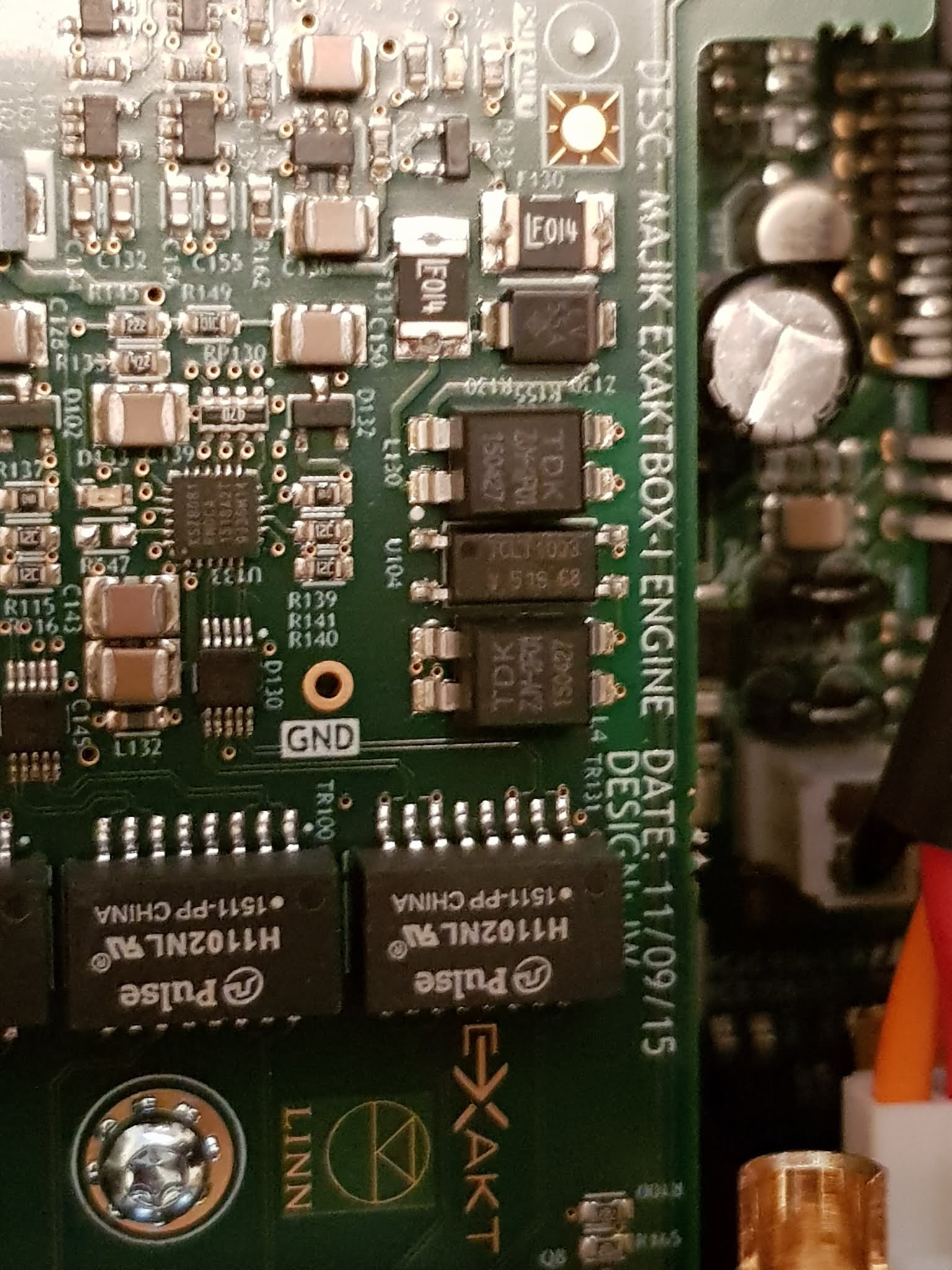
To the photos.  Note that every single audio board (DACs are combined with the power amps) and the Exakt processing board are changed in the upgrade - the photos with the green circuit boards are the Majik non-Kat version, the black circuit boards are the upgraded Kat version.  The PSU and the casework is untouched, save for the addition of a Katalyst sticker on the underside.


Externally the box is unchanged


BEFORE AND AFTER UPGRADE COMPARISON PHOTOS:

The most obvious difference from an overall perspective is the change from green to black and gold boards

Each side of the enclosure has 4 channels of power amps (the chips bonded to the heatsink are the obvious components) and 2x stereo DACs.  The DACs above are the cross-shaped cluster of an oblong chip surrounded by 8 smaller chips

Here you can see the difference in the DAC architecture - now we have the 2x stereo DACs which are the 2x flat square chips - the board layout is very different


The "flyover" board down one side of the enclosure is the Exakt processing board.  The above original layout has 3x FPGA processors - the large flat square chips. The one on the left is the "master" processor with the other 2 processing 4 channels each
On the new board there is one more powerful FPGA chip in the centre doing the work formerly done by 3x separate chips


Board labelling for channel 5 to 8 DAC / power amp board has been relocated


Relocated labelling for the Exakt board


The increased complexity and density of the components surrounding the DACs is clear in this comparison.  The Katalyst DAC has multiple different regulated power supplies which probably explains this increase in components


SOME KATALYST ONLY PHOTOS:


Xlinx FPGA that does all the Exakt processing


DACs and power amps for channels 1 to 4 live in the shadow of the Exakt board


Thursday, 13 September 2012

Linn Akurate DS/0 Dynamik vs Akurate DS/1 Dynamik With ADS/1 Upgrade Kit

As Scott Wilkinson would say - its time to geek out!
Apologies for the title, but there isn't really an easy way to describe this. Here is the bullet point version:

Linn produced an Akurate DS - we'll call this the ADS.
It was then available with a new power supply so it was they called the ADS Dynamik.
Linn made the power supply available as an upgrade so now it is possible to have and ADS Dynamik from the factory or an ADS with a retro-fitted Dynamik. Both are called ADS Dynamik and sound the same.

Then Linn launched a significantly improved Akurate DS called the ADS/1 which is in the same chassis but has a new front panel and a slightly different display panel.
The ADS/1 comes with a Dynamik power supply as standard, but we don't mention that in the product name - its just an ADS/1.
So after launching the ADS/1, the orignal ADS is now called the ADS/0 or ADS/0 Dynamik if it is a later version of the ADS/0 or an ADS/0 with a retro fitted power supply.

 OK? Try and keep up!

Linn have now decided that the circuit boards from the ADS/1 can be retro fitted to the ADS/0 and ADS/0 Dynamik.
You can then use old circuit boards to go into a new, fairly basic case to create the Akurate DS Renew or ADSR.
All ADSRs and ADS/0s that are upgraded to ADS/1 spec will have Dyanmik power supplies.
If you take this option of an upgrade to your ADS/0 or ADS/0 Dynamik you will effectively end up with exactly the same spec as and ADS/1, but it'll be inside an ADS/0 case.

What do we call an ADS/0 with ADS/1 circuitry inside? There doesn't seem to be a concensus, but I'm going to call it the ADS/0/1 on this blog.

So that's the history and naming nonsense out of the way. If you're still with me, now I'll write something about the sonic differences, which is waaaaay more interesting and important of course.

I heard an Akurate DS/1 in my system last week - we did ABABA comparison using the following tracks:

Blues Company - Cold Rain
Blues Company - Dark Days
Trentmoller - Evil Dub
Yello - Tangier Blue
Tom Baxter - Skybound

Found that the ADS/1 was much more organic, the treble even sweeter than my ADS/0/D and the imaging much more precise and 3 dimensional. A nice upgrade that should satisfy even analogue fans (maybe). The only thing that detracted was that the bass seems a little shy - I think that might be more control? We only spent about 20 mins so didn't get into speaker repositioning or anything.

So that's great, as far as it goes.  Being a skeptic I still wanted to hear an ADS/0 that had been upgraded to an ADS/1 for myself - just to be sure that the upgrade was as effective as a completely new ADS/1. I had the chance to take my ADS/0 Dynamik to my Linn dealer just a couple of days ago to compare with an ADS/0 Dynamik that has had the ADS/1 upgraded boards.

System: Akurate Kontrol/1 pre-amp, 2 x Majik 4100 Dynamik power amps with active crossover cards and Majik Isobariks loudspeakers (in Rosewood, just in case anyone thinks the veneer affects the sound...), Linn Silver interconnects, 2 x Linn K400 speaker cables, Quadraspire racks.

Tracks used: Robben Ford "Mystic Mile" Eagle Eye Cherry "Shooting Up In Vain"

Happily, my earlier notes about the ADS/0 Dynamik vs ADS/1 apply equally to this comparison. The upgrade is not subtle. The feeling and emotions in vocals come through much stronger, the bass guitar on the Ford track seems to be playing many more intricate moves which previously didn't stand out as being something so subtle and intricate, decay is longer but doesn't blur into other instruments so much. Imaging also gets a boost - left to right images are much more stable in space and there's more front to back depth. The keyboard on the intro to Shooting Up has so much more texture to it.

In summary, its worthwhile and very enjoyable to listen to.

Funny isn't it? I was very happy with my ADS/0 Dynamik, until I heard the upgrade. When you go back from the upgrade the original sounds black & white and 2D compared to the colourful textures and 3D of the upgrade. So its just a matter of time to get the cash together now!

It is very pleasing to see that Linn is making improvements in the ADS - and that they offer this improvement as an upgrade for existing customers - reducing the normal obsolecence in our consumer society.

p.s. I didn't listen to the ADS Renew as I don't intend to buy one, but the dealer suggested that it doesn't sound as good as an ADS/0 Dynamik and not that much better than a Majik DS Dynamik. I have no view on this, just passing along the discussion.

Sunday, 22 April 2012

Linn vs Naim Mid-range Streamer

Had the opportunity to spend some time comparing Linn and Naim streamers last weekend.

Context:
Friend's system as follows:
Naim CDX2 (latest version) with XPS2 power supply
Naim 282 pre-amp with Supercap power supply
Naim NAP250 power amp
NAC speaker cable
Wilson Benesch The Arc stand mounts with their dedicated stands

We have a difference of opinion on how a system should sound - to me the above seems to interpret the music rather than let it out, and it has that Naim immediacy that borders on shouty. It is much better than it was previously when it used to have a first iteration of CDX2 and a NAP180 amp.

So in came a Naim NDX streamer, using the existing XPS2 power supply. We used my Windows 7 Dell laptop, a 2.5" portable drive, FLAC in 16/44.1 and 24/96, an unmanaged network switch and Asset UPnP. Control was via the buttons and screen on the front of the NDS - really simple to use and gets you up and running quickly. I thought it was much simpler to set up than a Linn DS. It took us about 3 minutes to decide that the CD player was a non-event compared to the streamer. The difference is quite astounding - the streamer is much more organic and precise - it has an hint of analogue about it. The control it brings to the music really makes the CD player sound quite nasty, cluttered and over zealous. Job done. This streamer and power supply combination lists at about £6.5k. You can pick up ex-dems and secondhand and get this down to just under £5k. Not many about though, although I suspect more NDXs will start to surface now the NDS is on its way.

We brought in my Akurate DS/0 Dynamik and silver cables (yes, the 282 pre-amp has a couple of phono inputs on the back!) into the Naim system to conduct a direct comparison. We used the same data source as used for the NDX and used Kinsky on the laptop for control. How did it compare? Well its a tricky one really. I really wouldn't like to say which was better, but there certainly were some differences. For me the Linn brings more detail, separates the instruments better, times the music more naturally (more involuntary foot tapping) and is very musical. To counter this the Naim sounds more analogue, a bit more fluid and gives an open, more airy soundstage - almost like the room in which the recording took place was bigger. I know the current ADS/1 lists at £4.5k, but mine set me back just under half that amount.

So you pay your money (lots more for the Naim) and make your choice. I really would be happy living with either in the Naim system, but if you add VFM into the mix, the Linn wins out significantly.

Oh, and if you take the PSX2 out of the system, the NDX is a real disappointment compared to the ADS/0 Dynamik, but still outperforms the CDX2.

If we can find a suitable cable, I'll try and report back on the same comparison in my Linn system...
Scores (a bit simplistic, but there you go - all I'm trying to do is indicate relative performance rather than absolute performance):
Naim NDX / XPS2 = 90%
Linn Akurate DS/0 Dynamik 89%
Naim NDX = 75%
Naim CDX2 / XPS2 = 65%

Monday, 30 January 2012

LINN AV5125 vs C5100

Still haven't got the decorating finished so this isn't in my active Keilidh system, but when the AV5125 arrived over the weekend I had to get it out to give it a test.


AV5125 = 5 channels of 125W per channel into 8 ohms.  Older design with a standard power supply - can be upgraded using a Dynamik power supply, but this one is standard
C5100 = 5 channels of 100W per channel into 4 ohms.  Reasonably recent (but not current) design based on Linn's Chakra circuit design.  Very similar to the current Majik 5100 power amp, but without the current Dynamik power supply.

The end game is to use 8 channels of AV5125 and C5100 to power my tri-active Keilidhs and bi-active Centrik and compare them against my current many box collection of Cyrus amps.  Then decide which to keep - Cyrus or Linn.

So for testing purposes (to make sure the AV5125 was fit and well) I rigged up the Akurate DS/0 Dynamik with volume control into a couple of channels of the 5125 into the second system's Mission 773e floorstanders.

All is well with all five channels of the 5125.  But the temptation to compare against the C5100 was too much, so it came out of its box too.

The differences (as revealed through the Mission speakers which will be a limiting factor to some extent) are reasonably subtle.  I expected the 5125 to be much weightier than the 5100 and initially this seemed to be the case.  But a little longer listening shows that actually, the 5125 is putting a "bloom" around everything from the bottom up to and including male vocals.  Switching to the C5100 gave just as much depth, but the bloom or muddiness was gone.  Another benefit of the C5100 was the resolution of cymbals.  Using the track "Death Will Be My Bride" by Brendan Perry - I know, I live a cheerful life! - there is a very complex cymbal sequence in the last 90 seconds or so of the track.  The 5125 sounded like it was very detailed in this section, but switching to the 5100 shows just as much detail but by far more control - a lot of splashiness disappears.

So, the 5100 is sounding better through the Missions.  Its not a massive difference and most of it is in the treble so I'll be putting it on the tweeters in the active system.

Will report back on the Cyrus vs Linn amps in a few weeks when the room's all back together.


Sunday, 4 September 2011

Akurate Is The Way Forward

And so the Linn is gone. To be replaced by a Linn.

Some may have noticed that Linn have just brought out a new Akurate and Klimax DS pairing.  This means that the price of the original Akurate second hand has dropped considerably.

Which means, by selling the Cyrus DAC-X and adding the cash from the sale of the Sondek, I now have a loverly black Akurate DS with the later Dynamik power supply sitting in the system and it's absolute bliss.

When its been around a few weeks I write something about the sound, the control experience etc. etc.


Wednesday, 31 August 2011

Linn Streaming Evening, Chris Brooks Audio

Late summer and Chris Brooks Audio in Warrington has a streaming open evening (A Mid-Summer Night's Stream, but we'll forgive that one!) to launch the new Linn Akurate DS/1 and Klimax DS/1.  The local debut of the new Isobarik speaker was quite and interesting addition.

Chris did lots of talking about the technologies and why they were so much better than CD etc. etc.  As is often the case with this kind of evening, there was a bit too much talking rather than letting the music do that by itsself, but I guess us punters need to pay for our glass of wine / orange juice!  It was a very warm evening which gave the guys in the shop a bit of a problem as the main upstairs listening room was rather stuffy with 10 or so bods and some heat producing hifi gear.  Windows open to cool the room was just too noisy so it was a constant swing between noise then heat then noise then heat.  A shame, but a bit beyond the control of the shop.

In the upstairs room, the comparisons were performed - and very well too, it must be said.  Constantly swapping between different streaming devices could've been a problem as the iThingy control devices could've easily suffered from user error and be pointing to the wrong source at the wrong time. The system was an interesting mix of amps (all from Linn of course), and I can't remember if the speakers were being driven actively or bi-amped.  I think the Isobariks were being driven by the power section of a Majik DSi (that's a Majik DS and integrated amp all in one mid-sized case) and an Akurate amp of some description - probably a 4200.

Firstly, impressions of the new Majik Isobarik speakers.  They're about £3,500, so that makes them low mid-range in Linn terms and top of the Majik speaker range.  The shop had only had them for a few days so they might not've been run-in properly, I wasn't convinced that the Majik DSi amp would be really grunty enough for a speaker of this size and quality and I would imagine that the shop guys would need to experiment some more to get the best positioning for them.  There was a Linn guy on hand from the factory, so they had a reasonable chance of being about right.  I found them extremely dry but really rather superb on the detail front.  Bass, for an Isobarik, is not as deep and extended as I imagined it would be, but as expected from Linn, timing felt very accurate and enjoyable.  They were great for hearing the differences in the sources - but they didn't really give that sense of excitement that I look for in a system - just a bit to restrained.  Amps?  Not run-in? Or is that just the way they are?  Perhaps we'll see them in the press soon and find out what the "experts" think.


So to the sources.  All the following were demonstrated through this system:

Majik DSi (no recent changes to this, save the addition of the Dynamik power supply about 12 months ago) - the standalone streamer version of this (without the integrated amp section) is £1,900

Akurate DS/1 - the new version @ £4,500


Klimax DS/1 - also a new version @ £10,000 (top centre in this mouth-watering stack of music playing technology drool-fest)


How was the sound?  Well the Majik was very impressive as a starting point - lots of detail, good timing, clear vocals, good imaging.  Bringing in the Akruate was a big step up, much larger than any of the audience were expecting - the imaging filled the room, timing was stunningly better, separation of the instruments very clear and the pace of the music seemed to pick up somewhat.  Those in the audience with a Majik DS were either reaching for their cheque book, or looking a bit glum.  Then comes the Klimax.  If you look at the pictures of the Klimax circuit board vs that of the Akurate that can be found on the internet then there doesn't seem to be that much difference until just before the final analogue output stages.  Of course, the box is significantly different too.  However, it is clearly different to listen to.  I remember from the first generation of DS products that there was a big difference from Majik to Akurate, then a smaller difference from Akurate to Klimax, meaning that the Akurate was the price / performance sweet spot.  Now though, when you listen to the new Akurate DS/1, you're probably going to think "good grief, how can the Klimax be better than this?".  But it is, and significantly so.  The step from Majik to Akurate described above is delivered again in the next step.  Very, very impressive.

So those with Majiks and Akurates where then concerned that they were going to be disappointed when they got home, and those who have yet to go streaming were thinking that they would have to save up for the Klimax, or give up now if that was unlikely to be attainable.  However, Chris had another trick up his sleeve.

Bear in mind that I have a Meridian CD player and chose this over and above players from Linn and Naim - albeit about 10 years ago.  I've never really been convinced about Linn's CD players - they've always been somewhat underwhelming.  However, Chris rolled out a Linn CD12 - no longer in production now, but a £12k machine in its day.  Lets cut to the chase - the Majik DSi completely wiped the floor with this CD player.  Period.  I hope there was no one there who'd bought one of these...  This made the Majik DS or DSi owners and those who can't aspire to anything further up the range much happier!

Elsewhere in the shop, the back room downstairs was running a Klimax DS/1, Klimax Control, and indeterminate Klimax power amp and a pair of 350A speakers.  Outside the dem room, this system was attracting the most attention.  It was sounding very detailed and bass was stonkingly deep but extremely well controlled.  But for me, there was something missing.  Its a bit difficult to put into words, but I would describe it as a coolness - and I don't mean a lack of warmth, I mean a lack of emotion in the music - for me this makes it a bit pointless as its the emotional content that's most important.  Technically very very impressive, but overall just not something I wanted to sit down and listen to attentively.  It doesn't help on evenings like this that folk like to chatter when there's music playing, so its not a truly fair position to take, and I won't write off this system on the basis of this event.

Fortunately, no-one was interested in the downstairs front room, given that there was lots of loverly Klimatic Kit to listen to in the bacK.  Here in the front room I discovered something rather wonderful - the opportunity to listen to a complete "as good as it gets within the Akurate range" fully active system, all on my own, with no interruptions from chatter.  Akurate DS/1, Akurate Kontrol, 3 x Akurate 4200 power amps and fully active Akurate 242 loudspeakers.  Once the guys got this powered up for me, initial impressions weren't all that good - good, but not stunning.  A quick look down the back of the source / control components an "ah!" and off went my attentive shop assistant.  Approx 30 seconds later, he returned to the room clutching a pair of Linn silver analogue interconnects.  Off went the system, out came the balanced XLR leads from DS to pre-amp and in went the unbalanced Linn sliver interconnects.  Once powered up again, this change was absolutely stunning.  I've read lots about balanced connections outperforming unbalanced - this is the conventional wisdom.  However,  I would suggest its a matter of the combination of kit in use and the cables in use too.  This was not a subtle change, in this system, the unbalanced Linn interconnects were clearly superior.  Never assume without listening!  At last I was hearing something truly great.  Track after track (16 bit CD rips and 24/96 high res) had me glued to the music, often staggered by the scale and depth of the soundstage, shaking my head at the resolution of female vocals and actually gasping at the lowest of low notes, slamming out in a controlled way, or rumbling - deeply underpinning the rest of the music.  I spent a good hour browsing through the tracks available on the shop's NAS via an iPad - this is a great interface and very intuitive to use.  This system is the top end of Linn's mid-range range.  But that's not mid-range in traditional hifi terms, its a Linn perspective.  This system is knocking on the door of £30,000 without cabling, so its truly in the aspirational class for most of us.  However, I'd have no hesitation in recommending this system as a must listen to anyone fortunate enough to be able to consider spending that kind of cash on music.

It gets me thinking though...how long will it be before you can pick up this system for under £5k on ebay?  I'd give it 5 years or so.  Hopefully the DS tech will still be relevant then!

There was no LP12 vs DS comparison at this event, I'm sure that would be an interesting one, but a top end LP12 is North of £10k now, and I doubt it would get close to the Akurate DS/1, never mind the new Klimax DS.

P.S.  There's a lot of debate in the bloggosphere and the forumosphere (?!) about what Linn's doing for owners of the existing Klimax DS (now known as the DS/0).  If you take your Klimax DS/0 to your Linn dealer they'll upgrade it to a DS/1.  I'm not sure how much this costs, but the key thing here is that they don't just throw out the old DS/0 innards.  In fact, they re-box them into a case that's somewhat simpler and more cost effective than that of the Klimax - they call it the Renew DS.  The idea is that it gives customers and "almost" Klimax DS/0 to use in a second system in their homes.  Some customers think this is a great idea, others seem to think Linn are exploiting them by charging them for a Renew box to put their old innards into.  For me, this sounds like a great solution - you get a lower cost Klimax DS/1 through the upgrade and then you get a brilliant DS player for another room, meaning that the old electronics don't go on the scrapheap.  Its optional.  What's not to like - it would be good if other hifi manufacturers could follow this lead - re-boxing older kit when an upgrade is applied to the main system, great idea.