"What a refreshingly honest blog about listening to music through hi-fi. So happy to see views based upon the enjoyment of music rather than so-called sound 'quality'." - Peter Comeau, Director of Acoustic Design at Mission / Wharfedale
Showing posts with label Lejonklou. Show all posts

Monday, 9 February 2026

On Utopik - Linn's Latest SMPS Power Supply Reviewed

Linn power supplies have evolved over the years, sometimes quietly, sometimes with much fanfare.

Its a bit tricky to say precisely when Linn started to adopt Switched Mode Power Supplies (SMPS) - but it was during the LK era and they appeared in products such as the Kairn pre-amp and Tunebox active crossover.  Initially (and, of course modestly) they were branded as Brilliant, then Slimline, then they were just a PS in a product, gradually adopted across pretty much the full range of Majik, Akurate and Klimax units - pre-amps, streamers, turntable power supplies and power amps.  Until around 2009 these PSUs were pretty much anonymous, but then Linn made a big fuss about a new generation of SMPS - the Dynamik.

This was gradually rolled out across the then current range of products but, crucially, it was also available as a replacement unit across that same product range.  Mostly as a drop-in replacement in Majik and Akurate products, sometimes as a drop-in, sometimes as a return-to-base-for-machining process within the Klimax range.  There was much fanfare about this product but, more tellingly, almost everyone who heard the difference opted for the upgrade.  Linn provided a sticker for the bottom panel of your kit and a new 5 year warranty for the power supply.  It was a big success and probably made a nice contribution to Linn's bottom line.

But hey, a manufacturer offering to make an upgrade available to existing customers is definitely something to be praised.  So many other manufacturers expect you to ditch your existing, perfectly good, equipment and buy a whole brand new box.  I hope Linn continue this service for many years to come.

Which bring us to the (u)topic of this post.  Linn's latest power supply upgrade - the Utopik - was introduced in late 2022, starting with the Selekt (now Selekt Classic) modular streamer / pre-amp / DAC / processor / power amp unit.  Soon it was available for the "next generation" top of the range Klimax DSM/3 then gradually rolled out across the rest of the non-power amplifier products, including integrated loudspeakers, streamers, pre-amps and Akurate level Exaktbox processor / DAC units. I added Utopik to my Klimax System Hub streamer / pre-amp a couple of years ago and thought the improvement worthwhile rather than revolutionary.  That unit is, of course, digital only, do it was almost a surprise to hear any improvement, but there it was for all (who have heard it) to hear.  There are some customers who say they think that it is a bigger upgrade than the Organik DAC, but that's not my perception having heard the 2 separate upgrades in the Klimax DSM which is a streamer, pre-amp and DAC.

So what have Linn got to say for themselves about the Utopik power supply?

Well, here's the blurb, sourced from Ripcaster.co.uk - a Linn Dealer:

"Utopik - the all-new generation of exceptionally efficient and highly responsive Linn switch-mode power supplies.  This exceptionally efficient, highly responsive, and precision-regulated power supply design is Linn's first entirely new topology since 2009. Multiple feedback loops measure output versus input at each stage of the power supply, and persistently filter out mains-borne noise and eliminate 50Hz hum, even at extreme volumes.  Featuring intelligent Valley Switching, Power Factor Correction, and with precision-regulated and isolated power rails – these power supplies are Linn's cleanest and best yet.

Power is nothing without control:  Multiple feedback loops measure output versus input in each stage of the power supply, and persistently filter out mains-borne noise and 50Hz hum, even at extreme volumes. The sophisticated control mechanism at Utopik’s heart is optimised for handling between 90-250Hz mains supply, ensuring that it performs perfectly anywhere in the world without compromise. Utopik is electrically cleaner, and more efficient at higher power than any power supply we’ve ever made. Of course, this is better for the environment and saves on your electricity bill, but efficiency is also a reliable measure of how well a power supply is performing – as energy isn’t being lost as heat or noise. If you improve efficiency, you improve electrical cleanliness.


Intelligent Valley Switching: Utopik is an extremely sophisticated switch-mode power supply. In a sub-optimal switch mode power supply, you have no control over where in the input voltage waveform the switch turns off or on. It would switch anywhere, and randomised noise is generated. With Utopik however, we monitor oscillation at the transformer’s input, and look out for the lowest troughs in the voltage – a technique named Valley Switching. Utopik only throws the switch when at the floor of one of these valleys. With intelligent monitoring and control, we’re therefore keeping voltage as close to the ideal 0V when switching, resulting in dramatically reduced switching noise.


Precision-regulated Rails: Utopik has separate layers of precise regulation on its four power rails. Each has its own feedback loop, so that it is separately controlled, managed and isolated. This improves isolation between the relatively noisy digital power rail – with processors sporadically computing packets of data – and the analogue rails which feed components more sensitive to power fluctuations. Whatever the current demand of any aspect of the whole product, the remaining rails are unflinching.

Power Factor Correction: Switch-mode power supplies are common in modern technology. When in operation, each one of these is intermittently taking short gulps of current from the mains – acute spikes in current draw – which introduces mains-borne noise that affects other products on the grid by producing harmonics in the supply. Utopik modifies its current draw to be proportional to the voltage, and spreads it out over the length of the AC waveform. Instead of taking short gulps, the current draw is spread out to be more consistent over the length of the waveform. This is called Power Factor Correction – and by implementing it in Utopik, we can ensure that the product it’s powering isn’t introducing any distortion to the mains supply in the room, the building, and beyond.
Power Factor Correction is yet another technology in the power supply chain that regulates voltage and ensures that no ripples get through to the output stage of the product as a whole.  
Delivering the cleanest possible power to the rest of the chain. Utopik presents a consistent 400V output – anywhere in the world – regardless of mains supply quality."

So there you go. A lot of claims, although to look at, it's physically very similar to Dynamik.  Some comment on its switching frequency being much lower on Utopik to explain its performance, but I'm not sufficiently knowledgable to confirm or deny this speculation.

At the time of writing, Utopik can be added to the following Linn products:

Klimax DS (all models)
Klimax DSM (all models)
Klimax Renew DS
Klimax System Hub (all models)
Machined Radikal (original, /1, /2)
Klimax Exaktbox
Selekt DSM (all models)
Akurate DS (all models)
Akurate DSM (all models)
Akurate Exaktbox-6 and -10
Akurate Kontrol (all models)
Akurate CD
Kustom DSM Z4 and Z8
Majik DS (all models)
Unidisk (all models)

Two Versions

There is a physically larger version of Utopik that was released first, then there is the Utopik Miniline (the marketing term, as can be seen above, slimline seems to have made it onto the circuit board labelling).  The standard product is available in versions of Selekt and Akurate products and for the Klimax DSM/3.  The older, and physically much slimmer, Klimax products seem to have to make do with the Miniline version.  As there is only one choice to fit the product you might own, there's no way to directly compare the performance of each version against each other. Most new products have Utopik onboard from their release date - examples being Selekt Edition, Klimax Exaktbox/3 and Klimax Solo 500 and Solo 800.  Although the integrated top of the pile 360 loudspeaker is a very recent product, Linn are a little cagey about if it has Utopik or not - there's a fair chance that it is a hybrid product from a PSU point of view, perhaps having Utopik for the lower current areas such as the DACs, and Dynamik for the power amps.  But this is purely me speculating.

Klimax Exaktbox

As mentioned previously, Utopik for the streamer / pre-amp Klimax products, such as Klimax DSM, were released early in the Utopik product life.  Those with Klimax Exaktboxes have had to wait just over 3 years to see the retro-fit become an option. Even though it is the Miniline version of the PSU that comes to Exaktbox, its still necessary for a Linn dealer to send the unit back to the factory for some internal machining and the installation of the Utopik.  My UK domiciled unit was away for about 10 days, which is a very decent turnaround.  The PSU upgrade comes with a new 5 year warranty.

Just briefly - Exaktbox is Linn's proprietary multi-channel processor / DAC.  It takes an Exaktlink feed from a Linn digital streamer / pre-amp and does lots of stuff to do with phase correction, time alignment and loudspeaker crossover requirements.  Its a 6-channel box so is good for up to 6 loudspeaker drivers in mono or 3 loudspeaker drivers in stereo.  Its output is fed to multiple power amplifier channels (one channel per speaker driver) and on to speakers which have had their internal passive crossovers by-passed or removed.  Of course nearly all Linn speakers are supported with this digital approach to active crossovers, as are many others from third party provider speakerfilters.


Installed

For your investment, unlike with the Utopik upgrade to the Klimax System Hub, Linn provide you with a sticker for the underside of the Exaktbox to show the upgrade has been installed.  When the unit comes back from the factory (it has to go back there as the internals need to be machined to accommodate the new PSU) a "Utopik" sticker is provided in the box - it also includes the serial number of the Exaktbox.  Its good that this is provided, but its not an ideal solution - the sticker is too shallow and too long to go over the existing "Powered by Linn Dynamik" logo on the base panel, and a bit clumsy looking to sit underneath the existing serial number information.  I guess its generic and not specific to the Exaktbox, but that's a bit disappointing at this price. I opted to squeeze it in under the serial number.


Context

Here's the system context of this review:

Sources: CD rips and 24 bit downloads from Minim Server on Melco N1Z / Qobuz streaming service
The Chord Company Sarum-T ethernet cable
Streamer / pre-amp: Linn Klimax System Hub/0 fitted with Utopik PSU
Meicord Cat 6 Exaktlink
Processor / DACs with analogue outputs: Linn Klimax Exaktbox/2 which has the Organik R2R ladder DAC and a Dynamik PSU - this is the item to which the Utopik power supply has been added. This is has the crossovers from speakerfilters installed for the PMC Fact.12 loudspeakers.
Linn Silver analogue interconnects
3x Lejonklou Tundra Stereo 2.5 power amplifiers
Naim SuperLumina loudspeaker cables
PMC fact.12 loudspeakers on Iso Acoustics Gaia feet
Puritan Audio mains cables
Quadraspire Evo racks with Mission / Cyrus Isoplats

Listening Notes

I ran the system for about 10 hours before I started to do any listening.  I've no idea if Utopik is considered as needing to be "burned in" but I thought I'd give it some time anyway.  At the time of writing the system has been played for around 30 hours - I can't say I've heard any variation over that time period, but obviously can't say that none will happen in the future.  Many, of course, say that there's no such thing as burn-in...
Thoughts here are directly related to how the system sounded when the Exaktbox was powered by Dynamik, they're not intended to be absolutes.

Like Utopik for the Klimax System Hub streamer / pre-amp, the first thing to notice is yet another drop in what's going on in the negative parts of the music and the gaps between the music.  Yep, a tiny layer of noise has gone - and its a weird one because (like an extremely well set up subwoofer), you don't notice it until its not there.  I'd say this was a bigger change to this aspect than the PSU made inside the streamer.

Secondly, it seems that the music has picked up in pace.  Of course it hasn't, because the track still plays for the same length of time, but there is a little more urgency - I would guess this has something to do with the reproduction of transients of each new note - presumably there's a little bit less time lag for them to happen.  Thankfully this has been achieved without any sign of aggression nor harshness, which is the danger with systems that "crack along".  Its a welcome change, not one that should put you off if you like a more laid back kind of presentation - this isn't like a change between warm valves and analytical digital which can be presented as edginess, its just what feels like a timing improvement.

The main change, for me, is in the way that the music interacts with itself, if that makes any sense.
An example is Submotion Orchestra's "Prism" (from "Kites" on SMO Recordings) starts with Wood's floaty vocals underpinned by strings - after about 1m 30s the bass line kicks in.  Now this sudden contrast feels greater, the emotional change has more impact, the contrast between voice and backing is greater. Then as the vocals and bass line work more closely together you get a real feel for a collaborative effort building the crescendo across the rest of the track.  

On Tash Sultana's "Kiss the Sky" (from "Return to the Roots" on Lonely Lands Records) the lilting dubby background flows more convincingly, the kick drum effect has more thump, the initial cymbal crash has more impact and startles that bit more than before. Its an interesting contrast between the crispness of the rimshot, the brass and the flowing easy going nature of the under-currents.  The shimmering guitar part towards the end of the track really adds more lift to the song and makes me wish for a longer version to continue the experience. Overall the track is more fun to listen to and I get into the groove straight away.

Malia and Boris Blank's "Smoldering Ashes" (from "Convergence" on Universal) starts with a tom tom type drum pattern.  Previously this was easy to follow in terms of the pattern and the indivdual drum sounds but now it bounces along which gives a more jaunty feel - the toms that have a bass under pinning them have more punch and drama.  This track is full of tension but the short punctuations of minor chords, using various different instruments, really add more impact and shades of intrigue. The drum pattern is easier to follow through the whole track. 

Bonobo adds a few clicks and twists to the beginning of the track "Brambro Koyo Ganda (featuring Innov Gnawa)"  (from "Migration" on Ninja Tune). They might seem a bit superfluous, but actually they weave in and out of the whole track. This weaving in and out is now more relevant and tends to help tie the intro into the whole track.  Then there's that bass line - now more punchy, more purposeful and again there's that new ability to drive the track along with more energy but without more aggression.

To find out how an improvement to the presentation of individuals and instruments improves with this PSU, Michael Kiwanuka's recent track "The Rest of Me" (from "Small Changes" on Polydor) is a good example. The resonance qualities of the opening acoustic guitar are richer, more nuanced and add to the feel good factor right from the off.  The cymbals are shimmering, adding to the good feeling, not clashing nor jarring - they're full of subtle complexity.  The bass guitar, like the Malia track, bounces along to add feeling and groove.

To summarise, this PSU will give you more of a feel for the rhythm of the music, the contrasts, the emotions and the complexities.  If it is value for money, or not, is a personal choice.  For me its not far off the improvement that the Organik DAC brought to the musical experience.  More believable, more engaging.

Now, just one more track...


Saturday, 16 September 2023

A Tale of Three Amplifiers - Linn, Lejonklou and Naim(ish). GUEST REVIEW BY CLIVE G.

 Something a little different this time - a review of three power amplifier choices by occasional guest contributor Clive, one of the moderators of the popular Linn Hifi and Music Enthusiasts Facebook group.  Over to you Clive...

I'm fairly happy with my system, but, well, there's always room for improvements & I'd been
thinking maybe an amp or speakers upgrade.
 
My system at the time of writing comprises: -
Linn Klimax System Hub (Classic);
Linn Klimax Exaktbox with Organik DACs;
2 x Naim Olive 250s with Avondale HCR200 regulators & Witch Hat Phoenix amplifier boards;
Naim SL2s supplemented with a BK Electronics Double Gem sub;
English Electric 8 Switch & QNAP TS-251+ NAS drive;
Witch Hat Morgana interconnects & Spectre speaker cable;
Dedicated consumer unit with 5 x spurs in 6mm sq twin & earth & 6mm sq equipment leads


Maybe for those not in the know, I should explain the Linn System Hub & Exaktbox. The system hub
is a streamer only - it just controls the playlist from my NAS drive or streaming service (Qobuz or
Tidal) & other inputs (TV Box & Chromecast) and acts as a pre-amp with digital volume control. It has
no DAC and passes a digital stream of music and instructions to the Exaktbox. The Exaktbox is a digital crossover & 6 channel DAC (using the latest Linn Organik DACs). The advantage of having the crossover in the digital domain is that it can be far more accurate that an analogue crossover (I used to have a Naim SNAXO but this set up is far superior). The analogue outputs of the Exaktbox are fed to power amps - one for each speaker drive unit - so 2 x 250s in my case, SL2s being a 2 way speaker design.
 
In the past I've compared an Naim Olive 250 vs Naim Classic 250DR vs Linn Akurate 2200. I felt that the 250DR was more detailed but the Olive 250 more musical. Comparing Linn to Naim - Linn allowed all the separate elements of the music to be followed & analysed whereas Naim felt more like a band
performing. Both good - just a difference of presentation.
 
So I was interested a couple of months ago when I had the opportunity to compare, in passive
configuration, one of my modified 250s vs a new White Logo Naim 250 vs Linn Klimax Chakra Twin at a dealers showroom using a Linn Selekt Edition streamer with dual mono Organic DACs & Kudos 707s. When you consider the price differential Olive 250 with Avondale & Witch Hat boards ~ £1.7-2k vs New Naim 250 £5.7k vs Klimax Twin £9.4k you'd think it would be a fairly uneven contest... But was it?
First up was the New White Logo Naim 250 - bags of detail & pace but I found myself analysing the music rather than enjoying it. My feet stopped tapping! Switching to my modified Olive 250 & the foot tapping was immediately back. Sure it was a marginally less informative, but ultimately more enjoyable. Finally the Linn Klimax Twin. This was somewhere between the two. A bit more detailed than the Olive 250, more musical than the New White 250. But was it worth the £18.8k price tag for the upgrade (remember I need a pair of them)? I didn't think so - maybe a used pair but I would want to hear one in my home system.
So where did this leave me? Neil of Audiophile Musings & Speakerfilters has suggested to me a few
times that I should try Lejonklou Tundra 2.5 amps in place of my Naim 250s. For those of you who
haven't read Neil's previous posts about these amps - Fredrik Lejonklou used to work with Linn beforedeciding that he could build better amplifies for a much lower price. The Tundra Stereo was
first released in 2012 & is now in its ninth iteration in version 2.5 which sells for just under £3.25k.
Neil offered to lend me a spare Tundra he has to try in my system, which coincidently is for sale, so
no hidden agenda there (editor's note: it was a completely above board agenda, as it happens!). At the same time I've borrowed a Klimax Twin to try at home.
 
First thing was to put my system back to passive as I only had one Tundra & one Twin. It's a fairly
straight forward job with SL2s as they have external passive crossovers and put the Exaktbox into
pass through mode so the DACs are being used but not the digital crossover. I then played five of my
favourite test tracks to get a feel for how it sounded passive. The overall character remained
unchanged although a little of the precision of the timing & sound stage was missing but still very
enjoyable.
 
Before putting the Tundra into my system, I'd been warned that:
a. They have less gain ~21dB compared to the Naim/Linn ~29dB so I would have to turn the
volume up +8
b. They take about 20 minutes to warm up - not after being switched on, but 20 minutes actually playing music to come fully on song, not that they are bad initially, they just get better with playing.
So when I first switched to the Tundra, I tuned the volume up & played the five tracks through
before going back to the beginning for a serious listen. The first thing that struck me was how similar
the sound was to that which I was used to. The Tundra has similar PRaT that Naim amps are famous
for. The Naim maybe had a smidge more authority on bass lines, the Tundra maybe a smidge more
transparency in the mid-range… But I would be hard pushed to choose one over the other - both are
very enjoyable.
 
Next up was the Klimax Twin. I was immediately taken by how much better it was than the Akurate
2200 I'd heard a few years ago. Previously I've found Linn amps great if you want to listen to all the
individual strands of the music, whereas Naim amps present the music as a whole performance.
While this is still true, the Twin is much more similar to the sound I am used to from my Naim amps
& more enjoyable for it. The Twin is a maybe smidge more detailed & informative but the Naim has
more swing & induces more foot tapping. Apart from the wallet bending price of a pair, I could
probably live with the Klimax Twin… if I hadn't heard my 250s or the Tundra.
 
I was able to have both the Tundra & the 250 in my system rack at the same time so it was only a
minute or so to swap from one to the other to do a tune dem. So having warmed the Tundra up again, in an effort to differentiate between it & the Naim, I played some tracks that I don't know on
one then the other. Now the differences became a bit more apparent. While the 250 still had a little
more weight & authority in the bass lines, where the Tundra really excels is in conveying the
emotion in the music. It's difficult to explain in words but I feel that I can really hear the musicians
putting their heart & soul into the performance, whether they are vocalists, guitarists or a
saxophonist you just get the feeling that they are giving it that bit extra. The listening experience is
just that bit more… well musical, more fluid although it still wasn't night & day differences.
 
A few days later I had a friend round who has no interest in hifi but enjoys music, particularly to
dance to rather than sitting down listening at home. First I played a couple of tracks she wouldn't
have heard previously using the 250 before switching over to the Tundra. Her initial reaction was
that the presentation of the two was quite different. The 250 was laid back & enjoyable whereas the
Tundra was more up front & in your face. She didn't like the way that the Tundra demanded her
attention, demanded to be listened to. Interesting. Then we played a number of tracks that she
knew from dancing switching back & forth between the two. Now her preference switched to the
Tundra, hearing the additional nuances it brought to the experience, describing it as more engaging
as though the musicians were performing just for her. By the end of the evening she said that both
were enjoyable but on balance although the Tundra is more demanding, she felt it is also (a bit)
more engaging.
 
So am I swapping my modded Olive 250s for Tundras? Hmmm! The 20 minute warm up is a bit of a
downer. Most mornings, I have a listening session that's, at most, ½hr while I have a cup of coffee
after I've done my morning workout & there would be that nagging doubt that the amps are not
performing at their best for the majority of that time. Additionally, I've been in discussions with John
Jackson (ex Naim & Witch Hat) about an further mod to my 250s to add another regulator to power the amplifier board to create a Phoenix Plus board if you like and elevate the performance further.

So the jury is still out.
 
At the end of the day, the Tundra is a very musical amp & should certainly be on your shortlist to
audition if you are in the market for amps at this sort of level. In my view it's considerably more
musical than the latest generation Naim 250 which, to me, is very hifi, which is great if that's what
you are looking for but for me, Naim have lost the PRaT that they were renowned for. I also
preferred the Tundra over the Klimax twin which, considering its ~⅓ of the price, makes the Tundra
something of a bargain. And if you have a standard Naim Olive 250, again the Tundra will be an
upgrade. At the end of the day, you could argue that my Naim 250's are no longer Naim amps - all
that remains of the original amps is the case, transformer & the sockets.
 
Thank you to Neil Hallworth for the loan of the Tundra, & Nigel Moore for the loan of the Klimax
Twin

Monday, 8 August 2022

The UK's Most Interesting Hifi Show is Back - The WAM Show, 2nd October 2022

 The WAM hifi show is a show like no other.

There are a couple of commercial rooms, but beyond that there are 40+ rooms of systems put together by enthusiasts purely for your listening pleasure - no selling!  Each room will have a system brought along to the hotel by a HifiWigwam member, set up for the weekend, playing whatever music they fancy (or you request!) to let you hear real systems put together with love and care for the enjoyment of music.

It's unique amongst hifi shows and not to be missed.

This year its at a new venue, just outside the railway station at Stoke on Trent on Sunday 2nd October.

More information at the show website, tickets are only £10

https://show.hifiwigwam.com/

AudiophileMusings will be exhibiting in Room 221 - do come along and choose a track from our playlist.

Monday, 25 January 2021

System Synergy and Expectation Bias

A couple of phrases you might hear or read from time to time when researching or in dicussion about music playing hardware.  What are they about, and why would I be writing about them right now?

Sometimes how to phrase an audio experience is very elusive.  Some readers might say that continues to be the case, even for published posts!  This particular case has been more elusive than usual - its been a year since I made my notes on this project. How to frame those notes have been through about 6 iterations and I'm not sure I'm there yet. But a lot of time and effort went into this, and its time to just put it out there, good or bad, as the products involved might be old hat before I'm content with the wording.  I wanted to not just list the reviews, but to try and put them into some kind of relationship - finally settling on the synergy and expectation bias frame to hang it all from. So here it is, some kind of a review from circa Christmas 2019:

A 6 week or so period of frenzied (at least by my standards) box swapping, mostly for research purposes, but also to inform some purchasing options, mainly not for me, but for a good friend of mine, who's system features here. And it's all given the opportunity for another few blog posts too.  Elsewhere on the blog you'll soon find some impressions of some of the products involved so I won't go into huge amounts of detail here, but will cover a "flavour" of the systems involved. Long form, no photos and no apologies for that.

Coming to Terms

What do these words mean, in an audio system context?  Well, let me have a go at describing how I would use them, so these aren't definitions as such, but more setting the context of this post.

System Synergy - when putting together a whole series of components into a system - CD player, turntable, amp, speakers, cables, the room - do they work together in the way you would like them to?  Or do they lead to some kind of imbalance in a system?  Do you hear a coherent musical message, or is there something that grates like a bloated bass when you wanted tight tunefulness or a laziness to the sound where you wanted pace and energy?  Well, when it all comes together to meet your hopes, that, to you, would be a system that displays good synergy - the components complement each other to give an overall positive result.  If it doesn't work, the synergy's not there, then there needs to be a further search to find what's causing the imbalance, to work out what needs changing or improving.  Note that there is no mention of cost in this description - it has nothing to do with cost, it has to do with balancing characteristics of components to get a good result.

Expectation Bias - we'd probably all like to think we're impartial and can evaluate what we're hearing without regard to what we think we're going to hear or prefer.  Are we going to prefer one brand over another because its been a favourite for years? Are we going to like the sound of the component that has the nicest finish or a preferred species of wood on the front? Will we expect the more expensive bit of cable to sound better than the cheaper one?  Of course we all have these biases - its part of what makes us human.  I think its possible to try and minimise them by being concious of the issue, but probably not to eliminate it.  Blind testing (where you don't know which component is playing) is often advocated, but it just introduces different problems (such as an unnatural focus on the listening process), so I don't consider it to be the answer.  Just accept that a level of bias is inevitable and that it influences your opinion, but try to minimise this as much as possible.  That's one of the reasons why this blog is just opinion - there's nothing scientific about most of it, and that's just the way I prefer to keep it - the disclaimers make this clear.

So How?

If we're susceptible to expectation bias, how do we know if a system really has good synergy or if we're just expecting it to have good synergy?  Well I don't think there's a way to be totally objective (objectivity is restricted by the measures used anyway, as there's no way of knowing if a set of measures is comprehensive or relevant enough, that's why science keeps evolving) so just embrace the subjective and try to deal with it.  Its also worth noting that listening to music is meant to be an emotional experience and therefore, to me, it seems that choosing a system on some level of emotional evaluation is entirely reasonable.

Rooms

Mustn't leave the room out of the equation either.  Lots of impact on the way a system sounds comes from the room and the interaction of the speakers with the room, so I've included that in these musings to try and cover a little of the less obvious.  Where possible (ie with the Linn front end) SPACE optimisation was set up for each system.  What is often referred to as "Tune Dem" or "Tune Method" was used to position speakers and adjust SPACE.

Expectations

I'll go straight into listing the systems that I listened to over those few weeks a year back and that have fed this post, along with my expectation bias - as without that the rest of the post will be a bit meaningless.  The premise of the post being that my expectation bias wasn't met and I'll describe where and in what way.  Perhaps this is part of trying to be aware of my own bias and trying to rationalise how I have, at least partially, probably, tried to put it to one side and listen to what's actually going on. Still a big "if" though.

Systems

I won't go fully into every detail of the systems here, such as precise cables etc., but the main components that differentiate the systems.  I suppose its fair to say that my expectations are in comparison to my everyday system.  They're based on a mix of hearing 2 of these systems frequently and hearing the other components in other systems. It is fair to say that every single one of the components in these systems is highly respected, so there are no "duds" at all, and that's where the synergy element becomes so intriguing.

System 1: 

Melco N1ZH server, Linn Akurate DSM / Exaktbox Katalyst streamer, 3x Lejonklou Tundra Stereo 2.5 power amps, PMC Twenty.26 converted for active use, medium size pretty much rectangular room. This Exakt system uses filters for the PMCs available from SpeakerFilters.com, not the standard versions.
Expectation Bias 1: this is my everyday listen - its taken a long time to get to this system - it has a great deal of  detail but also a very musical flow to it.  Its not the last word in dynamics and slam but I can listen to it for hours (and do so, most evenings), following the tunes, enjoying the emotional impact of the music.  Its not perfect, no system ever is, but its what works very well for me.  What's my expectation?  Well, its more a reference point for comparison than an expectation really, but I would say that I expect it to be very difficult to beat in this evaluation with other systems having some benefits but not the overall balance of this system.

System 2: 

Melco N1ZH server, Linn Akurate DSM / Exaktbox streamer, 2x Lejonklou Tundra Stereo 2.5 power amps, Kudos Titan 505 on their dedicated stands and configured for active use, medium size pretty much rectangular room
Expectation Bias (comparative to System 1): more detail, a more dynamic presentation, a touch of brightness. Perhaps a little looseness in the bass.

System 3:  

Melco N1ZH server, Linn Akurate DSM / Exaktbox streamer, 2x Naim 250DR power amps, Kudos Titan 505 on their dedicated stands and configured for active use, medium size pretty much rectangular room
Expectation Bias (comparative to System 1): more detail, a more dynamic presentation, a touch of brightness, possibly assertiveness approaching aggression, more impact in the lower frequencies.

System 4:  

Melco N1ZH server, Linn Akurate DSM / Exaktbox streamer, 3x Naim 250DR power amps, PMC Twenty.26 converted for active use, medium size pretty much rectangular room
Expectation Bias (comparative to System 1): a more dynamic presentation, a touch of brightness, probably assertiveness approaching aggression, a loss of musical flow.

System 5:  

Naim NS01 server, Naim NDS streamer with 555DR PSU, Naim 252 pre with PSU, SNAXO crossover, 2x Naim 250DR power amps, Kudos Super 20 configured for active use, a medium sized room but L shaped, using the larger part of the L, which is smaller than the other listening room.
Expectation Bias (comparative to System 1): a system I'm already very familar with - a more dynamic presentation, too bright for my taste, assertiveness approaching aggression, a loss of musical flow somewhat compensated for by the enthusiasm.

System 6: 

Naim NS01 server, Naim NDS streamer with 555DR PSU, Naim 252 pre with PSU, SNAXO crossover, 2x Naim 250DR power amps, Kudos Titan 505 on their dedicated stands configured for active use, a medium sized room but L shaped, using the larger part of the L, which is smaller than the other listening room.
Expectation Bias (comparative to System 1): a more dynamic presentation, slight brightness, assertiveness approaching aggression, perhaps retaining the music flow, extra weight (because of the smaller room mainly), more information delivered.

So there we are, cards on the table. Something else worth mentioning - those who say "all competently designed solid state amps that measure within a gnats whisker of measurement-of-the-week all sound the same".  I have an expectation bias about that too - its just not true - I've heard far too many amplifier changes in systems to know that this is not true.  Unless I've only ever heard incompetently designed amps with bad measurements, which is also not true.

LISTENING WITH BIAS, OR NOT. MAYBE.

So here we go, here are the descriptions of systems 2 to 5 and a conclusion, that's not what I thought it was going to be:

System 2: the biggest suprise for me really.  The Titans give a far more detailed presentation than the PMCs, its suprising how much more they reveal in the recording. The extra brightness is certainly there, as per expectation, but is this just brightness or is it more detail too?  I'm going with the latter as there's more expression too in the vocals.  In fact the greatest strength of the Titans in this and the other systems is their vocal expression - its quite outstanding by any standards of the many systems I've heard.  Another element that was as expected is that, compared to the Titans driven by the Naim amps, there is a softness in the bass with the Tundras.  And here I think we see the first of the synergy issues - perhaps the Tundras and the 505s don't sit all that comfortably together as there was another element here that I wasn't expecting as the Tundras have never sounded like this in any other system I've heard - a sense of relentlessness.  Not shouty aggression, just a bit too much going on and losing some of that lovely flow that the Tundras present in partnership with speakers such as the PMCs and Graham Audio LS5/9. That, juxtapositioned with the lack of pace in the bass lines, meant that this wasn't the best of the combinations compared here.  There was a fair bit of experimentation with toe-in with the Titans in this room as there's definitely not the width or precision of soundstage compared to the PMCs. Don't get me wrong, we're talking about a decent sounding system, but in absolute terms, it lacked the right synergy.

Expectation bias 0: Systems 1

System 3: its long been a thing, a Linn front end with Naim amplification into a pair of speakers of choice.  Traditionally, of course, that was an LP12 and a passive Naim pre-power combination. Here we bring the tradition up to date with Linn streamer/pre and Naim power. Yep, more impact in the lower frequencies, no doubt about that - nearly reaching as low frequencies as the PMCs too - impressive. Mind you, the 505 standmounts on their dedicated and structurally massive stands are actually much more intrusive in the room than the much more constrained PMCs (which I always use the the grilles on). Definitely more detail from that (very) expensive tweeter - is it too bright? Its touch and go and track dependent, sometimes just tipping over the edge. But here's the thing - music, because listening to the music on this combination was very engaging - but its different to the regular system 1. There's an immediacy without shoutiness and that detail mentioned earlier but there's not the same musical flow that a Tundra delivers (in partnership with speakers they work happily with!). Whilst the Titans have very impressive bass power and immediacy, they still didn't quite fill the room like the PMCs do. Vocals are excellent again and there's plenty of engagement into the meaning of the music. This is good, but is very much along the lines of the expected.

Expectation bias 1: Systems 1 

System 4: before I go any further, just consider this: moving from Tundra to Naim power amps is a 50% price hike in amplification prices. And they do have a very different mix of abilities. I can also say that the Naim NAP250DR is a heavy beast.  Not too easy to lift onto a shelf and keep the shelf edges in pristine condition.  Those massive toroidal transformers are very heavy indeed. And noisy, good grief they're noisy. Not through the speakers, no issues there at all. But my goodness do they hum. I know my incoming mains typically carries about 2.5% distortion (the PS Audio regenerator displays this information) - I'm not sure if that's high, typical or low, but its certainly enough to get the NAPs a buzzin'. Just to be clear - neither of the power amps in this sequence of tests were plugged into the PS Audio, only the low current source electronics are fed from the regenerator. So there is no doubt that the 250 boxes have a tighter grip on the PMCs. There is more slam, there is more immediacy. There is a little more enthusiasm in the upper frequencies but it never becomes wearing in this system. All of this as expected.  What I didn't anticipate at all was the way everything hung together as a piece of music in very much the same manner of the Tundras into these speakers. Even that very taughtly controlled bass didn't disrupt the ability to follow the tune. Very good indeed. Except for gaps between tracks when the boxes from Salisbury irritated me significantly. Expection or surprise - calling this one a score draw.

Expectation bias 2: Systems 2

System 5: nearly all change.  Change of front end, speakers and room. As I'm very familiar with this system as it as grown and developed over the last 5 years with the Super 20s, then my "expectation bias" notes above are really all you need to know - they're more about experience than expectation. So let's call this one a no score draw!

Expectation bias 2: Systems 2

System 6: Would we expect (or have a bias!) that the 70% more expensive 505 with their stands would have a family feel when contrasted with the Super 20 floorstanders? Would there be a family resemblance from the North East parentage? Yes. And No. The Titans have that same family immediacy but the way they feel more "grown up" was far greater than my expectations.  Especially in the treble - where the Super 20 appears to major on detail, I find it gets too much after a while. What seems to be the case with the 505 is that the detail is real and it knows that it doesn't have to try too hard. I was a little worried about the size of the bass that comes with the upgrade to Titan (yes, the standmount has far more bass output than the floorstanders, in part due to their isobaric loading) in this smaller room, but it worked very well indeed - and there's an important reminder that system synergy includes the room.  Here, of course, there is no SPACE optimisation to make the best of the room so its all down to component choice and speaker positioning. What was just a touch underwhelming from these speakers in the bigger room is just right here. I don't get the same sense of ease of musical delivery compared to the Linn front end with Naim amps and these speakers, but I can see how their immediacy could appeal. No stridency, no experience of fatigue.

Expectation bias 2: Systems 3

OUTCOME

So you can now decide if any of this tells you anything about expectation bias or system synergy (which needs to include the room).  I certainly was surprised that the weight of the 505 could work in the smaller room, that the Tundras and Titans just didn't get on together at all and that I'd enjoy the Naim power amps in my regular system anywhere near as much as I did.

I wish the Naims amps didn't have 2 faults: that hum I can't just dismiss nor excuse, and their price. So I shall continue to be extremely happy with the Tundras as they work very well indeed with the PMCs.  As for my friend with the largely Naim system - he bought the 505s and has them working even better now the speaker cables are Super Lumina.

Tuesday, 26 May 2020

Building a Nindex Speaker - Part 3 Crossover Design, Measurements and Listening

PART 1 OF 3 HERE
PART 2 OF 3 HERE

As explained back in Part 1, the speaker is intended only to be operated in active mode with a Linn Exakt system. So a bit of an explanation of Exakt first.

In a traditional hifi system, an amplifier feeds a full range signal to the back of the speaker cabinet, then a passive electrical system inside the cabinet (the crossover) splits the signal into the correct frequency ranges for each of the drive units to handle.  This crossover is made of high power components which sap power from the signal, have wide tolerances and introduce their own problems such as phase errors.
In Linn Exakt, the full range signal from a digital source is fed to a component called an Exaktbox. In here the signal is split into the frequency range appropriate to each driver in the digital domain - this means it is done far more accurately than can be achieved in the speaker's own passive analogue crossover. The Exakt system allocates a DAC (digital to analogue converter) to each speaker driver and then the signal is passed to a power amplifer for each driver.  This is then connected directly to the appopriate driver in the speaker cabinet without any further components getting in the way, so the amp has better control over the movement of the driver.
So Exakt has very precise control over what gets to each driver and it introduces no phase errors of its own.  In addition to this, the system corrects for any phase errors within each driver and any frequency response "features" of the driver by applying an opposite signal to the error. Finally it also introduces time delays to drivers that are closer to the listener, in order to better time align the sound getting to the listener's ears. Some information here plus if you Google Linn Exakt you'll get lots more information and opinion.
Personally, I call it Linn Lessinexakt, but I don't suppose that would go down well in the marketing department...

Digital Design

As a consequency of the Linn Exakt approach, the Exaktbox system can be programmed to address pretty much any loudspeaker available, as long as there is someone who can measure the speakers and then carry out the design work to be loaded to the Exaktbox.  This is the service I offer under the SpeakerFilters brand.

There are several stages involved in creating the filters:
  • Physical measurement of the speakers which are then uploaded to Linn's database
  • Acoustic measurement of the passive speaker prior to modification to get a view on its existing characteristics (not part of this design work as there's no existing passive design to measure)
  • Electrical measurement of the speaker drive units (in and out of the cabinet if a ported design)
  • Translation of the electrical measurements into the parameters expected by the Linn Exakt Design system
  • Creation of initial crossover points and slopes, along with approximate attenuation of individual drivers - usually based on the passive crossover design
  • Acoustic measurement and listening with lots of experimentation to get the right mix of measured results and the best listening experience - this is the most time consuming with lots of iterations
So these were the next steps to the project.

Electrical Measurements

These are based on pretty straightforward impedance sweeps - showing the impedance in relation to the input frequency range from 20Hz to 20kHz - the generally accepted range of human hearing.

An example of the bass driver in the Nindex project is shown below:


The upper (red) line shows the phase response of the driver, the lower (blue) line shows the impedance curve which is fairly typical of a driver in a sealed cabinet - the peak is the driver's resonance frequency when mounted in the cabinet. By analysing various elements of this trace, the "thiel-small" parameters for the driver can be derived and fed into the Exakt design tools.

Looking at the response curves of the TM1-A array, it was a fairly straightforward choice of where to start with for the crossover points:

Mid Range Dome Frequency response - shows that the crossover points need to be above 850Hz at the lower end and below about 7500Hz at the top end (when the off-axis response starts to fall away)

The tweeter has a very wide response range and looks like it could handle from 1500Hz or so upwards - so it would be a good design to use with a larger mid-bass in a two way system.

I started with nominal crossover points of 1500Hz and 7000Hz, both with Butterworth 4th order crossovers - for those of you concerned about such steep slopes, remember that, unlike a passive crossover, the Exakt digital crossover doesn't introduce phase distortions based on the steepness of the slope. So the slope can be adjusted to suit integration requirements and the subjective listening experience.

The first acoustic measurement to take is just a quick sweep to check if the relative volumes of the drivers are somewhere near close.  Using the bass driver with attenuation of 0dB I usually put in -3dB for a mid-range and -4dB as the starting point.  Then work from there, usually by ear first, then refining with acoustic measurement. Its possible to hear changes of as little as 0.1dB which most people find very surprising until they hear it for themselves.

Then starts the refining of the crossover points - but only one at a time of course - listening for where the instruments sound more believeable but most importantly where the music itself is more engaging plus best for the most stable central imaging but widest overall spread of image - its not scientific, other than staying within the sensible ranges for each driver.  A crossover point is a nominal value - once this seems about right, more listening is done to various combinations of each driver roll-off point and therefore which mix is right and how steep the slopes might be.  For the bass to mid crossover, its easy enough to hear changes of around 25Hz in the values.  For mid to tweeter, I usually work in chunks of 100Hz.

Design work was completed using a Linn Majik DSM/3 network streamer / pre-amp and a Linn Majik Exaktbox-i which combines 8 channels of Exakt processing, 8 DACs and 8 power amplifiers - a remarkable bit of kit all in one box. The Exaktbox is the pre-Katalyst DAC version (at time of writing and design work - the upgrade is planned for the future).

Linn Majik DSM/3

Linn Majik Exaktbox-i


Here's the data that I ended up with for the Nindex:

Bass Driver
  • Roll-on = 10Hz
  • Slope Type = Butterworth
  • Slope Gradient = 4th Order
  • Roll-off = 1100Hz
  • Slope Type = Butterworth
  • Slope Gradient = 3rd Order
  • Attenuation = 0dB
  • Time Alignment = 0
Mid Driver
  • Roll-on =  1600Hz
  • Slope Type = Butterworth
  • Slope Gradient = 3rd Order
  • Attenuation = 4.0dB
  • Time Alignment = -119 microseconds
  • Roll-off = 4800Hz
  • Slope Type = Butterworth
  • Slope Gradient = 3rd Order
Treble Driver
  • Roll-on =  6700Hz
  • Slope Type = Butterworth
  • Slope Gradient = 3rd Order
  • Attenuation = 9.1dB
  • Time Alignment = -87 microseconds
  • Roll-off = 28000Hz
  • Slope Gradient = 4th Order
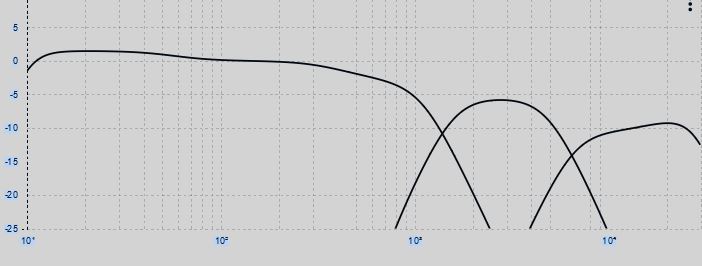
In the simplest terms, the resulting graphic looks like this below. Note that this is the electrical output required to achieve the crossover points and a flat response from each drive - so the curves aren't straightforward because Exakt is allowing for the characteristics of the drivers themselves.  Plus, in this image there are actually some filters hidden from view but having an effect - for example there is a small lift below 60Hz to add a little bit of weight to the bass.

The electrical outputs to achieve the crossover points

I then, by habit, add some "protective" filters to each driver - they're not shown above, but I'll put in a low pass filter for the bass driver than allows frequencies between 0Hz and 3000Hz. For the tweeter, for example, I'll add a high pass filter from 3000Hz upwards.  For example for the bass:

Example "safety" filter for the bass driver
Baffle step is a phenonmenon that means when a certain frequency and above reaches the edge of the baffle, it diffracts and becomes amplified for the listener - this is often cited as the reason that studio monitors are built into walls, to avoid any edges. This is obviously not possible for a speaker designed in a box so its best to put in step filters at the frequencies calculated on the baffle width and height.  So those calculations are done and appropriate filters added - with attenuation levels that are guessed to start with (they're often of a similar value between designs with the size of the attenuation rising as the frequency rises) and are typically in the range 0.2 to 2.5dB.  I usually start the step curve a little before the intended frequency and keep the slopes at a nice and gentle 2nd order. Here's the step for the mid driver which kicks in about 15Hz before the calculated point and is attenuated by 1.5dB:

Mid Range Baffle Step Filter
At this point, for confirmation of the rough acoustic measurements and subjective work, I'll take an acoustic 20 to 20000Hz sweep to make sure there are no glaring errors - preferring to work this way rather than relying entirely on measurements.

So now we have a pretty flat response through the design process, a choice of crossover points that give the best subjective sound and imaging.  Of course, in the background of all this the Exakt system has applied the calculations to each driver to deliver minimum phase errors, but all of that is invisible to the designer.

Now its time to do some detailed acoustic measurements and iron out any signficant frequency response anomylies in the drivers themselves.

I use REW software for acoustic measurements, paired with a calibrated UMIK-1 microphone connected to the laptop by USB. The laptop is dedicated to only the audio work, runs Windows 7 and pretty much nothing else. No fancy audio programmes nor drivers or anything else that will potentially add noise or unwanted processing effects.  For design work I always measure the speaker on-axis vertically with the tweeter as that is usually the most directional driver.  Horizontally I will measure on-axis and 30 degrees off axis.

My intention with this design was to get the 30 degrees off-axis frequency response pretty close to flat.  This will mean that on-axis the speaker will sound a little "bright" in that the treble output will be higher than the rest of the audio range.  This is deliberate to allow the speaker to be pretty much optimal with just a very small amount of toe-in.  Then for those who like a little more brightness or for older listeners whose hearing is starting to tail-off at the higher frequencies, a little more toe-in of the speaker will bring that change in balance.

Measurements are taken at 300mm to allow the mic to pick up the full frequency range but to minimise the effects of room reflections.  Not having an anechoic chamber to work with means that measurements below about 110Hz need to be completely ignored as they are prone to standing waves in the room.  Any tweaking below 110Hz is done purely by ear.


The camera angle makes this look more, but this is measuring 30 degrees off-axis in the horizontal

The software provides a sweep from 20 to 20,000Hz and measures the output from the speaker, corrected for the calibration of the microphone. I ignore all readings below 110Hz.

This then gives a picture of any interesting "features" of the frequency response of the drivers themselves, and, if there are any, where the drivers are perhaps overlapping too much, or leaving a trough due to not enough overlap.  Usually some quick adjustments to crossover points or possibly slopes get this sorted quickly.  The "features" of the drivers can be adjusted for with the Exakt digital crossover designs.

This is done by "modelling" the humps and dips in the response curve, then Exakt compensates electrically by applying the inverse to the signal delivered to the speaker.  So a 3dB hump at 1000Hz in the speaker will have an exact opposite - 3dB output applied at 1000kHz. It is possible to add bell curves, high or low pass and shelves. The height and width of a bell curve is adjustable.  It is possible to model each left and right speaker individually, or just go with a blend of the average of both.  In this project I worked on individual drivers - in commercial models it makes more sense to go with an average as there is little sense in trying to second guess the features of individual products out in the market.

So here is the resulting modelling for the left speaker with all the humps and dips modelled in for Exakt to correct for. It has to be said, apart from the need to add a lift from about 16000Hz upwards, the tweeter was the best behaved of the drivers.  Please be aware that I don't spend days and days dialling out every single ripple in the response curve. It would be rather unproductive - I focus on the main features and leave it at that.

The top line is the modelling of the "features" in the frequency response of the drive units.  The bottom 3 lines are the phase characteristics that Exakt has calcuated for correction.  Note, at this point the features include the effect of the cabinet, not just the drive units, so some of these could be due to the cabinet resonances mentioned in the build section (Part 2).

Top is the modelling of the frequency response of the drive units, including their "features".  The bottom is the Exakt modelling of the phase characteristics for correction

RESULT

So what is the ouput of all that work?

I've used 1/12th smoothing of the acoustic measurements to give a realistic idea of the reponse curve.  Below are 2 graphs to show why I'm mentioning this - if I was a speaker manufacturer, I would be tempted to publish the the 1/3th smoothing to make it look miraculously good!

Remember to ignore everything below 110Hz as there is too much room interaction.

Example with 1/3 Smoothing. Contrast With 1/12th Below. See how the above pretty much eliminates the room iteraction!  And those who really like their hifi to be "objectivist" rather than "subjectivist" sometimes forget that the numbers can be manipulated.  This is exactly the same data, just presented differently!

Exactly the Same Measurement But with 1/12th Smoothing - I use 1/12th in the results below
Single speaker result below - remember it is designed to be listened to off-axis.  Here you can see the more pronounced upper frequencies that would result in pointing the speakers directly at the listener compared to the intended only slight toe-in. Rotating the speakers with more toe-in allow a slightly brighter presentation if required.

Green line is on-axis response measurement. Red line is 30 degrees horizontal off-axis response measurement
 A word about phase correction with Exakt - one of its key selling points. It must be said that it is a phase error minimisation solution, it doesn't deliver a completely flat phase response.  However, I will provide a not to be named phase response example from a very well known domestic speaker maufacturer for comparison.  This is from their £16,000 speaker.  As usual, please ignore the measurements below 110Hz.  I do not post this comparison here to try and claim my project gets even close to being within sniffing distance of having a hint of the performance of the comparison speaker, but just to illustrate the effect of having no phase errors introduced by the crossover and the correction of phase errors within the drivers.

Nindex phase response, 30 degrees horizontal off-axis:
Phase Response of the Nindex Project Speaker

The dotted line in the above graph is the phase response of the £16k speaker
SOUND

So how does it sound?  Well, I'm not at all disappointed by the result. In fact, its rather enjoyable.  I don't think its the most dynamic speaker ever, but it does have a nice sense of flow - its definitely of the more laid back variety.  If you like most JBLs, you'll not like these.  Bass is tuneful but not "kicking", doesn't go massively deep but its pretty good for a box of this size.  There's no real noticable box artefacts, the treble is sweet and very detailed, the mids and vocals a touch polite but well articulated. Maybe it will appeal to those who prefer the BBC type of design?
Perhaps, at the next but one Wigwam Show (plans are already in place for the next one) you'll get a chance to come along for a listen.
Now perhaps its time to hook them up to the Akurate Katalyst / Lejonklou power amps in the main system and see how they get on.  Perhaps there'll be a post script later.

Finally, what's in a name. Well, not much thinking really. The base cabinet is an Index, but they're no longer Index, so they're Nindex. It works with the NINka drivers too. Kind of.

A few parting photos.  Thanks for reading!


PART 1 OF 3 HERE
PART 2 OF 3 HERE

Wednesday, 12 February 2020

***POSTPONED*** HIFI WIGWAM SHOW 15 MARCH 2020 @ Kegworth UK - PLAYLIST in Room 120

PLEASE NOTE THE WAM HIFI SHOW AT KEGWORTH ON 15TH MARCH 2020 HAS BEEN POSTPONED.

Please keep an eye on www.thehifishow.com for updates.

Audiophile Musings will be playing the following ACTIVE system at the show this year in Room 120:

Linn Akurate Exakt DSM Streamer
Linn Akurate Exaktbox6/1 Digital Crossover and Multi-Channel DAC
2x Lejonklou Tundra 2.5 Stereo Power Amps
Graham Audio LS5/9 (modified) Loudspeakers

When listening to this system, you can hear the following tracks which will be on auto shuffle, but we'd rather you chose a track of your preference - JUST ASK!


Artist Track Approx Genre Year
Agnes Obel Fuel To Fire Folk 2013
Alberta Cross City Walls Blues/Rock 2009
Alex Kassian Hidden Tropics Electronic 2019
Autograf Dream (Autografas Deep Dub) Deep house 2015
Black Sabbath Planet Caravan Rock 2000
Bob Moses Far From The Tree (from the 2013 'Far From The Tree' EP) Electronica 2015
Bob Moses Tearing Me Up (RAC Mix) Electro 2016
Bonobo Flicker Electronic 2019
Bugge Wesseltoft & Henrik Schwarz Leave My Head Alone Brain Electronic 2011
Calexico Crumble Folk/Rock 2003
Calexico Pepita Folk/Rock 2003
Calexico Woven Birds Pop/Rock 2003
Calexico Man Made Lake Folk/Rock 2008
Cat Power Blue Folk/Rock 2008
Chris Jones Darlin' Cory Folk 2003
Chris Jones No Sanctuary Here Folk/Rock 2003
Chris Jones & Steve Baker Roadhouses & Automobiles Blues 2003
Chris Jones & Steve Baker Damm Good Run Blues 2005
Chris Rea Looking For A Rainbow Rock 1989
Chris Rea Texas Rock 1989
Christine And The Queens 5 Dollars Pop 2018
Christine And The Queens Damn (What Must A Woman Do) Pop 2018
Craig Armstrong Let's Go Out Tonight (feat. Paul Buchanan) Electronic 1997
Craig Armstrong Weather Storm Electronic 1997
Daft Punk Giorgio by Moroder Electronic 2013
Damien Rice Cannonball Folk/Rock 2003
Damien Rice Cold Water Folk/Rock 2003
Damien Rice Delicate Folk/Rock 2003
Damien Rice Volcano Folk/Rock 2003
Daniel Lanois Shine Rock 2003
Dead Can Dance Agape Folk 2012
Dead Can Dance All In Good Time Folk 2012
Deadmau5 Avaritia Dance 2014
Dean Fraser Big Up/Armageddon Time Jazz/Reggae 1997
Death Cab For Cutie Doors Unlocked And Open Folk/Rock 2011
Devon Allman Time Machine Blues 2013
Dire Straits Six Blade Knife Rock 1978
Dire Straits Fade to Black Rock 1991
Dirty Vegas Days Go By (Acoustic Mix) Pop 2003
Dominique Fils-Aimé Birds (24_88) Soul / Funk / R&B 2018
Dominique Fils-Aimé Strange Fruit (24_88) Soul / Funk / R&B 2018
Doug MacLeod Serious Doin' Woman Blues 2015
Doug MacLeod You Got It Good (And That Ain't Bad) Blues 2015
Eddi Reader Hello In There Folk 1992
Eddi Reader Dear John Folk 1994
Elbow Asleep In The Back Indie 2001
Elbow Mirrorball Indie 2008
Elvis Presley Fever Pop Rock 2015
Erykah Badu Next Lifetime R&B 1998
Eva Cassidy Fields Of Gold Folk/Rock
Felix LaBand Black Shoes Electronic
Ficci & Laura Hahn Ficci - Breathe You In (feat. Laura Hahn) Electronica 2014
Fink Perfect Darkness (Live from Union Chapel, London Oct 5 2011) Folk/Rock 2012
Flash And The Pan Walking In The Rain Pop 1990
Fleetwood Mac Go Your Own Way Rock 2011
Fleetwood Mac The Chain Rock 2011
Funkerman Speed Up (ATFC Remix) Dance 2012
Ganga Don't Wake Me Up Electronic 2006
Ganga Down But Up Electronic 2006
Georges-Emmanuel Lazaridis Grandes Etudes de Paganini Etude III Classical 2007
Hue & Cry Makin' Whoopee Jazz
Hugh Masekela Stimela (The Coal Train) World Blues 2006
I Am Kloot Hold Back the Night Rock 2013
I Am Kloot Let Them All In Rock 2013
Ian Shaw A Good And Simple Man Jazz 2008
It's Immaterial Driving Away From Home (Jims Tune) Pop 2008
Jakatta American Dream (Afterlife Mix) Electronica 2001
James Taylor Gaia Folk/Rock 1997
Jay Fisher Old Man McKeensley Folk/Rock
Jennifer Warnes Big Noise, New York Pop 1992
Jenny Lewis Pretty Bird Country 2008
Joan Armatrading Love And Affection R&B 1976
Joan As Police Woman Get Direct Rock 2014
Joe Bonamassa Feelin' Good Blues/Rock 2009
John Lee Hooker The Healer (with Carlos Santana & The Santana Band) Blues 1989
John Martyn A Little Strange Folk/Rock 1996
José González Crosses Acoustic 2003
Justin Currie No, Surrender Rock 2008
k.d. Lang Constant Craving Folk 1992
Keb’ Mo’ For What It's Worth Jazz 2004
Ken Haddock One Woman Folk 2019
Kiasmos Looped Electronic 2014
Kiasmos Thrown Electronic 2014
Kiki Dee Amoureuse Folk
Kiki Dee Don't Go Breaking My Heart Folk
La Roux In For The Kill (Skream's Let's Get Ravey Remix) Electronic 2009
London Grammar Wicked Game Pop
London Grammar Hey Now Rock 2013
Lorde Royals Pop 2013
Lyle Lovett North Dakota Alternative Country 1992
Malia & Boris Blank Magnetic Lies Electronic/Jazz 2013
Malia & Boris Blank Tears Run Dry Jazz 2013
Marta Gomez Lucia Jazz/Classical 2009
Mary Gauthier Falling Out Of Love Country 2005
Massive Attack Three Electronic 1994
Michael Jackson Liberian Girl Pop 2001
Millenia Nova Beautiful Electronica 2000
Nick Drake 'Cello Song Folk 1969
Nils Frahm Ode Alternative 2015
Nils Lofgren Black Books Folk/Rock 1997
Nils Lofgren Wonderland Rock 1997
Nitin Sawhney Letting Go Chill 1999
Pete Alderton (She Said That) Evil Was Her Name Blues 2012
Pete Alderton Jesus In A Bottle Blues 2012
Pete Alderton Passing Ships Blues 2012
Peter Gabriel Don't Give Up Folk/Rock 2012
Peyton Falling (EK's Poolside Mix) Electronica 2008
Pitch Black Dub Smoke Electronica 2016
Ray LaMontagne Be Here Now Pop/Rock 2006
Richard Thompson Easy There, Steady Now Folk 1994
Richard Thompson Mingus Eyes Folk 1994
Royksopp Sparks Drum & Bass 2002
Sam Cooke Chain Gang Blues
Sam Cooke Cupid Blues
Sarah McLachlan Ice Folk/Rock 1994
Sarah McLachlan Wait Folk/Rock 1994
Schiller Das Glockenspiel (Schill Out Mix) Electronica 2004
Seal Kiss From A Rose Soul 1995
Seal Love's Divine (Acoustic) Soul 2004
Seal Prayer For The Dying (Acoustic) Soul 2004
Semisonic Closing Time Rock 1998
Semisonic Secret Smile Rock 1998
Son Little Loser Blues Blues 2016
St Germain Dub Experience II Electronic 1995
St Germain Mary L. Electronica 2015
Steely Dan Babylon Sisters Jazz/Rock 2000
Steely Dan Cousin Dupree (24/96) Jazz/Rock 2001
Stephen Fearing Carsten Folk 1989
Stephen Fearing Out To Sea Folk 1989
Stephen Fearing Welfare Wednesday Folk 1989
Swing Out Sister Breakout Pop 2001
Talking Heads Road To Nowhere Pop 2008
T‐Bone Burnett Fear Country Blues 2006
Tchaikovsky 'Dance Of The Reeds' From The Nutcracker Classical 2003
Tears For Fears Mad World Pop 2007
Ten Walls Walking With Elephants Pop 2014
Tep No Me And My Guitar Electronica 2016
The Black Keys Sister Blues/Rock 2011
The Brand New Heavies Boogie (Eric Kupper Mix) Electronic 2004
The Cardigans Erase/Rewind Pop 1998
The Farm All Together Now Pop 1995
The Jeff Healey Band Blue Jean Blues Blues/Rock 1988
The Killers Human Rock 2008
The Wailin' Jennys All The Stars Country 2011
The Wailin' Jennys Swing Low Sail High Country 2011
The XX Reunion Balearic/Downtempo 2012
Thea Gilmore Bad Moon Rising Folk 2003
Thievery Corporation Amerimacka Electronica 2010
Thievery Corporation The Richest Man In Babylon Electronica 2010
Thom Yorke Black Swan Blues 2006
Thom Yorke Traffic Alt. Rock 2019
Thomas Newman Still Dead Soundtrack 2000
Tom Baxter Night Like This Jazz 2007
Tom Baxter Skybound Jazz 2007
Tom Jones Thunderball Soundtrack 2002
Tom Robinson The End Of The Rainbow Folk/Rock 1993
Tunng Jenny Again Folk 2006
U2 Hold Me, Thrill Me, Kiss Me, Kill Me Rock 1995
U2 In A Little While (N.O.W Remix) Rock 2003
Underworld Banstyle, Sappys Curry Electronic 1996
Underworld Caliban's Dream (feat. Dockhead Choir, Dame Everlyn Glennie, Only Men Alound, Elizabeth Roberts, Esme Smith, Alex Trimble) Electronic 2012
Was (Not Was) Papa Was A Rolling Stone Pop 1992
Willie Nelson What Is It You Wanted Country 1993
Willy Porter Cool Water Folk 1995
Willy Porter Jesus on the Grille Folk 1995
X-Press 2 Lazy (Original) Dance 2002
Yello Friday Smile Electronic 2009
Yello Kiss In Blue (Feat. Heidi Happy) Electronic 2009
Yello X-Race Electronic 2009
Yello Blue Biscuit (24_48) Electronic 2016
Yello Starlight Scene (24_48) Electronic 2016
Zero 7 Destiny Electronica 2001
Zero 7 Give It Away Electronica 2001