Friday, 16 January 2015
SCALFORD HIFI WIGWAM SHOW - 29TH MARCH 2015
Listen to systems put together by enthusiasts for enthusiasts to listen to. Over 40 systems with more combinations of components that you could possibly imagine.
Eclectic systems
Eclectic music
Pies
Prizes
A couple of vendors
Beer
A great day out.
Get there early - there's always a queue before the 10am start.
FIND OUT MORE HERE: http://www.thehifishow.com/
Sunday, 11 January 2015
NAD 1240 Pre-Amp and 2155 Power Amp FOR SALE
http://www.ebay.co.uk/itm/291352100827?ssPageName=STRK:MESELX:IT&_trksid=p3984.m1558.l2649
MUSICAL FIDELITY V90-AMP FOR SALE
http://www.ebay.co.uk/itm/291351841021?ssPageName=STRK:MESELX:IT&_trksid=p3984.m1558.l2649
Thanks
LINN LVX BASIK PLUS TONEARM **SOLD***
http://www.ebay.co.uk/itm/291349195779?ssPageName=STRK:MESELX:IT&_trksid=p3984.m1558.l2649
Now Sold: Thanks!
Thursday, 8 January 2015
FRANKENKEILIDHS - Zombie Speakers Rise Up: PART 5
PART 2 here
PART 3 here
PART 4 here
![]() |
| Rear of the mid-bass driver |
![]() |
| Front of the mid-bass driver. Note foam surround. The driver looks like its metal, but actually that's a very thin film of something shiney (not sure what though) on a core of polypropylene. |
![]() |
| The uncompressed gasket in place on the back of the driver and held in place on the mounting bolts |
Now to the choice of tweeters. As in the picture below, the tweeter mounting plates look like a similar diameter. However, seen from the side they're very different. The 737R driver (on the left) is essentially flat with the magnet protruding a small amount to the rear. The 782 driver (on the right) has an essentially flat back panel with the chassis and magnet protruding forward - creating a very shallow horn shape.
![]() |
| Tweeter options |
I don't have the tools, nor the confidence to think about routing the baffle nor to machine down the tweeter backplates nor faceplates. So the 782 option almost excluded itsself immediately because the backplate is too big to fit into the recess in the baffle, but the smaller front protruding section is not deep enough to pass through from the back of the panel and be flush with the front.
However, I did want to give both options a listen, just to be sure it wasn't going to be worth the effort of finding another way.
To get the 737R tweeter to fit, a small part of the baffle opening had to be made slightly larger to allow for the terminals to sit inside the opening. Given this wasn't going to prevent the fitting of standard tweeters again at some point in the future, the powerfile came out and some MDF dust was created. Although the mid-bass drivers are bolted in at the moment, the tweeters need mountings that are different to the originals, so are blu-tacked in place at this point, making sure the ring of blu-tac is complete to ensure a seal.
![]() |
| Laying on their backs, installing the drivers was straightforward |
![]() |
| Here the 737R tweeter is sitting slightly proud of the baffle, but not significantly so |
![]() |
| Looking a bit more like a speaker again |
![]() |
| 782 tweeter from the front view |
At this point, all the drivers came out again to be able to install the internal wadding. From converstaions, it seems the Keilidh was filled with polyester wadding. However, it seems somewhat harder to find out how dense this should be packed. The internal bracing in the cabinet is very solid just below the lower mid-bass driver. It has 4 small holes in it, but I'm not sure if this should be packed with wadding or not. I choose, at this point, not to fill this cavity, thinking that if the bass doesn't sound right, I can add some into there later, whereas extracting it again looks like it would be hard work.
So, polyester filling? Where to get that from? Quick chat with Mrs Musings and it seems that cheap pillows are filled with the stuff. That's lucky as we have some of those in the garage - they've been used for packing stuff in the boot of the car, in trailers etc. to protect items in transit. Scissors into action and 3 pillows are soon emptied of their filling.
I choose to pack the material quite tightly, remembering to feed the cables through before they get lost in amongst the wadding.
![]() |
| Here you can see the small areas filed out of the tweeter cut out |
![]() |
| Labelling the cables for each driver seemed like a good idea |
Crossovers and first listening in the next part.
FRANKENKEILIDHS - Zombie Speakers Rise Up: PART 4
PART 2 here
PART 3 here
I only have reasonably basic tools available, so no fancy routing of baffles or anything like that.
Let's start at the back of the cabinets. Normally, Keilidhs have 6 terminals on the back panel to facilitate connecting up to 3 pairs of cables from 3 amps. They're an integral part of the crossover circuit board and, once the external collars are screwed onto the posts, hold the crossover into the cabinet:
![]() |
| Original Keilidh Crossover (from www.costrruirehifi.net) |
I also decided that I wanted to make conversion of Frankenkeilidhs from passive to active and back again as easily as possible, as I have a vague idea that I'd like to play with some low cost DSP crossovers at some point. So the approach is just to fit a set of terminals into the existing holes in the back panel of the Keilidhs and connect them directly to each of the speaker drivers, thus avoiding the need to house a crossover inside the cabinet, and facilitate active conversion without opening the boxes up again.
ebay again and some nice looking binding posts were sourced at £1.95 a pair. They claim to be gold plated and look the part. I guess we'll know in a year or two's time how true that is. Anyway, they're long, substantial and provide the option of bare wire or 4mm banana plug connections.
![]() |
| One binding post stripped down to its parts, ready to fit |
For speaker cables, I'm using some high purity 42 strand copper cable from Maplin - its left over from a 50m drum that was bought when putting the garden speakers in place. Do I cost it in or not?
![]() |
| Tining up the speaker cables ready for soldering to the binding posts |
![]() |
| Threaded through to the outside |
![]() |
| Fit the plastic red or black washer first (for easier identification of + and - terminals), then the clear washer |
![]() |
| Then push the binding posts into place and tighten the nuts from the inside of the cabinet |
![]() |
| Here all 6 posts are completed on the inside of the cabinet |
![]() |
| And from the outside - looking very professional, even if I do say so myself! |
FRANKENKEILIDHS - Zombie Speakers Rise Up: PART 3
PART 2 here
The starting point, a set of cabinets in very good condition, but kinda missing tweeters, mid-bass drivers, wadding, crossovers, terminals and any sense of self esteem:
| Empty cabs - no drivers, crossover, wadding, terminals nor bases |
![]() |
| Inside, Linn fitted these "Kustone" blocks which are said to help with absorbing internal reflections |
![]() |
| The Linn logo is moulded into these, but a bit tricky to see here |
![]() |
| Its a loosely packed set of granules, held together with adhesive. Water would probably pass through this material |
![]() |
| Here you can see some of the internal cross-bracing and the thickness of the MDF in use. These are suprisingly sturdy and well constructed boxes |
![]() |
| Further internal bracing - the flat board with small holes is horizontal and the larger hoop is in the vertical |
So I started with tweeters - and already there is some doubt over how to calculate the budget for this build, as I attempt to keep track of the spend. I have decided the following (possibly dubious) rules:
- I only include the cost of what goes into the final version
- Parts tried along the way can be sold on or used in other projects, so are not included in the total
- Where I've used parts which are components of some other product or project, I've allocated a nominal value to them, based on a vague recollection of what I paid for the complete product
- Labour is not included, otherwise I'd be looking to buy a brand new pair of M140s or something...
Here were my choices of tweeters. Why Mission? Well, I have some lying around in the workshop, there's loads of them about and they sell at very reasonable prices. The left hand flat faceplate driver looks very similar to other Linn drivers from earlier designs such as Isobariks and early Kabers. But they also look very similar to a million other soft dome tweeters out there and probably originate from a limited number of manufacturing plants, regardless of the branding on the product. Of course, there will be many subtle variations in design, materials and sonic outcome. This particular pair are from a pair of Mission 737R speakers from the 1980s. Sourced from a pair I had that suffered a little too much from aging cabinet glue and the mid-bass drivers having brittle rubber surrounds. So I paid about £45 for those originally, breaking them after about 3 years of ownership. Let's call it £15 the pair.
At the time I was looking into this, a pair of much more recent Mission 782 tweeters came up on ebay and I picked those up for £18. As it happens, later testing revealled suprisingly little difference in the performance of these drivers - the 737R driver sounding a little more enthusiastic, the 782 smoother and more cultured, but these were very slight differences.
At £15 and £18 a pair, both options look like they're going to be within the budget.
![]() |
| Tweeter options. 737R (1980s) and 782 (90s - 2000s). Front |
![]() |
| Rear views with the 737R at the top |
Here they are in the original homes:
| Mission 737R |
![]() |
| Mission 782 |
![]() |
| Mission 773e - similar to the Keilidh in concept, but newer, cheaper and a somewhat less well built cabinet. Decent sounding for their price though. Might be a good donator of a crossover. Or not. |
FRANKENKEILIDHS - Zombie Speakers Rise Up: PART 2
So what are the main challenges with bringing a set of empty speakers back to life?
Well, for many speakers it could be straightforward - spend some time on ebay, Google, Wilmslow Audio (I'm sure other good driver vendors are available too), find either the original drivers or something very close, buy them up and bolt them in. Or find something with really rough cabinets and transfer all the bits into your better, but empty, cabinets.
So here's the challenge with the Linn Keilidhs, a speaker I believe to have been Linn's best selling speaker ever with around 25,000 units shipped. Available for most of the 1990s with a few tweaks over the years, such as the addition of an optional wide footprint heavy polymer stand, 2 variations of mid/bass drivers (013/2 and 013/4) 3 variations on the tweeter (numbered 015/1, 015/2 and, wait for it, 015/3) and a move from a painted front baffle to a veneered version. Possibly there was a 015/5 tweeter, but maybe not.
Some information here about the Keilidh history and specifications:
Owners' Manual
Lots Of Images
A Review
Some Data On Versions
Musings' Own Keilidhs (when being used active with Rotel power amps, since sold on)
Whilst the Keilidhs have 3 drive units (1x tweeter, 2x mid-bass) per speaker, they're actually a 2-way design. The 2x mid-bass drivers are fed by the same information from the crossover and they share the same cavity inside the cabinets. You can drive these speakers passively with a single amplifier, bi-amplify them passively or active or you can go for 3 amplifiers in active mode. Passive means using the crossovers inside the speaker cabinets, active means using an external (much more accurate) crossover which then feeds a single to one power amp directly connected to the tweeter and one or two power amps connected to the mid-bass drivers. In the 20 years I had the Keilidhs in my system, I went through all of these steps, finishing with them driven tri-actively with Rotel amps and later Linn amps (we'll skip over the 10 days or so going down the wrong turn labelled "Cyrus").
Today Keilidh's sell for 200 to 350 GBP depending on age, finish, condition, location etc. They're great value for money and sound very good when equipped with Linn's later 038/2 tweeter from the Katan / Ninka era. Early Keilidhs which still have the 015/1 to 015/3 tweeters sound a little uncultured in comparison, but still play a tune well.
Tweeters are shared with the contemporary Keltik, which was Linn's top of the range floor stander, later versions of the Kaber mid-range floorstander and the Tukan - a small standmount speaker. So there are lots of opportunities for finding the tweeters, although they usually fetch a reasonable price. But curiously, the mid-bass drivers rarely come up for sale, and a quite highly priced for something that might have already seen 20 years of use, and is a reasonably straightforward design. The mid-bass is also an unusual diameter at 6.5" / 165-170mm in the home audio world, more frequently seen in the car audio world.
So here are the challenges:
- genuine mid-bass drivers quite rare and pricey
- genuine crossovers probably just as rare, if not more so
- choice of replacement mid-bass drivers is limited, and those that are from established speaker component sellers are priced reasonably, but 4 of those would quickly come to more than the price of a complete set of secondhand speakers
- mid-bass chassis diameter is unusual (thanks Linn!)
- tweeter faceplate diameter is unusual (thanks Linn!)
So, off to t'Interweb to research some options.
Monday, 5 January 2015
FRANKENKEILIDHS - Zombie Speakers Rise Up: PART 1
This was an accidental project, rather than a plan, at least initially. A pair of black empty cabs in good condition came up on ebay with a start price of 10 GBP. I didn't bid as I had no need for them. The auction ran its course without a sale. They were re-listed with the same start price so I recklessly (!) bid a tenner for them. One week later they were mine! After picking them up, I then had to work out what to do with them, so set about finding out if they could be resurrected for under 100GBP. Turns out that was never going to be possible with original drivers. Tweeters are easy to find but not exactly a bargain, mid-bass drivers very much more difficult and when they do appear they sell for between 45 and 75 GBP. Each.
So I now have a solution that is sounding OK in the workshop, but they need to come indoors for a longer listen, and there's some finishing off to do too.
Before and after pictures below, with the project documented over the next few posts.
| Starting Point |
![]() |
| Midway through the build with drivers still coming in and out of the cabs as the inner wadding was tweaked and before the crossovers had their housings |
![]() |
| Nearing The End Of The Build |
The detailed story of the build starts in PART 2. A project that has taken an elapsed time of about 6 months. It went well to start with, but then took a long, loss of morale enforced break.
Tuesday, 9 December 2014
I Feel For You, Chaka
Chaka Khan. A blast from my 80s past and one of my first 12" singles, no doubt annoying my parents as it blasted out from my Thorens / Mayware / Nagaoka / NAD / Mission bedroom combo.
And there it is again, playing on vinyl and valves in a London pub. Beer to hand is a bit different this time. Back when I bought my first system on proceeds from my college part time job at Fine Fare there was no beer to be seen at the age of 17. Honest.
So a second visit to Spiritland.com in Shoreditch. The pub with hifi and a different music theme every night. Last time was bonfire night, a subdued evening of folk and ethereal stuff which kind of suggested the early onset of drunkeness, even when sober - a bit trippy in a gently olde worlde kind of way. The audience was equally subdued. Chilled rather than cool, comfortable and vaguely familiar whilst been strangers. Maybe the evening was a bit like borrowing someone else's old but comfortable slippers for few hours.
Tonight, I should've brought my baseball cap. To wear sideways. Or backwardz. But probably best not to. Mutton dressed as lamb and all that. So as you can see from the post title, tonight is much more lively. A contrast and probably an excellent way to show exactly how Spiritland hopes to do something different and to offer either choice, or the opportunity to widen perspectives and broadend musical tastes. You choose.
Who's tonight's guest vinyl spinner? Young Guru, who has been Jay-Z's DJ since 1999. So kind of well known without many folks knowing him at all. DJs tend to be out of the limelight with that kind of artist, but I'm sure those in the know are well aware of him.
Things are a little louder tonight, suiting the much younger audience in baggy Ts and ripped jeans. But its still not loud and conversation is possible if you raise your voice. The music is mainly disco and dance oriented with some fusion and jazz funk here and there. I walk into the pub to the theme tune to Starsky and Hutch. Unfortunately I've left my massive knitted cream cardigan at home, and I've never really been a fan of the wallowy old Ford Torino. Even with a white Nike stripe...
So another, but again very enjoyable couple of hours in Spiritland. A very different place to my last visit. And yet, one and the same place. A place of quality music, quality sounds and an amiable atmosphere. For someone as old as I'm getting, that counts as cool ;-)
Friday, 5 December 2014
Meridian Squashes Hi-Res Files
Meridian MQA Press Release at WHF
Is seems as though this can be carried inside a standard FLAC, WAV or ALAC type container. No mention of who they are partnered with on the content provider side, but it looks interesting.
The article at Stuff seems to suggest that a compatible device is needed, but non-compatible devices will play the file at CD quality.
Stuff Mag
The "A" in MQA stands for authenticated. Which is a bit worrying, but if it is only used for streaming, I guess the ability to use the music across multiple devices is about apps not about portability of encrypted files.
Monday, 24 November 2014
Preparation For The Hifi Show 2015
Sunday, 16 November 2014
Acitvating Katans With AV5125
![]() |
| In original single wired passive form. By removing all the collars on the terminals, the configuration cards that are recessed into the back of the speaker cabinet can be lifted out |
![]() |
| Collars removed - each side of the configuration card there is a recess in the speaker cabinet, allowing for access to lift the cards out |
![]() |
| There are 2 configuration cards. Each one has a different configuration on each side - in this case 'single wire passive' is on one side of both cards. Put the unwanted configurations back onto the connection terminals first, then the card you require with the required configuration facing outwards, then refit the terminal collars. |
![]() |
| This is the reverse side of the 2 cards shown in the picture above. Choices here are 'Katan active' and 'Katan bi-wire passive' |
![]() |
| The 'Katan bi-wire passive' card has been fitted onto the terminals, then this 'Katan active' card has been laid on top |
![]() |
| Collars are fastened back on and tightened. Any blanking plugs inside the terminals need to be moved to new positions, freeing up the appropriate connections for active use. Here I've used red = bass +ve; black = bass -ve; yellow = treble +ve, grey = treble -ve |
![]() |
| Now to the amp. Switch off and unplug the amp and disconnect the mains cable! Laying on a firm but covered surface (to protect the finish) top downwards, the amp looks like this. There are 4 self tapping screws along the silver section which need to be removed. |
![]() |
| The cover of the amp can then be slid off - the amp chassis slides out of the back of the cover. Once removed, place the cover out of the way and somewhere where it won't get damaged. Place the amp chassis on your work surface, base side down. |
BEFORE PROCEEDING FURTHER, YOU MUST TAKE ANTI-STATIC PRECAUTIONS BY EARTHING THE AMP CHASSIS AND WEARING AN EARTHED ANTI-STATIC STRAP. IF YOU DON'T KNOW WHAT THESE ARE OR HOW TO USE THEM, STOP NOW AND TAKE YOUR KIT TO A DEALER. STATIC ELECTRICITY CAN DAMAGE THE CIRCUITRY!![]() |
| This is the amp chassis without any active cards or support fittings. The stereo active cards are going to be fitted top left in this picture - across the back of the amp |
![]() |
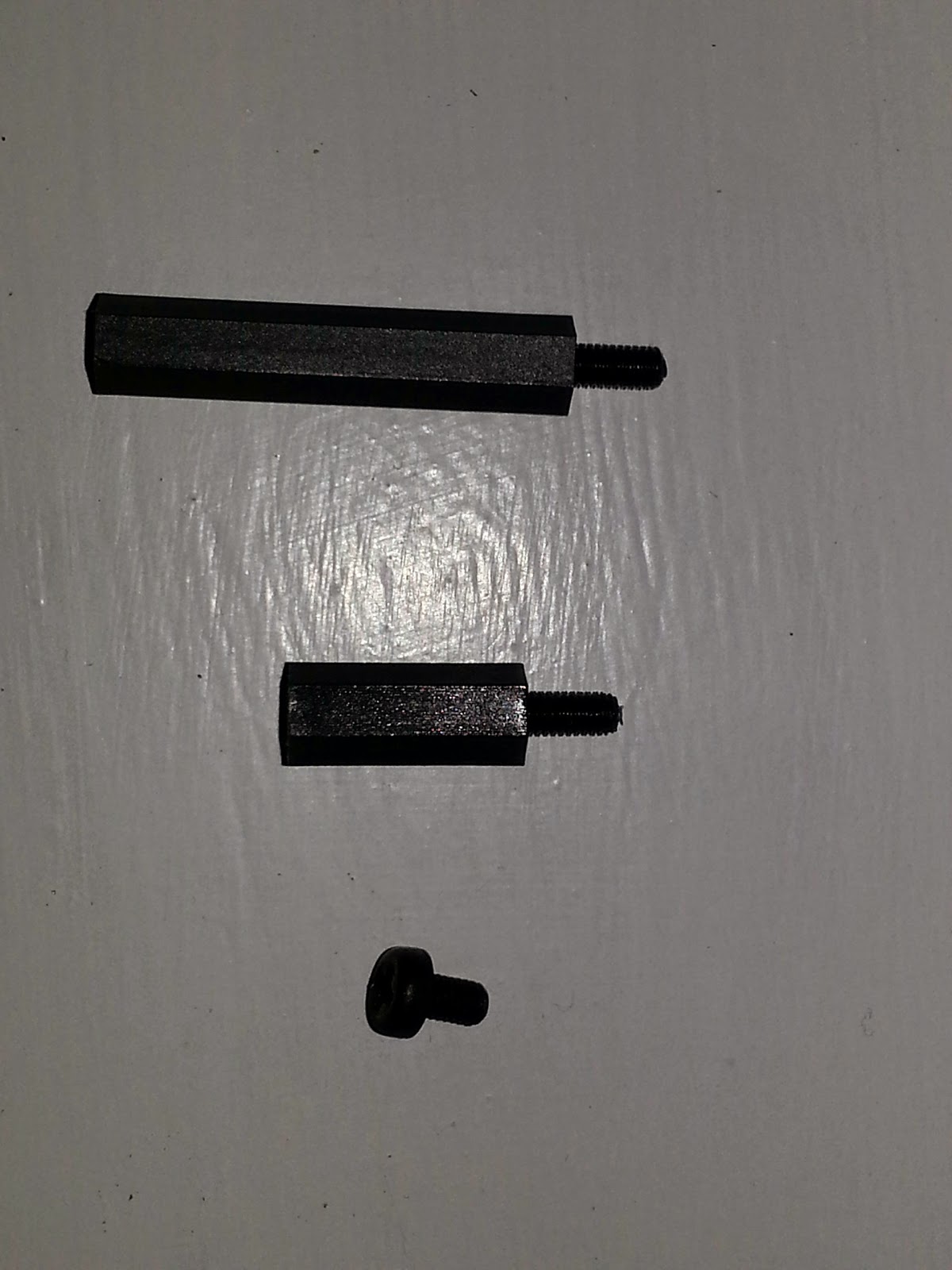
| To fit the cards, the plastic circuit board stand-offs and screw are required. These are usually inside the amplifier. However, many amps will not have these installed as they have gone missing over the lifetime of the amp. If your amp is missing these, or the ones for the mono card, please get in touch as I have complete sets available for purchase. In the full kit there are long, medium and short stand-offs with a protruding thread at one end and a recessed thread at the other. There is also one very small stand-off with recessed threads at each end. The tall stand-off and the very small stand-off with recessed threads at both ends are used only for the mono card. Fitting the stereo cards as described here uses the medium and short stand-offs that have a protruding thread at one end and recessed thread at the other, along with a short screw. These are the stand-offs shown above |
![]() |
| Fit the medium stand-off as shown above, into the threaded hole at the rear left of the amp. Finger tight is enough - the threads are only plastic, so please take care. A second picture of the medium stand-off is shown below. |
![]() |
| A stereo active card. This is the bass card for a Tukan (or a Katan, or a Sekrit) |
![]() |
| For the first card being fitted, fit the short connection cable as shown above |
![]() |
| Now slide the card into the lower set of slots in the back of the amp (you can see the green tabs of the card peeping through the amp's back panel). The slots are the same height in the amp as the top of the medium stand-off fitted earlier |
![]() |
| Another view of the first card sitting in situ. Note that the card sits neatly on top of the medium stand-off fitted earlier |
![]() |
| Now connect the connecting cable into the amp board as shown - channels 4 & 5. In my install this is the bass card, so now Channels 4 and 5 will output bass information |
![]() |
| Now fit the short standoff by feeding it through the installed card and then tightening into the thread of the medium stand-off. Again, finger tight only - take it gently! |


.jpg)