"What a refreshingly honest blog about listening to music through hi-fi. So happy to see views based upon the enjoyment of music rather than so-called sound 'quality'." - Peter Comeau, Director of Acoustic Design at Mission / Wharfedale
Showing posts with label Chakra. Show all posts

Saturday, 9 January 2016

Is The Kudos Super 20 a Neat Solution?

Audiophile Musing's system has been "active" for about 18 years.  In Linn style, this means a set of active crossover cards - one per speaker drive unit and one power amp channel to deliver to that drive unit.  This was how the Keilidhs were when they retired and were replaced by an actively powered pair of Majik 140s.

About 8 months ago, I heard a comparison of active 140s using Majik power amps (Linn's lowest rung), just like my own set up, against the same pair of speakers returned to passive crossovers and a pair of Linn's top of the range Klimax Solo/Dynamik mono power amps.  There was no comparison. The passive Solos were not streets ahead, more of a complete city ahead.  They remain an ambition. However, about 4 months ago one of Linn's top of the range stereo power amps (the Klimax 500 Chakra Twin/Dynamik) came available ex-dem and at a very attractive price. And it was black. So the Majik 140 speakers were converted back to passive and in came the Twin.  Its not at Solo level, but it is a significant step up from active Majik.

So what has this got to do with the Kudos Super 20?  Well, its quite straightforward really.  Once the system is no longer active, then the range of speaker choices opens up to pretty much everything out there.  No longer "limited" to Linn.  Of course, Linn speakers are still of interest (particularly the Akubarik, my favourite of the current range), but why not listen around to see what else is possible? My local Naimist, Richard (you'll have read about him before in some of the comparison tests and for his help at Scalford etc), has a pair of Kudos Super 20s.  In an act of some considerable generosity, Richard offered up the loan of the Kudos speakers for a week (which turned into 2 weeks, due to schedules and an extremely long period of wet weather when it wouldn't have been good to be moving the speakers between houses).

Let the fun begin.

Well, it wasn't too much fun to begin with.  The Kudos's had to come down the narrow tight cornered stairs from the loft conversion and then into the car. To make sure the 140s went back in their correct place (and the Super 20s back in their home), positions were marked on the floors with masking tape. Then there was the lifting of the M140s out of the room - I'd forgotten how heavy they are with their solid metal bases.  The Kudos stands slightly shorter, is slightly more shallow and somewhat lighter. They're beautifully built and finished, a real credit to the team from the North East.  I had high expectations for these as they do work well for Richard and I've found Kudos's T-808s a thoroughly enjoyable (if rather expensive) pair of boxes.
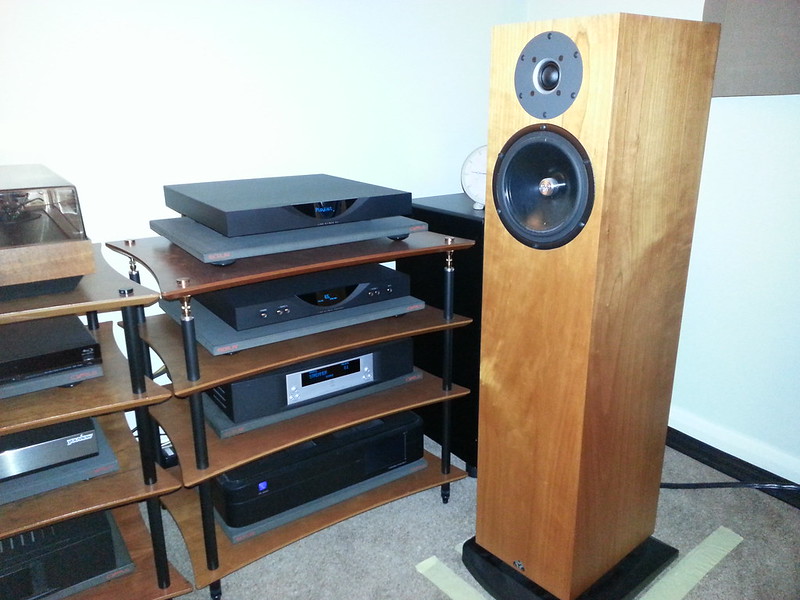
Left speaker installed.  Masking tape showing position of the M140s
Starting with the 20s in the exact same position as the M140s, Linn SPACE was disabled (due to the need to start from scratch) and the messing about with speaker positions began.  Listened for about 30 mins in this position and then shuffled the speakers about, playing tracks for 10-15 mins between each position.  Ended up with the speakers about 15cms further out from the wall.  Toe-in was best at the same angle as the 140s.

Then the tuning using SPACE began, and that proved to be much more of a faff than I was expecting. SPACE comes with the Super 20 as one of the listed speakers, so that was easy enough. Measurements were taken of where the speakers are in the room and SPACE calculation run.  It was awful.  All life sucked out of everything, speakers sounding over bright.  I re-checked all the measures.  I then worked through the SPACE instructions on how to tweak the deep notches.  It took a long time before something came back to the system.  I left it like this for a few days, found the system difficult to listen to.  It was edge of the seat stuff all the time, even with music that's supposed to be chilled and relaxing.

I reported back to Richard and he suggested we swap out the speaker cables.  I'm using Linn K200 (which is split K400).  Richard is using Naim SuperLumina.  This had a marked effect on the system - it brings a level of refinement and "care" to the sound.  Its not over smooth, but it removes some rough edges and brings an extra level of tiny details.  Bass got a little tighter and much more subtley textured.  A quite remarkable bit of wire.  Tried it later with the M140s and it did similar things there too.  Impressive.  Enough of a change to necessitate switching SPACE off and to mess about with positioning again.  This resulted in the speakers being about 12-13cms further from the wall compared to the Linns.  A small change from the initial 15cms, but worthwhile.

And then all the messing with SPACE again.  This time I ended up taking nearly all of the SPACE notches out.  The lowest frequency notch went from -29dB to -6dB and the other 2 smaller notches dropped from around -9dB to -2dB.  I also let in -1dB of treble shelf to tame the top end.  This was another 2 or 3 days of messing about to get to this position.  So that was the set up done.  At last.
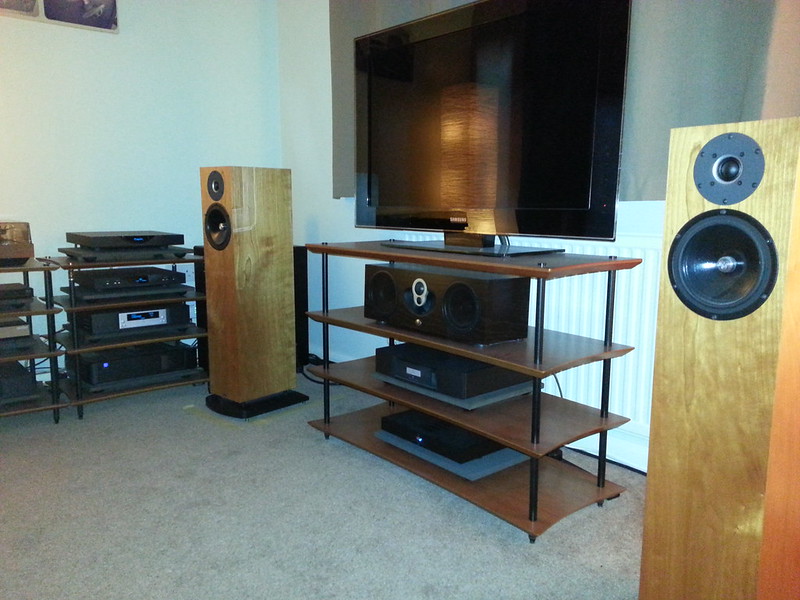
General view, but before the speakers were moved to their best position
So how did it sound with the SuperLumina and with SPACE dialled in to its best?  Well I'm going to write about this in reference back to the Linns I'm afraid - a comparative review rather than in absolute terms.  I think that's because that's what I'm looking for - something that's an improvement on the 140s.  Its worth saying, at this point, that they didn't work well with the Linn speaker cable and therefore something different would be a requirement.  SuperLumina might be the thing, but others might be as good or better (or worse of course).

Here's what the Kudos Super 20s do better than the Linns - instrument separation, speed (they sound like they respond to inputs from the amp a little quicker) and they image better too - not so much left to right, but certainly back behind the speakers.  So they're an exciting listen.  Attack is great, the music is pacey and the instruments are easily picked out.  The Linns are good at instrument differentiation, but the Kudos moves this on a notch.  They go reasonably deep too, when the content is there in the music.  Female vocals are a particular forte, just as they are in their home Naim system.

What do they not do so well?  There's a few things really.  I still never really relaxed into any music whilst they were in the house for 2 weeks (although it was so much better with the SuperLumina in place).  The speed I found a little distracting.  I notched the treble shelf down another 0.5dB and that helped a little, but I didn't really get settled with them.  This, and they sound a little out of breath in my room.  Back in their home system, they're in a 12ft x12ft (ish) area of an L shaped loft room, which has part sloping roofs.  The listening seat is closer to the speakers too.  In my room they're in a 19ft x 12ft full ceiling height room and that might be just a touch too big for them.

So its a mixed bag.  I really understand why they're a good seller and why their owners enjoy them so much - I get the appeal of the etched instruments, I get the speed, I get the way they do female vocals. If I was in the market for speakers at this price point, I would say that they could be on a short list. But I need to relax into my music.  I like chilled out music to wash into the room and give a warm feeling as I sit back after work and wind down. When a system doesn't let me do this, its not right for me.  Others will have a different view.

As such, these aren't the right speakers for me or my room.  They're different to the M140s, but they're not the right mix of abilities to justify a change to the Super 20s.  I'm looking for a bigger difference, but perhaps, more of what I have, rather than a different direction.

Must get around to trying the SuperLumina again and compare it with other options.  Its capabilities are impressive - far more of a change than a bit of wire has any right to deliver.

A huge thanks to Richard for trusting me with his expensive and highly valued speakers.  They're back in their home now, and the brand new Naim 250DR is probably warmed up enough now for him to get thoroughly back into enjoying his music.

Saturday, 1 August 2015

Today's TLA Report: KCT, TST, KDS and DVC. Linn and Lejonklou Content.


TLAs?  Three Letter Acronyms.  There's a lot of them about.  Do they sound any good?  I spent an evening chez Whizz to find out.

Here's an itch that's been scratched at last - how does a Lejonklou Tundra Stereo 2 (TST) stack up against the Linn Klimax Chakra Twin (KTC), both in their latest, up to date 2015 configs?

Much has been written on the Linn forum, the Lejonklou forum and probably in other places too, about the giant killing abilities of the £2.5k Tundra Stereo - now in, I think, its fourth iteration - v1, 1.1, 1.2 and now v2.  As is usual, the inside of the Lejonklou and the design science that goes into it is less than accessible than it might be.  Lejonklou put a lot of effort into the design, focussing primarily on sound quality, encompassing all aspects right down to the torque settings for the outer sleeve (you're not supposted to change these, hence there's not much information about what goes inside the box).  The KCT has also evolved over time, the biggest change of note being the Dynamik power supply and a new main board layout - but it is an old design now - based on Chakra circuitry, its a bit like an Linn Akurate amp on steroids.

Previously...

Given that the KCT is based on Akurate design, I need to put some cards on the table - I don't like the current Akurate amps - to me they sound like hifi.  I've had Akurate in my system and went back to Majik as, although Majik amps don't extract as much information from the signal, they do, to me, sound more musical.  To use Linn's terminology, the Majik amps Tune-dem better, at least to me.  And when you can't afford Klimax amps, then its Majik or something non-Linn.  Talking of which, I've heard only one Lejonklou product to date - the original Tundra Stereo (it wasn't called Stereo then, as there wasn't a Mono version) in a system with Linn KDS/0 Renew and Linn Katans (note, no pre-amp in that system).  You can see my notes on that here: http://audiophilemusings.blogspot.co.uk/2012/07/toms-system-linn-klimax-lejonklu-tundra.html   As you will see, it worked well within the limits of physically small speakers, I did appreciate the imaging (a Katan strength) and subtle finess within the music.  Lejonklou doesn't use Tune-dem to evaluate their products, they use Tune-method - subtle eh?

Also in the "previously..." category is the KDS/1 which is the streamer I use in the main system at home.  To date, its the best digital source I've heard, that's why its in the system.  Recently, it was superceded by (imaginatively), the KDS/2 which has a new clock and revised circuit layouts, in addition to Linn's Exakt outputs.  With the launch of KDS/2 (streamer) and the sister KDSM/1 (streamer and pre-amp), Linn also stopped producing analogue pre-amps - they say the Digital Volume Control (DVC) now outperforms the analogue volume control in their previous top-or-the-range pre-amp, the Klimax Kontrol/1/D (also in my system).  This has caused some controversy on the forums (forums like that, don't they?) too, with some pro- (they're the quiet ones, if they exist) and some anti- (they're the vociferous ones) the DVC.  So, is set, the background to the evening's listening.

I suppose that I also ought to say at this point that I'm not a fan of the Linn Klimax 350 speakers - I've yet to really enjoy them either passive (with their active servo bass system of course), internally active nor Exakt internally active.  I find their bass challenging - its deep enough and there's plenty of it, it just sounds a bit detached from the rest of the music, somehow.

Expectation bias - yep, I guess we all suffer from that, in my case, this time, I was expecting it to be very difficult to choose between the amps.  This is based on reviews on forums that claim the Tundra is close to Linn's Klimax Solos, never mind the Klimax Twin.  I was prepared for having to pick out small nuances and to have to think about the character of the sound rather than the musicality or detail presented.

Bistro

I met Whizz in a bistro.  Very nice it was too - decent  food and a glass of wine.  We headed off to Whizz HQ and settled down with a cuppa, looking at the following, very simple looking, system:

Linn KDS/2 (DVC in use)
Linn Silver Interconnect
Lejonklou Tundra Stereo 2
Linn K200 speaker cable
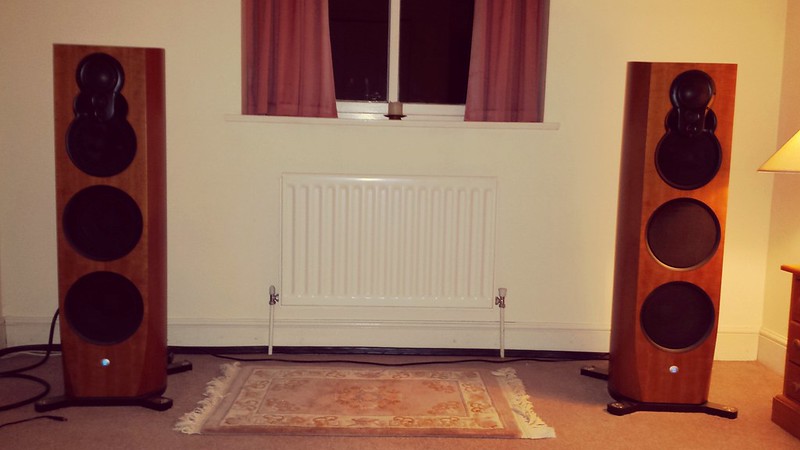
Linn Klimax 350 passive speakers in Cherry with black arrays
Quadraspire Evo rack
No fancy mains treatment, room treatment nor cable lifters in sight...

Most of the music we used came from Tidal (a few tracks from the local laptop) and included Malia, Eagle Eye Cherry, Deadmau5, Ficci, Felix Laband and Tina Doci.  Control was via a laptop running Kinsky (for ease of use) and Kazoo (for access to Tidal).  The KDS/2 was using SPACE room optimization, set up by Whizz when using the KCT power amp.

DVC

Let's get this one out of the way to start with, but first a qualifier.  This is the first KDS/2 I've heard, I've not yet compared it to the KDS/1 back to back in the same system, nor have I had the chance to compare one using the DVC versus feeding it through the analogue volume control of a KK/1 - that's the subject of a near future post.  We used volume levels of between 58 and 62 (for the Linn power amp) and between 66 and 72 (for the Tundra, which has 8dB less gain than the Linn).  So we didn't try the DVC at lower listening levels.
  
Across both the Tundra and Klimax power amps, I can't say that I heard anything that made me think there was any problem at all with the DVC.  With the Klimax amp, there was occasionally an "edge" to the lead of some instruments and voices, but that could be the KDS/2 or the Klimax Twin amp, as I've not heard either of these in their current configs.  Interesting that the Tundra didn't reveal these edges, so maybe it was the amp...  Anyway, at these volume levels, there wasn't even a hint of the "horrendous" nor the "unlistenable" comments I've read elsewhere.

Sweden

So kicking off with the Tundra Stereo 2 - an unassuming little black box - this one being just a few weeks old and only with about 10 hours use.  It was warmed up though, having been switched on and used a couple of hours earlier.  And what a polite little box it is.  Goes plenty loud enough, at least for me, but its really rather soft in its presentation - almost valve-like (and that's not really a complement from me, but I know many will like this kind of presentation).  The top-end doesn't sparkle, the imaging is flat and rather narrow but vocals (particularly female vocals) are sweet and clear.  Not sure why Tori Amos sounded about as wide as the window between the speakers though.  

What of the bass?  Well, it was difficult for me to tell as the 350s were sounding very different when driven with this amp - the usual slightly detached bass issue was not very easy to distinguish because it was all rather loose.  Bass notes started OK, but they don't stop too well.  Its not boomy as such, it just kind of happens then takes its time to stop again. Deadmau5 didn't have me tapping my foot or wanting to dance, which is an usual experience - even on my much more modest Majik amp and speakers, the track we used drives hard and always gets me foot tapping or jigging in the seat (so to speak).  Another favourite is Blues Company's Dark Day - a track full of sparkling cymbals, triangles and snappy rimshots, along with some extremely deep electronic drum effects.  Whilst the vocals were good and the track flowed along, the cymbals, which should be distinct, clear, individually identifiable in space and shimmering as they are struck and fade away, well, they're just underwhelming and ill-defined - some of them being very indistinct.  The electronic bass drums impacted well, but then kind of flapped about a bit - it really had me wondering if developing a power amp through the little Linn Majik 109 standmounts makes sense, or are the 350s just too demanding?  Maybe Lejonklou used other speakers too, but I understand the 109 was the most frequently used in development.  

It was all OK, but we tended to talk over the music, or move onto the next track before the existing one was finished.  I've never heard the Klimax 350 powered by anything less than its internal amps or external Klimax amps before, so I have no idea how they sound when powered with something less exotic and more affordable.  So maybe this is how a £2.5k power amp sounds with these speakers, I just don't know.  And maybe something more expensive doesn't do a better job either?

Scotland

After about 50 minutes of Sweden, we moved onto Scottish power.  The KCT had been switched off for about 3 weeks, so was going to be fired up and used from cold.  Swap over only took a few minutes and the music was up and running pretty quickly - Whizz had the amps back to front on the rack to provide quick access to the connections.  And whoa!  Even from completely cold this amp was a revelation in comparison to the previous hour or so of listening.  The 350 bass timing "characteristics" were back, because now the amp was gripping these speakers much much better - you could hear bass notes starting and stopping.  And the room got bigger - not the actual room, but the room in which music was recorded - Fink were in a proper venue, not the front room.  Tori Amos's voice is now a much more sensible size - and absolutely locked to the centre.  

And detail - there's more coming through from the recording, instruments that were indistinct or not even noticable with the TST are much more obvious and finely etched.  We play Dark Day again, and we listen to the whole track in silence to the end - captivated by what we were hearing.  There is a down side - there is now, an occasional "edge" to some instruments and vocals - but get this into perspective - its a tiny criticism compared with the Tundra's compromises.  As the KCT warmed up, within 20 minutes it was doing a great job.  Tight rhythms, deep bass, clear space between instruments, the atmosphere of the venue much more obvious, sparkly cymbals.  Foot tapping?  Yep, its back - good.  Perhaps this is the best I've heard the 350p, but I can't get away from that slightly weird bass timing issue.

2015-08-01_09-08-53 

Conclusion

DVC - still more investigation to do, but no obvious issues at all tonight, unless its that edginess heard through the KCT, but not through the Lejonklou.  If it is down to the DVC, its a fairly minor issue - not enough to want to listen to something different.

Tundra vs KCT - this was not what I was expecting at all.  Soft, loose and a bit vague, the Tundra was out of its depth here.  Would still like to hear it with other, lets say, more conventional - less challenging, speakers - I'm almost sure that the 350s are not its ideal partner.  No doubt there will be some who say that it needs 6 weeks to be at its best or similar - if that's the case, then they need to play for whatever length of time is required for them to work properly before they leave for their owners. Maybe the Tundra was disadvantaged by the SPACE settings being set up with the KCT - another reason to try to find the opportunity to listen again under different circumstances. I was expecting a difficult choice - to need to swap back and forth between amps to try and fathom subtle differences in presentation or character.  Nope, in this system, in this room, this was an easy, no-contest win for the KCT in my opinion. 

What about the cost - the Tundra is very much cheaper than the KCT. And that's a very important point here, and why I would like to hear the comparison again with more normal speakers - maybe my Majik 140s, maybe some PMC Twenty.26s, or Kudos Super 20s would be a fairer load for it to deal with.  But as a giant killer against the KCT?  No, its just not close on this evidence in this system.  A secondhand KCT would be a better way to go, for me at least.


Thanks to Whizz for his hospitality and the opportunity to listen to this kit, a good way to spend an evening.