"What a refreshingly honest blog about listening to music through hi-fi. So happy to see views based upon the enjoyment of music rather than so-called sound 'quality'." - Peter Comeau, Director of Acoustic Design at Mission / Wharfedale
Showing posts with label NAP250. Show all posts

Tuesday, 1 October 2019

NAIM SBL Loudspeakers: From SNAXO Active to Linn Exakt: Guest Contributor

Here's something a little different.  The first ever "guest contributor" post on AudiophileMusings.  Below is Clive Gidney's experience of working with SpeakerFilters on development of Linn Exakt filters for the Naim SBL loudspeakers.

Full disclosure: the lead designer at SpeakerFilters is also the "editor at large" of AudiophileMusings.  Note the article below is entirely Clive's own words without any edits.  Enjoy, and thank you Clive for your contribution.

NAIM SBL: FROM SNAXO ACTIVE TO LINN EXAKT by Clive Gidney

At the beginning of the year, having been running a pair of SBLs with a pair of 250s sort of bi amped (one for left channel only & one for right - just because I had 2 x 250s & hadn't got round to swapping them for a pair of 135s) I decided that it was time to do the proper thing & go active. 
 
 70643072_10157593750100682_2280851719799
 
 So SNAXO  & Supercap added and this gave a significant improvement in detail, soundstage, PRaT & all the things that SBLs are famous for... But I was still left with the feeling that they are a bit forward & a bit bass light. In fact a non audiophile friend described them as "a bit shouty".  And yes - I'd done all the set up things, as close to a solid brick wall as the skirting board would allow, re-sealed the bass loading box etc.
 
Then a couple of months ago I was at Brian & Trevor's in Manchester for a musical evening  listening to a Linn/Kudos Exakt active system thinking this system sounds amazing (although I would have liked to hear it with Naim power amps) but the transparency that the Exakt technology brought, which performs the crossover in the digital domain, was breath-taking. In the interval I remarking to one of the other attendees how great Exakt was & that I wished it was available for SBLs! And he said "I write Exakt filters for speakers that Linn doesn't support" OMG!! That person was Neil Hallworth of speakerfilters.com
 
So we embarked on the Exakt SBLs project.
 
Step 1 was to physically measure the SBL cabinets, the position of the drive unit centres, the front baffle slope etc. These numbers were then plugged into Linn's system to enable Linn's Space Optimisation to be enabled. That is available now for free for anyone using a Linn DS or DSM with SBLs via Konfig! 
  
Step 2 involved Neil calling at my house to take some electrical measurements of the drive units to measure their impedance.
 
Step 3 Neil then took these measurements together with some information on the crossover frequencies & slopes obtained from Naim to work some digital magic to create a first cut of the digital Exakt crossover filters. In fact he sent me three versions with different crossover slopes, 2nd order, 3rd order & 4th order. It was very quickly apparent that the 3rd order (which is what Naim used) was the best. The 2nd order sounded congested in the mid-range while the 4th order sounded as though there was a hole in it. He then sent me a 3rd order v2 without telling me what he'd done. When I tried it, it was clear that this was an improvement over v1 with better definition & spatial separation. The sound stage was more clearly defined & I was in heaven. The slightly bright & comparatively bass light presentation was gone without losing any of the strengths of musicality & PRaT that SBLs are renowned for. Neil assured me that there would be more to come in step 4 but I was so impressed that my SNAXO & Supercap were already up for sale!
 
71178756_10157593750645682_6600916446740
 
Step 4 Neil called again to fine tune the filters. Firstly we agreed that in taming the brightness, they had lost a little of their sparkle. Now apparently, the sound waves emanating from all drive units have an interaction with the speaker cabinet front baffle and to compensate for this, within the Exakt crossover Neil had created a 0.8 dB treble filter. Now I'd been advised by John Jackson (ex Naim Senior Test & Service Engineer & currently Witch Hat Lead R&D Engineer) that the SBL cut away foam grill was designed to overcome the treble baffle interaction issue. So Neil removed the filter, updated the Exaktbox & sparkle was back. Hi hats shimmered, room acoustics were tangible, the space around instruments & performers improved. 
 
Next we played with the actual crossover frequency. With v1 the bass/mid roll off & treble roll on were at the same point 2.4khz which we'd got from one Naim source. In v2 the bass/mid was rolled off at 2.3khz & the treble rolled on at 2.5khz (from a different Naim source) So we tried widening the gap by 50hz either way - not as good. Leaving the bass/mid where it was but bringing the treble back again - immediate improvement!
 
Adding baffle filters for the bass/mid drivers for both the length & width of the cabinet added further improvements and the subtlety  of the changes that could clearly be heard was mind blowing;  -0.5 dB - too much, - 0.25 dB, not enough so we settled on - 0.4 dB. Adding a 1.5 dB lift in the bass from 0-60 hz - too much, 1.2 dB - still too much, 1.0 dB - bingo! In all we went through 17 variations fine tuning the Exakt crossovers in just over two hours. Imagine trying to do that with resistors & capacitors in the analogue domain!
 
The end result? Absolutely stunning. If you thought going from passive to active with a SNAXO was a big step... from SNAXO to Exakt is like having seven league boots on! Really, it's that good. 
 
Oh, the cost?  Well  I'm going to make a few assumptions. If you're already active with SBLs, then presumably you've got a good front end - LP12 around Akurate spec, a Naim NDX minimum, maybe NDS, or a Linn Akurate DS/DSM Katalyst, Naim 82/Supercap or more likely 52/Supercap, SNAXO / Supercap.
Hardware. You keep whatever power amps you're using - in my case a pair of olive Nap 250s which will retain your signature sound. Ideally you'll need a Linn Akurate System Hub which becomes your pre amp - £2700 new or about £1600 pre owned, & a Linn Akurate Exaktbox Katalyst which is where the majik happens (see what I did there) - £5000 new or I picked one up pre owned with 4 years warranty for £3200; And, you'll need a set of  Exakt filters from speakerfilters.com  which are just £295. These  can be tested for a free 2 week  trial period before purchase. Total cost  about £5400 pre owned or ~£8000 going new
But you can recoup say £1500 on your NDX, or £2000 on your Akurate DS, £2000 on your 82 /Supercap & £1500 on your SNAXO /Supercap = £5/5500 so approx. cost  neutral going pre owned :) And if you've got a 52 or an NDS you might even have some cash left over :)


A huge shout out for Neil of speakerfilters.com for all the work designing & refining the filters. 

Clive. 

Saturday, 23 September 2017

ACTIVE SERVICE - Naim with Kudos T-707

Yesterday Acoustica Hifi in Chester had a Kudos open day.  T-808, T-707 and T-606 were on offer.  Thanks to Acoustica for the invitation.

I turned up towards the end of the day and all three pairs of speakers were crammed into the room.  A big sounding Deadmau5 track was pumping out and I assumed the T-707s were in action.  However, local Naimist R was sat there having a listen to the T-606s in passive mode - so a very impressive introduction.

There are quite a few reports on Audiophile Musings about the development of the Kudos Titan family, most of them are here:

Acoustica Show 2015

Acoustica Show 2017

Munich High End Show 2017

National Audio Show 2015

Indulgence Show 2016

The T-606s tonight were not ideally placed, in fact it was remarkable that they could sound anything like decent, given their position in the room.  Just enough to get a taster.  They did not disappoint and their performance here (being driven by an all Naim system, culminating in a 300DR amp and SuperLumina cables) just reinforced the view of their performance in Munich back in May.

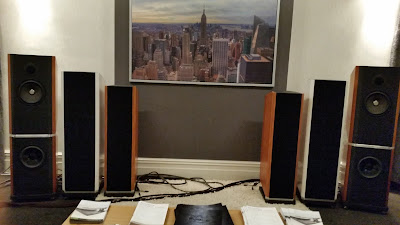
T-606 in the centre flanked by T-707 and the T-808s on the outside


But the main course tonight were the T-707s, the mid-size speaker in the Titan range.  If you look at the above links, you'll find much praise for these speakers.  They don't have quite the finesse of the 808 and they don't go quite so deep, but boy do they boogie.  There's a real sense of fun in what they do - they party and let the music flow along very well.  Back at the Acoustica Chester show in March, they were driven actively by a development Naim SNAXO crossover.  Here they were in a similar set up, but the SNAXO has been back to Naim for some tweaks to the components and the box is now described as pre-production.  Hopefully Naim will find a slot to crack on with production soon.

The room was joining in quite a lot tonight, so conditions weren't perfect, and some tracks from Tidal sounded good (the Deadmau5, Kiasmos, for instance) and some sounded pretty ropey (for example, Eric Bibb).  So for proper listening we focused on locally stored rips on the NAS.  Daft Punk's "Georgio Moroder" and a Janis Ian track that I didn't get the name of were used for the focussed listening.  After enjoying the 707s active for a while, it was time to get down to a worthwhile comparison, despite the rather compromised room setting, at least the comparisons would be on a consistently inadequate set up and could therefore deliver a level playing field.

The speakers were switched back to passive.  As is usual with the Titan range, this just involves a few u-shaped metal links - with the links in place the internal passive crossover divides the signal between the drivers - remove the links, hook up 2 stereo power amps and the splitting of the signal needs to happen before the power amps - in this case a Naim SNAXO.  This SNAXO is now described as pre-production and will work with T-707 and T-808 with a small tweak to one of the internal potentiometers.

In passive form, the Janis Ian track was a pleasure to listen to.  The room was joining in to an extent but it was easy to hear that and ignore it to get to what was going on directly from the speakers.  The track is fairly funky by JI standards, which is to say its a not very funky track by funky standards, but there's some decent electric bass lines along the way.  The track starts quietly then adds extra instruments and complexity along the way.  The music was joined up and enjoyable in passive form, bass tuneful, imaging is good but not exceptional (but hey, look at the way they were set up on this occasion, that's no surprise), vocals nicely rendered - this is a very good pair of speakers in action.  We listen to the whole track, then go back and listen to the first 90 seconds or so to try and get the beginning of the track stuck in the memory.

Conversion to active takes a couple of minutes.  Understanding the magnitude of the difference it brings is a matter of seconds, then, as the track plays that understanding develops and deepens.  The active conversion brings much of what I'm used to hearing in equivalent changes in Linn active systems.  Its that clarity thing, the edges of notes are better defined, instruments start and stop with more conviction, the bass lines are crisper, tunes are easier to follow, the reverb on a guitar goes on that much longer but doesn't crash into the other instruments, there's a space between and around each instrument that wasn't there before.  Ian's vocals are better rendered, they've taken a step forward from the mix - there's subtelty in there that wasn't there before.  But all this is still joined up as a single musical message.  Back to that first few seconds of going active, and the thing that I really wasn't expecting but was quite a stunning change - the Ian track has a number of quiet elements right at the beginning of the track and that quietness was soooo much quieter than before.  With passive, I wasn't really concious of any background noise and hash in those quiet elements, but with active, the lack of that noise is very apparent (I'm sure there's still some there, but its notably less obvious).
I wish I'd made a note of this track - I've been trawling through the Janis Ian tracks on Tidal, but its a long list and I haven't found it yet!  I have discovered lots of tracks that I like along the way though, so that's a plus.

We then listened to the Georgio track and the way these active 707s can power through this piece of Daft Punk inventiveness is very impressive.  The intro clearly reveals the sounds of the 3 different mics used to record it, and the chatter in the background is easy to follow.  But the real test of this track is about 3/4 of the way through when the very complex bass lines play at tremendous speed and there majority of systems just can't do this bit very well - they end up playing monotone thumps rather than several complex and tuneful notes.  The active 707s do a great job on this not only maintaining the tune but revealling a really growly edge to the note, far better than some more expensive systems.  And playing loud doesn't phase them at all.

So, for me, an easy conclusion to reach.  But here's the sting in the tail, that will be of interest particularly to Naim system owners.  The passive system was using a single NAP300DR with Naim's expensive SuperLumina speaker cables.  The active system used 2 of the "lesser" NAP250DR power amps and the far more reasonably priced AudioQuest Rocket speaker cables.  Game set and match to active!  Get that SNAXO on the production line Naim!

Thanks to the gents from Kudos and Acoustica.

I look forward to giving the T-707 a listen in my Linn Exakt system - I think they could be on the Musings system roadmap.  Just need Kudos to finish up the Exakt crossovers in the next few weeks.

Friday, 28 February 2014

Hell Freezes Over?

There's a follow up posting to this story, 3 weeks later here.  Read this post first then check out the follow-up.

As a starter for a weekend of hifi, I guess this is one of the more exotic ways to kick off. 
After the usual week of work, everything was planned and ready to go for the Wigwam hifi show at Scalford with travelling on Saturday and the show itself on Sunday.  Friday evening was supposed to be time at home before disappearing off for a weekend of sonic indulgence and maybe the occasional glass of beer.  But "Richard Is My Naim", my local Naimist and co-conspirator at Scalford dropped a killer call at knocking-off time on Friday evening.  Another black box had arrived.  It needed setting up.  It needed listening to.  Now.  An NDS had landed.
Back Story
In 2 parallel universes, somewhere in North Wales, 2 journeys from CD to streaming have been played out.  Myself predominantly with Linn,  Richard consistently with Naim.
My starting point:  Meridian CD508.20 / Meridian 541 Pre / Rotel power amps / Active Linn Keilidhs.  Via Squeezebox, CA and Cyrus DACs, Cyrus and older Linn power amps, Linn AV5103 pre etc., at the end of 2013 I was at Linn Akurate DS/0/1, Linn Akurate Kontrol/0/D, Linn Majik Dynamik amps and active Majik 140 speakers.  And very happy was I.  Until a "friendly" Linn forum member let me hear a KDSM versus the Klimax Renew (KRDS) streamers.  With the advent of Linn Exakt, a good few Klimax DS/1s (KDS/1) came on the market, the prices fell, and, at the beginning of 2014, a black KDS/1 stepped in to my system and completely re-wrote the rule books.  I could almost see the cogs whirring in Richard's head when he heard how profound a change the KDS/1 brought to my music.
Richard's starting point: Naim CDX2, XPS power supply, NAC252 pre with HiCap PS, NAP180 power and Wilson Benesch Arc standmount speakers.  Then, via the second version of the CDX2, and improved XPS2, NAP250 power amp, NDX with XPS2, he has ended up with NDX / 555PS DR streamer, NAC282 / HiCap pre-amp, NAP250 power amp and Kudos C20 Super floorstanding speakers.  He was also very happy.
So here we have 2 very different ways of getting to a decent quality streaming solution.  And they sound very different too.  Both have bags of detail, but the Linn system is very precise and instruments are really well separated whereas the Naim system sounds more like it wants to get on with everything (like there's not enough time in the day), it has a particularly expansive soundstage and, for me, can occasionally sound a bit strident.  Guess what?  We both think we have the correct answer, but we also seem to respect what the other is enjoying, if that makes sense.
Why Is Hell Freezing Over?
This is a reference to a couple of things.  First, the live album by The Eagles - when they originally split up, one of the band was quoted as saying they would only get back together, "when Hell freezes over", yet there they were, playing live again together.  The second reference is to the relationship between Linn and Naim as companies.  Back in the 1970s, when Linn started out with the LP12 turntable and Naim started out making simple but well engineered amplifiers, the two companies had very similar outlooks - they were out to challenge the establishment and did so very effectively.  When Linn added speakers to their range, and Naim expanded their line of amplifiers, all was well.  The components worked well together and became the "established" route for UK audiophiles.  But when Linn added amplifiers to their range (rumour has it that the Naim MD used one as an office doorstop), then Naim produced a tonearm for the LP12, it all started to go a bit off-kilter.
Despite that, many dealers and customers still work with and enjoy combining the 2 manufacturers' equipment today.
So perhaps this isn't Hell freezing over, but putting the top of the range (almost - more later) Naim streamer on the same rack as the top of the range Linn streamer is probably not something that happens too often.
Naim NDS on a shelf above the Linn KDS/1
Richard's usual streamer solution is Naim NDX with the 555PS DR power supply.  The most recent upgrade step was to swap out the XPS2 for the 555PS DR power supply a good few months ago, and we were both stunned by the improvement this brought in terms of imaging, leading edge attack and more atmosphere to the music.  In source terms, there's only one place its possible to go from there, and that would be to swap out the NDX streamer for Naim's current top of the range NDS streamer.  The NDS can use a single 555PS DR power supply - the one Richard currently uses with his NDX - so its a straight swap, NDX out, NDS in.
Having packed up the KDS/1 into its Linn box, I was round to Richard's house fairly sharpish.  Down to business - get all this stuff up and running to allow us to make the comparison.

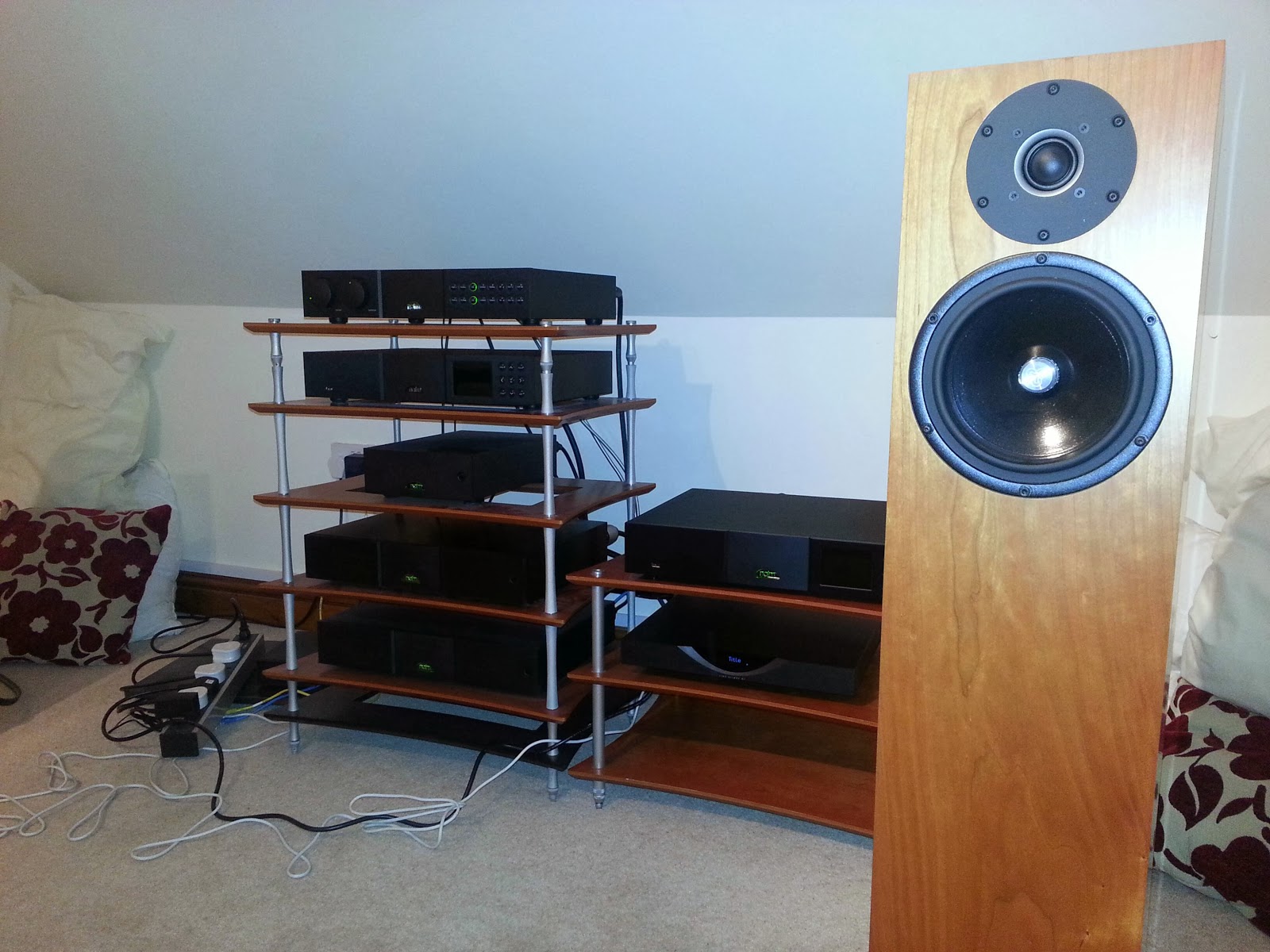
A bit untidy with Ethernet and power cables. Left hand rack consists of Naim NAC282 pre-amp, Naim NDX, Naim HiCap PS for the 282, Naim 555PS DR for the NDS, Naim NAP250 power amp.  In the foreground the Kudos C20 Super (in cherry veneer).  Racks are by Quadraspire.


Get Set, Before Go
An unmanaged switch was connected into the Devolo Ethernet over mains plug to allow 2 x Ethernet connections.  The KDS/1 was hooked up to the network, and with the wifi password sorted out, was pointed at the correct UPnP database from my Android phone (using BubbleDS control point) and that was sorted.  Linn Silver interconnects into the back of the NAC282 (actual phono sockets!) and that was ready to go.
The Naim is a little more complex as it needs two very large ("bundy") cables connecting - both of these are intended to be connected to the 555PS DR power supply.  It took us a while to work out which is which cable - apart from the different arrangement of pins in the plugs, there's not much to go on.  Until we worked out that one cable had a single white band at one end with the other having 2 white bands.  Turns out that this correlates to input 1 and input 2 on the back of the NDS.  Easy when you know how!  One more cable to carry the signal to the NAC282 pre-amp and we're good to go.  The NDS pops up on the iPad and music is available from both sources.
Where Did That Come From?
The previous weekend I'd been at the Bristol show organised by Audio-T and WHF magazine.  Naim had been there, with their first European public demo of the Statement amplifier which you can read about here.  Turns out that what we had there in front of us right now was the NDS streamer that Naim had used in that demo in Bristol.  Surprisingly, they seemed to have used a brand new unit that weekend, so perhaps it got better over the weekend and those who heard the system on Sunday may have heard something more enjoyable than the demo I was lucky to get into, first thing on the Friday.  So it had some burn-in time, but not a great deal.  My KDS/1 has about 15 months use, so no chance of any burn-in issues there.
Worth pointing out, at this point, that the KDS/1 and the NDS with a single 555PS DR are pretty much on a par, price wise.  The KDS/1 is the top of the Linn range at the moment (of the conventional streamers that is, excluding the Klimax Exakt DSM which is a different kettle of deep fried fish in technology approach), but the Naim NDS can be upgraded further by the addition of a second 555 PS DR power supply.  Apparently one serves the analogue circuits, the other the digital circuits, hence separating stuff even further.
Listen Up
Testing my memory a bit now, but I think this is what we listened to:
Steely Dan - Any Major Dude
Fleetwood Mac - Rumours (24 bit)
Ane Brun - Worship
Nirvana - Smells Like Teen Spirit
James Taylor - Gaia
Eagles - Hotel California (Live)
Eagle Eye Cherry - Shooting Up In Vain
Some Radiohead, which I choose not to remember, and some other stuff I can't remember due to advancing age (probably).  Maybe Richard will be along soon to provide an update - although he is one year older than me, so maybe that's unlikely  ;-)
Strangely, for us, Blues Company didn't feature at all.
So What?
Well, that's a very good question.  So what?
I like my Linn system.  Richard likes his (almost all, but thank goodness there are no Ovators in the area) Naim system.  Can you guess where this is going?
I've suggested a "Part 2" where we put the NDS into my Linn system.  The NDS is on demo at the moment, so we're not sure if we'll find a mutually available time to give that a go.  If it happens, you'll read about it here.
Interestingly (maybe?), this bake-off fitted with the Scalford Hifi Wigwam show weekend very well.  How so?  Did it sound like vinyl, played through valves and a set of extreme home made horns?  No.  No.  Not at all.  The alignment is this - Scalford is about variety and variety, with some added variety.  For example, when exhibiting with my budget system and playing a Yello DVD (with a projector too), we had some people who walked out in less than 30 seconds (I think 3 minutes would be a fairer time to decide, but hey, I'm kind of known for being unreasonably reasonable, sometimes), and some who watched the whole video end to end - 40 minutes.  Equally, I like to give every room a try, but some I stay in, others I find 3-5 minutes with a couple of different tracks and I want to move on.  There is a theme with the Wam - there are some systems that do lots of things very well, but there are many systems that do one or two things exceptionally well, but don't do all the other things well at all.  And that's what it seems to be about - enthusiasts playing what they think is right, whether you, dear visitor, like it or not.
Variety.  See?
And whilst I wouldn't accuse either the Linn, nor the Naim, of doggedly pursuing a very narrow set of goals, you can very much hear a house sound from both devices, even in a predominantly Naim system (hence my suggestion we do this again in a Linn system at some point, to get some balance, maybe).
How is it that 2 expensive, highly engineered solutions, using exactly the same source material across exactly the same network, create such a different feel?  What's happening to those bits and, further down the chain, those analogue waves that crunches them out so differently, and yet with some commonality?
What's common?  Detail, layers upon layers of intricate detail.  Tiny nuances in voices, subtle touches of cymbals which are normally hidden underneath other cymbals or percussion on lesser components.    Bass lines that aren't one instrument, but are 2 or 3 that play tunes that intertwine with each other.  That extra level of control that is only stunningly apparent when its there, and then when you step back to a lesser component and notice that the looseness is back.  It amazes me that what sounds great on a system is suddenly put into a perspective of inadequacy when you hear it done "right".  What is "right" anyway?  I wasn't there at the recording so I don't really know, and yet its somehow obvious.  A bit like colour in a photograph - its often obvious what's been changed in Photoshop (other programs are available), yet you weren't there to see the real thing - you just instinctively know its not right, not natural. And rhythm.  Both of these players time superbly.  Tap tap go the toes - its involuntary, its pretty much inevitable.
What's different?  Everything else. 
The Linn sounds so much like its fully in control.  The music will do what the Linn tells it to do.  The instruments are carefully "placed".  The imaging is immaculately controlled.  You can imagine the subtlety with which a string is plucked, a cymbal brushed, a sigh is delivered.  Its precise.  And yet, it flows so smoothly.  There's something about the Linn that makes the music feel crafted by hand with skill and attention by musicians who care. Not lacking in attack, but instrument attack is precisely delivered - starts and stops are there to be heard.  Decay is beautifully extended yet the instruments don't blur together.  Clearly this works brilliantly on material such as James Taylor, the Eagles and Eagle Eye Cherry.  Does this make Nirvana and Radiohead polite and lacking in bite?  No, strangely not, the bite and anger is there, the emotion flows through.
The Naim is clearly a Naim component.  There's very little chance that you would mix up the 2.  It punches, it attacks the music, there's no doubt whatsoever that it means to get on with the job, to tell you that this is the way the music is, get on and enjoy it, or get out of my way.  Its a much more raw experience than the Linn, and I think that's what Richard enjoys - he takes this as being more emotional, more like real life.  For me it gets too much at times - pushing my limits of enjoyment, getting close to the point of aggression and boarding on harsh.  Its not my cup of tea, but I can absolutely hear the appeal.  The Naim has a tiny more expression in the vocals, especially female vocals - just a bit more texture, if you like.  It also has a wider soundstage, filling the room more from left to right, but not quite so much front to back - delivering this as a counterpoint to the precision of the Linn.  Sometimes the decay of instruments is lost a little in the mix, in comparison with the Linn - perhaps that's something that contributes to the need to move on, to deliver the next bit of excitement.
So there it is.  Not much of a conclusion really, is it?  Guess what?  I'm very happy to have chosen the Linn, but that's not a slight at the Naim which I fully respect for what it does and what it achieves.  Put the Naim in a Naim system and you get exactly what you might expect, just more of it, to a finer level of detail and with that extra bit of passion.  I suspect that Richard will also choose the Naim.  He's leaving it playing during the week, so maybe a bit more time on the NDS will change it further.
But I'm left with a bit of a nagging doubt, and we discuss it a number of times over the weekend at Scalford.  Is the NDS worth the asking price over and above the NDX?  On the basis of this session, upgrading the NDX / XPS2 to NDX / 555PS DR delivered a bigger step.  Yes the NDS is better than the NDX, but it hasn't delivered as much as the power supply change.  Seems counter intuitive really doesn't it?  Surely a different DAC, analogue output stage and improved physical isolation makes a bigger change than a better, beefier, tighter power supply change?  Not on this showing it doesn't.
Lets see what the week's extra burn-in brings.  For this test I come away happy with the KDS/1, Richard comes away wondering about that 10 year old Porsche Boxster...
There's a follow up posting to this story, 3 weeks later here.

Sunday, 22 April 2012

Linn vs Naim Mid-range Streamer

Had the opportunity to spend some time comparing Linn and Naim streamers last weekend.

Context:
Friend's system as follows:
Naim CDX2 (latest version) with XPS2 power supply
Naim 282 pre-amp with Supercap power supply
Naim NAP250 power amp
NAC speaker cable
Wilson Benesch The Arc stand mounts with their dedicated stands

We have a difference of opinion on how a system should sound - to me the above seems to interpret the music rather than let it out, and it has that Naim immediacy that borders on shouty. It is much better than it was previously when it used to have a first iteration of CDX2 and a NAP180 amp.

So in came a Naim NDX streamer, using the existing XPS2 power supply. We used my Windows 7 Dell laptop, a 2.5" portable drive, FLAC in 16/44.1 and 24/96, an unmanaged network switch and Asset UPnP. Control was via the buttons and screen on the front of the NDS - really simple to use and gets you up and running quickly. I thought it was much simpler to set up than a Linn DS. It took us about 3 minutes to decide that the CD player was a non-event compared to the streamer. The difference is quite astounding - the streamer is much more organic and precise - it has an hint of analogue about it. The control it brings to the music really makes the CD player sound quite nasty, cluttered and over zealous. Job done. This streamer and power supply combination lists at about £6.5k. You can pick up ex-dems and secondhand and get this down to just under £5k. Not many about though, although I suspect more NDXs will start to surface now the NDS is on its way.

We brought in my Akurate DS/0 Dynamik and silver cables (yes, the 282 pre-amp has a couple of phono inputs on the back!) into the Naim system to conduct a direct comparison. We used the same data source as used for the NDX and used Kinsky on the laptop for control. How did it compare? Well its a tricky one really. I really wouldn't like to say which was better, but there certainly were some differences. For me the Linn brings more detail, separates the instruments better, times the music more naturally (more involuntary foot tapping) and is very musical. To counter this the Naim sounds more analogue, a bit more fluid and gives an open, more airy soundstage - almost like the room in which the recording took place was bigger. I know the current ADS/1 lists at £4.5k, but mine set me back just under half that amount.

So you pay your money (lots more for the Naim) and make your choice. I really would be happy living with either in the Naim system, but if you add VFM into the mix, the Linn wins out significantly.

Oh, and if you take the PSX2 out of the system, the NDX is a real disappointment compared to the ADS/0 Dynamik, but still outperforms the CDX2.

If we can find a suitable cable, I'll try and report back on the same comparison in my Linn system...
Scores (a bit simplistic, but there you go - all I'm trying to do is indicate relative performance rather than absolute performance):
Naim NDX / XPS2 = 90%
Linn Akurate DS/0 Dynamik 89%
Naim NDX = 75%
Naim CDX2 / XPS2 = 65%