
Clicking on the images will show a larger version. Remember, its all IMHO, your experiences might be different, and its worth noting that show hotel rooms aren't ideal of course.
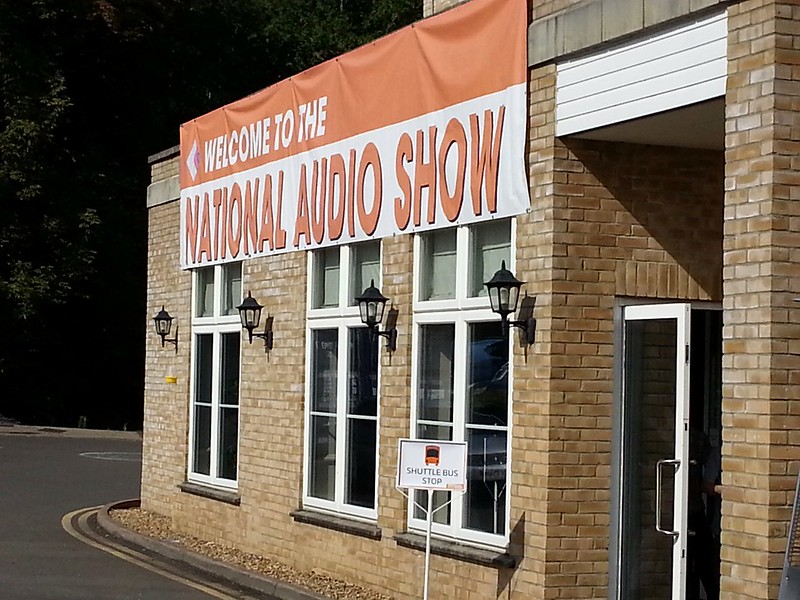 |
| Entrance to Whittlebury Hall for showgoers |
There's a big grass car park (or you can use a shuttle bus from Milton Keynes station), a 5 minute walk from the show entrance and the show is held over 2 floors, with rooms spreading out from a central courtyard where a BBQ was available most of the day. The rooms range from something like a typical living room size up to some very large conference / dining rooms. As is typical of these shows, the rooms don't contain much in the way of soft furnishings, so empty echoey rooms are always going to be a challenge. Lots of banners in evidence and some attempts at treating the rooms with columns and panels.
Attendance - having not been to this show before, I can't say if it was busy or not, compared to previous years. There were around a maximum of 40 rooms on offer, in addition to large rooms with "stalls" for accessories, and the very large "Headzone" area for headphones and associated amps. Some of the rooms we had to go back to, in order to get a seat, some were quiet and some (the ticket only music / talks / demos) were sold out all day. The corridors were reasonably busy between 11:30 and 15:00 on Saturday, much quieter after that. We arrived at 11:30 and there were some punters leaving already. The usual suspects were present - middle to later years males, but quiet a few females too, and a smattering of kids (including my own).
Also worth noting that some of the 40 rooms were very large, but contained small systems playing in one area and then lots and lots of kit on display - to be honest, if you're a vendor who wants to go this way, better to get a room for the static display and a smaller room for the small system to play in - in these vast rooms they're essentially lost (although, there was one exception to this - see later). Because of this, I would say there's probably more like 30 rooms to listen to.
What of the rooms and systems? Well, I did find some gems, and will say below which I enjoyed most, but didn't get to all the rooms, so may have missed something better.
Headzone
 |
| The very large and comprehensive "Headzone" - a really good feature of the show |
Anyway, I listened to a few examples that were of interest to me, but there are many here that really aren't of interest either because its the same stuff as heard at other shows (i.e. Grado) or because they're too ugly, too expensive, or open backed and therefore don't fit into my typical headphone usage. My son has AKG 451s and found the Y50s to be a good upgrade - they're the same drivers but in a larger closed back design that fit over rather than on his ears. He found them to have a deeper, richer bass and therefore a more relaxed listen. Seem good value. They were using the tiny Schiit Magni 2 - a £90 amp that seems to do a really good job
Stax - I tried some that were £1895 including the amplifier. I just don't get them. Lots of detail, but its a lightweight sound that really comes across as unnatural and processed. This being a theme for me - the Oppo PM-3 Planar Magnetics playing through the HA-2 amp were very similar - synthetic sounding, plus the combo started distorting at suprisingly low volume levels. Another pair of headphones (didn't make a note of what they were) on the Chord stand with the Dave DAC exhibited the same characteristics. Maybe high end headphones just aren't my thing.
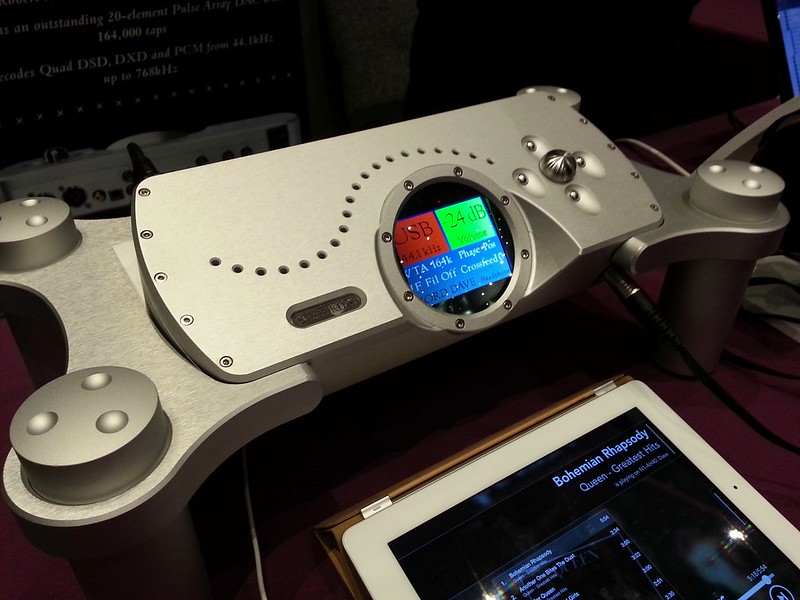 |
| Chord Dave DAC. Nice machining, dubious taste (IMHO!) |
Audioquest were exhibiting their first pair of headphones, the Nighthawk. They had 2 rigs on the go - both fed from Apple Macbooks. The first used the Chord Hugo TT as DAC and headphone amp and were ugh. Thin and synthetic again. I nearly didn't try the other pair, but glad I did - they were powered by an AudioQuest Dragonfly DAC and a £900 Trilogy 931 headphone amp, this was a really good set up - flowing music, some warmth to the sound, decent bass depth, good timing and, thank goodness, none of that synthetic sounding treble and vocals so much in evidence elsewhere. Not sure about the wisdom of pairing an £800 analogue cable with a £130 DAC and £900 amp though...
Off to the main rooms, but distracted part way along the accessories bit by a demo by Max Townsend at Townsend audio. They have some speaker "platforms" for want of a better term. Essentially, some metal plates suspended on 4 compliant towers - not sure if these towers contain springs or some kind of rubber type compound. You spec the physical size of your speaker bases and their mass when ordering - to ensure the right spec of compliance to match the mass. On top of each of a pair of PMC FACT12 speakers there was an iPad running a seizmic measuring app - one speaker was spiked to the floor, the other on one of the Townsend platforms. By jumping up and down near the speakers, the "normal" speaker analysis showed lots of disturbance and oscillations. The one on the platform continued to show a small amount of background movement. Apparently "background" seismic activity in the UK is equivalent to about 10x the movement of a tweeter dome, hence connecting the speaker to the ground makes the speaker sound "blurred", according to Townsend. The static demo was very impressive, but I'd much preferred to have heard the effect, if there's any. As usual, open minded but sceptical until I hear if for myself. Apparently PMC are fans (but weren't using the platforms in the Fanthorpe's room). The non-platformed and spiked speaker could be rocked a millimeter or so by pushing on one top corner, so it wasn't entirely convincing.
 |
| Townsend Speaker Platform |
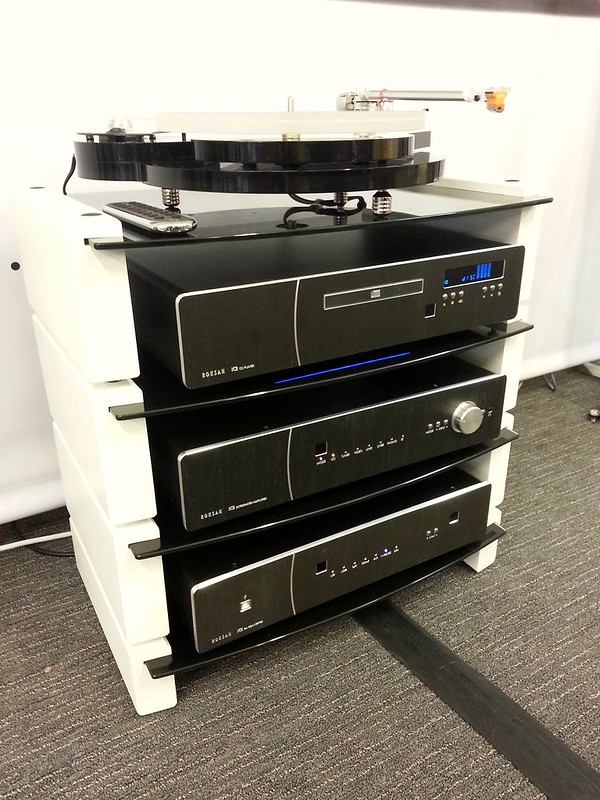
Here we found a modest pair of speakers and a 2 seater couch along one wall of a vast room full of products on display - I think it was the Henley Designs room. Found this a bit pointless so won't comment on the sound. Here's a picture though, as the kit does look nice.
VTL / Kaiser / Vertex AQ
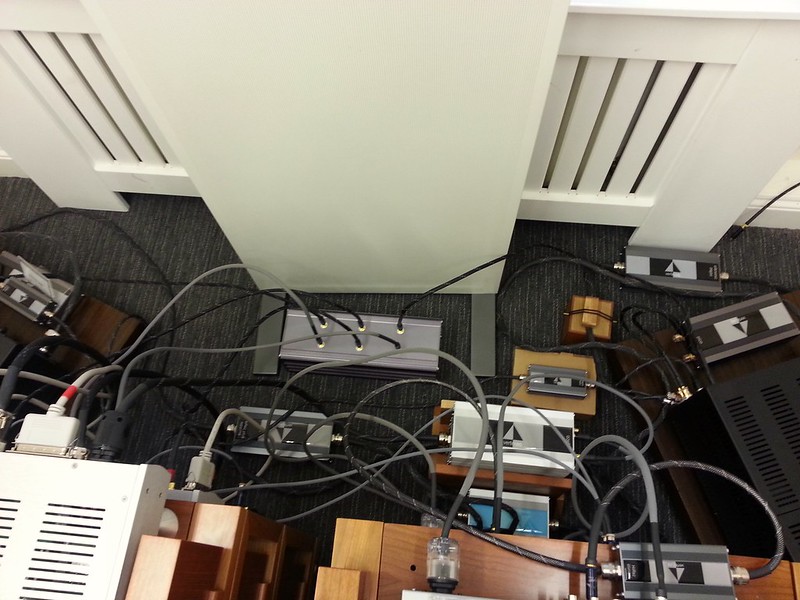
Eeek! Vertex AQ - not familiar with this, but this is the stuff of dedicated listening rooms methinks. Loads of cabley, mysterious box and cable lifter magic going on here. Apparently Vertex AQ (according to the room handout) are "cables, mains supplies and platforms to absorb vibration and RFI/EMI and reveal the detail and dynamics of the recording". So there you have it. In practice, it looks like this kinda mess (I'm not a cable skeptic, but I'm a touch OCD about keeping a systems as cable tidy as possible):
The rest of the system looked like this, and was a belt drive CD player feeding into VTL pre-amp , massive (£16,500 a pair) VTL monoblock power amps and Kaiser Kawero! (their punctuation, not mine):

I'm not sure quite what all that Vertex AQ stuff is doing, but its not holding back any dynamics. This is probably the fastest, most dynamic valve system I've heard. Usually valves soften and hold back a bit, but not here. Not sure about real music (that wasn't played), but a really clear pair of tracks - one percussive, the other choral - sounded very impressive in here. One of the best sounds of the show, would like to hear again with music more like the type I normally listen to.
rmb
These were playing when we were in the room. Personally, not really domestically acceptable - looking like they were built in a garage or shed. The actual finish was fine, but all that exposed plywood and screw heads doesn't do it for me. In terms of sound? Polite, gentle, inoffensive, not at all exciting. There was another, just as quirky, design in the room that looked like it might be more interesting (dome treble and mid drivers on a vertical baffle above 2x woofers in a large cabinet and facing about 45 degrees up to the ceiling). Didn't have time to go back when they were in action.
 |
| rmb |
Three rooms were in action from Cymbiosis - the highly respected LP12 fettlers and Linn / Naim dealers. Good to meet Peter at last (if only briefly, when we talked about cars). He was a busy man - particularly as long term magazine reviewer Paul Messenger was in the vicinity at the time. And there's another thing - why did Mr Messenger stand up at the back of the room? May be he's heard all this stuff before, maybe he was going back later for a proper listen (or maybe even a private listen?). But experience suggests that standing at the back of a room, next to a wall, ain't going to give a good impression. Anyway...
First up we went in the Naim 500 room, with passive Kudos Titan T808 speakers. I heard these at the Chester show earlier in the year and ended up really enjoying them (when the Naim electronics had got up to speed after their usual reluctance when new out of the box) with a Naim streamer heading things up. They've different tweeters now. Here they were being fed by a high spec LP12 (Radikal, Ekos SE, Dynavector XX, that kind of stuff) and were somewhat underwhelming - nicely detailed, but soft and too polite for my tastes. Again, due to time constraints, no time to hear with the streamer.
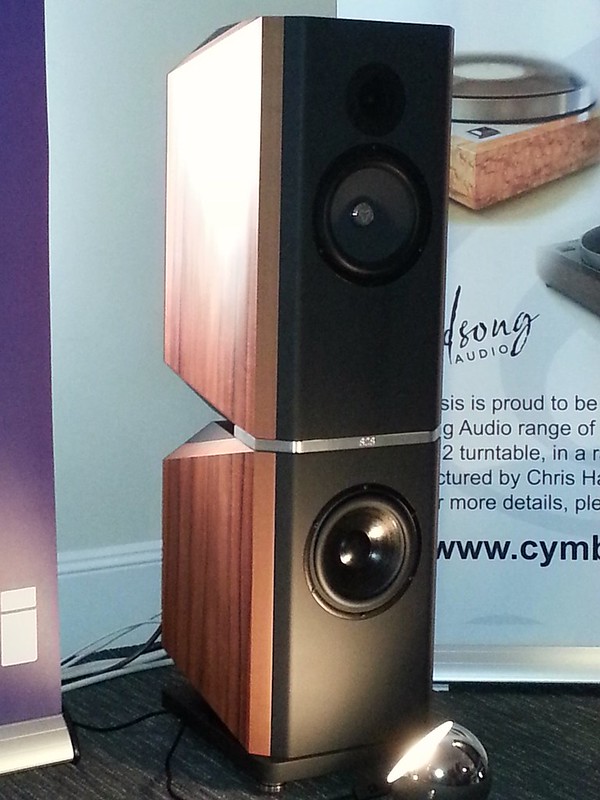 |
| Kudos Titan T808 (not sure which pair this is, I think it was in the Linn room) |
Next, trying to make a direct and quick comparison, was the Linn Exakt system, feeding another pair of Kudos T808s. In here, sources were (again) a high spec LP12 and Linn Klimax DSM/1. The DSM/1 (streamer and pre-amp) were feeding Linn Klimax Exaktboxes (crossovers, DACs, room optimisation, phase aligment etc. etc) into 6 Linn Klimax Solo mono power amps (one per driver in the speakers). With the LP12, this was making a more interesting sound than the Naim system - somewhat better in terms of a more "precise" rendition. Still soft around the edges though. Switching to the streamer confirmed my personal choice of main source - streamed digital being far more involving, exciting and foot tapping than the vinyl source. I know that's a personal choice, but here was a very stark reminder of why I went down that route. The streamer didn't add any harshness, it just added so much more pace, dynamics and detail. This is sounding good, but I don't think quite as good as the passive Naim system at Chester. Of course, a long way and a long time apart and with completely different rooms. Would like to hear them both in the same room on the same day - not the easiest thing to arrange I suppose. So, Linn Klimax Exakt with T808s proving the best so far (out performing the Kaiser / VTL system, but not massively) so far.
 |
| Linn Klimax Exakt system - there's another rack to the right with just as many boxes onboard |
In between the T808 rooms was a room with Linn Akurate DSM/1, Akurate 2200 power amp and a pair of Kudos Super 20 speakers. Here Chord were demonstrating speaker cable upgrades. During this part, I didn't have a good listening place and the room was both square and all hard surfaces - not so many absorbent banners in here. I've heard this demo before and its pretty convincing, but didn't really get into it here because the system was sounding harsh and unpleasant from where I was standing - this outweighing any changes there might have been - some of this is probably attributable to the room (my local Naimist has the same Kudos Super 20s, and they don't display any harshness at all, even with Naim). Towards the end I got a seat off-centre hear the front, the AC/DC had stopped and it sounded much better from there. They then demonstrated some SilentMount discs to put under speaker spikes, using a Fleetwood Mac track. This was interesting in the way they made the track sound like a different mix of the same song. On the face of it they provided an improvement, but it would need more listening to decide if it was better or just different. For their price, I think investment might be better elsewhere, but this was a quick listen in less than ideal circumstances.
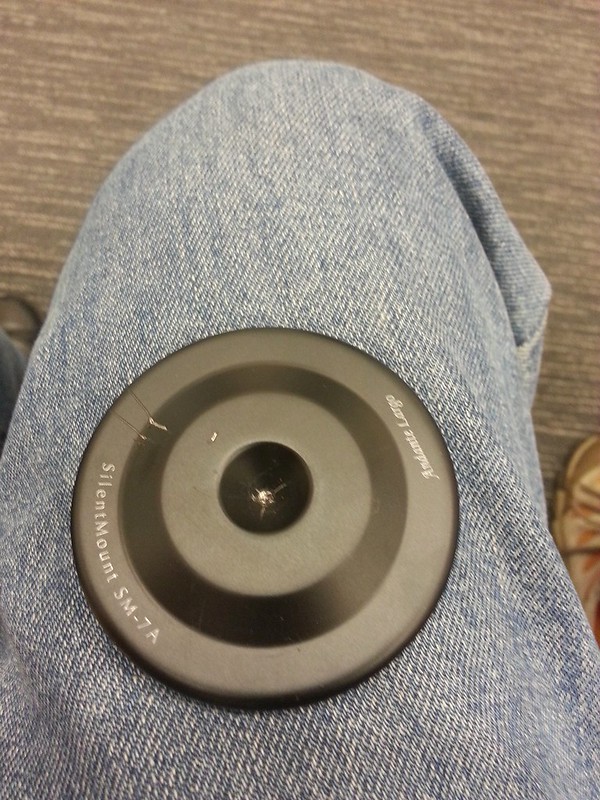 |
| SilentMount speaker supports - Two bonded layers of metal involved - the one that supports the spike is a "secret" alloy of some sort. Oooh :) |
 |
| Here you can see the SM-7A in proportion to the Kudos Super 20 speakers |

Audio Note
A dark room, which, in itsself is OK - I think removing distractions helps, but I also suspect that there is more to that here. Let's cover the sound first - a Yello track was playing and it sounded rather confused, less than tuneful and rather hashy/harsh. Maybe being in the front row wasn't helping here. I've heard AN systems at a few shows now, and only found them OK once - at Cranage Hall. Typically they've sounded a bit thin and not much fun. Here it was just so-so, but at least there was a bit of attack to it.
But here's the thing I really don't get about AN. And that's just the look of the gear. Now I appreciate that the way hifi looks is absolutely not the most important factor. But when we're talking about the price of kit like AN and many others, there's something in the joy of looking at something and admiring the way it looks - be it because its well crafted or how it fits into a particular decor type or by good looking components coming together to make a whole. But here, in the twilight, I don't see any of that. And I think the market for the anti-style product is probably becoming vanishingly small, very quickly. Why does every box have to be different sizes? Some black, some silver? Different styles of knobs, switches etc. And all of it very plain, just like those speaker baffle boards. Perceived VFM is very low. Coupled with this, at this show there seemed to be a particular lack of pride in the products. It was all dusty. There were greasy marks around volume controls and the turntable's tonearm was distinctly grubby. Its not a good sales technique, as far as I can see. More effort required maybe?
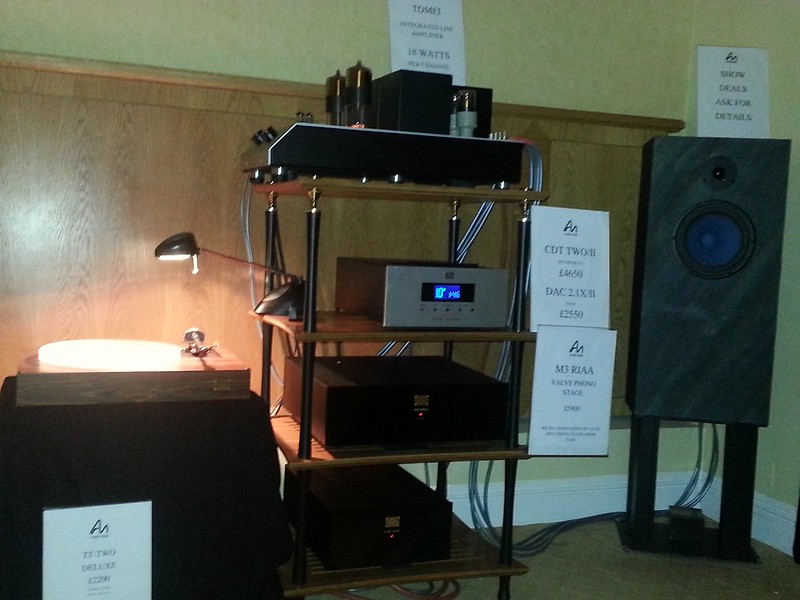 |
| Audio Note |
A reasonably large room here, but was it large enough? Not sure about all the electronics (with some of the tallest valves I've seen to date, if not the fattest) which I think were Zeta fronted by Oppo, but the speakers in here were very distinctive. They're pictured below and originate from Poland. When I was in the Orbital 306 large "patio heater" style speakers were playing. Their bass driver is in the top of the lower cylinder and points upwards, the other cylindrical ribbon driver(s?) are contained in the upper perforated cylinder. Interesting. I'm suspecting these are from a reasonably small company. They have large oval chrome badging, with "Zeta Zero" script writing engraved into them - kind of reminded me of giant dog collar tags.
This was another dark room but they brightened it up with scented candles. Nice change, no doubt some liked the scents in use and others would not enjoy, but the candle light itself was a interesting change.
These Orbital speakers, as sources, pretty much didn't really existing in the room, from a sound perspective which is an impressive achievement. The room was filled with sound and it was a kind of enveloping experience. Decent levels of tightly controlled bass, lots of detail, but the top end was (again, so many systems like this today) harsh and not pleasant to listen to for more than a few minutes. Maybe the room was too small for them, and it would be better to be sat further away. No imaging at all - if that's important to you, look elsewhere - maybe the Venus Picolla (in the other picture) would work better. Didn't hear them, so can't say. So I'd say that these are an interesting idea, probably with some potential, but also unlikely to occupy many domestic living rooms.
"Luxurious Sound For Connoisseurs" says the website. Well, I don't know what sort of connoisseurs they are referring to, but if that's luxury I'd rather rough it a bit :)
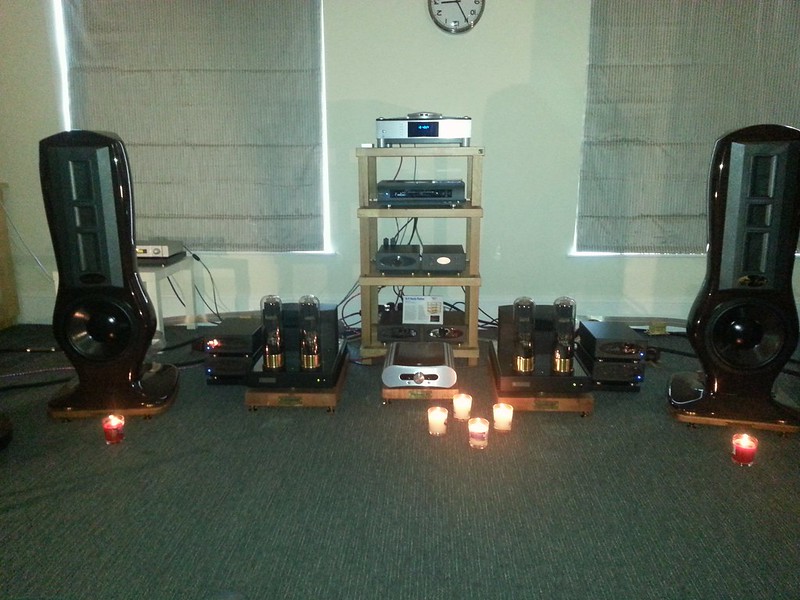 |
| Zeta Zero Room - Venus Piccola speakers & candles |
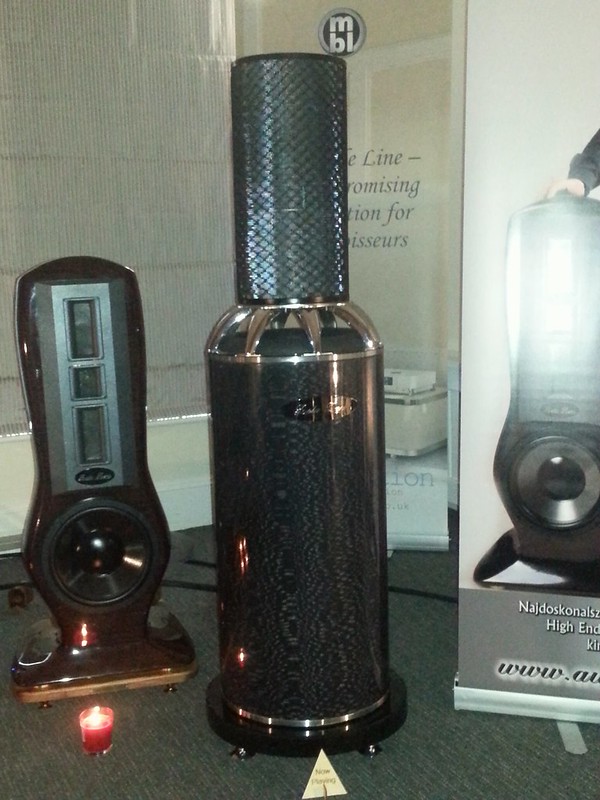 |
| Zeta Zero Orbital 360 |
Vivid brought along some of their more modest sounding speakers - perfectly suited to the size of the room they were allocated. I like the integrated look of these speakers- stands and cabinet - they look like a quality item and are very well finished. The larger of the 2 models were playing when I was in there. Sounded good, but I didn't make any particular notes on their performance - nothing objectionable, nothing exceptional. I suppose that's as much as I can say really. Not much fun being in their room though - listeners were facing a window which faced directly into a bright Sun. Just not possible to relax in those circumstances - squinting not conducive to comfortable listening. The blind just needed pulling a bit more than half the way down to make it much better. Its a lack of attention to things like this that distract somewhat. Makes for poor photos on my phone's camera too:
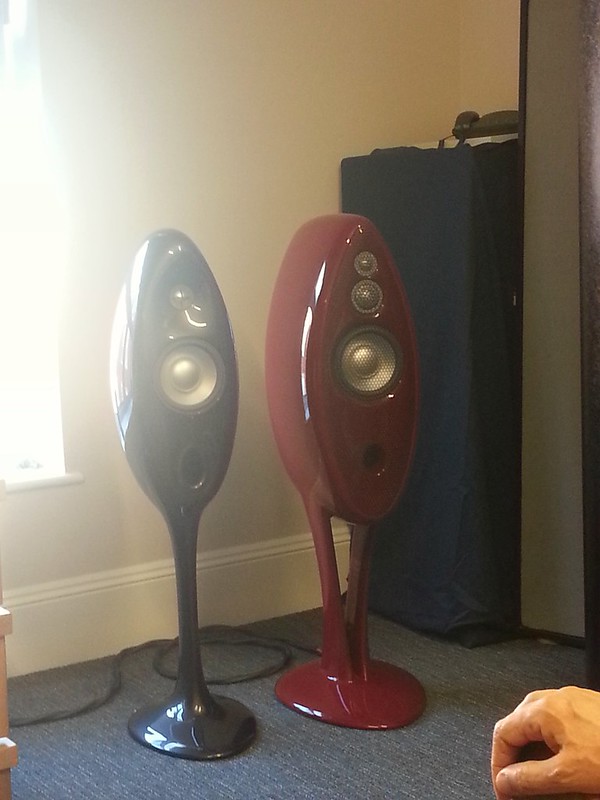 |
| Vivid (and bright light) |
AVID / Bryston / PMC / Fanthorpes
There's something about Fanthorpes as a dealer that appeals. They're active on a number of forums including CyrusUnofficial and the Wam. They're good at demos, open days, communication with customers (and potential customers), tap into some great reconditioned / ex-demo kit deals from manufacturers and promote both used kit and trade-ins. They actually display some kind of approach that is aligned to what customers might want to enjoy in terms of customer service. Radical eh? They even thought to put a banner over the window to quell the bright sunshine.
Today they had an AVID turntable playing into AVID phono stage, Bryston amps and PMC Twenty.26 speakers. Overall this system was doing a good job of playing music. I didn't get a good seat in the room, yet it was still doing well. That's the 4th time I've heard the .26 speakers and another good result. Glad PMC have finally done away with the detatched bass that I found distracting, and I think the dome midrange does a great job with vocals.
Fanthorpe's had the new Chord Dave DAC in their room too - unfortunately time restrictions meant I didn't get to hear that. Shame as it uses FPGA processors, like the Linn Klimax kit.
 |
| AVID / Bryston / PMC. Chord Dave DAC top right |
Here there were 3 pairs of active speakers on very tall, professional studio rack type stands - probably too tall really - maybe this is the one room in which standing up would've been better. The largest of these speakers are said to be the reference model in many German studios and were used by the BBC this year for the live Proms broadcast monitoring this year. A very simple digital source and pre-amp were in use.
The three models had a pretty much identical sound, just more bass extension added as we stepped up through the models. It was very much a BBC kind of sound - smooth, effortless, unexciting. Nice, but not what I'd want to live with. They're not exactly the prettiest boxes either. I'm sure there are many who will enjoy the way they sound.
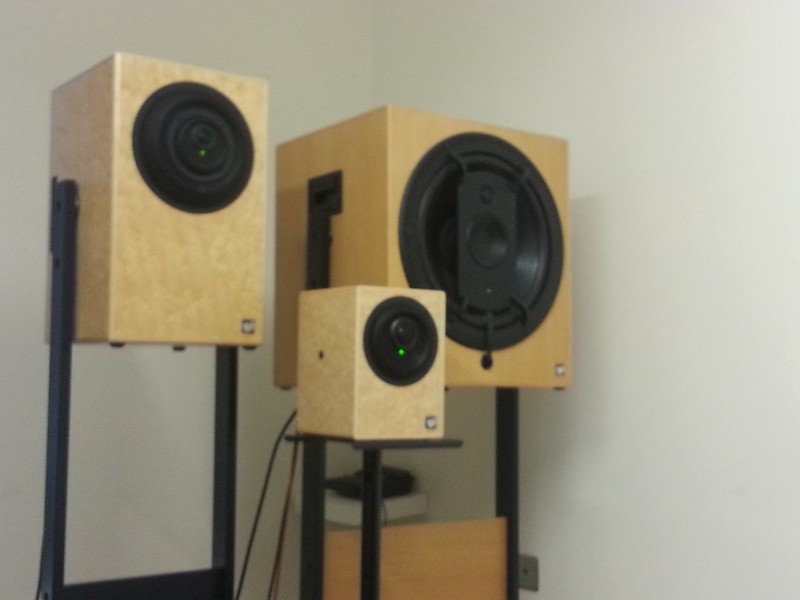 |
| Me-Geithian |
I said, right at the top, that there were some very big rooms with some very small systems and that this just didn't seem the right way to demo this kit, but there was one exception. And this was the exception. The Leema room had 2 systems in place - on walls that were at 90 degrees to each other. They were playing one system or the other for longish periods and re-arranged all the chairs to face the system in use at the time.
We went in here when the smaller system was playing - the room was pretty much empty, which is a shame.
The little system was very, very simple. It consisted of the Elements CD player, the Elements Integrated amp and some tiny standmount speakers that are near ready for production, but don't seem to have a name yet. They feature cast and machined aluminium baffles - the pair on dem appeared to have red carbon fibre sides and tops, but that might be a finish rather than their structure. They look like they might be an update on the Xen product. The DAC in the CD player was in use, rather than the one in the integrated amp.
Gregory Porter was playing when we went in. Not my type of music, generally speaking and yet it was captivating. We listened to 3 tracks on this disc, enjoying the presentation which carried weight, emotion, dynamics and detail. No massively deep bass, but these speakers went deep enough to make this a non-issue. Hoping to trip them up with music that needs a driving bass line, we tried some Yello - The Rythm Divine (with Shirley Bassey). This drove along well, the deep, lush bass lines were well portrayed and Ms Bassey was up front and centre, just as you would expect. A deeply impressive system. The tiny speakers are a somewhat more substantial £2.5k, but if you wanted a great sound in a flat, for example, where deep bass would just annoy the neighbours, this would be a good system to sample.
Nice humbug mints with toffee centres too :)
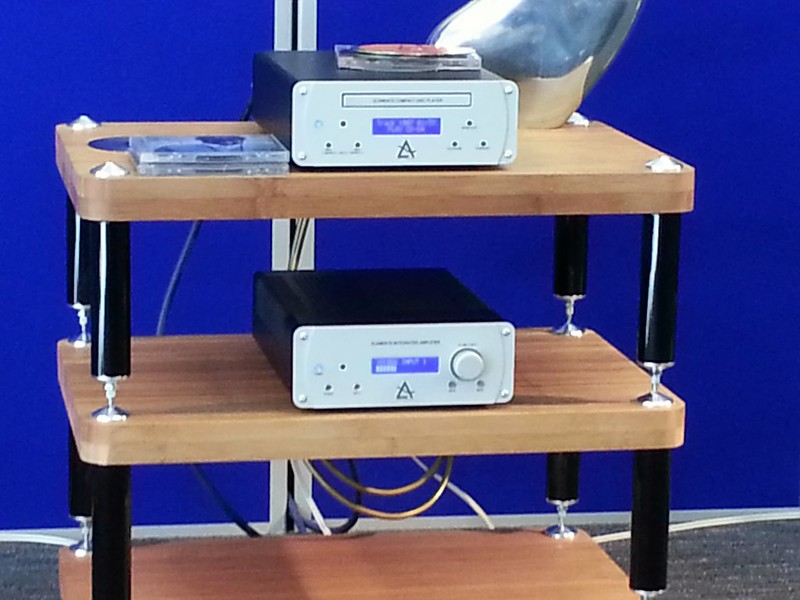 |
| Little Leemas - the Elements are compact, but not compressed. Smaller stands needed! |
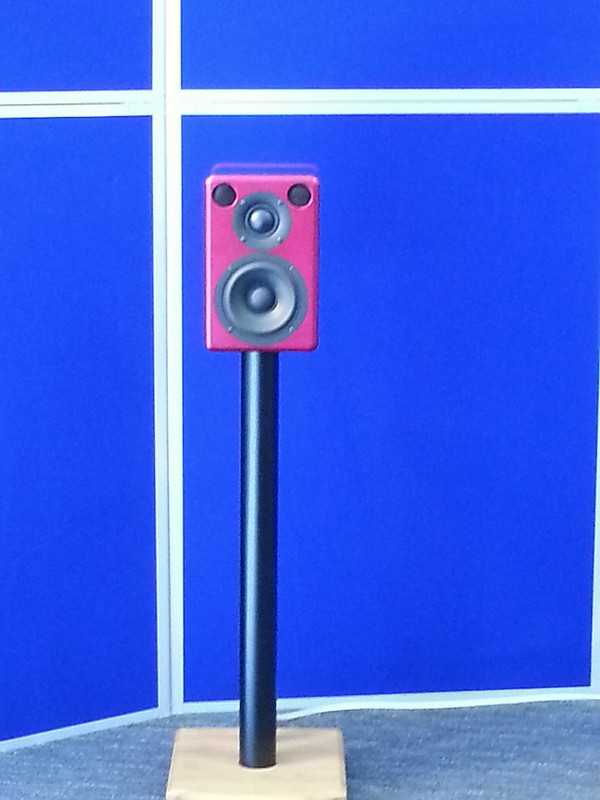 |
| Tiny speakers, big achievement |

dCS / d'Agostini / Wilson Audio
And to round off the day, we found the best sound of the show. It wasn't a walkover, the Linn Exakt / Kudos Titan system was a close contender, but this one just pipped it for me. Here we had a fully digital sourced system - no vinyl here. Data was coming from a Mac and presented by dCS streamer / clocking / pre-amp to a pair of D'Agostini monoblock amps into the imposing (and, in this case, grey) Wilson Audio Alexia speakers.
A good amount of time had been spent on the room - 3 cylindrical sound treatment thingummies standing behind each speaker, lights dimmed, plants in place and illuminated etc. etc. It was a big room but felt smaller than it was, due to the way everything was set up. Nicely done. We heard Take 5 in here (usually, that's a good reason to leave the room at a hifi show, but the sound was just too good here to do that) - fantastically clear, well separated instruments, sparkling and detailed top end with absolutely no hint of edginess nor harshness, tuneful and dynamic. A Yello track (featuring Till Bronner on a very breathy trumpet) was stunningly well delivered. The only touch of criticism was a little bass looseness, probably as part of a room node - but given all the room treatment, I would've expected that to have been dialled out. Maybe Linn SPACE as a source?
All in all, a good sounding room. But massively expensive too! The dCS kit is fabulously built too.
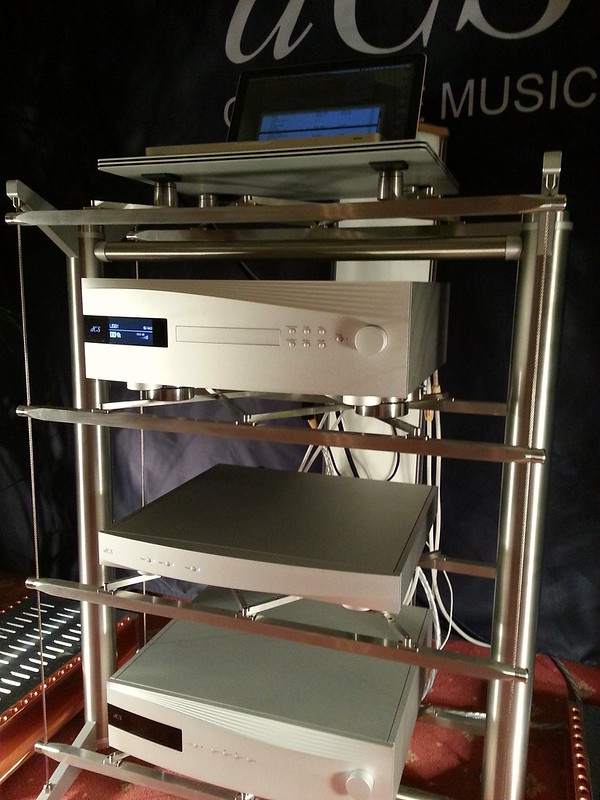 |
| dCS. Beautiful machining |
 |
| Wilson Alexia (and one of the room treatment cylinders, to the left) |

Devialet Phantom
In a very large room, a number of these interesting new products were scattered. A pair being along one wall on their very attractive dedicated stands. The Phantoms can be used on their own, in pairs or as part of a 5 channel system. They contain lots of digital type connectivity, DSP processing, power amps and speaker drivers within each cabinet. They're well built and seem to be well thought through. There's some active changes going on with the cabinets too - something to do with the way they produce bass notes.
Some are proclaiming them as the next big thing and perhaps worth ditching whole systems for. I've heard them briefly before, but wanted to give them some more time, particularly as their software seems to be developing rapidly.
To put these speakers in context, I would compare them to those flatscreen TVs you see in department stores. They're all set to "dynamic" mode for demonstrating in the shop, but try and use them at home like that and you'll get a sore head pretty quickly. Well, that's how the Phantoms sounded to me. Initially they're very impressive, particularly for such a small box. Loads of bass, lots of speed from the pair on stands. But listen for a while and they reveal themselves to be prodigious but not necessarily in control. The treble is fizzy and a little artificial, the mid-range recessed and therefore not brilliant at vocals and the bass, well there's lots of that, but it doesn't really follow a tune as such - it seems to prioritise quantity over control and quality.
Switching to a single Phantom and it made more sense - it actually sounded more musical that way. Were the stereo pair set up at the wrong distance apart, causing bass peaks and mid-range troughs? Possibly, but the discussion in the room was more about tech than music. They seem to make sense to me as a single device in a supporting role in a room rather than the main event. Take it out to the garden for the BBQ, turn it up in the kitchen at a party maybe. Could be good for action movies in a 5 channel system too, but they might miss the nuances and subtleties of a film like The Piano, for instance.
I really like the ideas behind these, but for me they've got some way to go as a quality music reproducer. I hope they continue the development and get there soon.
Oh, and my son christened them "Wubby Wubs". Sums it up nicely.
Other Rooms
A couple we dropped into briefly, including the Kralk and Magnific rooms were rather loud and harsh to listen to. Russ Andrews had racks of stuff and a small system playing so quietly at the back of the room as to be a bit pointless really. Shame we didn't have time to attend the Dragon presentation, nor other rooms such as Origin Live, Music First Audio, Teddy Pardo etc.
Generally
We met a fellow Wammer there who was attending for 2 days in order to give each room a number of visits - either to sample different music on the same system, or to hear their alternative set ups (e.g Leema) or both. I think that might be a good way to get the best out of the show and to have time to catch the presentations. I didn't enjoy the show quite as much as Cranage, but it was OK - this might've been something to do with the restricted time rather than the location or systems. There was a decent choice of (not cheap, but not rip-off) food too.

