"What a refreshingly honest blog about listening to music through hi-fi. So happy to see views based upon the enjoyment of music rather than so-called sound 'quality'." - Peter Comeau, Director of Acoustic Design at Mission / Wharfedale
Showing posts with label Twin. Show all posts

Saturday, 16 September 2023

A Tale of Three Amplifiers - Linn, Lejonklou and Naim(ish). GUEST REVIEW BY CLIVE G.

 Something a little different this time - a review of three power amplifier choices by occasional guest contributor Clive, one of the moderators of the popular Linn Hifi and Music Enthusiasts Facebook group.  Over to you Clive...

I'm fairly happy with my system, but, well, there's always room for improvements & I'd been
thinking maybe an amp or speakers upgrade.
 
My system at the time of writing comprises: -
Linn Klimax System Hub (Classic);
Linn Klimax Exaktbox with Organik DACs;
2 x Naim Olive 250s with Avondale HCR200 regulators & Witch Hat Phoenix amplifier boards;
Naim SL2s supplemented with a BK Electronics Double Gem sub;
English Electric 8 Switch & QNAP TS-251+ NAS drive;
Witch Hat Morgana interconnects & Spectre speaker cable;
Dedicated consumer unit with 5 x spurs in 6mm sq twin & earth & 6mm sq equipment leads


Maybe for those not in the know, I should explain the Linn System Hub & Exaktbox. The system hub
is a streamer only - it just controls the playlist from my NAS drive or streaming service (Qobuz or
Tidal) & other inputs (TV Box & Chromecast) and acts as a pre-amp with digital volume control. It has
no DAC and passes a digital stream of music and instructions to the Exaktbox. The Exaktbox is a digital crossover & 6 channel DAC (using the latest Linn Organik DACs). The advantage of having the crossover in the digital domain is that it can be far more accurate that an analogue crossover (I used to have a Naim SNAXO but this set up is far superior). The analogue outputs of the Exaktbox are fed to power amps - one for each speaker drive unit - so 2 x 250s in my case, SL2s being a 2 way speaker design.
 
In the past I've compared an Naim Olive 250 vs Naim Classic 250DR vs Linn Akurate 2200. I felt that the 250DR was more detailed but the Olive 250 more musical. Comparing Linn to Naim - Linn allowed all the separate elements of the music to be followed & analysed whereas Naim felt more like a band
performing. Both good - just a difference of presentation.
 
So I was interested a couple of months ago when I had the opportunity to compare, in passive
configuration, one of my modified 250s vs a new White Logo Naim 250 vs Linn Klimax Chakra Twin at a dealers showroom using a Linn Selekt Edition streamer with dual mono Organic DACs & Kudos 707s. When you consider the price differential Olive 250 with Avondale & Witch Hat boards ~ £1.7-2k vs New Naim 250 £5.7k vs Klimax Twin £9.4k you'd think it would be a fairly uneven contest... But was it?
First up was the New White Logo Naim 250 - bags of detail & pace but I found myself analysing the music rather than enjoying it. My feet stopped tapping! Switching to my modified Olive 250 & the foot tapping was immediately back. Sure it was a marginally less informative, but ultimately more enjoyable. Finally the Linn Klimax Twin. This was somewhere between the two. A bit more detailed than the Olive 250, more musical than the New White 250. But was it worth the £18.8k price tag for the upgrade (remember I need a pair of them)? I didn't think so - maybe a used pair but I would want to hear one in my home system.
So where did this leave me? Neil of Audiophile Musings & Speakerfilters has suggested to me a few
times that I should try Lejonklou Tundra 2.5 amps in place of my Naim 250s. For those of you who
haven't read Neil's previous posts about these amps - Fredrik Lejonklou used to work with Linn beforedeciding that he could build better amplifies for a much lower price. The Tundra Stereo was
first released in 2012 & is now in its ninth iteration in version 2.5 which sells for just under £3.25k.
Neil offered to lend me a spare Tundra he has to try in my system, which coincidently is for sale, so
no hidden agenda there (editor's note: it was a completely above board agenda, as it happens!). At the same time I've borrowed a Klimax Twin to try at home.
 
First thing was to put my system back to passive as I only had one Tundra & one Twin. It's a fairly
straight forward job with SL2s as they have external passive crossovers and put the Exaktbox into
pass through mode so the DACs are being used but not the digital crossover. I then played five of my
favourite test tracks to get a feel for how it sounded passive. The overall character remained
unchanged although a little of the precision of the timing & sound stage was missing but still very
enjoyable.
 
Before putting the Tundra into my system, I'd been warned that:
a. They have less gain ~21dB compared to the Naim/Linn ~29dB so I would have to turn the
volume up +8
b. They take about 20 minutes to warm up - not after being switched on, but 20 minutes actually playing music to come fully on song, not that they are bad initially, they just get better with playing.
So when I first switched to the Tundra, I tuned the volume up & played the five tracks through
before going back to the beginning for a serious listen. The first thing that struck me was how similar
the sound was to that which I was used to. The Tundra has similar PRaT that Naim amps are famous
for. The Naim maybe had a smidge more authority on bass lines, the Tundra maybe a smidge more
transparency in the mid-range… But I would be hard pushed to choose one over the other - both are
very enjoyable.
 
Next up was the Klimax Twin. I was immediately taken by how much better it was than the Akurate
2200 I'd heard a few years ago. Previously I've found Linn amps great if you want to listen to all the
individual strands of the music, whereas Naim amps present the music as a whole performance.
While this is still true, the Twin is much more similar to the sound I am used to from my Naim amps
& more enjoyable for it. The Twin is a maybe smidge more detailed & informative but the Naim has
more swing & induces more foot tapping. Apart from the wallet bending price of a pair, I could
probably live with the Klimax Twin… if I hadn't heard my 250s or the Tundra.
 
I was able to have both the Tundra & the 250 in my system rack at the same time so it was only a
minute or so to swap from one to the other to do a tune dem. So having warmed the Tundra up again, in an effort to differentiate between it & the Naim, I played some tracks that I don't know on
one then the other. Now the differences became a bit more apparent. While the 250 still had a little
more weight & authority in the bass lines, where the Tundra really excels is in conveying the
emotion in the music. It's difficult to explain in words but I feel that I can really hear the musicians
putting their heart & soul into the performance, whether they are vocalists, guitarists or a
saxophonist you just get the feeling that they are giving it that bit extra. The listening experience is
just that bit more… well musical, more fluid although it still wasn't night & day differences.
 
A few days later I had a friend round who has no interest in hifi but enjoys music, particularly to
dance to rather than sitting down listening at home. First I played a couple of tracks she wouldn't
have heard previously using the 250 before switching over to the Tundra. Her initial reaction was
that the presentation of the two was quite different. The 250 was laid back & enjoyable whereas the
Tundra was more up front & in your face. She didn't like the way that the Tundra demanded her
attention, demanded to be listened to. Interesting. Then we played a number of tracks that she
knew from dancing switching back & forth between the two. Now her preference switched to the
Tundra, hearing the additional nuances it brought to the experience, describing it as more engaging
as though the musicians were performing just for her. By the end of the evening she said that both
were enjoyable but on balance although the Tundra is more demanding, she felt it is also (a bit)
more engaging.
 
So am I swapping my modded Olive 250s for Tundras? Hmmm! The 20 minute warm up is a bit of a
downer. Most mornings, I have a listening session that's, at most, ½hr while I have a cup of coffee
after I've done my morning workout & there would be that nagging doubt that the amps are not
performing at their best for the majority of that time. Additionally, I've been in discussions with John
Jackson (ex Naim & Witch Hat) about an further mod to my 250s to add another regulator to power the amplifier board to create a Phoenix Plus board if you like and elevate the performance further.

So the jury is still out.
 
At the end of the day, the Tundra is a very musical amp & should certainly be on your shortlist to
audition if you are in the market for amps at this sort of level. In my view it's considerably more
musical than the latest generation Naim 250 which, to me, is very hifi, which is great if that's what
you are looking for but for me, Naim have lost the PRaT that they were renowned for. I also
preferred the Tundra over the Klimax twin which, considering its ~⅓ of the price, makes the Tundra
something of a bargain. And if you have a standard Naim Olive 250, again the Tundra will be an
upgrade. At the end of the day, you could argue that my Naim 250's are no longer Naim amps - all
that remains of the original amps is the case, transformer & the sockets.
 
Thank you to Neil Hallworth for the loan of the Tundra, & Nigel Moore for the loan of the Klimax
Twin

Saturday, 11 May 2019

4 Lots of Kudos in One Night - Passive and Active

Kudos' Titan 808 has been around a few years now, and has given a great account of itsself at multiple shows 'musings has attended in the UK and Germany.
Most recently with the rather good Naim SNAXO active system at the Chester Hifi show earlier in the month.  I also chose a Linn Exakt driven pair when presenting a "MyTunes" playlist evening at Manchester dealer brianandtrevors, where they were augmented by a pair of REL No 25 subwoofers.

But there's more to Kudos than their well received top of the range T-808.  There are entry level "X" models, mid-range "Super" models and 4 different interpretations of the Titan formula.  So what's the rest of the range like?  To find out, 'musings returned to brianandtrevors for an evening of Kudos discovery.  The evening followed a fairly typical approach for a joint dealer / manufacturer evening - gradually stepping up the range, but perhaps with a little twist tonight.  To allow the comparison of the speakers, a pretty much "no compromise" system was put together from Scottish manufacturer Linn:

A largely Klimax level LP12 - Radikal PSU (in the Akurate casework), Ekos SE2, Kandid and a booplinth.  Onboard was a Urika 2 phono stage which fed an Exakt signal to a Linn Klimax DSM acting as pre-amp and streamer.
Initially the KDSM ran with its internal Katalyst equipped stereo DAC to a Linn Klimax Twin/D stereo power amp.
I/C cables were Linn silvers, with Chord Music making sure there were no compromises on the speaker cable side.

That's quite some front end to feed into the first speaker we heard tonight - the diminutive little Kudos X2 compact floorstander.  Bear in mind that, at £1600, it was being fed by a system that included speaker cables that come in at (assuming they were 3m in length) 4x the price of the speakers.
It has to be said that these little speakers probably weren't designed for use in a room the size of tonight's dem room.  Before they were played, Kudos' Dave White introduced himself and the company philosophy - keep things simple and use the best quality components and cabinets that can be achieved at a price point.  Drivers all come from SEAS, modified or created to Kudos's own requirements.  So until the top of the range, simplicity means 2-way designs, uncluttered crossovers and quality cabinet veneers.  So the little boxes played and did a pretty good job.  Yes, there was a looseness in the bass, which goes surprisingly low, there was some vagueness in the treble but the music was flowing, feet tapping, even the room joining in with some modes didn't detract from enjoying what was going on.  It would be great to listen to these in a smaller room, where I'm sure they'd work pretty well.  We listened to a few tracks from the streamer then moved on with a 3x price jump to the middle of the range Super 20 speakers.

This is another 2-way floorstander, but around 850mm high and sporting significantly higher quality components.  Again the finish is superb with matched veneers on the baffles. Well, this was a significant step-up in the musical presentation to match the price change.  The SEAS tweeter in the S20 is several steps up from the X2 in terms of detail, definition, believability and control. Similar improvements come from the mid-bass driver. Curiously the initial impression was of a speaker producing less bass output than the baby floorstanders, but in reality its just hugely better controlled and keyed into the hooks and rhythms of the tune.  The treble presentation, whilst far more refined, is just a little to forward in the mix for my personal taste, but there's no doubt the others in the group of 12 were enjoying what they were hearing.

The next step up was 2x on the price-o-meter and takes us into Titan territory.  We didn't hear the 505 standmount tonight, going straight to the first of the floorstanders, the 606.  This is similar in height to the Super 20, but the cabinent is very differently constructed.  Dave introduced the isobaric mid-bass driver and the thin-walled inner cabinet which is surrounded by heavy MDF side panels that are connected to the inner panels with damping material.  The tweeter too is from SEAS's upper end Krescendo family, amended to Kudos spec - the tweeter alone costs more to Kudos than all the drivers put together in a pair of X2s.  They're very substantially built speakers, needing a trolley to move them around, even though they're still under a metre high.  And how was this?  Well, it wasn't all a complete step up from the Super 20.  Bass a little deeper, treble that much more clear and definitive in the way it starts and stops, vocals carrying more emotion, along with tighter imaging, most if it was good.  But for me the Super 20 won out on the bass lines keeping pace with the rest of the music, and providing that foot-tapping drive.  So not a complete success for me.  After a short break to refresh glasses, along came the "twist" of the demo.  The Kudos Super and Titan ranges have a little trick up their sleeves - they have a clever but simple connection panel on the rear that means they can be converted to work in active mode - that is, effectively removing the internal passive crossovers to allow power amplifiers to be connected directly to each drive unit with the splitting of the frequencies delivered by an active crossover in front of the power amps.  This works with Naim analogue active crossovers and with Devialet and Linn digital crossovers.

So the Klimax DSM changed its role from digital to analogue converter, to one feeding a still digital Exakt feed to a Linn Klimax Exaktbox/1.  The Exaktbox does the digital to analogue conversion, along with some clever stuff such as phase correction of the drive units (and no crossover phase distortion), time aligning the drive units and adjusting the speakers' output to counteract room modes that normally causes "boominess".  Because each drive unit now needs its own power amplifier channel, an additional Klimax Twin was pressed into action, along with more Chord Music speaker cables.  Now the Titans are singing. This is a massive step up in performance for these speakers, much as we've experienced before when hooking the Super 20s up to an Exakt system back at 'musings base.  The reservations with the 606 in passive mode are almost gone - there's still a little reticence in the bass lines, but its very minor now and allows the other elements to shine through.  The live Eva Cassidy track we started with on the X2s is now in a huge venue, the soundstage goes back a long way beyond the speakers, Eva's voice is full of emotion, inflections and phrasing details. Nice.  We listen to a good few tracks from the streamer. Interesting set of feet on the 606s tonight, seem to tackle some of the shrillness I've heard from these speakers when sitting on standard spikes. Other than understanding they have some Sorbothane de-coupling, there wasn't time to discuss further tonight.

Another break follows, and the final set up of the evening is rolled into the room whilst more wine, coffee and juice is sorted out for the audience of a dozen or so listeners.  In the break we swap system information, who's interested in what and why Kudos is of interest.  Most have Linn front ends of some sort - vinyl and streaming, there's a few Naim front ends (streaming and CD) mostly Linn amplification but also Naim and a few others.  From a speaker comparison perspective, Linn, PMC, Kudos and others are in use.

Back to listening and we're now at the top of the Kudos range with the Titan 808.  Unlike last time in this room, the 808 was not supported by the big REL subs.  They had to fend for themselves.  It turns out that they're quite capable of looking after themselves thanks very much, and I ended up enjoying them more on their own.  The sense of scale of the Eva Cassidy venue is stunning on the 808 and they punch hard and fast.  Unlike the 505, 606 and 707 which have slightly (intentionally) leaky isobaric chambers, the lowest bass driver, in its separate box, is a more conventional sealed isobaric.  The 808 is a 3 way design but described as 2.5 way by Kudos by which I think they mean the lowest bass driver augments the lower end of the mid-bass rather than delivering a completely separate set of frequencies.  So this top-end speaker needs 6x power amp channels and as such another Klimax Twin and pair of Chord Music cables were helping out in this final system configuration.  The same tweeter is featured across the Titan range yet it somehow seems clearer and smoother in this configuration, but its the clarity, transparency and realism of the mid-bass combined with the sheer kick and tightness of the lower bass that stand out here.  We listen to lots of tracks and the LP12 is pressed into action for a few songs, including an album by one of my current favourites, Bob Moses from Canada.  There was some boominess with this system, Linn's SPACE optimisation wasn't in use until later in the evening, after the formal presentation has been completed.

What did we learn?  Well, in passive form, mostly spending more gets a better result, but not always in all areas.  But once Exakt was deployed, the whole experience was a huge improvement in performance and consistency. And, yet again, the 808 produced a great result - personally I think they performed better than with the REL subs in this room - not quite so jaw-dropping in terms of sheer power and impact, but more musically satisfying.  The X2's are good for their price and did a reasonable job of filling the big room.  But then again there's no real substitute for box volume, driver quality, cabinet construction and, most importantly, a high quality front-end active system. It would've been nice to hear the Super 20 moving from passive to active, but you can't fit everything into one evening.  I do wonder about those in the audience who might've been contemplating the 606 - were they satisfied, or do they now spend a longer time saving for the 808?  But then again, there's the 707 in between, and that's definitely worth a listen. I won't be changing my Twenty.26s for the 606s as they didn't do absolutely everything comprehensively better.  Perhaps the 707s?  Will have to leave it until another time to find out.

Thanks once again to Brian, Trevor, Dave and the other attendees for another enjoyable and instructive evening.

Saturday, 9 January 2016

Is The Kudos Super 20 a Neat Solution?

Audiophile Musing's system has been "active" for about 18 years.  In Linn style, this means a set of active crossover cards - one per speaker drive unit and one power amp channel to deliver to that drive unit.  This was how the Keilidhs were when they retired and were replaced by an actively powered pair of Majik 140s.

About 8 months ago, I heard a comparison of active 140s using Majik power amps (Linn's lowest rung), just like my own set up, against the same pair of speakers returned to passive crossovers and a pair of Linn's top of the range Klimax Solo/Dynamik mono power amps.  There was no comparison. The passive Solos were not streets ahead, more of a complete city ahead.  They remain an ambition. However, about 4 months ago one of Linn's top of the range stereo power amps (the Klimax 500 Chakra Twin/Dynamik) came available ex-dem and at a very attractive price. And it was black. So the Majik 140 speakers were converted back to passive and in came the Twin.  Its not at Solo level, but it is a significant step up from active Majik.

So what has this got to do with the Kudos Super 20?  Well, its quite straightforward really.  Once the system is no longer active, then the range of speaker choices opens up to pretty much everything out there.  No longer "limited" to Linn.  Of course, Linn speakers are still of interest (particularly the Akubarik, my favourite of the current range), but why not listen around to see what else is possible? My local Naimist, Richard (you'll have read about him before in some of the comparison tests and for his help at Scalford etc), has a pair of Kudos Super 20s.  In an act of some considerable generosity, Richard offered up the loan of the Kudos speakers for a week (which turned into 2 weeks, due to schedules and an extremely long period of wet weather when it wouldn't have been good to be moving the speakers between houses).

Let the fun begin.

Well, it wasn't too much fun to begin with.  The Kudos's had to come down the narrow tight cornered stairs from the loft conversion and then into the car. To make sure the 140s went back in their correct place (and the Super 20s back in their home), positions were marked on the floors with masking tape. Then there was the lifting of the M140s out of the room - I'd forgotten how heavy they are with their solid metal bases.  The Kudos stands slightly shorter, is slightly more shallow and somewhat lighter. They're beautifully built and finished, a real credit to the team from the North East.  I had high expectations for these as they do work well for Richard and I've found Kudos's T-808s a thoroughly enjoyable (if rather expensive) pair of boxes.

Left speaker installed.  Masking tape showing position of the M140s
Starting with the 20s in the exact same position as the M140s, Linn SPACE was disabled (due to the need to start from scratch) and the messing about with speaker positions began.  Listened for about 30 mins in this position and then shuffled the speakers about, playing tracks for 10-15 mins between each position.  Ended up with the speakers about 15cms further out from the wall.  Toe-in was best at the same angle as the 140s.

Then the tuning using SPACE began, and that proved to be much more of a faff than I was expecting. SPACE comes with the Super 20 as one of the listed speakers, so that was easy enough. Measurements were taken of where the speakers are in the room and SPACE calculation run.  It was awful.  All life sucked out of everything, speakers sounding over bright.  I re-checked all the measures.  I then worked through the SPACE instructions on how to tweak the deep notches.  It took a long time before something came back to the system.  I left it like this for a few days, found the system difficult to listen to.  It was edge of the seat stuff all the time, even with music that's supposed to be chilled and relaxing.

I reported back to Richard and he suggested we swap out the speaker cables.  I'm using Linn K200 (which is split K400).  Richard is using Naim SuperLumina.  This had a marked effect on the system - it brings a level of refinement and "care" to the sound.  Its not over smooth, but it removes some rough edges and brings an extra level of tiny details.  Bass got a little tighter and much more subtley textured.  A quite remarkable bit of wire.  Tried it later with the M140s and it did similar things there too.  Impressive.  Enough of a change to necessitate switching SPACE off and to mess about with positioning again.  This resulted in the speakers being about 12-13cms further from the wall compared to the Linns.  A small change from the initial 15cms, but worthwhile.

And then all the messing with SPACE again.  This time I ended up taking nearly all of the SPACE notches out.  The lowest frequency notch went from -29dB to -6dB and the other 2 smaller notches dropped from around -9dB to -2dB.  I also let in -1dB of treble shelf to tame the top end.  This was another 2 or 3 days of messing about to get to this position.  So that was the set up done.  At last.

General view, but before the speakers were moved to their best position
So how did it sound with the SuperLumina and with SPACE dialled in to its best?  Well I'm going to write about this in reference back to the Linns I'm afraid - a comparative review rather than in absolute terms.  I think that's because that's what I'm looking for - something that's an improvement on the 140s.  Its worth saying, at this point, that they didn't work well with the Linn speaker cable and therefore something different would be a requirement.  SuperLumina might be the thing, but others might be as good or better (or worse of course).

Here's what the Kudos Super 20s do better than the Linns - instrument separation, speed (they sound like they respond to inputs from the amp a little quicker) and they image better too - not so much left to right, but certainly back behind the speakers.  So they're an exciting listen.  Attack is great, the music is pacey and the instruments are easily picked out.  The Linns are good at instrument differentiation, but the Kudos moves this on a notch.  They go reasonably deep too, when the content is there in the music.  Female vocals are a particular forte, just as they are in their home Naim system.

What do they not do so well?  There's a few things really.  I still never really relaxed into any music whilst they were in the house for 2 weeks (although it was so much better with the SuperLumina in place).  The speed I found a little distracting.  I notched the treble shelf down another 0.5dB and that helped a little, but I didn't really get settled with them.  This, and they sound a little out of breath in my room.  Back in their home system, they're in a 12ft x12ft (ish) area of an L shaped loft room, which has part sloping roofs.  The listening seat is closer to the speakers too.  In my room they're in a 19ft x 12ft full ceiling height room and that might be just a touch too big for them.

So its a mixed bag.  I really understand why they're a good seller and why their owners enjoy them so much - I get the appeal of the etched instruments, I get the speed, I get the way they do female vocals. If I was in the market for speakers at this price point, I would say that they could be on a short list. But I need to relax into my music.  I like chilled out music to wash into the room and give a warm feeling as I sit back after work and wind down. When a system doesn't let me do this, its not right for me.  Others will have a different view.

As such, these aren't the right speakers for me or my room.  They're different to the M140s, but they're not the right mix of abilities to justify a change to the Super 20s.  I'm looking for a bigger difference, but perhaps, more of what I have, rather than a different direction.

Must get around to trying the SuperLumina again and compare it with other options.  Its capabilities are impressive - far more of a change than a bit of wire has any right to deliver.

A huge thanks to Richard for trusting me with his expensive and highly valued speakers.  They're back in their home now, and the brand new Naim 250DR is probably warmed up enough now for him to get thoroughly back into enjoying his music.

Saturday, 1 August 2015

Today's TLA Report: KCT, TST, KDS and DVC. Linn and Lejonklou Content.


TLAs?  Three Letter Acronyms.  There's a lot of them about.  Do they sound any good?  I spent an evening chez Whizz to find out.

Here's an itch that's been scratched at last - how does a Lejonklou Tundra Stereo 2 (TST) stack up against the Linn Klimax Chakra Twin (KTC), both in their latest, up to date 2015 configs?

Much has been written on the Linn forum, the Lejonklou forum and probably in other places too, about the giant killing abilities of the £2.5k Tundra Stereo - now in, I think, its fourth iteration - v1, 1.1, 1.2 and now v2.  As is usual, the inside of the Lejonklou and the design science that goes into it is less than accessible than it might be.  Lejonklou put a lot of effort into the design, focussing primarily on sound quality, encompassing all aspects right down to the torque settings for the outer sleeve (you're not supposted to change these, hence there's not much information about what goes inside the box).  The KCT has also evolved over time, the biggest change of note being the Dynamik power supply and a new main board layout - but it is an old design now - based on Chakra circuitry, its a bit like an Linn Akurate amp on steroids.

Previously...

Given that the KCT is based on Akurate design, I need to put some cards on the table - I don't like the current Akurate amps - to me they sound like hifi.  I've had Akurate in my system and went back to Majik as, although Majik amps don't extract as much information from the signal, they do, to me, sound more musical.  To use Linn's terminology, the Majik amps Tune-dem better, at least to me.  And when you can't afford Klimax amps, then its Majik or something non-Linn.  Talking of which, I've heard only one Lejonklou product to date - the original Tundra Stereo (it wasn't called Stereo then, as there wasn't a Mono version) in a system with Linn KDS/0 Renew and Linn Katans (note, no pre-amp in that system).  You can see my notes on that here: http://audiophilemusings.blogspot.co.uk/2012/07/toms-system-linn-klimax-lejonklu-tundra.html   As you will see, it worked well within the limits of physically small speakers, I did appreciate the imaging (a Katan strength) and subtle finess within the music.  Lejonklou doesn't use Tune-dem to evaluate their products, they use Tune-method - subtle eh?

Also in the "previously..." category is the KDS/1 which is the streamer I use in the main system at home.  To date, its the best digital source I've heard, that's why its in the system.  Recently, it was superceded by (imaginatively), the KDS/2 which has a new clock and revised circuit layouts, in addition to Linn's Exakt outputs.  With the launch of KDS/2 (streamer) and the sister KDSM/1 (streamer and pre-amp), Linn also stopped producing analogue pre-amps - they say the Digital Volume Control (DVC) now outperforms the analogue volume control in their previous top-or-the-range pre-amp, the Klimax Kontrol/1/D (also in my system).  This has caused some controversy on the forums (forums like that, don't they?) too, with some pro- (they're the quiet ones, if they exist) and some anti- (they're the vociferous ones) the DVC.  So, is set, the background to the evening's listening.

I suppose that I also ought to say at this point that I'm not a fan of the Linn Klimax 350 speakers - I've yet to really enjoy them either passive (with their active servo bass system of course), internally active nor Exakt internally active.  I find their bass challenging - its deep enough and there's plenty of it, it just sounds a bit detached from the rest of the music, somehow.

Expectation bias - yep, I guess we all suffer from that, in my case, this time, I was expecting it to be very difficult to choose between the amps.  This is based on reviews on forums that claim the Tundra is close to Linn's Klimax Solos, never mind the Klimax Twin.  I was prepared for having to pick out small nuances and to have to think about the character of the sound rather than the musicality or detail presented.

Bistro

I met Whizz in a bistro.  Very nice it was too - decent  food and a glass of wine.  We headed off to Whizz HQ and settled down with a cuppa, looking at the following, very simple looking, system:

Linn KDS/2 (DVC in use)
Linn Silver Interconnect
Lejonklou Tundra Stereo 2
Linn K200 speaker cable
Linn Klimax 350 passive speakers in Cherry with black arrays
Quadraspire Evo rack
No fancy mains treatment, room treatment nor cable lifters in sight...

Most of the music we used came from Tidal (a few tracks from the local laptop) and included Malia, Eagle Eye Cherry, Deadmau5, Ficci, Felix Laband and Tina Doci.  Control was via a laptop running Kinsky (for ease of use) and Kazoo (for access to Tidal).  The KDS/2 was using SPACE room optimization, set up by Whizz when using the KCT power amp.

DVC

Let's get this one out of the way to start with, but first a qualifier.  This is the first KDS/2 I've heard, I've not yet compared it to the KDS/1 back to back in the same system, nor have I had the chance to compare one using the DVC versus feeding it through the analogue volume control of a KK/1 - that's the subject of a near future post.  We used volume levels of between 58 and 62 (for the Linn power amp) and between 66 and 72 (for the Tundra, which has 8dB less gain than the Linn).  So we didn't try the DVC at lower listening levels.
  
Across both the Tundra and Klimax power amps, I can't say that I heard anything that made me think there was any problem at all with the DVC.  With the Klimax amp, there was occasionally an "edge" to the lead of some instruments and voices, but that could be the KDS/2 or the Klimax Twin amp, as I've not heard either of these in their current configs.  Interesting that the Tundra didn't reveal these edges, so maybe it was the amp...  Anyway, at these volume levels, there wasn't even a hint of the "horrendous" nor the "unlistenable" comments I've read elsewhere.

Sweden

So kicking off with the Tundra Stereo 2 - an unassuming little black box - this one being just a few weeks old and only with about 10 hours use.  It was warmed up though, having been switched on and used a couple of hours earlier.  And what a polite little box it is.  Goes plenty loud enough, at least for me, but its really rather soft in its presentation - almost valve-like (and that's not really a complement from me, but I know many will like this kind of presentation).  The top-end doesn't sparkle, the imaging is flat and rather narrow but vocals (particularly female vocals) are sweet and clear.  Not sure why Tori Amos sounded about as wide as the window between the speakers though.  

What of the bass?  Well, it was difficult for me to tell as the 350s were sounding very different when driven with this amp - the usual slightly detached bass issue was not very easy to distinguish because it was all rather loose.  Bass notes started OK, but they don't stop too well.  Its not boomy as such, it just kind of happens then takes its time to stop again. Deadmau5 didn't have me tapping my foot or wanting to dance, which is an usual experience - even on my much more modest Majik amp and speakers, the track we used drives hard and always gets me foot tapping or jigging in the seat (so to speak).  Another favourite is Blues Company's Dark Day - a track full of sparkling cymbals, triangles and snappy rimshots, along with some extremely deep electronic drum effects.  Whilst the vocals were good and the track flowed along, the cymbals, which should be distinct, clear, individually identifiable in space and shimmering as they are struck and fade away, well, they're just underwhelming and ill-defined - some of them being very indistinct.  The electronic bass drums impacted well, but then kind of flapped about a bit - it really had me wondering if developing a power amp through the little Linn Majik 109 standmounts makes sense, or are the 350s just too demanding?  Maybe Lejonklou used other speakers too, but I understand the 109 was the most frequently used in development.  

It was all OK, but we tended to talk over the music, or move onto the next track before the existing one was finished.  I've never heard the Klimax 350 powered by anything less than its internal amps or external Klimax amps before, so I have no idea how they sound when powered with something less exotic and more affordable.  So maybe this is how a £2.5k power amp sounds with these speakers, I just don't know.  And maybe something more expensive doesn't do a better job either?

Scotland

After about 50 minutes of Sweden, we moved onto Scottish power.  The KCT had been switched off for about 3 weeks, so was going to be fired up and used from cold.  Swap over only took a few minutes and the music was up and running pretty quickly - Whizz had the amps back to front on the rack to provide quick access to the connections.  And whoa!  Even from completely cold this amp was a revelation in comparison to the previous hour or so of listening.  The 350 bass timing "characteristics" were back, because now the amp was gripping these speakers much much better - you could hear bass notes starting and stopping.  And the room got bigger - not the actual room, but the room in which music was recorded - Fink were in a proper venue, not the front room.  Tori Amos's voice is now a much more sensible size - and absolutely locked to the centre.  

And detail - there's more coming through from the recording, instruments that were indistinct or not even noticable with the TST are much more obvious and finely etched.  We play Dark Day again, and we listen to the whole track in silence to the end - captivated by what we were hearing.  There is a down side - there is now, an occasional "edge" to some instruments and vocals - but get this into perspective - its a tiny criticism compared with the Tundra's compromises.  As the KCT warmed up, within 20 minutes it was doing a great job.  Tight rhythms, deep bass, clear space between instruments, the atmosphere of the venue much more obvious, sparkly cymbals.  Foot tapping?  Yep, its back - good.  Perhaps this is the best I've heard the 350p, but I can't get away from that slightly weird bass timing issue.

2015-08-01_09-08-53 

Conclusion

DVC - still more investigation to do, but no obvious issues at all tonight, unless its that edginess heard through the KCT, but not through the Lejonklou.  If it is down to the DVC, its a fairly minor issue - not enough to want to listen to something different.

Tundra vs KCT - this was not what I was expecting at all.  Soft, loose and a bit vague, the Tundra was out of its depth here.  Would still like to hear it with other, lets say, more conventional - less challenging, speakers - I'm almost sure that the 350s are not its ideal partner.  No doubt there will be some who say that it needs 6 weeks to be at its best or similar - if that's the case, then they need to play for whatever length of time is required for them to work properly before they leave for their owners. Maybe the Tundra was disadvantaged by the SPACE settings being set up with the KCT - another reason to try to find the opportunity to listen again under different circumstances. I was expecting a difficult choice - to need to swap back and forth between amps to try and fathom subtle differences in presentation or character.  Nope, in this system, in this room, this was an easy, no-contest win for the KCT in my opinion. 

What about the cost - the Tundra is very much cheaper than the KCT. And that's a very important point here, and why I would like to hear the comparison again with more normal speakers - maybe my Majik 140s, maybe some PMC Twenty.26s, or Kudos Super 20s would be a fairer load for it to deal with.  But as a giant killer against the KCT?  No, its just not close on this evidence in this system.  A secondhand KCT would be a better way to go, for me at least.


Thanks to Whizz for his hospitality and the opportunity to listen to this kit, a good way to spend an evening.

Friday, 10 January 2014

A View From The Top?

Where is the top?  Well, if I climb Moel Famau a few miles from home I'm pretty sure I know when I've got to the top of that particular hill.  It has a small pseudo castle on top and the views from there across the Clwydian hills are either spectacular, or invisible, depending up on the weather.

Moel Famau (photo courtesy of www.visitclwydianrange.co.uk)
 
But, in audio terms, where exactly is the top?

You'll know that my system is heavily Linn, and until Q4 last year (2013), the top in Linn terms would've been Klimax DS/1, Klimax Kontrol/2, Klimax Tunebox crossovers, 8 Klimax Solo mono power amps and Klimax 350p speakers.  That lot adds up to about £93k, give or take.  Add cables and that gets you to about £95k.  You'd think that'd be pretty near the top wouldn't you.  But rather like those hill walks you go on that have a number of false summits, there's still a whole bunch more money you could spend on audio gear, should you have the means and the inclination.  By way of example, on 7 January 2014 at CES in the US, Naim Audio launched a new pre-amp and 2 x mono-block powers amps.  This "Statement" amp is listed at $120k.  So it would be fairly easy (on a price list browsing basis, not on an affordability basis) to build a system in excess of £300k.  Yet another (probably false) summit. Probably.

Now Linn introduces the Klimax Exakt DS and 350 speaker combination for £50k.  But Exakt can be had as a Tunebox too, feeding Solo power amps into 350 speakers, or the older Komri speaker, or the even older Keltik speaker.  With more options to come soon. Exakt, Solos and 350p are probably in the region of £90k too.

Which brings me to the subject of this review.  Sort of.  Because regardless of Exakt, or not, I don't consider the Klimax 350 speaker (in passive or active form), Linn's current top of the price list speaker as either their most musical current speaker (that's the Akubarik) nor their finest achievement to date.  For me, their finest achievement to date goes to the long discontinued Komri.  Last seen at £32k list price, they were superseded by the 350 around 5 or 6 years ago.  I've heard them a couple of times before.  The most recent was on one of my earliest visits to the House of Linn when they were being driven by a top of the line LP12 and the original Klimax DS with 4 Klimax Twin stereo power amps.

Linn Komri.  On the rear there are 4 pairs of speaker cable connections for super tweeter / tweeter / mid and upper bass. Alongside is the XLR low level connection to feed the onboard power amps for the bass drivers.  Top half of the back panel are the heatsinks for the bass power amps.  Photo from blog.daum.net
I've never heard a pair of Linn Klimax 350 speakers come close to the enjoyment provided by that system including the Komris.  Even Exakt 350s.

But then an invitation arrived, a bit out of the blue, on the Linn forum.  I'd been in touch with Pablo before, as I knew he lived only 15 miles or so from home and that he had a pretty good Linn system.  We'd agreed to meet up sometime, but never really got around to it.  But then this latest communication said that Pablo was expecting his Klimax Exakt DSM and Komri Exakt Tuneboxes to arrive just before Christmas, and would I like to go for a listen?  That's not really a tough one to answer and we soon sorted out a time, slotting into the holiday period between Christmas and New Year.  The time also worked for another forum member "To Be A Rock And Not A Roll" (referred to as Rock from here onwards) so we were set for a small forum get together o give these Exakt Komris a listen.

After a bit of a challenge finding Pablo's lair (its hidden down a side road in what used to be the neighbour's back garden), we settled in with a cuppa to some tracks.  Rock already had some Pink Floyd playing, but it wasn't one of my favourite albums and tends to the harsh.  Pablo went to load up some tracks I'd brought with me and we got going.  The first thing I noticed, and we discussed, is just how tidy Pablo's system is - all you can see is the Komris - there are no electronics in the room.  There are wide pipes buried into the walls through which the 2 x K400 speaker cables and 1 x Linn Silver balanced interconnects per speaker disappear.  These are connected to the 8 x Klimax Solo/Dynamik mono power amps and Exakt Komri Tuneboxes up in the loft space and in turn the Tuneboxes are connected by Exakt Links down to the Klimax Exakt DS in the dining room, just behind the wall where the speakers are located.  This is all super neat, but I can't help thinking that personally, I'd really like to see all that beautifully crafted Klimax hardware out in the open, something a bit like this:

Klimax Electronics.  Photo from www.linn-prestige.ru


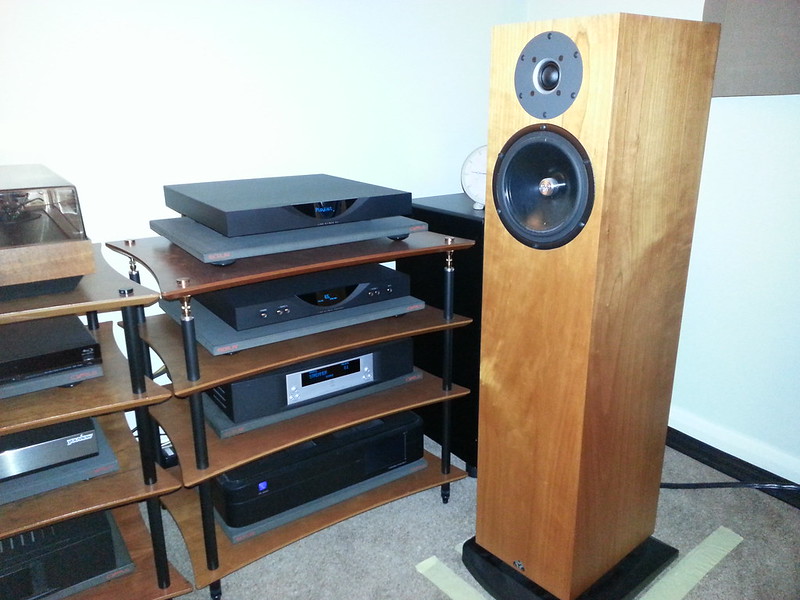
As it is, this is what you see in Pablo's listening room, just the cherry veneered Komris:


So how does all this lot sound?  Well, there's absolutely no doubt in my mind that this is the top of the hill for an all-Linn system.  The 350 Exakt is just not in the same league as the Komris.  Apparently production was stopped due to some difficult to source parts.  That's a shame because they really are a big step up from the 350 - there is no doubt about what they're doing with the music - no hint of that strangely disconnected bass in the 350.  The first thing that struck me was the masses of detail in the upper ranges - but this has no hint whatsoever of being "in your face" or at all aggressive - its sweet, smooth and sparkly, all at the same time.  What's more, it doesn't seem to originate from the speakers at all - instruments hanging in space, rock steady in location, regardless of what else comes along in the music.  Vocals are outstanding too - there's so much expression, nuance and feeling in what we're hearing and this system doesn't favour male over female or vice-versa, its all there in spades.

What about the weight and dynamics?  Well, whatever you want is there without being overwhelming.  I find it very difficult to describe very weightly, deep deep deep and super solid in nature but not hung over, no boom etc.  Its an amazing mix of capabilities.  So often I read about oodles of boominess and swamping bass or hear it in some systems, but this is completely different to that.  Its hard to comprehend that so much complexity and so many rhythms are hidden in those bass lines from the likes of Yello and Trentemoller.  But here they all are - and fully part of the complete make-up and flow of the music.  How to describe instruments that stand so clearly apart and distinct yet they're so much part of the emotional presentation of a tune?  I don't know, but here it all happens.

We chat for a while then play some more tunes.  Rock and I are constantly smiling, shaking heads and tapping our feet.  We're both wrapped up in the music and we're both late to leave as its so difficult to drag ourselves away from what this system is doing.  We try and describe what we're hearing but (as you'll see above) its really difficult to describe.  We eventually settle on a feeling (note that its a feeling, not a technical description) of completely effortless presentation of music, flow and emotion.  Stunningly effortless.

There, that's the verdict.  I'm not sure here if we're at the top of the hifi hill - perhaps Pablo's system is another of those false summits, but there's no doubt that this is my new reference.  When I think back to some of the frankly music-free and un-enjoyable high-end systems I've heard at hifi shows that cost as much and more than this system (including a pair of speakers alone that cost 50% more than this complete system and were incapable of carrying any musical emotion), its great to know that there is something truly high end that can really play music.  Komri's aren't for me - they need a bigger room in which to work, but if I had that kind of cash and a room to put them in, they'd be worth seeking out.  And great that Linn continues to support its customers who have made such an investment in their products - offering their latest Exakt system approach to work with these out of production speakers.

So there we have it.  Great to meet Rock and many thanks to Pablo for his hospitality.  We've been invited back - there's no doubt that's an invitation I'll be keen to follow up.

Marvellous.