"What a refreshingly honest blog about listening to music through hi-fi. So happy to see views based upon the enjoyment of music rather than so-called sound 'quality'." - Peter Comeau, Director of Acoustic Design at Mission / Wharfedale
Showing posts with label DVC. Show all posts

Wednesday, 2 September 2015

Digital vs Analogue? But Not Streaming vs Vinyl.

Its already been raised in a couple of posts.

Linn have discontinued their analogue pre-amps.  So its digital volume controls all the way now, with the streamers and pre-amps being combined into the DSM streamer/pre-amp products.

Linn announcement covered here

Initial thoughts on a first listen to a digital volume control (DVC) are here

So how is this relevant to the main system at Audiophile Musings?  Well, it has the following streamer and pre-amp:

Klimax DS/1 (KDS/1) streamer
Klimax Kontrol/1/D (KK/1/D) analogue pre-amp

So Linn are now, effectively, advising customers that combining these 2 products into one Klimax product and using a DVC is an improvement on separates.  They still sell a separate streamer - the Klimax DS/2 (KDS/2) which features a new circuit board layout and an improved clocking system. Said to sound better than the KDS/1, of course.  The alternative, and what Linn seem to be recommending is the combined streamer and pre-amp in one box, the Klimax DSM/1 (KDSM/1) which features a DVC.  Of course, the older, KK1/D separate pre-amp features an analogue volume control.

The analogue vs DVC debate is lengthy on the Linn forum and there's the usual conjecture, assumptions and actual experiences recorded there.  Some are vehemently against, some are accepting, many are still on the fence, probably not having listened yet.  Linn themselves have produced technical information proving that the DVC introduces less distortion into a system, and is therefore, according to them, a good thing.

Why is this currently relevant?  Well, as the KDS/1 has been superceded by the (supposedly) improved KDS/2 streamer, then there's an option to consider upgrading the KDS/1 in the main system.  In typical Linn style, its possible to upgrade an existing KDS/1 to KDS/2 internals.  But it's also possible to upgrade the KDS/1 to the combined streamer and pre-amp, the KDSM/1.  So upgrade to KDS/2 or to KDSM/1 and sell the KK/1/D pre-amp? Or neither and stay as-is, or stay as-is to try and work out what Linn will do next - the myriad changes in the last 18 months or so is probably de-stabilising customers' system development plans, to say the least.  These upgrade options also come with Linn's proprietary Exakt digital outputs which allow the use of Exakt digital crossovers or Exakt enabled Linn active speakers in addition to traditional analogue output. This decision combines the following:

- commit to DVC (or not)
- upgrade the DS (or not)
- upgrade the DS to a DSM (or not)
- open up the option for Exakt at some point in the future (or not, but upgrading doesn't mean this has to be the future)
- are any of the upgrades good value (in the context of a Linn Klimax system)
- consider how any of this works with or without the KK/1/D pre-amp and the multi-channel cinema processor (or not, possibly leading to lots of other considerations / expenditure)

As you can probably see, lots of options for Linn's existing customers (although, as a new customer, things are very much simplified now), and, consequently, lots of confusion.  Change to new Linn? Move to a different manufacturer? Do nothing? Wait and see - for how long?

So, down to the dealer to have a listen, as that's the only way to resolve a few of these questions.  But with the demise of the analogue pre-amps, even that's not so easy now.  In order to listen to the KDS/1 against KDS/2 through a KK/1 pre-amp, its necessary to take along both the DS and the KK. But this does at least allow comparison of the 2 separate products compared to the combined KDSM/1.  A time was sorted out and about 2.5 hours was spent working through the options and making a decision.

At House of Linn, we used a Majik power amp into passive Majik 140s in the upstairs front room - so similar to my own system, but not identical as there weren't enough Majik power amps on hand to run the M140s in active mode.  The shop's pair of Solo power amps were out on demo, so they weren't an option either.  Linn Silver interconnects and one half of K400 speaker cables were used.  All the source and pre-amp components were placed on the top shelf of a Quadraspire Sukono Vent rack with a bamboo top shelf supported by their latest bronze spikes. Control was through Linn Kinsky on iPad and we used volume levels in the 60-65 range. We listened to the following combinations:

KDS/1 and KK/1/D
KDS/2 and KK/1/D
KDSM/1

These were swapped in and out of the system to enable A to B comparisons.  The KDSM/1 was used with the HDMI ports switched off and the KDS streamers with their internal volume controls disabled.  SPACE was disabled and the speakers had been positioned in the room using Tune-Dem by Brian and Trevor of HoL.  We used tracks familiar to me such as Nils Lofgren Live, Malia & Boris Blank, Blues Company, Peter Alderton, Yello and FAC15.  May be a few others over the 2.5 or so hours.

Top Shelf: Left to Right - Shop KDS/2, my KK/1/D and my KDS/1
Second shelf: Majik Power Amp
Rack: Quadraspire Sukono Vent with Bamboo Top Shelf and Bronze Spikes
KSDM/1 not shown in this picture
So first up was the most straightforward option - KDS/1 versus the newly released KDS/2, both playing through the KK/1/D and therefore using analogue volume control. Given that the KDS/1 is the most musical digital source I've heard to date, its surprising to find that Linn have, again, managed to deliver another notable upgrade.  The new clocking and circuit layout has been a spin-off from work done on the Exakt versions of these products, and the changes are more significant in the sound than I was really expecting.  I was thinking (maybe hoping?) that the improvements would be negligible and I could use the cash elsewhere, but no, this is another step forward.  Listen to the KDS/1 and you would think there was no noise floor, no hash in the music, until you hear the same track through the KDS/2 which sounds cleaner - its hard to describe, but there's more definition in the instruments and vocals, there is less "background" for want of a better phrase.  Imaging is more precise (again, I wasn't really aware of a lack of precision in the KDS/1, its still an excellent product) but the biggest change for me was the intonation and expressiveness of vocals.  There's just so much more texture to the way the singer is interpreting the words and providing the feel of the song.  Good stuff.  Is it worth the upgrade price?  No, its not.  However, when factoring in the ability to use the old KDS/1 electronics to create a new streamer (the DS Renew option) and then selling that onwards, then the upgrade becomes much more affordable and worth the extra (IMHO of course).

So, within about 30 minutes it was clear (after discussion around Renew values etc.) that the KDS/2 was something that interested me.  But how will that compare to the KDSM/1?  Will the combined streamer / pre-amp outperform the separates?  The KDS/1 was replaced on the top shelf of the rack with the KDSM/1 and we got started.  Some of the same tracks were used and we swapped between KDS/2 with KK/1/D and then to the KDSM/1 and back.  And here's the thing - its pretty easy to hear the difference between these 2 options, but which you will prefer, I think, will come down to individual choice.  In terms of detail retrieval, then the KDSM/1 is a marginal improvement on the separate boxes.  There's definitely more fine details resolved and there's a little more in terms of the acoustic space of the venue (on live recordings).  So that's it then, choice made?

No, its not that simple.  If I were a new buyer and only heard the KDSM/1, there's every chance that I would enjoy it and want to buy.  It plays tunes, it sounds good.  There are a couple of things I didn't like though - one is a very slight sharp edge to the lead of the notes and vocals - it doesn't sound like distortion, it's just a bit too abrupt.  But more importantly, there's less coherence and flow to the music.  The KDSM/1 plays a tune, but the separates play a more coherent and flowing tune - its easier to follow, to remember and enjoy.  Is the KK/1/D rounding the edges a bit?  Is it softening the spikes to make the music more "comfortable"?  Quite probably.  But when the music needs to shock or excite or thrill, its all there with the KK/1/D - this isn't about slowing the music or softening the impact, its about music sounding like music rather than a hifi.  The KDSM/1 is more hifi, the separates more musical.

So, is the KDSM/1 no good?  Not at all, its very good, and would be fine, and an improvement on the KDS/1, if I hadn't heard the KDS/2 and KK/1/D combination.  Which is superb and sounds like something I can listen to for hours.

KDS/1 is now back at Linn HQ, and a KDS/2 with a Renewed KDS/1 should be back in a couple of weeks.  Really looking forward to the KDS/2 in the system :-)


Saturday, 1 August 2015

Today's TLA Report: KCT, TST, KDS and DVC. Linn and Lejonklou Content.


TLAs?  Three Letter Acronyms.  There's a lot of them about.  Do they sound any good?  I spent an evening chez Whizz to find out.

Here's an itch that's been scratched at last - how does a Lejonklou Tundra Stereo 2 (TST) stack up against the Linn Klimax Chakra Twin (KTC), both in their latest, up to date 2015 configs?

Much has been written on the Linn forum, the Lejonklou forum and probably in other places too, about the giant killing abilities of the £2.5k Tundra Stereo - now in, I think, its fourth iteration - v1, 1.1, 1.2 and now v2.  As is usual, the inside of the Lejonklou and the design science that goes into it is less than accessible than it might be.  Lejonklou put a lot of effort into the design, focussing primarily on sound quality, encompassing all aspects right down to the torque settings for the outer sleeve (you're not supposted to change these, hence there's not much information about what goes inside the box).  The KCT has also evolved over time, the biggest change of note being the Dynamik power supply and a new main board layout - but it is an old design now - based on Chakra circuitry, its a bit like an Linn Akurate amp on steroids.

Previously...

Given that the KCT is based on Akurate design, I need to put some cards on the table - I don't like the current Akurate amps - to me they sound like hifi.  I've had Akurate in my system and went back to Majik as, although Majik amps don't extract as much information from the signal, they do, to me, sound more musical.  To use Linn's terminology, the Majik amps Tune-dem better, at least to me.  And when you can't afford Klimax amps, then its Majik or something non-Linn.  Talking of which, I've heard only one Lejonklou product to date - the original Tundra Stereo (it wasn't called Stereo then, as there wasn't a Mono version) in a system with Linn KDS/0 Renew and Linn Katans (note, no pre-amp in that system).  You can see my notes on that here: http://audiophilemusings.blogspot.co.uk/2012/07/toms-system-linn-klimax-lejonklu-tundra.html   As you will see, it worked well within the limits of physically small speakers, I did appreciate the imaging (a Katan strength) and subtle finess within the music.  Lejonklou doesn't use Tune-dem to evaluate their products, they use Tune-method - subtle eh?

Also in the "previously..." category is the KDS/1 which is the streamer I use in the main system at home.  To date, its the best digital source I've heard, that's why its in the system.  Recently, it was superceded by (imaginatively), the KDS/2 which has a new clock and revised circuit layouts, in addition to Linn's Exakt outputs.  With the launch of KDS/2 (streamer) and the sister KDSM/1 (streamer and pre-amp), Linn also stopped producing analogue pre-amps - they say the Digital Volume Control (DVC) now outperforms the analogue volume control in their previous top-or-the-range pre-amp, the Klimax Kontrol/1/D (also in my system).  This has caused some controversy on the forums (forums like that, don't they?) too, with some pro- (they're the quiet ones, if they exist) and some anti- (they're the vociferous ones) the DVC.  So, is set, the background to the evening's listening.

I suppose that I also ought to say at this point that I'm not a fan of the Linn Klimax 350 speakers - I've yet to really enjoy them either passive (with their active servo bass system of course), internally active nor Exakt internally active.  I find their bass challenging - its deep enough and there's plenty of it, it just sounds a bit detached from the rest of the music, somehow.

Expectation bias - yep, I guess we all suffer from that, in my case, this time, I was expecting it to be very difficult to choose between the amps.  This is based on reviews on forums that claim the Tundra is close to Linn's Klimax Solos, never mind the Klimax Twin.  I was prepared for having to pick out small nuances and to have to think about the character of the sound rather than the musicality or detail presented.

Bistro

I met Whizz in a bistro.  Very nice it was too - decent  food and a glass of wine.  We headed off to Whizz HQ and settled down with a cuppa, looking at the following, very simple looking, system:

Linn KDS/2 (DVC in use)
Linn Silver Interconnect
Lejonklou Tundra Stereo 2
Linn K200 speaker cable
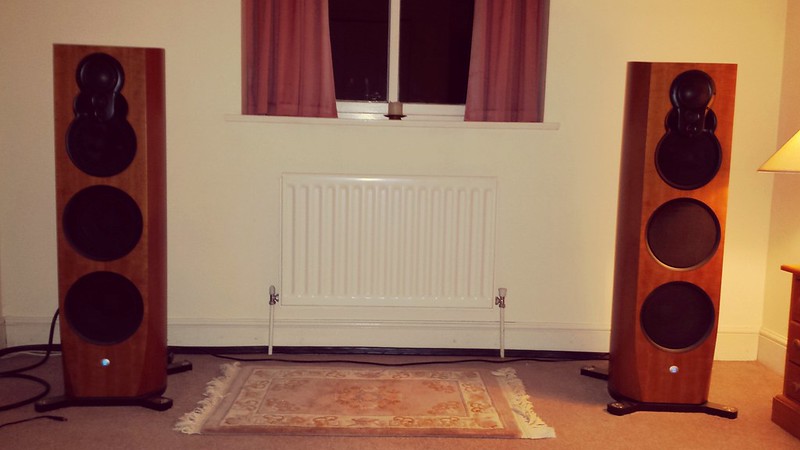
Linn Klimax 350 passive speakers in Cherry with black arrays
Quadraspire Evo rack
No fancy mains treatment, room treatment nor cable lifters in sight...

Most of the music we used came from Tidal (a few tracks from the local laptop) and included Malia, Eagle Eye Cherry, Deadmau5, Ficci, Felix Laband and Tina Doci.  Control was via a laptop running Kinsky (for ease of use) and Kazoo (for access to Tidal).  The KDS/2 was using SPACE room optimization, set up by Whizz when using the KCT power amp.

DVC

Let's get this one out of the way to start with, but first a qualifier.  This is the first KDS/2 I've heard, I've not yet compared it to the KDS/1 back to back in the same system, nor have I had the chance to compare one using the DVC versus feeding it through the analogue volume control of a KK/1 - that's the subject of a near future post.  We used volume levels of between 58 and 62 (for the Linn power amp) and between 66 and 72 (for the Tundra, which has 8dB less gain than the Linn).  So we didn't try the DVC at lower listening levels.
  
Across both the Tundra and Klimax power amps, I can't say that I heard anything that made me think there was any problem at all with the DVC.  With the Klimax amp, there was occasionally an "edge" to the lead of some instruments and voices, but that could be the KDS/2 or the Klimax Twin amp, as I've not heard either of these in their current configs.  Interesting that the Tundra didn't reveal these edges, so maybe it was the amp...  Anyway, at these volume levels, there wasn't even a hint of the "horrendous" nor the "unlistenable" comments I've read elsewhere.

Sweden

So kicking off with the Tundra Stereo 2 - an unassuming little black box - this one being just a few weeks old and only with about 10 hours use.  It was warmed up though, having been switched on and used a couple of hours earlier.  And what a polite little box it is.  Goes plenty loud enough, at least for me, but its really rather soft in its presentation - almost valve-like (and that's not really a complement from me, but I know many will like this kind of presentation).  The top-end doesn't sparkle, the imaging is flat and rather narrow but vocals (particularly female vocals) are sweet and clear.  Not sure why Tori Amos sounded about as wide as the window between the speakers though.  

What of the bass?  Well, it was difficult for me to tell as the 350s were sounding very different when driven with this amp - the usual slightly detached bass issue was not very easy to distinguish because it was all rather loose.  Bass notes started OK, but they don't stop too well.  Its not boomy as such, it just kind of happens then takes its time to stop again. Deadmau5 didn't have me tapping my foot or wanting to dance, which is an usual experience - even on my much more modest Majik amp and speakers, the track we used drives hard and always gets me foot tapping or jigging in the seat (so to speak).  Another favourite is Blues Company's Dark Day - a track full of sparkling cymbals, triangles and snappy rimshots, along with some extremely deep electronic drum effects.  Whilst the vocals were good and the track flowed along, the cymbals, which should be distinct, clear, individually identifiable in space and shimmering as they are struck and fade away, well, they're just underwhelming and ill-defined - some of them being very indistinct.  The electronic bass drums impacted well, but then kind of flapped about a bit - it really had me wondering if developing a power amp through the little Linn Majik 109 standmounts makes sense, or are the 350s just too demanding?  Maybe Lejonklou used other speakers too, but I understand the 109 was the most frequently used in development.  

It was all OK, but we tended to talk over the music, or move onto the next track before the existing one was finished.  I've never heard the Klimax 350 powered by anything less than its internal amps or external Klimax amps before, so I have no idea how they sound when powered with something less exotic and more affordable.  So maybe this is how a £2.5k power amp sounds with these speakers, I just don't know.  And maybe something more expensive doesn't do a better job either?

Scotland

After about 50 minutes of Sweden, we moved onto Scottish power.  The KCT had been switched off for about 3 weeks, so was going to be fired up and used from cold.  Swap over only took a few minutes and the music was up and running pretty quickly - Whizz had the amps back to front on the rack to provide quick access to the connections.  And whoa!  Even from completely cold this amp was a revelation in comparison to the previous hour or so of listening.  The 350 bass timing "characteristics" were back, because now the amp was gripping these speakers much much better - you could hear bass notes starting and stopping.  And the room got bigger - not the actual room, but the room in which music was recorded - Fink were in a proper venue, not the front room.  Tori Amos's voice is now a much more sensible size - and absolutely locked to the centre.  

And detail - there's more coming through from the recording, instruments that were indistinct or not even noticable with the TST are much more obvious and finely etched.  We play Dark Day again, and we listen to the whole track in silence to the end - captivated by what we were hearing.  There is a down side - there is now, an occasional "edge" to some instruments and vocals - but get this into perspective - its a tiny criticism compared with the Tundra's compromises.  As the KCT warmed up, within 20 minutes it was doing a great job.  Tight rhythms, deep bass, clear space between instruments, the atmosphere of the venue much more obvious, sparkly cymbals.  Foot tapping?  Yep, its back - good.  Perhaps this is the best I've heard the 350p, but I can't get away from that slightly weird bass timing issue.

2015-08-01_09-08-53 

Conclusion

DVC - still more investigation to do, but no obvious issues at all tonight, unless its that edginess heard through the KCT, but not through the Lejonklou.  If it is down to the DVC, its a fairly minor issue - not enough to want to listen to something different.

Tundra vs KCT - this was not what I was expecting at all.  Soft, loose and a bit vague, the Tundra was out of its depth here.  Would still like to hear it with other, lets say, more conventional - less challenging, speakers - I'm almost sure that the 350s are not its ideal partner.  No doubt there will be some who say that it needs 6 weeks to be at its best or similar - if that's the case, then they need to play for whatever length of time is required for them to work properly before they leave for their owners. Maybe the Tundra was disadvantaged by the SPACE settings being set up with the KCT - another reason to try to find the opportunity to listen again under different circumstances. I was expecting a difficult choice - to need to swap back and forth between amps to try and fathom subtle differences in presentation or character.  Nope, in this system, in this room, this was an easy, no-contest win for the KCT in my opinion. 

What about the cost - the Tundra is very much cheaper than the KCT. And that's a very important point here, and why I would like to hear the comparison again with more normal speakers - maybe my Majik 140s, maybe some PMC Twenty.26s, or Kudos Super 20s would be a fairer load for it to deal with.  But as a giant killer against the KCT?  No, its just not close on this evidence in this system.  A secondhand KCT would be a better way to go, for me at least.


Thanks to Whizz for his hospitality and the opportunity to listen to this kit, a good way to spend an evening.