"What a refreshingly honest blog about listening to music through hi-fi. So happy to see views based upon the enjoyment of music rather than so-called sound 'quality'." - Peter Comeau, Director of Acoustic Design at Mission / Wharfedale
Showing posts with label House of Linn. Show all posts

Thursday, 30 April 2026

LINN Upgrade Their Flagship 360 Loudspeaker - World First Demo

Linn's 360 speaker was introduced in 2023, heralded as their best ever speaker product. It was certainly a huge step in the right direction after the somewhat long in the tooth 350. It features some interesting technology, particularly in the fully active version - such as Organik DAC / power amp modules with adaptive bias amplifiers, Exakt phase correction / time alignment and the cabinet that features no flat panels - improving dispersion and imaging.

Within about 6 months of its introduction Linn quietly dropped the beryllium tweeter in favour of a less toxic material - other than that little has changed in the 3 years since.

However, today, Linn launched an upgraded version with new upper bass and bass drivers - Audiophile Musings was invited along to the product launch at House of Linn in Manchester for the first ever demonstration of the product outside the Linn factory. 

Those of you who know a little about the 360 will also notice another change - the availability of a full cabinet walnut veneer - a no cost option alongside the existing paint finishes.

Talking of cost - this new version has upped the list price of the fully integrated active version from £87.5k to £99.5k.  The passive with active bass version sees a similar uplift of around £12k.  Existing owners can upgrade for £16k but if you bought within the last 6 months the upgrade is the same as the uplift in the list price - £12k.


Linn's ambassador Paul was on hand to explain the differences in the drivers between the original version of the 360 and this latest iteration.  In brief:

- the original used "off the shelf modified" drivers from a well-known driver provider

- the new version uses all-new Linn designed drivers built exclusively for them

- these are the first ever "designed from scratch" Linn drivers

- they're dubbed Pistonik - the design features in the upper bass and bass drivers

- they feature a large motor structure, an aluminium cone which is almost flat, a double layer suspension system and enormous linear (front to back) excursion

- they are claimed to reduce distortion

- are said to be designed to suit the 360 cabinet

More information and pictures on Linn's website here: https://www.linn.co.uk/uk/speakers/upgrades/linn-drive-units

DEMO

Audiophile Musings was invited to the first ever demo of these upgraded speakers outside the Linn factory.  Thanks to Brian and Trevor at House of Linn for hosting the session.

The system tonight:

Turntable: Linn LP12 with Bedrock plinth, Keel SE subchassis, Ekos SE arm, Ekstatic cartridge, Urika II phono stage

Streamer / Pre-amp: Linn Klimax DSM/3 with Utopik PSU

Loudspeakers: fully integrated Exakt active original 360 with Utopik PSU and fully integrated Exakt active upgraded 360 with Utopik PSU

We started with a couple of tracks from Qobuz - which included some electronic, jazz and female vocals.  As ever with the 360, I get a feeling of clarity and technical accomplishment, but not so much feeling nor emotion from the music.  Good to get familar with the product again.

"This Is What You Are" by Mario Biondi And The High Five Quintet

"I Can't Stand the Rain" by Beverley Knight

"End of the Road" by Infected Mushroom

We then had a 10-15 minute break whist the team swapped over the 360s to the upgraded version.  When going back into the dem room there was a 3 or 4 minute video explaining the driver upgrades and the technology within them - some nice graphics etc.

Then we went back to the same tracks and the difference in the bass was immediate and obvious - the new drivers clearly exposed the old drivers as somewhat woolly and vague (in absolute terms) -  not just in terms of articulating the sounds of the instruments, but more obviously in the clarity of when the note(s) start and when they stop.  This was not a subtle upgrade, but something quite clearly worthwhile.  The solidity and punch on the Infected Mushroom track was a particularly good way to bring out the capabilities of the new drivers.  There's also more texture and detail in the bass lines, more insight is perhaps a good way to describe this.

A few more tracks were selected by Linn including some on the LP12:

"What I Am (Album Version)" by Edie Brickell & New Bohemians

"You Look Good To Me" by Oscar Peterson (on the LP12)

"Satisfied Mind" by Mavis Staples

"Shostakovich Symphony No. 10 in E Minor, Op. 93: II. Allegro" by Philharmonia Orchestra - The Simon Rattle Album (on the LP12)

"Secret Heart (Album Version)" by Ron Sexsmith

"Penpals" by The Stan Tracey Quartet

"Who'll Stop The Rain (John's Version)" by John Fogerty


Then the track choice was handed over to the attendees at which point we enjoyed the following:

"Kiss the Sky" by Tash Sultana

"Waiting on the World to Change" by John Mayer

"Yamore (feat. Cesaria Evora, Benja (NL)" by Moblack and Salif Keita

"A Plea" by Flea

"Counting (Remastered)" by The Motels

"And They All Came Marching Out of the Woods" by Jakob Bro, Thomas Morgan & Jon Christensen

"Mahler Symphony No. 5 in C-Sharp Minor: I. Trauermarsch. In gemessenen Schritt. Streng. Wie ein Kondukt" Sir John Barbirolli


All of the above cemented the initial impressions - great tightly controlled bass (possibly one of the bess bass performances of any system I've heard) and that extremely clear but unemotional overall presentation.  If you have 360 and the wherewithal to have the upgrade, its pretty obvious that its something worth considering.  If you have mostly liked the 360 but you felt the bass could be tighter, punchier, more revealing or all 3, now's the time to go take another listen.  It will be interesting to see if Pistonik (3 years in the making) will filter down to the by-now-inevitable 2nn series speakers from Linn - that's the gap that needs plugging as soon as possible.


Saturday, 11 May 2019

4 Lots of Kudos in One Night - Passive and Active

Kudos' Titan 808 has been around a few years now, and has given a great account of itsself at multiple shows 'musings has attended in the UK and Germany.
Most recently with the rather good Naim SNAXO active system at the Chester Hifi show earlier in the month.  I also chose a Linn Exakt driven pair when presenting a "MyTunes" playlist evening at Manchester dealer brianandtrevors, where they were augmented by a pair of REL No 25 subwoofers.

But there's more to Kudos than their well received top of the range T-808.  There are entry level "X" models, mid-range "Super" models and 4 different interpretations of the Titan formula.  So what's the rest of the range like?  To find out, 'musings returned to brianandtrevors for an evening of Kudos discovery.  The evening followed a fairly typical approach for a joint dealer / manufacturer evening - gradually stepping up the range, but perhaps with a little twist tonight.  To allow the comparison of the speakers, a pretty much "no compromise" system was put together from Scottish manufacturer Linn:

A largely Klimax level LP12 - Radikal PSU (in the Akurate casework), Ekos SE2, Kandid and a booplinth.  Onboard was a Urika 2 phono stage which fed an Exakt signal to a Linn Klimax DSM acting as pre-amp and streamer.
Initially the KDSM ran with its internal Katalyst equipped stereo DAC to a Linn Klimax Twin/D stereo power amp.
I/C cables were Linn silvers, with Chord Music making sure there were no compromises on the speaker cable side.

That's quite some front end to feed into the first speaker we heard tonight - the diminutive little Kudos X2 compact floorstander.  Bear in mind that, at £1600, it was being fed by a system that included speaker cables that come in at (assuming they were 3m in length) 4x the price of the speakers.
It has to be said that these little speakers probably weren't designed for use in a room the size of tonight's dem room.  Before they were played, Kudos' Dave White introduced himself and the company philosophy - keep things simple and use the best quality components and cabinets that can be achieved at a price point.  Drivers all come from SEAS, modified or created to Kudos's own requirements.  So until the top of the range, simplicity means 2-way designs, uncluttered crossovers and quality cabinet veneers.  So the little boxes played and did a pretty good job.  Yes, there was a looseness in the bass, which goes surprisingly low, there was some vagueness in the treble but the music was flowing, feet tapping, even the room joining in with some modes didn't detract from enjoying what was going on.  It would be great to listen to these in a smaller room, where I'm sure they'd work pretty well.  We listened to a few tracks from the streamer then moved on with a 3x price jump to the middle of the range Super 20 speakers.

This is another 2-way floorstander, but around 850mm high and sporting significantly higher quality components.  Again the finish is superb with matched veneers on the baffles. Well, this was a significant step-up in the musical presentation to match the price change.  The SEAS tweeter in the S20 is several steps up from the X2 in terms of detail, definition, believability and control. Similar improvements come from the mid-bass driver. Curiously the initial impression was of a speaker producing less bass output than the baby floorstanders, but in reality its just hugely better controlled and keyed into the hooks and rhythms of the tune.  The treble presentation, whilst far more refined, is just a little to forward in the mix for my personal taste, but there's no doubt the others in the group of 12 were enjoying what they were hearing.

The next step up was 2x on the price-o-meter and takes us into Titan territory.  We didn't hear the 505 standmount tonight, going straight to the first of the floorstanders, the 606.  This is similar in height to the Super 20, but the cabinent is very differently constructed.  Dave introduced the isobaric mid-bass driver and the thin-walled inner cabinet which is surrounded by heavy MDF side panels that are connected to the inner panels with damping material.  The tweeter too is from SEAS's upper end Krescendo family, amended to Kudos spec - the tweeter alone costs more to Kudos than all the drivers put together in a pair of X2s.  They're very substantially built speakers, needing a trolley to move them around, even though they're still under a metre high.  And how was this?  Well, it wasn't all a complete step up from the Super 20.  Bass a little deeper, treble that much more clear and definitive in the way it starts and stops, vocals carrying more emotion, along with tighter imaging, most if it was good.  But for me the Super 20 won out on the bass lines keeping pace with the rest of the music, and providing that foot-tapping drive.  So not a complete success for me.  After a short break to refresh glasses, along came the "twist" of the demo.  The Kudos Super and Titan ranges have a little trick up their sleeves - they have a clever but simple connection panel on the rear that means they can be converted to work in active mode - that is, effectively removing the internal passive crossovers to allow power amplifiers to be connected directly to each drive unit with the splitting of the frequencies delivered by an active crossover in front of the power amps.  This works with Naim analogue active crossovers and with Devialet and Linn digital crossovers.

So the Klimax DSM changed its role from digital to analogue converter, to one feeding a still digital Exakt feed to a Linn Klimax Exaktbox/1.  The Exaktbox does the digital to analogue conversion, along with some clever stuff such as phase correction of the drive units (and no crossover phase distortion), time aligning the drive units and adjusting the speakers' output to counteract room modes that normally causes "boominess".  Because each drive unit now needs its own power amplifier channel, an additional Klimax Twin was pressed into action, along with more Chord Music speaker cables.  Now the Titans are singing. This is a massive step up in performance for these speakers, much as we've experienced before when hooking the Super 20s up to an Exakt system back at 'musings base.  The reservations with the 606 in passive mode are almost gone - there's still a little reticence in the bass lines, but its very minor now and allows the other elements to shine through.  The live Eva Cassidy track we started with on the X2s is now in a huge venue, the soundstage goes back a long way beyond the speakers, Eva's voice is full of emotion, inflections and phrasing details. Nice.  We listen to a good few tracks from the streamer. Interesting set of feet on the 606s tonight, seem to tackle some of the shrillness I've heard from these speakers when sitting on standard spikes. Other than understanding they have some Sorbothane de-coupling, there wasn't time to discuss further tonight.

Another break follows, and the final set up of the evening is rolled into the room whilst more wine, coffee and juice is sorted out for the audience of a dozen or so listeners.  In the break we swap system information, who's interested in what and why Kudos is of interest.  Most have Linn front ends of some sort - vinyl and streaming, there's a few Naim front ends (streaming and CD) mostly Linn amplification but also Naim and a few others.  From a speaker comparison perspective, Linn, PMC, Kudos and others are in use.

Back to listening and we're now at the top of the Kudos range with the Titan 808.  Unlike last time in this room, the 808 was not supported by the big REL subs.  They had to fend for themselves.  It turns out that they're quite capable of looking after themselves thanks very much, and I ended up enjoying them more on their own.  The sense of scale of the Eva Cassidy venue is stunning on the 808 and they punch hard and fast.  Unlike the 505, 606 and 707 which have slightly (intentionally) leaky isobaric chambers, the lowest bass driver, in its separate box, is a more conventional sealed isobaric.  The 808 is a 3 way design but described as 2.5 way by Kudos by which I think they mean the lowest bass driver augments the lower end of the mid-bass rather than delivering a completely separate set of frequencies.  So this top-end speaker needs 6x power amp channels and as such another Klimax Twin and pair of Chord Music cables were helping out in this final system configuration.  The same tweeter is featured across the Titan range yet it somehow seems clearer and smoother in this configuration, but its the clarity, transparency and realism of the mid-bass combined with the sheer kick and tightness of the lower bass that stand out here.  We listen to lots of tracks and the LP12 is pressed into action for a few songs, including an album by one of my current favourites, Bob Moses from Canada.  There was some boominess with this system, Linn's SPACE optimisation wasn't in use until later in the evening, after the formal presentation has been completed.

What did we learn?  Well, in passive form, mostly spending more gets a better result, but not always in all areas.  But once Exakt was deployed, the whole experience was a huge improvement in performance and consistency. And, yet again, the 808 produced a great result - personally I think they performed better than with the REL subs in this room - not quite so jaw-dropping in terms of sheer power and impact, but more musically satisfying.  The X2's are good for their price and did a reasonable job of filling the big room.  But then again there's no real substitute for box volume, driver quality, cabinet construction and, most importantly, a high quality front-end active system. It would've been nice to hear the Super 20 moving from passive to active, but you can't fit everything into one evening.  I do wonder about those in the audience who might've been contemplating the 606 - were they satisfied, or do they now spend a longer time saving for the 808?  But then again, there's the 707 in between, and that's definitely worth a listen. I won't be changing my Twenty.26s for the 606s as they didn't do absolutely everything comprehensively better.  Perhaps the 707s?  Will have to leave it until another time to find out.

Thanks once again to Brian, Trevor, Dave and the other attendees for another enjoyable and instructive evening.

Friday, 15 March 2019

My Tunes at brianandtrevors 14 March 2019

The House of Linn, aka brianandtrevors, is a hifi dealer in Manchester.  The ex-Linn team started out as House of Linn then expanded into a parallel business that stocks non-Linn gear.  I've spent a few evenings there for demos and we've done some business together, on the Linn side of the house.  Its a fine old high ceiling end terrace with 3 dem rooms, a workshop and, perhaps most importantly, a kitchen for brewing tea and dispensing wine.

Most of the evening events have focussed on a product launch, or a manufacturer visit. Quite a few times B&T have mentioned having relaxed music only evenings and finally, they've kicked off a new series dubbed "My Tunes".  The idea is for a customer or other visitor to play some tunes, chat a little about them whilst enjoying the afforementioned tea or wine.  And that was the brief I was given when invited to be the "selector" for the first of these evenings.  Play a few tunes and tell the group a bit about why they were chosen.

I only had one request, that I could choose the system we'd use, and fortunately B&T are now Kudos dealers so it was straightforward to ask for something interesting, but more of that later, there was some planning to do.  What to play?  I do have a collated album of around 450 "favourite" tracks saved on the Melco NAS so I headed there and started to think about what to play and what to say.  It takes a bit of time to whittle it down, try and think of a good variety and then think back to why the track was in the main list, how it came into my life, and how to frame the story.

Eventually there were few enough tracks to put into 2 slots of about 50 minutes each, to allow for a break part way through (to recharge glasses of course!).  The first track was easy - play the first record I bought for myself - and then I remembered that there is a little box of singles in the house, so a quick check and there it was - the original copy of Solid Gold, Easy Action by T-Rex.  Glam rock!  I think it cost me about 35 pence, probably quite a few weeks of pocket money back in 1972.  It then occured to me that it might be worth not only talking about the music, but my hifi journey too, given the location.  So I tried to mix the two things along the way - a bit about the music, a bit about the hifi.

A good size audience of 15 joined the evening.  B&T introduced the idea and myself and that was it, get on with it!  Something I really appreciated, and hoped the audience did too, there was no mention at all of the kit in use, except to answer questions during the break. So no selling as such, a nice relaxed approach.  But we'll cover the system now, because it was something that I'd wanted to hear for a while and something I hoped would work really well.

We started the evening with that very old and pretty well worn T-Rex single, running on an almost full Klimax Linn LP12.  So a Radikal motor and PSU, Ekos SE, Keel, Urika II phono stage, Kandid cartridge and the one deviation from Klimax - B&T's own bamboo based booplinth plinth.  Brave of them to let the Kandid track this old single.  It sounded a bit thin, but remarkably free of pops and crackles, but clearly showing signs of stylus damage.  For the rest of the evening we played the tracks from the Innuos Zenith through a Chord Music ethernet cable into a Linn Klimax DSM - but using the Exakt outputs tonight.  The Exakt signal travelled down a Cat 7 ethernet cable to a Klimax Exaktbox/1 (that's the Katalyst version).  This was on a small rack near the speakers which also accommodated three Linn Klimax Twin power amps, each driving one of the 3 drivers in each Kudos Titan T-808 speaker, via Chord Music speaker cables.  So that was the system I'd asked for, but B&T threw in a couple of Exakbox sub boxes and a pair of REL No 25 subs at the back of the room.  All the electronics were supported by Quadraspire racks.

Click on the images for larger versions:


Kudo Titan 808 speaker along with a stack of Linn Klimax ingots - one Exaktbox, 3 Twin power amps, and a couple of boxes not in use tonight


From the top: Linn LP12 turntable in a booplinth, Linn Klimax DSM streamer / pre-amp, Innuos Zenith NAS, Linn Radikal power supply for the LP12 all on a Quadraspire X-Ref rack

Chord Music Cables
View across the largest of the dem rooms


Before the guests arrive we chewed the fat on the latest in hifi stuff and more, then had a listen to the system - just spending a little time tweaking the volume of the subs down a little to get the best balance.  SPACE is in play on the system and, as is often the case now, with the latest software versions, the default setting in a Exakt system is pretty much spot on.  And the system was sounding fantastic, pleased to say that its probably the best system I've heard in the house.  Full of detail, speed, tuneful bass lines, crisp, clear, beautifully resolved and emotional vocals and slam like I've never heard in the house before.  Fantastic.  I also spent a bit of time listening to a pair of Titan 505s in the smaller upstairs dem room, being driven by Linn Akurate Exakt electronics.  That was a good listen too - the Titan range seems to be a good design.

Below is the list of tracks I went with.  I have to say, I'm not sure its the right list, or the best list, or whatever, but its the one I came up with for the evening.  I did put some time into it but I didn't over think it or spend time putting tracks in and out of the list. Maybe I'll get invited back in a few years time and I can go with a completely different list.  So in there there are some older tracks, some new stuff, electronic music, jazz, americana, folk, covers, punk and rock/pop.

You can click on the image for a larger version:


I was hoping to put together something that some people would know (Teenage Kicks, of course), some tracks known but in new versions (Ever Fallen In Love, Don't Go Breaking My Heart) and something that would be new to most if not all (Pitch Black, perhaps Fink).  During the break it would seem that the balance was OK for most, but I've no doubt there were some genres missing or perhaps too much of one genre for others.

The audience were very attentive, there was some banter during the introductions, hopefully the little stories were interesting, but mainly, I hope that the music was of interest and enjoyable.  Certainly that system did it all justice.  If nothing else, I enjoyed the evening!

I'm looking forward to the next time B&T organise a session - it'll be interesting to be in the audience and hear someone else's selections and stories.

Thanks to B&T for the invitation to "select".


B&T have made the most of this post for their newsletter  :)

Sunday, 3 March 2019

14th March 2019 - Manchester Dealer Launches "My Tunes" Musical Evenings


Manchester dealer brianandtrevors (aka House of Linn) are launching a new series of occasional musical evenings.

The idea is pretty simple - a guest selects a bunch of tunes they enjoy and plays them to other guests / customers.  We get the chance to hear a good system and hopefully some good music with the possibility of being introduced to new material and artists.

'musings has been invited to present the first of these evenings on 14 March 2019.  Should be fun.

You can reserve a seat by calling or emailing brian and trevor.  More details in the latest newsletter:

https://www.brianandtrevors.com/almost-spring-2019-newsletter/

Friday, 10 June 2016

Linn Exakt and PMC Twenty.26. World First Review Part Three - Set Up and Listening

Part Three of a Three Part Review

Part One Here

Part Two Here

If you’ve read the above first 2 parts of this mini-saga, then you’ll be aware that we’re part way through the story of moving Audiophile Musings’ system from passive Klimax electronics into Majik 140 speakers towards Linn Akurate Exakt and PMC Twenty.26 speakers.

The Exakt kit was a mix of new and ex-demo and consists of:
  • Akurate Exakt DSM (an Ethernet connected streamer, digital pre-amp and box of tricks that converts all digital signals into Exaktlink protocol before passing this along to the Exaktbox) – AEDSM; 
  • A Cat 7 cable to connect AEDSM to Akurate Exaktbox 10; 
  • Akurate Exaktbox 10 (a digital crossover which contains 2x Linn Exakt engine processors and 10 independent digital to analogue converters (DACs) and outputs 10 channels of analogue ready to be amplified) – AEBOX10; 
  • 6x Linn Silver analogue interconnects connecting the AEBOX10 to the power amps; 
  • 8x channels of Linn Akurate 4200/1 power maps (4200 has 4 channels so after moving from M140 speakers to PMCs, 2x channels are not used for the stereo parts of the system, the 2 spare channels are used to power the centre speaker of the complete 5.1 set up) – A4200/1;
  • 4x 2.5m of Linn K400 speaker cable to connect the power amps to the speakers (initially for the Majik 140s);
  • 2x 2.5m of Linn K600 speaker cable to connect the power amps to the speakers (later, for the PMC Twenty.26 speakers) 
  • Linn Konfig software running on a Windows laptop.

Trevor of the House of Linn came to set up the system, starting with the Majik 140s. We had to do that as the Linn Exakt software filters for the PMCs weren’t available at the time – see Part One of the story for the thinking behind making the jump to Exakt, even before the PMC filters were available. After all the Klimax gear was disconnected, we started on unpacking all the boxes for the new kit and did a bit of shelf dusting whilst we were able. One of the aspects I really appreciate about Trevor’s work is the attention to detail around taking care of the kit. Everything is handled with care and respect, he removes his watch and nothing is left to chance in terms of laying everything out in a logical order etc.
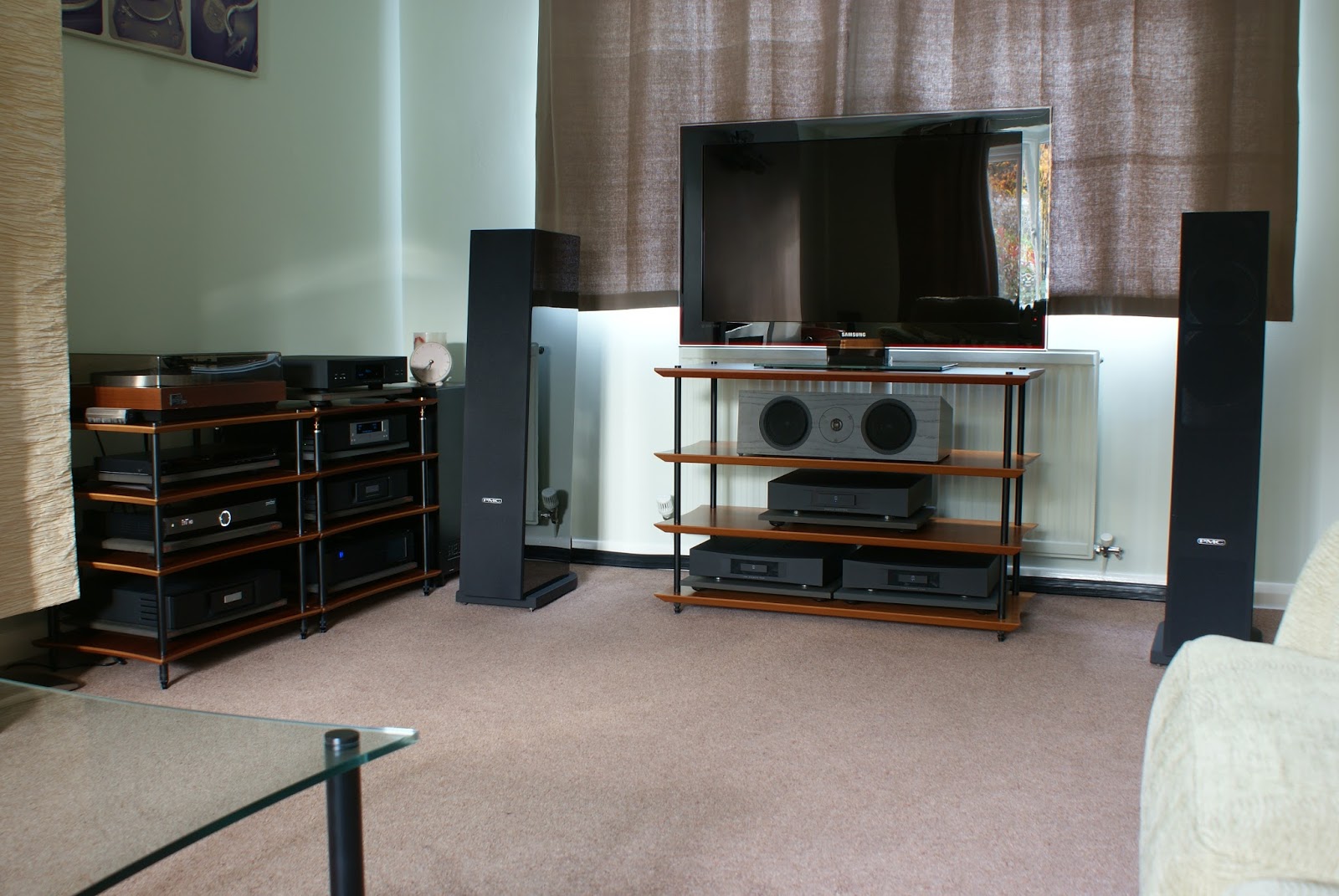
So the DSM is set up on the rack to replace the KDS/2 streamer and the power amps and Exaktbox are installed on the centre rack between the speakers, under the TV. Of course, all installed on Cyrus Isoplats. The Linn software and documentation give diagrams on connecting up the power amp channels to the back of the Exaktbox. Because there are 10 channels on the Exaktbox and because there are many different speakers supported by the software, the connections to the power amps are very much dependent on the speaker in use. So the back of the Exaktbox is just labelled channels 1 to 10 – it’s the diagrams in Konfig that show you how to connect up. Konfig then needs the speaker serial numbers entering and it downloads the correct filter profiles for that particular make and model of speaker. The filters apply all the correct frequency cut-offs and phase corrections tailored through software for the speakers in use. For the Majik 140, channels 1 to 4 and 6 to 9 are used. These Exaktbox outputs were hooked up to 2x Akurate 4200/1 4 channel power amps using Linn Silver interconnects (these have silver coloured sleeves, but the conductors are copper). One power amp was used per left / right channel.

Akurate Exaktbox 10
 
Linn Konfig is fired up on the laptop and work starts on configuring the system. First up is to select the speakers for the Exaktbox – select the model from the drop-down lists and then enter the serial numbers – choosing which speaker (left or right) will use each set of channels (1 to 4 or 6 to 9). Then all the room information for SPACE room optimisation can be input (dimensions, materials, window positions etc etc), or the existing room information is retained, which is the position we were in. SPACE was left switched off and we spent the best part of an hour re-positioning the speakers in the room. There was only about 10-15mm change in position in the room to get the best sound from their previous position.
At this point, SPACE optimisation was calculated and applied. It was pretty much spot-on – a result which is markedly better than using SPACE in a non-Exakt system. In Exakt, the optimisation is called SPACE+ and is applied in the Exaktbox (rather than in the DS in analogue systems). This uses fewer compromises (for example, the position of individual bass / mid-range drivers and the bass ports are much more accurately modelled in SPACE+) and seems to give a great result. We messed a little with the SPACE settings, but ended up back at those calculated by the system. Impressive.
So the Exakted M140s using Akurate level electronics are a major improvement on the same speakers driven passively by the higher-up-the-range Klimax electronics. Some may find this difficult to take, particularly those heavily invested in Klimax gear. But here we have a system that performs both musically and technically far better and by selling on the Klimax components, actually left me financially better off. Why do I find it better? Well tighter timing, massively better imaging, bass control, a naturalness to the vocals and completely involuntary foot tapping. Given that Linn equipment already sounds very well controlled – to the point where some listeners find them too controlled and lacking in liveliness and wanting them to “let go” more – then its possible to see how Linn have developed Exakt to take this one step further. Did the electronics improve over time? Did they “burn-in”? I’m not sure that they did. Certainly, not enough for me to have noticed. But then it was only the AEDSM that was new – the Exaktbox and power amps were ex-dem and as such would’ve experienced “burn-in”, if such a thing exists with these systems. What is noticeably though, is the warm-up effect. The system sounds great when first switched on, but there’s definitely an improvement at somewhere between 20 and 30 minutes of use. The sound “fills out” and becomes both warmer, deeper in the bass and yet just as controlled. It’s a nice effect, but it would be much better if the system sounded this way from the start. I try to find the time to run the system for a while before sitting down to a focussed music listening session.

What of the PMCs? Well at this point I was kind of thinking the M140s would be around for a while longer whilst saving up for Akubariks. But it wasn’t long (about 3 weeks) and the PMC filters were released. So time to give it a whirl. Some correspondence with Linn suggested that they had found the PMCs a little bright and tiring too and had tailored the Exakt filters to take out a fair amount of treble energy. So the work was done to convert the speakers (see part 2 here), the M140s were replaced by the PMCs.
But its not a straight swap of course – everything was powered down to start with. First, documentation was consulted and the PMC wiring diagram was identified. Now channels 1-3 and 6-8 of the Exaktbox are in action. 2 channels of the power amps were disconnected from the Exaktbox and the speaker cables were changed out from 2x K400 for K600 (3 pairs of cables in one sheath). Next the AEDSM and Exaktbox were powered up (NOT the power amps) – once they were visible on the network then Konfig was opened on the laptop, the correct PMC speakers (curiously, there is choice of 1x Twenty.26 or 2x Twenty.26 available – this is for those who wish to use one Exaktbox per channel – apparently for sound quality purposes, but I doubt that’s something I’m going to consider in the near future – one of the major benefits of the PMCs is the ability to run them off one Exaktbox, including the 6 channel Klimax version). So 2x Twenty.26 was selected and SPACE switched off. I then connected up the bass power amps to the bass drivers and powered up, listened to a couple of minutes of music to check bass information was coming out of the bass drivers. Then the mid-range was added, checked and finally the treble was connected up and checked for treble output. This sequence is important to make sure that drivers are not damaged. The great news was that everything worked as it should. A major relief that the speaker conversion has been a success.
The system was then played and speaker positioning commenced, taking about an hour to start with, then tweaked again after a couple of hours. Like the M140s, the .26s ended up positioned only 10 to 15mm away from their position when using a traditional system.


So a little time was spent listening with SPACE+ turned off, then the position of the PMCs entered into the Konfig room information and SPACE+ optimisation was applied. Like the M140s, the PMCs benefitted from the improved modelling in SPACE+. The room optimisation notches applied by the Linn calculations are excellent, again I found that tweaking them made no improvements, in fact, deviations messing stuff up really. After a few weeks of use, the only change I made at the room optimisation end of things (ie the bass) was to add a 0.9 dB bass “shelf” to add a little weight over the full bass range. What of that sometimes tiring top end? Well the effect of the Linn Exakt filters are easily spotted – with the treble much more in keeping with the rest of the frequency range. A nice change and one I stayed with for a week or so, but eventually dialled in a -1.8dB treble shelf (after much experimenting with values above and below this). Now we have, to my ears at least, a well-balanced frequency range.
One more area that didn’t sound right to me was a harsh edge on vocals – particularly female vocals. There’s nothing to play with here on Linn Konfig so I experimented with a few cables and found something quite astonishing – the supposed perfect digital signal going along the Exaktlinks makes a difference. This doesn’t make much sense, but its probably about noise getting into the Exaktbox – I’m sure its nothing to do with data corruption. So changing from a standard Cat 7 ethernet cable between AEDSM and the Exaktbox to a Chord C-stream (their most basic streaming cable) lost the sharp edge on the vocals and I can’t hear any downsides. Strange but true.

So what of the overall sound of the system? Well at this point, with SPACE+ set up and the cable change above, what we have is a very musical result. The changes I noted going from M140 to PMC in the traditional system are all relevant here, but without any noticeable downsides. The PMCs go deep but are better controlled, vocals really come across with nuances and texture and treble is both full of detail and subtlety. On top of this, Exakt brings a sense of the recording space, speed, masses of information and a step change in the separation between instruments. And I can listen for hours. And hours. And hours, and I do so.
From what I remember of the Exakted Akubariks (at this point about 5 weeks ago in a different room, and about 3 or 4 months ago in Canada), then the PMCs are at least their equal in terms of detail retrieval and subtleties. But they have a different approach to life – they’re very much more lively – they drive a rhythm along with more conviction and a sense of fun, but they do this without being out of control or aggressive. Perhaps the PMCs don’t go quite so deep as the Akubarik, but this is very room dependent so there’s no real direct comparison here. So all was well, but the story doesn’t stop there.
About 3 weeks after Exakt conversion, there was a new software release (for the detail people, it was Exakt compiler version 16). This made no changes to the filter settings for the PMCs, but it changed the way in which the Exaktbox processes and applies those filters. At first, I didn’t quite believe what I was hearing. It took the best part of a day to get past the initial size of the change. That this magnitude of change could happen through software, and to move on to all the little subtle changes that came with this release is an eye-opener. First, and most obviously, was the massive improvement in the sense of imaging and space of the sound. I’m guessing that this is down to much more effective phase alignment processing and it is astonishing in its effect. The speakers truly disappear and instruments and voices are absolutely defined in space – very stable and very believable. The context of the recording is much more obvious – particularly live tracks where the sense of the recording space is portrayed into the listening room. I would liken the size of this software driven improvement being equivalent to moving from ADS/1 to KDS/1. And it was free. Remarkable.
But all this separation, sense of space and believability allows through so much more detail and subtlety. And it’s across the frequency spectrum. Bass lines on Daft Punk’s "Giorgio Moroder" (from the Random Access Memories album) reveal themselves to be even more complex than before and as the crescendo builds at the end, all that complexity remains in control with no tendency towards harshness. Throughout the track there are numerous synth sounds that move from bleeps and blops to being clearly identified sounds that evolve within each note – adding texture and flavour to the track. At the end, the click evolution is much more obviously about a note generated with a very “square” profile. " Get Lucky" (also from Daft Punk's Random Access Memories) is revealed as being much more complex than just a good bit of dance-pop. The lead vocal is clearly more “breathy” with words like spinnin’ now being spinnin-uh, with the uh part only just discernable, but clearly there. Midway through the track the bass line drops out and there’s a buzzy synth underlying the main theme – but it is now audible as a vocoder vocal sample that’s been stretched and twisted. These might seem like minor points, but together they add up to a track that’s much more musically enjoyable – one worth sitting down and concentrating upon rather than being some kind of background or party track.
The echo of the venues on Fink’s live album (entitled "Wheels Turn Beneath The My Feet") is both more obvious and decays away for longer without crashing into or blurring the following notes. The sound of hammer on anvil is right there about 3 feet out from the speakers, just left of centre and about 3ft off the ground in Funkerman’s "Speed Up" (ATFC Remix from the Speed Up EP). Mary Gauthier’s hatred and ire in "Falling Out of Love" (on the "Mercy Now" album) are laid bare whilst the heat pipes hiss. On all of this music, even though there is this very clear separation of individual instruments, there’s no doubt about this being a presentation that still hangs very much together as a joined up performance. Very soon, you get wrapped up in the messaging and mood of the music, enjoying the expressions and flavours, ignoring the hifi, which tends to just disappear.

As you might have gathered, I’m very impressed with the implementation of Linn Exakt with PMC Twenty.26 speakers. The approach Linn has taken to produce digital crossover filters, phase correction between and within drive units and time-aligning the signal has paid massive dividends. The combination of Exakt and PMC really pushes these speakers to compete in a price bracket two or three above where they are as a passive speaker. They sound different to, but very much in the same performance league as Exakt Akubariks. And they’re different in a way that brings more life and fun to the music, but in a way that’s not tiring or wearing – but listenable for hours. And boy do those hours fly past quickly!

 Now we can look forward to Linn releasing this as an official conversion – it’s a pity that the Twenty.26 will be in the shadows a little now that Twenty5.26 is about to hit the market – the gestation time seems too long to have hit the market at the right time. On the flip-side, think of all those traded-in Twenty.26s that will be hitting the market ripe for the transformation that Exakt can bring to them…

For those that heard Exakt in the early days and weren’t impressed, or for those who thought/think that a Klimax badged system MUST be better than an Akurate badged system, I urge you to think again and give Exakt another listen.

Post Script: Since the initial implementation, my Klimax Twin amp has been added into the system – I use this for the mid-range where it seems to bring the best improvements, having tested it across the board. Taking the mid-range from Akurate level to Klimax level amplification has helped at a little more subtlety and detail, but its not a huge uplift – more of a nice to have, given that the amp was already in my possession. If another becomes available at a sensible price I would add it into the bass before the treble.

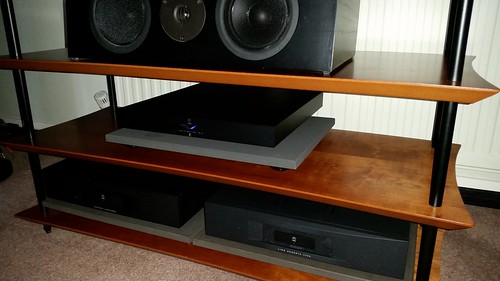
Now with added Twin
Post Post Script: I'm now wedded to the PMCs for the longer term, so Twenty.21 have replaced the Linn Katans (formerly there were Linn Majik 109s prior to this recent wholesale change) as rear speakers and a Twenty.C has replaced the Linn Tukan (again, formerly a Majik 112 for a number of years) as the centre to complete the 5.1 set up. I must say, the Twenty.C is in a different league to the Majik 112 - a very impressive centre speaker


Sunday, 8 May 2016

House of Linn / brianandtrevors Interview At Hifi Pig

These guys have been part of my music enjoying experience over the past 6-7 years and here's an interview with them at Hifi Pig

http://hifipig.com/behind-the-brands-with-brian-trevor-of-house-of-linn-brianandtrevors/

Monday, 16 June 2014

CRANAGE HALL AUDIO SHOW JUNE 2014 - Linn at Brian and Trevor's

Showcasing the latest iteration of Linn's Exakt digital crossover / room optimisation system with the Akubarik Exact loudspeakers,  These accept an Exakt digital signal, digitally splits this into 5 different frequency bands, corrects for phase and timing distortions between and within each speaker drive unit, corrects for the actual measured manufacturing variances in each driver and then feeds each of the 5 bands to a dedicated power amplifier for each driver.  This is all housed in the aluminium extruded housing down the back of the cabinet.  Connections in the back are just a mains lead and an Exakt Cat 5 cable (its not ethernet, its proprietary). The speakers are reasonably compact and use a pair of isobaric loaded bass drivers facing downwards, helping to make the speakers less room boundary dependent.  They're good looking, but I prefer the darker satin colours to the glossy examples on display today.


The electronics feeding the speakers is the Klimax Exakt DSM - its a streamer and pre-amp with mostly digital inputs.  There is one analogue input which uses a very high quality 32 bit analogue to digital converter, so even the LP12 signal is digitised so the Exakt software can do its stuff with analogue too. By measuring the room dimensions the software can also reduce the appropriate low frequencies in the signal to help reduce boom.

Music was being played using the KEDSM as a streamer and from a top spec LP12 turntable.  All the components were being fed by mains from PS Audio Perfect Wave power regenerators.  These are not conditioners, they take the incoming distorted AC mains, turn it to DC, then regenerate a 240V 50Hz mains output without the distortion.

Left Top Down: LP12, KEDSM, Uphorik Phono Stage, but not sure what's on the lowest shelf.  On the right is a PS Audio Perfect Wave P10 sitting on a PS Audio Power Base
So how did all of this sound?  Very Linn.  Understated, controlled, detailed, musical and very tuneful.  It doesn't leap out at you, but you can listen to it for hours.  Occasionally it was a touch too loud and the LP12 was sounding suprisingly lightweight - very unusual.  When playing at a sensible volume you could hear the benefits of Exakt with excellent imaging and no obvious timing issues.  I did think that it would be a bigger improvement than it seems to deliver over the standard active Akubariks.  This is probably due to the limitations of Akurate level DACs and amps that are somewhere between Majik and Akurate level all built into the back of the speakers.  I'm thinking Klimax Exakt crossovers, external amps and passive Akubariks might bring a better (but even more expensive) result.

Decent sounds here, much better than the Linn sound at the Manchester airport show last year, and in the top 5 of rooms I heard at Cranage.

Monday, 9 June 2014

CHESHIRE AUDIO SHOW THIS WEEKEND 15 JUNE 2014

Great to have an audio show in the North of England.  It's this weekend in Cheshire and just off the M6.

With Free Entry there's every reason to go along.

Exhibitor list and applications for tickets here:   http://www.audioshow.co.uk/

Wednesday, 4 December 2013

The Extraordinary Rachelle Ferrell

Just discovered this incredible singer thanks to a recent Exakt demo evening at House of Linn.

See here live performance below on YouTube.  If you only have a few minutes to dip into this, try minutes 56 through to 70 to get an idea of what she's capable of.  Enjoy.

<iframe width="560" height="315" src="//www.youtube.com/embed/Of6l1JTLjok" frameborder="0" allowfullscreen></iframe>

Wednesday, 6 November 2013

First UK Dealer Exakt Demo

See below about the date and location of the first dealer Exakt demo evening:

http://audiophilemusings.blogspot.co.uk/2013/10/house-of-linn-demo-of-exakt-will-there.html

And here's the report on activities.  How exact is Exakt?  I deliberately didn't comment on the sound of Exakt heard at the 40th Anniversary event at the factory as the conditions just weren't suitable to make a sensible evaluation.  Tonight's event wasn't perfect as most of us won't be listening to a system with 18 other people, but it was much more realistic than the factory event, and later in the evening when the room emptied out, even better conditions were experienced.

As usual, Brian and Trevor were excellent hosts - drinks (including an excellent Malbec from Morissons, a bottle was seen in the hands of one Managing Director on his way out at the end of the evening...) and snacks made available and a relaxed atmosphere as the gathering built momentum from about 19:45 onwards.  For those who don't know House of Linn, it is just that - a very large substantially built end terrace house.  So the rooms are much more "domestic" than most dealers, including the kitchen / diner at the back of the house where we gathered - in the case of HoL the party starts in the kitchen, but usually ends with ears glued to the music in the large listening room at the ground floor front of the house.

Gilad Tiefenbrun, Susan and Andy represented Linn this time around and they were running the first dealer version of the Exakt demo for the UK, being an evolution of some demos done during the 40th Anniversary weekend at the factory.

Gilad kicked off the evening with about 18 customers in attendance (many happily making the best of the Malbec) explaining the basics of the Exakt technology (see here: http://audiophilemusings.blogspot.co.uk/2013/09/more-exakt-info.html  and here: http://audiophilemusings.blogspot.co.uk/2013/09/exakt-photos.html  for the salient points) and introducing some nicely produced animated videos to help with the explanation.  If anyone was still confused about what the technology is, the Q&A session didn't reveal any fundamental mis-understandings.

Andy from Linn (standing) and Gilad Tiefenbrun (sitting) and Some Abstract Art (hanging). Note the Dark Wood  Non-Exakt 350a Speakers in Place At This Point
 
Disclaimer:  I'm not the biggest fan of Linn's 350 speakers.  So please bear that in mind here - I prefer the Akubariks and Komris.  Having heard 350s in a number of different system configs and locations, I've never really got on with them.  However, its also worth saying that they sound much better at HoL than the did in the Linn Home dem rooms at the factory...  I mention this as I won't be able to say that what I heard was the best system I've ever heard (which I would expect Linn to be hoping customers to be saying), as there are compromises with these speakers that don't suit me, whereas the compromises in the Akubariks (for example) are easier for me to put to one side given how well they do pretty much everything else - particularly their ability to be difficult to listen to as a hifi component, because there's just so much music to listen to.  Anyway, I digress - so back to the 350 speakers used tonight - I'll not describe what I heard in absolute terms (other than setting a baseline from the non-Exakt system), but just in terms of the way they changed as the demos progressed.  Hope that makes some sense - trying to evaluate the effect of Exakt, rather than the basics of the system.   As usual, these notes are only my opinion and thoughts, based on the experience of the evening - its not definitive!

With the system feeding from PS Audio power re-generation products all evening, Andy then stepped us through the demo process as follows:

Starting System: KDSM, maxed out Klimax LP12, 350a in "tune-dem" determined position
2 x 30-45 seconds of track 1 - 24 bit FLAC
2 x 30-45 seconds of track 2 - vinyl

Audiophile Musings thoughts: the usual sound here - very tuneful, bags of detail in the treble and mid, sparkling smooth top end, something not quite right about imaging and the integration of the upper mid and lower mid drivers (exhibited, for me, as the vocals being clear, but strangely recessed in the mix, but moving forward and back in the mix, depending on the singer and even which part of the tune is being sung) and deep, powerful, but somewhat (struggling for the right phrase here) less than detailed bass.  I know this is not the KDSM electronics as it sounds great with other speakers in the Linn range.  So a very good sound, but not the ultimate sound, for me at least - but remember this is in context of a very expensive system - I suppose I just expect a bit more at this level of spend, but in terms of the complete hifi spectrum, this is still a very good sounding system.


Changed system to: KEDSM, maxed out Klimax LP12, Exakt 350 in the same location as the 350a - room optimization settings off, speaker position optimzation settings off
2 x 30-45 seconds of track 1 - 24 bit FLAC
2 x 30-45 seconds of track 2 - vinyl

Discussion on the differences
Audiophile Musings thoughts:  The tune is just as easy, if not easier to follow.  Timing of the bass lines improves dramatically, snapping into line with the rest of the music.  Instruments much more separated, much more stability in the vocals in terms of front to back in the mix and in terms of left to right image stability.  350s much easier to listen to.  Generally the room agrees it can here a significant difference but not all are fully convinced that everything is unequivocally better.  There is no disagreement about the effects being just as dramatic on vinyl as it is on the digital source.


Changed system back to KDSM, maxed out Klimax LP12, 350a in "tune-dem" determined position
1 x 30-45 seconds of track 1 - 24 bit FLAC
1 x 30-45 seconds of track 2 - vinyl

Discussion on the differences
Audiophile Musings thoughts: Going backwards in the upgrade path for me is usually easier to hear than an upgrade.  And so it proves here.  In the upgrade, what I've described above as much greater separation of instruments, in the step back, is much more discernible muddling (remember, this is all relative and the system is still very good in absolute terms - I think the reference point has been moved by Exakt, up a couple of steps on the ladder).  The vocals are much easier to identify as changing position over the pitch range to the point where its now clear that they are wandering around quite distinctly.  That lack of detail in the bass is back too.


2 x 30-45 seconds of track 3 - 24 bit FLAC
2 x 30-45 seconds of track 4 - vinyl

Changed system back to: KEDSM, maxed out Klimax LP12, Exakt 350 in the same location as the 350a - room optimization settings off, speaker position optimization settings off

1 x 30-45 seconds of track 3 - 24 bit FLAC
1 x 30-45 seconds of track 4 - vinyl

Discussion on the differences
Audiophile Musings thoughts: unsuprisingly all the Exakt changes are back.

Changed system to: KEDSM, maxed out Klimax LP12, Exakt 350 in the same location as the 350a - with room optimization settings on (determined earlier in the day), speaker position optimization settings off

1 x 30-45 seconds of track 3 - 24 bit FLAC
1 x 30-45 seconds of track 4 - vinyl

Discussion on the differences
Audiophile Musings thoughts: Bass much more tuneful.  At first it sounded less extended, but this is often the effect heard when bass is brought under greater control.  This also freed up the mid-range somewhat to let vocals be rock solid in the image now, and to really breath freely and flow in a very natural and fluid way.  Given that this software works based on the physical measurements of the room, I found the effect more profound than expected.  Was it a complete success?  May be not - I thought the music lost a touch of liveliness or impact, so its a different set of compromises.  On balance on the evidence of the evening, I preferred the music with the optimisation on, but I think its something that would have to go through a more thorough comparison in your own home to be absolutely sure.

Changed system to: KEDSM, maxed out Klimax LP12, Exakt 350 moved back into either side of the large bay window - with room optimization settings on, speaker position optimization settings off

1 x 30-45 seconds of track 3 - 24 bit FLAC
1 x 30-45 seconds of track 4 - vinyl

Discussion on the differences
Audiophile Musings thoughts:  Disastrously bad positioning of the speakers in this room.  Image collapsed and the tune was dragging its feet through mud.  A clearer demonstration of the benefits of placing speakers in the correct place in a room as I've ever heard.  And its amazing how you can pick this out in the first 3 or 4 bars of a very simply constructed acoustic track such as Emily Barker.   The idea here is that the speaker placement optimisation software is supposed to allow for a more "domestically acceptable" positioning of speakers, but only when the ideal position is not tenable.  To configure the speaker optimisation software, first the dealer will identify the best place for the speakers in the room using "tune dem" and record the measurements (from back and side walls), then tell the software the domestically acceptable position in the room and the optimisation is then applied to the signal by the Exakt engine in each speaker.  Interestingly, the distance to the side walls became the distance to the edges of the bay window, not to the edge of the room.

Changed system to: KEDSM, maxed out Klimax LP12, Exakt 350 moved back into either side of the large bay window - with room optimization settings on, speaker position optimization settings on (determined earlier in the day)

1 x 30-45 seconds of track 3 - 24 bit FLAC
1 x 30-45 seconds of track 4 - vinyl

Discussion on the differences
Audiophile Musings thoughts: The tune comes back, imaging somewhat improved, but its not a complete success - having the speakers in the correct position in the room is still clearly better.  But its an impressive result.  If 350s are too big for the room and you would need to apply speaker position optimisation, I think it would be worth trying some smaller speakers in the correct room position before making a decision.


Throughout, the TV in the room displayed the configuration in use and the track being played, to help us remember what was going on!  Also worth noting is that the speakers not in use were wheeled out of the room, so Brian and Trevor had a good deal of (heavy) box shifting to do through the evening.  So particular thanks to them for the hard work on this.

Brian Installing the Exakt 350 (again!) in Oak Finish

A Q&A session followed with Gilad which covered a number of topics.
Will there be an Akurate Exakt DSM? Nothing definite yet, but probably.
Will there be a Majik Exakt DSM?  Highly unlikely.
Will there be an Akurate Exakt Tunebox - probably and like the Klimax Exakt Tunebox it will eventually cover most, if not all, of Linn's current and previous speakers.
Including the Keilidh?  Yes, as there are around 27k Keilidhs out there, it would seem to make sense to do so, but it might not be an economically sensible way to spend a system upgrade budget, particularly with the Klimax Exakt Tunebox.
Akubarik the next to have an Exakt module?  Very likely, given that it was developed in parallel with Exakt and it has the ideal amp module format. As an aside, Gilad shared that there is no such thing as an "Aktiv Akubarik".  There is only "Akubarik" and "Akubarik Passive" as Linn now see active as the norm at Akurate and above, not the exception.
Will there be Exakt modules for the rear of Majik speakers and older Akurates such as the 242?  No, Exakt Tunebox will be the approach for these - the speaker cabinets are not designed for a built-in or built-on module.
Gilad confirmed that the Klimax (and Akurate, should there be one) Tunebox will be the same for all Linn speakers, with only the software for the digital crossovers being different for each speaker model - these will be downloadable from "the cloud" as the Internet seems to be referred to these days.
Confirmation that Exakt Tunebox and the relevant settings for Komri and Keltik will be next and soon.
Will there be a Urika Exakt version?  Unlikely.
Which is Linn's top system - is it KEDSM and Exakt 350a, or is it KEDSM, Exakt Tunebox, lots of Solos and 350p?  Gilad's answer was very revealling of Linn's thinking - they're both seen as the Linn reference system.  With KEDSM and Exakt 350 being the reference simple solution and the KEDSM / Tunebox / Solos / 350p being the reference enthusiast system.  They meet different demands and exhibit different compromises so are different references. So Audiophile Musing's take on this is that there is a "tidy reference" and a "geek reference".
Questions about pricing - no change here.  KEDSM with Exakt 350 is £50k.  KEDSM and Exakt upgrade for 350a / 350p / Artikulat priced at £25k (in this case you retain your KDS or KDSM to re-use elsewhere or sell on.
Will the optimisation software improve over time?  Yes, as more and more data is collected from installations, then the algorithms will be amended to improve the capability of the optimisation software - and these will be downloadable to be applied to their systems.

We then went back to KEDSM, maxed out Klimax LP12 (interestingly, not used for the rest of the evening), Exakt 350 in the same location as the 350a - with room optimization settings on (determined earlier in the day), speaker position optimization settings off and some really great tracks (I have to say this, they were from my own playlist!) were enjoyed as folks came and went - music in the demo room, chatter in the kitchen.  As usual, I came away with an introduction to some new music that I'll be buying.  In this instance it was Rachelle Ferrell's Individuality album.  Give it a try on Spotify - particularly the track "Sista".  Incredible voice.  Stayed until after midnight, just to be sure I'd given the system a good listen in a quiet room and with some very familiar music.  Overall the system at the end of the evening (I wasn't on the Malbec by the way, so I hadn't mellowed through the evening!) was significantly better in pure hifi terms and in sheer musicality - but my prejudices about the 350 remain - I just don't get lost in the music the way some systems can take me. 

Came away with a positive impression of Exakt - can't wait to hear KEDSM / Exakt Akubarik!  Best start saving, or buy a lottery ticket.  Probably both.

Thursday, 24 October 2013

House of Linn Demo of Exakt - will there be fireworks?

5th November 2013

House of Linn with special guest Gilad Tiefenbrun, Linn's Managing Director, on 5th November from 8pm, will be launching Linn's new Exakt system.  So it will be the first chance for me to hear this system in more familiar surroundings.

HoL say: Gilad, Brian and Trevor will be on hand to answer any questions. Relax, drink, chat and listen to music. A variety of music will be played via Klimax Exakt DSM from standard digital rips, studio masters and vinyl. Music selections will be played courtesy of HoL customer Neil - the playlist contains a fantastic and varied selection of music. Take your own music on USB, CD and Vinyl.

To register for the event, you can email HoL or call via the contact details at the House of Linn website.

Thursday, 18 July 2013

How Good Can It Be?

I've now had my current system config for about 12 months, and we seem to be getting on well together.  I feel as though the upgraditis of the previous 18 months was worth all the box shuffling and uncertaintity has paid off.  In that time I've also made a few friends along the way through the forums, at House of Linn and with some local audiophiliacs.  Good stuff.  Music has not been so addictive before and I truly relish and look forward to the few hours I can find each week to sit down and get immersed into the music and play "just one more track".

So, lots of self-contratulations there - perhaps I should get into the theatre and the award ceremony merry-go-round.  Perhaps not.

So this means all is good and no further upgrades are required, right?  Yes.  For now.  But I work in a strategy role, and that occasionally kind of spills over into non-work time.  Plus, any significant changes are going to take equally significant chunks of cash.  So a plan needs to be worked on so next steps can be planned out and funds saved over time.  If you don't know where you're going its difficult to know which way to go, how long its going to take to get there: you might end up in the wrong place and get lost along the way.

Way back, when I'd decided that the Marantz CD40 wasn't the best CD player out there (this kind of decision is usually linked to availability of cash), I could've taken a number of steps over time and worked my way up the CD player hierarchy.  But I chose not too - deciding to save over a period of time and go straight to where I thought I wanted to get to - the Meridian 508.  Perhaps that also saved some cash due to less depreciation steps along the way. And maybe that's what I should think about now.  Indeed, the 508.20 worked well for me and actually did end up being my last serious CD player, so the wait was worthwhile and I didn't hear anything in the 10 years it was in my system that convinced me there was a need to move on.  Plus, it sold for a reasonable price and, along with letting the LP12 go to a new home, gave me the opportunity to go into streaming at a reasonable high level of quality.

So does that mean it'll be straight to the top with Klimax DS, Klimax Kontrol, lots of Klimax Solos and a pair of 350s in active config then?  Errr, no, not really.  The end game doesn't need to be the ultimate possible, but a balance of what's best within a budget and a time frame.  If you aim too high, there's a very real possibility that you'll never get there.  And I've heard the 350s, and I don't think they're as good as the Komris they replaced.  Timing can also allow for the secondhand market and when the products currently available might reach a more acceptable price point.

So there's the usual bit of pre-amble and positioning stuff out of the way, now lets get down to the content of this post.  And its more on the Akubariks.

House of Linn ran an Akubarik open couple of days recently, so having booked into an evening session, I took local Roksan owning neighbour Chris along to listen and get a second opinion.  In typical HoL style we were welcomed with cups of tea / coffee, a bit of a chat and introduction to Chris before moving into the front listening room where we found a pair of Oak active Akubariks, Klimax DS/1 and Klimax Kontrol all hooked up and ready to go, powered by PS Audio mains regenerators.  HoL know that the LP12 doesn't interest me these days, so vinyl was off the menu.  We loaded up my list of demo tracks (see here for clues) and got stuck into listening to some music.  The demo tracks are chosen for the following reasons, in order of priority: emotionally involving; excellent songwriting and/or musicianship; excellent recording quality; something that would test at least one aspect of what a system can do, such as bass depth, slam, delicacy of the treble, female vocals, imaging etc. etc.

If you've read the post below, you'll know that I found it difficult to concentrate on the sound being produced last time I heard the Akubariks - as hard as I was trying, I kept getting distracted by the music and forgot about the sound quality.  Well, as we were using music I'm very familiar with this time, perhaps it was a touch easier to focus on the system, yet still I struggled to find a flavour, or character for this system.  For sure, the bass goes deep - deeper than the Majik 140s - but there's something there that just doesn't happen with the 140s, Majik Isos, 242s, 350p, 350a and many other non-Linn speakers such as those from Wilson Benesch, Kudos, Vienna Acoustics and many others on which I've listened to the same tracks.  And that's the tune.  There is so much more tune going on in the bass that I've not heard on any other system before.  I know some systems can differentiate bass notes better than others, and can remove some of apparent monotonic bass lines presented by other systems (such as moving from Linn Keilidhs to Majik 140), but this combination of components really plays a tune in the bass - its quite a remarkable revelation and one I encourage you to seek out.  I found myself wrapped up in following this aspect of the music - to the point where I was smiling involuntarily at the revelation.  Marvellous.

Elsewhere, the 3K array seems to integrate very well with the lower mid-range driver - in other Linn designs with the 3K array it's often discernable where this unit finishes and the lower frequency drivers take over - if there is a problem with that in the Akubarik, I need better ears to detect it.  There's been a change to the phasing of the crossovers for the 3K array itsself and, as noted in the earlier report below, this seems to have driven out a step change in the ability of a Linn speaker to image properly.  L to R, front to back and up & down, this system images extremely well - little to no vagueness, realistic instrument sizing (where the recording allows of course) and rock solid in the soundstage (but see the next posting above about other observations on this particular aspect).  I expect that the tuning of the crossover to match the actual drive units installed in each speaker (to the point that the crossovers in a pair of speakers may be very slightly different between left and right speakers) to eliminate any differences that manufacturing tolerances may have introduced could well be a contributor to this new found imaging performance.  The other characteristics of the array remain intact - such as the very clear highest frequencies with no edginess - good news.

And that's about all I can say about this system (I know this is primarily about the active Akubariks as they are the new bit here, but they can't perform unless they're given a good signal).  Acoustic music, bass heavy electronica, happy dance music, female vocals covering depressing scenarios, all came across with heaps of emotion, extensive detail, rock solid imaging and lots and lots of tune laden attitude.

You might've detected that I'm a fan.  I've heard systems that can do that last nth level of deeper bass, I've heard those that can perhaps slam a touch harder, I've heard systems that cost twice as much and were abysmal and I've heard Linn's current top of the range speaker system.  All of them have compromises that tend to outweigh the benefits of that little thing they do just that little bit better. You can read about many of those experiences elsewhere in the blog, but for me, this is the most tuneful, enjoyable, uncompromised system I've heard to date.

I think I see some clarity of direction emerging.

Thanks to B & T at HoL for hosting and Chris for looking a bit gobsmacked (by the music and the list prices!).

Friday, 3 May 2013

What's All The Fuss About?

I'm fairly sure that Linn don't launch new speakers very often, the last being the Majik Isobarik in late 2011/early 2012.  Their speakers also spend a long time on the market - 6 years is fairly typical. I also note that the current floor stander in the Akurate range, the 242, is both aging somewhat and, from forum chatter, something that polarises opinions. Ive heard them sounding very good on the end of a fully active Akurate system (that'll be 10 channels of amps), but have not heard them driven passively.

Its worth noting at this point that, with the Majik Isobariks, Linn has returned to a speaker design technique that served them very well in their earlier days.  This is the isobaric principle where 2 bass drivers are working in tandem with each other, the space between them being a sealed chamber - the idea being to get close to double the surface area of a single driver, but without the need for a large amount of front baffle space. This approach was applied to the early speakers such as the standmount Sara and the floorstanding Isobarik. It also put in an appearance in the Keltik which was the top of the range in the late eighties/early 90s. Funilly enough, all of those speakers polarised opinion in their days. The more recent Majik Isobarik doesn't seem to have caused such extreme reactions, but it doesn't seem to have driven much enthusiasm amongst those with cash to spend. Personally, I like their bass, but don't like the way they struggle with imaging nor the strange way they push male vocals back in the soundstage. They're also a visual challenge for me, so I chose the 140 speakers as a preferable set of sonic compromises, at half the price.

That's probably enough background and pre-amble, lets get on with some content. Unfortunately the descriptive element of listening to the speaker will be necessarily brief, the reason for which will become clear soon.

So the "big event" for Linn is the launch of a new speaker in their mid-range, the Akubarik (I don't like the name really - its a bit twee, I thought Majik Isobarik was fine, so Akurate Isobarik would be fine too).  At first this will be an active only offering, with all the active filters and power amps built into a suspended aluminium casing mounted on the back of the each speaker cabinet.  The amplifier circuit boards and active filter boards are one and the same - so this is a new set of electronics.  Not sure what the power amps are related to, but its probably fair to guess that they will be Akurate based.  Power supplies are based on the Dynamik from the Klimax Twin power amp. Rumours abound of a passive version later, but nothing official. You can see a video interview with designer Phil Budd here, where he explains the thinking and tech behind the design. Briefly, we see the familiar 3k mid/tweeter/supertweeter array (with new crossover design and different phasing), an upper bass driver in the front baffle and a pair of lower bass drivers in isobaric configuration in the lower part of the cabinet with the outer driver facing downwards into the stand, along with a pair of bass ports. The cabinet has curved sides but a flat top and is available in the standard Linn finishes or any colour you like. The array is available in black or silver. Personal favourites all feature the black array combined with gloss white, piano black or black ash. Having seen them in a largish room, they look reasonably compact, beautifully finished and much less confrontational than the Majik Isobarik, 242 and 350 speakers. I like the way they look, probably a little bit more than is healthy!  I would prefer the option of the legs in black, perhaps they should match the choice of 3k array?

The first listening opportunity arose at the House of Linn's John Coltrane Linn Lounge event in the last week of April. The speakers were being fed by a Linn Klimax DS/1 streamer and a Kimax Kontrol pre-amp, both sucking their mains from a PS Audio P10 regenerator. A full spec Klimax LP12 / Ekos SE / Kandid was also pressed into action during the evening.  The Linn Lounge is a great idea - its either an evening where a full classic album is played on a high end Linn system, or the body of work of an artist is explored in some depth.  This is the first one I've been to, on this occasion local saxophonist Nat Burchill took us through a potted history of the life and works of John Coltrane.  I think it was an excellent approach - I have very little knowlege of Coltrane's work, but now understand and appreciate it much more than before.  Tracks were played from early albums recorded in the 40s through to his last albums in 1967, just before his death.  Nat demonstrated Coltrane's techniques from his early days of playing to the accepted standards of his earlier days, to how he developed his own interpretations of existing and new works by others, into the much more improvisational later stuff that was challenging in its day, and is still challenging for me today.  I also learnt some jazz terms such as modal, which I hadn't happened across previously.  Excellent presentation, very well illustrated with tracks at sensible points in the story and well received by the capacity (about 40 people?) audience.

So on to the music and the sound of the speakers.  Here, my comments are going to be (probably disappointingly) brief.  There are 2 reasons for this.  The first is that all the music we listened to being John Coltrane or Miles Davis or other artists to whom Coltrane was contributing, it was largely unfamiliar to me.  With the exception of Love Supreme Part I, all of the music was new to me.  It was also 99% lacking any vocals - as these carry much of the emotion of many pieces of music, I think I need to hear much more vocals and much more familiar music before giving a more full verdict on the Akubariks.

The second reason is one that I really find difficult to explain.  Once we got beyond the first couple of recordings (which clearly suffered from the quality of technology available when they were recorded) I tried time and time again to focus on not just the music, but how the speakers were representing that music.  I guess its worth noting that the Klimax front end is reputed to be very musical and very neutral (I've heard them a number of times in different systems and there have always been some kind of limitation - usually the environment, but sometimes the music) - some reviews have called the sound of the electronics as too sterile, but that's not something I find as a problem - I think that everyone is looking for something different in the way their stereo plays music, and those that find Linn too sterile are looking for some kind of colouration or warmth that they are more used to.  From a personal perspective I don't hear them as sterile, I hear them (or don't hear them!) as very revealing and very transparent.

So the first reason means I need to hear more later, hopefully reasonably soon, but after the HoL pair have had some more time running-in.  But the second reason I find both frustrating and very very telling about listening to these speakers.  Frustrating because its going to be very difficult to describe the way they sound. Telling because its now going to be very difficult to describe the way they sound!  Let's start with the one thing that really stood out for me, and that's imaging.  For me, Linn speakers have never been very good at this, from the first Isobarik through to the current range - imaging is approximate rather than precise.  Each upgrade step I've made with my system has brought better imaging - now it is very much three dimensional, and it extends beyond the speakers quite significantly, but a singer's voice is just kind of roughly in the centre and instruments tend to be wider than perhaps you'd expect.  Its one of the compromises and I'm happy to make that compromise given the other characteristics of the system around timing, musical flow, naturalness, unforced but dynamic etc.  Even the 242 and 350 speakers don't image as well as they should.  If you want a reference point for imaging, Cyrus electronics with Vienna Acoustics BBG speakers would be a good place to start.  In the Akubarik, Linn may finally have cracked it.  Even though I was just right of centre in the room, imaging is superb - 3 dimensional and precise, quite a revelation.

One other point to note was one occasion there was a track that generated some bass boominess.  Only one track though - every other track showed none of this.  It was one of the tracks played on the turntable - I'm not saying the turntable was at fault, more of an observation.  It would be good to get some seriously bassy tracks playing through the DS (think Yello, Trentemoller, Nitin Sawnhey, Blues Company) to check this out more thoroughly.

And that's all I have to say on the subject of how these speakers sound, at this point.  Because I really didn't hear them very much.  Yes, throughout the 90 minutes or so there must've been at least 45 minutes of music playing, but I just didn't hear the speakers.  I listened to the music.  I got wrapped up in the music.  I understood much of what Nat was explaining.  I still don't really appreciate some of the later non-rhythmic Coltrane music, but I did get engrossed in the nuances of his playing, the phrasing, the complexity of the tunes. This is the first system I've listened to that I didn't really listen to - within about 30 seconds or so of the start of each track I was completely focussed on the music, even though I was trying to evaluate the speakers.  And maybe that's all you need to know.

More investigation with more familiar music is required.  As it stands at the moment, I think my medium term plans for the system may be taking shape.

Apologies for my bad camera phone photo - should've taken the proper camera:


Thanks are due for Brian and Trevor at House of Linn for hosting another excellent and enjoyable evening.  Focussing on the music, of course.