"What a refreshingly honest blog about listening to music through hi-fi. So happy to see views based upon the enjoyment of music rather than so-called sound 'quality'." - Peter Comeau, Director of Acoustic Design at Mission / Wharfedale
Showing posts with label NDS. Show all posts

Monday, 25 January 2021

System Synergy and Expectation Bias

A couple of phrases you might hear or read from time to time when researching or in dicussion about music playing hardware.  What are they about, and why would I be writing about them right now?

Sometimes how to phrase an audio experience is very elusive.  Some readers might say that continues to be the case, even for published posts!  This particular case has been more elusive than usual - its been a year since I made my notes on this project. How to frame those notes have been through about 6 iterations and I'm not sure I'm there yet. But a lot of time and effort went into this, and its time to just put it out there, good or bad, as the products involved might be old hat before I'm content with the wording.  I wanted to not just list the reviews, but to try and put them into some kind of relationship - finally settling on the synergy and expectation bias frame to hang it all from. So here it is, some kind of a review from circa Christmas 2019:

A 6 week or so period of frenzied (at least by my standards) box swapping, mostly for research purposes, but also to inform some purchasing options, mainly not for me, but for a good friend of mine, who's system features here. And it's all given the opportunity for another few blog posts too.  Elsewhere on the blog you'll soon find some impressions of some of the products involved so I won't go into huge amounts of detail here, but will cover a "flavour" of the systems involved. Long form, no photos and no apologies for that.

Coming to Terms

What do these words mean, in an audio system context?  Well, let me have a go at describing how I would use them, so these aren't definitions as such, but more setting the context of this post.

System Synergy - when putting together a whole series of components into a system - CD player, turntable, amp, speakers, cables, the room - do they work together in the way you would like them to?  Or do they lead to some kind of imbalance in a system?  Do you hear a coherent musical message, or is there something that grates like a bloated bass when you wanted tight tunefulness or a laziness to the sound where you wanted pace and energy?  Well, when it all comes together to meet your hopes, that, to you, would be a system that displays good synergy - the components complement each other to give an overall positive result.  If it doesn't work, the synergy's not there, then there needs to be a further search to find what's causing the imbalance, to work out what needs changing or improving.  Note that there is no mention of cost in this description - it has nothing to do with cost, it has to do with balancing characteristics of components to get a good result.

Expectation Bias - we'd probably all like to think we're impartial and can evaluate what we're hearing without regard to what we think we're going to hear or prefer.  Are we going to prefer one brand over another because its been a favourite for years? Are we going to like the sound of the component that has the nicest finish or a preferred species of wood on the front? Will we expect the more expensive bit of cable to sound better than the cheaper one?  Of course we all have these biases - its part of what makes us human.  I think its possible to try and minimise them by being concious of the issue, but probably not to eliminate it.  Blind testing (where you don't know which component is playing) is often advocated, but it just introduces different problems (such as an unnatural focus on the listening process), so I don't consider it to be the answer.  Just accept that a level of bias is inevitable and that it influences your opinion, but try to minimise this as much as possible.  That's one of the reasons why this blog is just opinion - there's nothing scientific about most of it, and that's just the way I prefer to keep it - the disclaimers make this clear.

So How?

If we're susceptible to expectation bias, how do we know if a system really has good synergy or if we're just expecting it to have good synergy?  Well I don't think there's a way to be totally objective (objectivity is restricted by the measures used anyway, as there's no way of knowing if a set of measures is comprehensive or relevant enough, that's why science keeps evolving) so just embrace the subjective and try to deal with it.  Its also worth noting that listening to music is meant to be an emotional experience and therefore, to me, it seems that choosing a system on some level of emotional evaluation is entirely reasonable.

Rooms

Mustn't leave the room out of the equation either.  Lots of impact on the way a system sounds comes from the room and the interaction of the speakers with the room, so I've included that in these musings to try and cover a little of the less obvious.  Where possible (ie with the Linn front end) SPACE optimisation was set up for each system.  What is often referred to as "Tune Dem" or "Tune Method" was used to position speakers and adjust SPACE.

Expectations

I'll go straight into listing the systems that I listened to over those few weeks a year back and that have fed this post, along with my expectation bias - as without that the rest of the post will be a bit meaningless.  The premise of the post being that my expectation bias wasn't met and I'll describe where and in what way.  Perhaps this is part of trying to be aware of my own bias and trying to rationalise how I have, at least partially, probably, tried to put it to one side and listen to what's actually going on. Still a big "if" though.

Systems

I won't go fully into every detail of the systems here, such as precise cables etc., but the main components that differentiate the systems.  I suppose its fair to say that my expectations are in comparison to my everyday system.  They're based on a mix of hearing 2 of these systems frequently and hearing the other components in other systems. It is fair to say that every single one of the components in these systems is highly respected, so there are no "duds" at all, and that's where the synergy element becomes so intriguing.

System 1: 

Melco N1ZH server, Linn Akurate DSM / Exaktbox Katalyst streamer, 3x Lejonklou Tundra Stereo 2.5 power amps, PMC Twenty.26 converted for active use, medium size pretty much rectangular room. This Exakt system uses filters for the PMCs available from SpeakerFilters.com, not the standard versions.
Expectation Bias 1: this is my everyday listen - its taken a long time to get to this system - it has a great deal of  detail but also a very musical flow to it.  Its not the last word in dynamics and slam but I can listen to it for hours (and do so, most evenings), following the tunes, enjoying the emotional impact of the music.  Its not perfect, no system ever is, but its what works very well for me.  What's my expectation?  Well, its more a reference point for comparison than an expectation really, but I would say that I expect it to be very difficult to beat in this evaluation with other systems having some benefits but not the overall balance of this system.

System 2: 

Melco N1ZH server, Linn Akurate DSM / Exaktbox streamer, 2x Lejonklou Tundra Stereo 2.5 power amps, Kudos Titan 505 on their dedicated stands and configured for active use, medium size pretty much rectangular room
Expectation Bias (comparative to System 1): more detail, a more dynamic presentation, a touch of brightness. Perhaps a little looseness in the bass.

System 3:  

Melco N1ZH server, Linn Akurate DSM / Exaktbox streamer, 2x Naim 250DR power amps, Kudos Titan 505 on their dedicated stands and configured for active use, medium size pretty much rectangular room
Expectation Bias (comparative to System 1): more detail, a more dynamic presentation, a touch of brightness, possibly assertiveness approaching aggression, more impact in the lower frequencies.

System 4:  

Melco N1ZH server, Linn Akurate DSM / Exaktbox streamer, 3x Naim 250DR power amps, PMC Twenty.26 converted for active use, medium size pretty much rectangular room
Expectation Bias (comparative to System 1): a more dynamic presentation, a touch of brightness, probably assertiveness approaching aggression, a loss of musical flow.

System 5:  

Naim NS01 server, Naim NDS streamer with 555DR PSU, Naim 252 pre with PSU, SNAXO crossover, 2x Naim 250DR power amps, Kudos Super 20 configured for active use, a medium sized room but L shaped, using the larger part of the L, which is smaller than the other listening room.
Expectation Bias (comparative to System 1): a system I'm already very familar with - a more dynamic presentation, too bright for my taste, assertiveness approaching aggression, a loss of musical flow somewhat compensated for by the enthusiasm.

System 6: 

Naim NS01 server, Naim NDS streamer with 555DR PSU, Naim 252 pre with PSU, SNAXO crossover, 2x Naim 250DR power amps, Kudos Titan 505 on their dedicated stands configured for active use, a medium sized room but L shaped, using the larger part of the L, which is smaller than the other listening room.
Expectation Bias (comparative to System 1): a more dynamic presentation, slight brightness, assertiveness approaching aggression, perhaps retaining the music flow, extra weight (because of the smaller room mainly), more information delivered.

So there we are, cards on the table. Something else worth mentioning - those who say "all competently designed solid state amps that measure within a gnats whisker of measurement-of-the-week all sound the same".  I have an expectation bias about that too - its just not true - I've heard far too many amplifier changes in systems to know that this is not true.  Unless I've only ever heard incompetently designed amps with bad measurements, which is also not true.

LISTENING WITH BIAS, OR NOT. MAYBE.

So here we go, here are the descriptions of systems 2 to 5 and a conclusion, that's not what I thought it was going to be:

System 2: the biggest suprise for me really.  The Titans give a far more detailed presentation than the PMCs, its suprising how much more they reveal in the recording. The extra brightness is certainly there, as per expectation, but is this just brightness or is it more detail too?  I'm going with the latter as there's more expression too in the vocals.  In fact the greatest strength of the Titans in this and the other systems is their vocal expression - its quite outstanding by any standards of the many systems I've heard.  Another element that was as expected is that, compared to the Titans driven by the Naim amps, there is a softness in the bass with the Tundras.  And here I think we see the first of the synergy issues - perhaps the Tundras and the 505s don't sit all that comfortably together as there was another element here that I wasn't expecting as the Tundras have never sounded like this in any other system I've heard - a sense of relentlessness.  Not shouty aggression, just a bit too much going on and losing some of that lovely flow that the Tundras present in partnership with speakers such as the PMCs and Graham Audio LS5/9. That, juxtapositioned with the lack of pace in the bass lines, meant that this wasn't the best of the combinations compared here.  There was a fair bit of experimentation with toe-in with the Titans in this room as there's definitely not the width or precision of soundstage compared to the PMCs. Don't get me wrong, we're talking about a decent sounding system, but in absolute terms, it lacked the right synergy.

Expectation bias 0: Systems 1

System 3: its long been a thing, a Linn front end with Naim amplification into a pair of speakers of choice.  Traditionally, of course, that was an LP12 and a passive Naim pre-power combination. Here we bring the tradition up to date with Linn streamer/pre and Naim power. Yep, more impact in the lower frequencies, no doubt about that - nearly reaching as low frequencies as the PMCs too - impressive. Mind you, the 505 standmounts on their dedicated and structurally massive stands are actually much more intrusive in the room than the much more constrained PMCs (which I always use the the grilles on). Definitely more detail from that (very) expensive tweeter - is it too bright? Its touch and go and track dependent, sometimes just tipping over the edge. But here's the thing - music, because listening to the music on this combination was very engaging - but its different to the regular system 1. There's an immediacy without shoutiness and that detail mentioned earlier but there's not the same musical flow that a Tundra delivers (in partnership with speakers they work happily with!). Whilst the Titans have very impressive bass power and immediacy, they still didn't quite fill the room like the PMCs do. Vocals are excellent again and there's plenty of engagement into the meaning of the music. This is good, but is very much along the lines of the expected.

Expectation bias 1: Systems 1 

System 4: before I go any further, just consider this: moving from Tundra to Naim power amps is a 50% price hike in amplification prices. And they do have a very different mix of abilities. I can also say that the Naim NAP250DR is a heavy beast.  Not too easy to lift onto a shelf and keep the shelf edges in pristine condition.  Those massive toroidal transformers are very heavy indeed. And noisy, good grief they're noisy. Not through the speakers, no issues there at all. But my goodness do they hum. I know my incoming mains typically carries about 2.5% distortion (the PS Audio regenerator displays this information) - I'm not sure if that's high, typical or low, but its certainly enough to get the NAPs a buzzin'. Just to be clear - neither of the power amps in this sequence of tests were plugged into the PS Audio, only the low current source electronics are fed from the regenerator. So there is no doubt that the 250 boxes have a tighter grip on the PMCs. There is more slam, there is more immediacy. There is a little more enthusiasm in the upper frequencies but it never becomes wearing in this system. All of this as expected.  What I didn't anticipate at all was the way everything hung together as a piece of music in very much the same manner of the Tundras into these speakers. Even that very taughtly controlled bass didn't disrupt the ability to follow the tune. Very good indeed. Except for gaps between tracks when the boxes from Salisbury irritated me significantly. Expection or surprise - calling this one a score draw.

Expectation bias 2: Systems 2

System 5: nearly all change.  Change of front end, speakers and room. As I'm very familiar with this system as it as grown and developed over the last 5 years with the Super 20s, then my "expectation bias" notes above are really all you need to know - they're more about experience than expectation. So let's call this one a no score draw!

Expectation bias 2: Systems 2

System 6: Would we expect (or have a bias!) that the 70% more expensive 505 with their stands would have a family feel when contrasted with the Super 20 floorstanders? Would there be a family resemblance from the North East parentage? Yes. And No. The Titans have that same family immediacy but the way they feel more "grown up" was far greater than my expectations.  Especially in the treble - where the Super 20 appears to major on detail, I find it gets too much after a while. What seems to be the case with the 505 is that the detail is real and it knows that it doesn't have to try too hard. I was a little worried about the size of the bass that comes with the upgrade to Titan (yes, the standmount has far more bass output than the floorstanders, in part due to their isobaric loading) in this smaller room, but it worked very well indeed - and there's an important reminder that system synergy includes the room.  Here, of course, there is no SPACE optimisation to make the best of the room so its all down to component choice and speaker positioning. What was just a touch underwhelming from these speakers in the bigger room is just right here. I don't get the same sense of ease of musical delivery compared to the Linn front end with Naim amps and these speakers, but I can see how their immediacy could appeal. No stridency, no experience of fatigue.

Expectation bias 2: Systems 3

OUTCOME

So you can now decide if any of this tells you anything about expectation bias or system synergy (which needs to include the room).  I certainly was surprised that the weight of the 505 could work in the smaller room, that the Tundras and Titans just didn't get on together at all and that I'd enjoy the Naim power amps in my regular system anywhere near as much as I did.

I wish the Naims amps didn't have 2 faults: that hum I can't just dismiss nor excuse, and their price. So I shall continue to be extremely happy with the Tundras as they work very well indeed with the PMCs.  As for my friend with the largely Naim system - he bought the 505s and has them working even better now the speaker cables are Super Lumina.

Friday, 15 June 2018

Naim ND555 - New Top of the Range Streamer - First Listen

Had the pleasure of the comparison between NDS and ND555 at Acoustica this evening.

System was Core / NAC552 / 300DR into B&W 803D3 with SuperLumina throughout.  NDS / 555DR vs ND555 / 555DR swapping the interconnect between the sources (hence keeping the same input on the pre).  All electronics on Fraim.  Chord C-Stream for ethernet.  Nice to see the continuation of the green logo.  The ND555 and its 555DR PS are on the top shelves in the picture above.  Thankfully, we didn't have to suffer more of the upper range of Focal speakers today.

The ND555 is an evolution of the NDS.  It uses the same B-B DAC but with a different power supply design.  In fact, as you might expect from Naim, there are a number of power supply changes inside the ND555.  Each "stage" (digital, analogue, clock) has its own dedicated and DR fed power supply inside the box (in addition to DR in the physically separate 555PS of course).  The digital section is similar to the new platform in the Uniti range and therefore supports the latest stuff such as Roon.  It is housed in its own dedicated metal box which "floats" inside the ND555's main case - it is mechanically and electrically isolated from the DAC and analogue stages which themselves sit on suspended thick brass plates.  The screen is also shielded internally.  There was also an explanation about how there are two clocks - an input clock that can vary its timing to match the incoming data feed and a second clock to time the DAC.  Not sure about this and how that's a benefit when there's a buffer involved, but there you go.  "Normal" Naim Burndy cables are provided with the ND555 for connection to the power supply (or supplies as there is an option to use 2x 555PS units with the ND555).
Although I'm not a big fan of the B&Ws, this was probably the best I've heard from them.  They have a slightly un-natural treble and a squidgy bass that doesn't appeal to me.  A little boom caused by the room too, but it wasn't excessive nor overwhelming. NDS first of course, then we swapped between the 2 sources a few times before settling in to a longer listen to the ND555.  Jason from Naim was looking after the demo.
First thing to say is that the NDS doesn't "sound broken".  It does a great job, just as it has done for a long while now.  We started with an acoustic guitar track then onto a trio of female folk singers listening to the NDS.  The trio was then played again for 40 seconds or so before switching over to the ND555 and listening to the same track again.  We selected some Shelby Lynne and repeated the process.
Its not a "gob smacking" change for me - its more subtle than that, but that shouldn't de-value the size of the upgrade, its just that you have to think about it rather than have it fed to you on a plate.  The instruments most definitely separate more clearly, the edges of notes are better defined without being edgy, you can hear more of the way in which a note is plucked on a string or how a bass line starts and stops more clearly.  Yet these more clearly defined instruments don't stand alone as the timing seems more coherent, enabling them to make better sense of the "whole" of the tune.  But the biggest impact for me was the added emotional element, particularly in Shelby Lynne's voice.  That was what stood out for me, once we'd settled into the changes.
Worth a longer audition at home, whilst the VFM, as ever, continues to be a personal choice of course.
Thanks to Acoustica and Jason for a very effective and relaxed dem.

Sunday, 15 April 2018

Acoustica Chester Show, April 2018

Its come around again - Chester dealer Acoustica's nice little show at the DoubleTree hotel on the outskirts of the city.

A sample of previous reports here:
http://audiophilemusings.blogspot.co.uk/2017/03/chester-hifi-show-2017-naim-kudos-t-707.html
http://audiophilemusings.blogspot.co.uk/2017/03/chester-hifi-show-2017-naim-uniti.html
http://audiophilemusings.blogspot.co.uk/2017/03/chester-hifi-show-2017-naim-snaxo-and.html
http://audiophilemusings.blogspot.co.uk/2015/03/chester-acoustica-show-march-2015-kudos.html
http://audiophilemusings.blogspot.co.uk/2015/03/chester-acoustica-show-march-2015-naim.html
http://audiophilemusings.blogspot.co.uk/2014/04/chester-show-2014-chord.html
http://audiophilemusings.blogspot.co.uk/2014/04/chester-show-2014-rega.html
http://audiophilemusings.blogspot.co.uk/2013/03/chester-hifi-show-march-2013-review.html

Acoustica is well known as one of the leading Naim dealers in the UK.  It should come as no surprise then that many of the rooms at the show feature Naim sources and amplification - often only the speakers are the differentiating factor.  There's a decent smattering of other manufacturers too.  The hotel features a number of decent rooms in the original building, with other systems in hotel bedrooms - some of which are a reasonable size, some very small indeed.  Let's get stuck in.

You can click on the images to see a larger version.

Naim ND/555/252/500 and some more power supplies plus the Focal Utopias (I think they are the Maestro Evos) on Fraim and connected by SuperLumina

Positioned in the large function room, this year the system was set up firing across the room, aiming towards the section that has the low ceiling.  The main part of the room has a very high, vaulted ceiling which really is a major challenge for any system.  I can't recall this room being used in recent years, but 5 years ago, with active Ovator 800s firing down the length of the room, it wasn't a great result.

Behind the main listening area here 3 podiums with kit on the top of each - the new "classic" range of streamers.  Unfortunately they weren't in use, but it was nice to see them with the lids off.  They have a mix of surface mount, microchip and tradition pin-through components - as the range progresses from ND5 XS 2 to NDX 2 to ND555, the more traditional components you see.  The ND555 has 2 "floating" brass boards, supporting the main circuit boards - with the digital stuff in its own physically separated and boxed area.  The NDX 2 had a loose yellow wire taped up at each end, so these are clearly late prototypes. A quick word with the Naim team reveals that a production ready small batch has been built and these are going through final comparative testing and tweaking.  June possibly?  Taking them out of the batch testing process for a show delays the testing process too much, so they weren't there on demo.

ND555

ND555
NDX 2

ND5 XS 2


So how was the system?  Well NDS/252 and 500 with the usual array of power supplies were feeding Focal Maestros in a rather natty metallic mid-blue, all hooked up with SuperLumina cables.  We listened to 5 tracks in the room, all of them fairly simple acoustic or jazz music.  The 3rd row of seats were suffering from some room boom so moving forward a row helped.  This system delivers quite a lot of detail but its all very disjointed and "bitty", with no real imaging - both speakers were very clearly the source of the sound.  We didn't hear any complex music, which is usually a challenge with these speakers.  Anyway, in this combination, in this room, there's no real evidence of the benefit of £100k of hifi.


NAIM and Dynaudio 40th Anniversary Specials


A nice big pile of Naim electronics.  I think the streamer was an NDS/555 with 252/PS and the amp was a 300DR with its PS.  All Fraimed of course.  This system was in the largest of the dem rooms upstairs in the original building - normally we've heard top end electronics with various Focal Utopias in this room, but this year, we didn't need to walk out in relief like those previous years.

Here the little standmounts were doing a decent job in such a large room.  I think they did the electronics justice from a detail resolution perspective - pretty musical too.  They do a decent job on the bass too.  But there was something odd about the imaging - sometimes it was there, sometimes it was lost.  Curious.  Having heard them sounding pretty good at Bristol, they're probably worth further investigation if that's they type of speaker and price you're considering.


NAIM Electronics with B&W 803D3

Normally, I'd expect to be writing "detailed if a little clinical top end and mids, with warm slightly over-blown bass".  Not this time.  Apologies, I never found out what the electronics were in this system, but we weren't in the room long enough to find out.  This system was hard, harsh, piercing and just intolerable.  We had to leave the room.  Surely there was something wrong here???

NAIM 272/555, 300DR, Kudos Titan 505


Well, another Acoustica show and another no-show for the SNAXO active crossover.  Very frustrating for Kudos I would expect.  But no matter, because there was good news in this room anyway.  The "baby" of the Titan range, which debuted at Bristol in February 2018, was making its first showing at the Chester show.  All the electronics were brand new on Friday night and those who know Naim know that there will be more to come from this system once the electronics have some hours on them.
Its really that not easy to describe what the Titan family does so well, but its still present here in the little standmounts.  They kick well above their size with a good, solid, tight sound, making the best of what seems to be the best room at the show.  As I've only heard the other Titans with higher end Naim and Linn electronics, its difficult to tell what's down to the speakers and what's down to the electronics, but these Titans were a little less detailed than previous listens.  But the musicality, the sheer joy of listening is still there.  Good result.

LEEMA SIRIUS II, TUCANA AND ATC SCM 50 PASSIVE


Pretty much the same system as Leema played at Bristol this year, and pretty much the same result - nice enough, rather polite, no glaring problems.  This version of the speaker has a cabinet that doesn't require a stand - apparently the lowest part of the cabinet is not included in part of the cabinet that contains the drivers, so its essentially the same as the cabinet that benefits from the short stands.

NAIM ELECTRONICS AND RUSSELL K


Russell K were demonstrating some prototype floorstanding speakers, due for lauch in September or so this year.  I hope there's a lot more development work to come.  Despite finding previous Russell K speakers lively and reasonably enjoyable, these have a long way to go to be even remotely interesting.  Top end percussion sounded like someone randomly dropping teaspoons onto a splash cymbal and there was no real bass to note - even when moving around the room to make sure it wasn't the effect of a null.  At this point, they're not worth anywhere near their projected £6k.

PROJECT CLASSIC TURNTABLE, PROJECT BOX ELECTRONICS, PROJECT BOX 10 SPEAKERS


I rather enjoyed this diminutive little system.  I think it was the only turntable in use, at least, it was the only one I heard in action this weekend.  This system was nicely engaging with no real issues of note and the extremely slim little £900 speakers were doing a decent job.  Good to see a manufacturer demonstrating something suitable for the room size available...

HEGEL ALL-IN-ONE AND DYNAUDIO CONTOURS


Having heard this little all-in-one at Bristol with tiny Amphion speakers, it was interesting to see how it fared today with a more substantial standmount speaker.  And it was reasonably engaging, reasonably detailed and had a good grip on the music.   It didn't have the same "wow" factor that these electronics delivered through the tiny Amphions, its still a decent sounding system.  Both boxes look very modern and well finished.

AURALIC ALL-IN-ONE AND SPENDOR A3 SPEAKERS


Another nicely made little box of tricks here - the Auralic combining storage, streaming, pre-amp and power-amp in a very small space.  Here they were feeding the new A3 speakers from Spendor.  I've been critical of recent encounters with the more expensive D series speakers from this manufacturer - too safe, too smooth, a little dull.  But the A3s are differently voiced and are quite a bit of fun to listen to, having more life and dynamics.  Nicely done in this system.  Curiously though, no seats provided in this room, so crouching was required to get a decent idea of what was going on.  Odd.

MARK LEVINSON ELECTRONICS AND REVEL SPEAKERS


Here we had £30k of electronics into £3k standmounts, in a small room.  So the standmounts were probably a good idea as there was little to no boom in here.  Lots of detail, very good imaging, but no real musical or emotional involvement in the music.  Odd choice of components.  Note the new Arcam electronics on the rack at the top - unfortunately they weren't being demonstrated when we were in the room, but apparently were in action later. Shame to miss them and they might have been a better mix with the little Revels.

INNUOS SERVER, LEEMA ELECTRONICS, KUDOS TITAN 606 SPEAKERS


Audiophile Musings awarded the "Sound of The Show" to these speakers at the Bristol Show 2018.  Here, the Leema electronics weren't quite up to the standard of the Linn Exakt electronics at Bristol, the combination here sounding a little thinner and brighter.  Not a bad system though.

 ATC CDP/PRE-AMP/STREAMER AND ACTIVE SCM100A SPEAKERS


 Large, that's what they are, and the styling's not so subtle either.  I think this system was playing too quietly.  It was OK, but I suppose I was expecting a more, given the imposing visuals.  Again, a system with large bass drivers that don't move very much is a little disappointing - it seems, from experience, that smaller drivers that move more a more "friendly" sounding, and better suited to a domestic environment.

NAIM ELECTRONICS AND ATC SCM50 PASSIVE


This combination made for a much more lively, engaging kind of musical presentation compared to the active floorstanding versions of these speakers.  Worth further investigation


AURALIC VEGA WITH ATC SCM40A ACTIVE SPEAKERS


Diminutive little Auralic streamer and DAC/pre-amp feeding into ATC's smallest floorstander, the active SCM40A (thankfully, without their hideous chicken wire grilles).  Well this was a great sounding system - lively without being harsh, detailed without being shouty, warm but articulate in the bass.  Tunes were easily followed and musically engaging.  There was a bit of boom added by the room, but it was possible to ignore this, and it was a pretty small room for this size of speaker.

Whilst the Kudos T-505 room was probably the better sounding system, once price is factored in, this system delivered the sound of the show for me.

NAIM UNITI NOVA ALL-IN-ONE AND FOCAL KANTA


The new Uniti stuff seems to be consistently good, when used with the right speaker - and room.  Heard with Kudos Titan or Focal Aria the examples I've heard have been very enjoyable.  However, the room at Bristol meant that the Nova / Kanta combination was impossible to evaluate - just a boomy mess.  At Chester though, the combination was working much better.  Kantas are at Focal's kind of lower mid-range, being more expensive than Aria whilst less expensive than Sopra.  It shares the same mid-bass driver materials of the Aria.  Yet again, the lower priced Focals comprehensively out-played their vastly more expensive breatheren at the same show.  The Kanta / Nova combination being rather enjoyable, although we didn't hear any tracks that might've exposed any aggressiveness from that tweeter.


As usual, the Acoustica Chester show delivered in 2018, in terms of organisation and a relaxed atmosphere in a decent quality venue.  Dominated by Naim, as expected, there were some other gems to enjoy too.  Thanks Acoustica.

Thursday, 30 March 2017

Linn Exakt and Kudos Super 20: World First Review

There's a bit of a back story, so please bear with me.

First, I'm going to assume a working knowledge of Linn Exakt and what it can do to process the musical signal coming from a DAC, through a set of power amps and on to each driver in a loudspeaker.  If you're not so sure, you can follow these links for some more information:

Also, there's lots on the blog about my current system of Linn Akurate Exakt and PMC Twenty.26 which forms the basis of comparison here, so have a dig around if you need to catch up on the reference point for this review.  But before the PMCs, I tried some different options, one of which was the Kudos Super 20.  At the time, this was with a Linn Klimax system using a more traditional, passively driven, approach.  That review is here, but to summarise on my view of the Super 20s in that system in my room:
"So its a mixed bag.  I really understand why they're a good seller and why their owners enjoy them so much - I get the appeal of the etched instruments, I get the speed, I get the way they do female vocals. If I was in the market for speakers at this price point, I would say that they could be on a short list. But I need to relax into my music.  I like chilled out music to wash into the room and give a warm feeling as I sit back after work and wind down. When a system doesn't let me do this, its not right for me.  Others will have a different view.
As such, these aren't the right speakers for me or my room.  They're different to the M140s, but they're not the right mix of abilities to justify a change to the Super 20s.  I'm looking for a bigger difference, but perhaps, more of what I have, rather than a different direction."
 
So not a ringing endorsement in my system and room, but certainly something to consider in the right size room - they work well in their owner's own listening room which is somewhat smaller in volume than my own room.

Kudos Get Activated
Since then, Kudos have committed to delivering all their "upper" range speakers (at the moment, that's Super 10, Super 20, T-707 and T-808) with the ability to run with active amplification - ie, the passive crossover in the loudspeaker is by-passed, an active crossover is placed in front of the power amplifiers and each power amp channel controls just one driver each. This has been successful for T-808 with both Linn Exakt and Devialet implementations which you can read about at those links. Most recently, I had my first taste of Kudos's newly launched T-707 being partnered with Naim electronics including a SNAXO active crossover. This is a deeply impressive combination, heard at the Chester Hifi Show 2017.

A little while ago, the Super 20 (re-named 20a) has been treated to the Kudos connection panel which allows passive or active use of the speaker. Conversion from passive to active is extremely simple - just pull out 4 jumper hoops and connect your amps to the appropriate driver connections. So simple, in fact, that Kudos don't explain how this is done on their instruction sheet. Perhaps there is an expectation that the dealer is involved in most installations.

New Kudos Super 20a ready for listening
 Review Caveats
There are a couple of caveats to this review to bear in mind. First, and crucially, we had a pretty much brand new demo pair to work with. So new, the Cherry veneer was still very pale indeed - I know this darkens over time to something much deeper and richer. We estimated the speakers had about 50 hours of use on them - this is important to bear in mind as you read the review, as speakers often take a while to settle down or 'break-in' from new and their character can change a surprising amount over this time. Second, we only had a 3 hour window to work within, so there's a chance there may be more to come given more set up time - on this one, we saved a good chunk of time by going straight to the speaker position we'd found had worked best for the speakers in passive form. I think that's a very reasonable approach to take and should result in something pretty close to optimal.

Local friend R has earlier passive Super 20s in a Naim NDS/555, 282/Supercap DR and 250DR system with SuperLumina cables throughout. This lot feed a pair of the earlier Super 20s which don't permit active operation. This means there are 2 of us with experience or extensive experience of the Super 20s in this system. R's Super 20s are the ones reviewed in my previously passive Linn Klimax system. This gave the opportunity to directly compare the brand new speakers against a set with thousands of hours of use. Hence the first caveat - straight out of the box the newer pair were over bright and the bass was 'stiff' and inarticulate in comparison. To the extent that both of us found listening rather tiring. So they were left playing away to themselves, facing each other with one out of phase to reduce the amount of sound they produced. This is how we know they have at least 50 hours of music under their belts.

Set Up
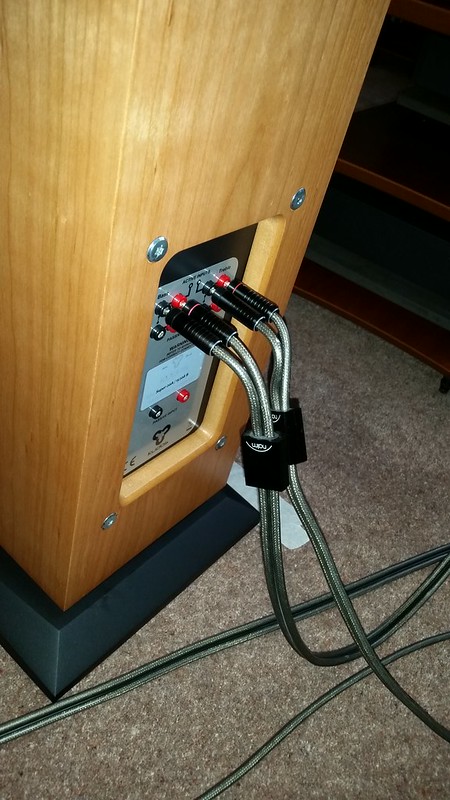
Distinguishing the Super 20a from the Super 20 is the connection panel. At the base are the normal single-wire passive inputs. The second row down are normally vertically linked to the top row by u-shaped links during passive operation.  Here the top row of connections are being fed active treble and bass signals from Naim SuperLumina cables.

So some perspective from the above in the context of a familiar system and a current (very happy) owner.
2 days later and they're set up in the Musings listening room, positioned where the passive pair had sounded best. A quick look at the brief instructions soon told us that we had to work out the active connectivity ourselves, but it is simple. Pull out the 4 connecting loops and hook up the correct speaker cable to their respective 'active treble' or 'active bass' connection.  Linn Konfig was spun up on the laptop and the Exakt filters for the Super 20s were selected from the menu and installed into the Exaktbox whilst the power amps were still switched off. After confirming the Exaktbox connections against the Konfig diagram, it only took 15 minutes or so for everything to be ready to go. As is the way with active systems - care with connecting is critical.  Connect a bass channel to the tweeter and you can expect a short puff of smoke, silence and a bad smell.  So the bass driver is always connected first - if you accidentally send treble information to this driver its no big deal.  So make sure the bass drivers are connected then listen to music at low volume and make sure the bass driver is producing bass.  If its all good, then connect up the treble and listen to it very quietly to make sure its only handling treble.  If all is good, on with the music...

System

Here's the system driving the Super 20a with an Exakt feed, in source to speaker order:

  • 16 bit and 24 bit uncompressed FLAC files
  • QNAP 251 NAS with WD Red drives
  • Minimserver UPnP database
  • Cat 7 ethernet cable
  • Netgear GS-108T network switch with Friwo medical PSU
  • Chord Anthem streaming cable
  • Linn Akurate Exakt DSM streamer / Pre-amp (with power from PS Audio P5 regenerator)
  • Chord C-Stream streaming cable
  • Linn Akurate Exaktbox 10 DAC/processor (with power from PS Audio P5 regenerator)
  • Linn "silver" analogue interconnects
  • 2x Linn Akurate 4200/1 power amps (with power directly from the mains)
  • 2x 3m pairs of Naim SuperLumina speaker cables
  • All electronics supported by Cyrus Isoplats on Quadraspire EVO racks

 Tracks used:
  • Falling Out of Love - Mary Gauthier
  • Six Blade Knife (24 bit from DSD) - Dire Straits
  • Gula - Deadmau5
  • Keith Don't Go - Nils Lofgren
  • Fender Bender - Chris Jones
  • Breathe You In (ft. Laura Hahn) - Ficci
  • Wicked Game - London Grammar
  • Walking With Elephants - Ten Walls

First Impressions


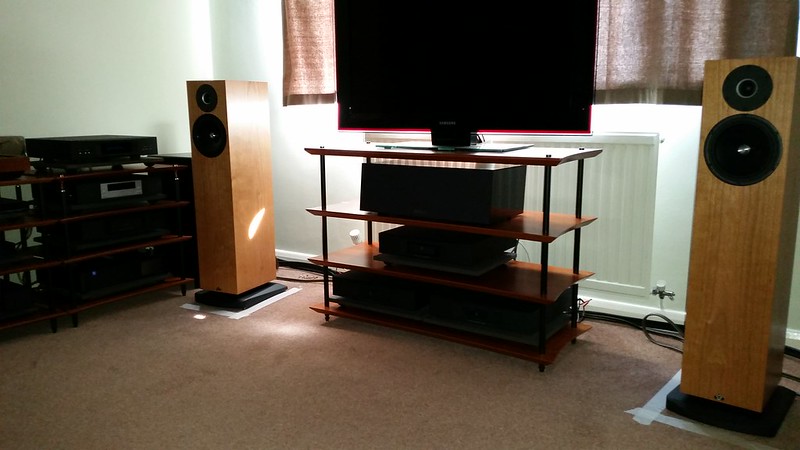
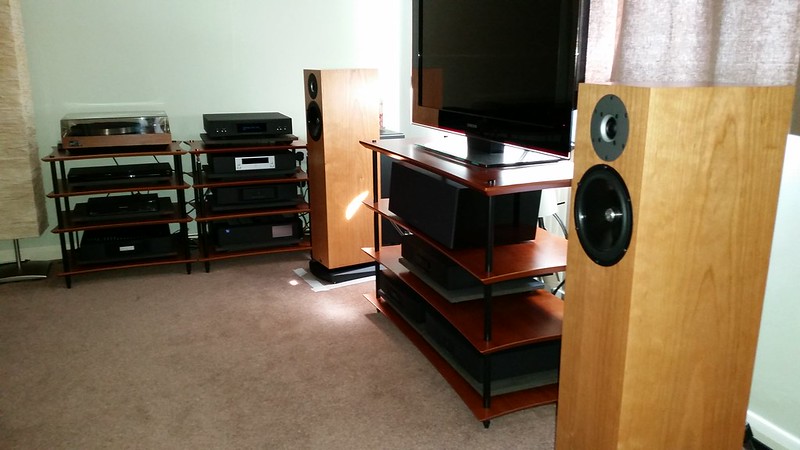
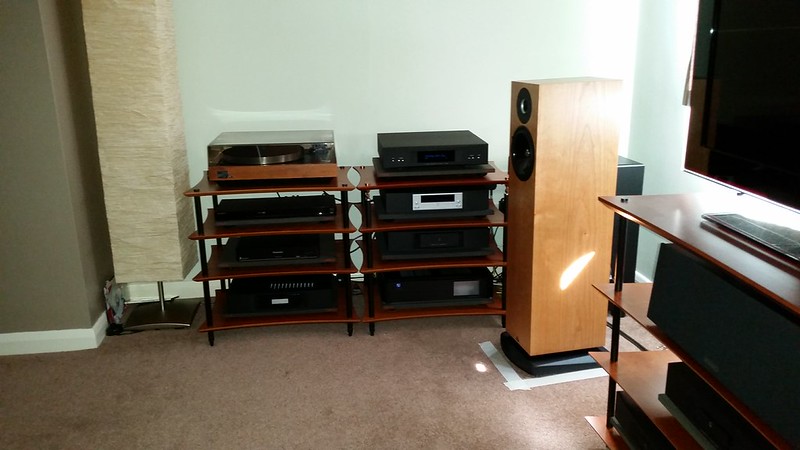
Here you can see how fresh the Cherry veneer is on this pair - contrast with the Quadraspire cherry shelves.  Akurate Exakt DSM is on the far right hand rack, the Exaktbox 10 is on the middle shelf under the TV with the 2x 4-channel 4200/1 power amps on the lowest shelf
 
That brightness noted in R's home system was still in evidence here, making the system difficult to listen to, but bear with me as this isn't the end game here.  One thing we also noticed immediately was the articulation, drive and rhythm in the bass line - although there were some room modes being driven here, leading to a touch of boom - that initial stiffness noted at first listen in R's system isn't evident in the Exakt system - either due to the different system, some benefits of the 50 hours of playing time, or perhaps a combination of both. Vocals immediately stood out as crisp and clear with tone and intonation clear in the expression of the words.  So, some work to do.  I think it would've been good to leave them playing for a couple more days, but time was against us.

SPACE

Turning once again to Linn Konfig, the first thing to address was the room modes which were giving a touch of boom in the room - it wasn't at all excessive, but it was there.  Whilst the room measurements themselves were untouched, the position of the speakers in the room was amended to suit the positions of the Kudos boxes and the optimise button was pressed.  The newer SPACE implementation - where each left / right speaker receives different settings - was evident in the profile graph - much more so than with the PMC 26s.  This brought an immediate improvement to the punchiness, tunefulness and articulation of bass line.  But it was a touch light so we took a couple of dB out of the notch and narrowed it significantly and that worked a treat.  As usual with SPACE this opened out the mid-range and treble too - a mixed blessing.
Sometimes, its possible to tackle some vocal harshness by adding notches in space in the 65 to 74Hz range and whilst these gave some subtle benefit, it just wasn't significant.  So we moved up the range and added a -1.8 then -2.0dB treble shelf which Linn allows you to add from 8kHz upwards - and this was a little helpful, but not the answer.  So that was moved up to 17kHz and then we added a custom filter - a -2dB dip centred around 8.5kHz but with a very high width value which effectively gave us a 3.5kHz to 17kHz wide shelf. And that really hit the spot.  Notching this down to -3dB across the same frequency range got us to the right place.  Everything clicked at that point and we started to settle down into listening to the music rather than to the system and its tendancy to spotlight every single thing in the upper frequencies.  This is the first caveat - it would be great to get the speakers back again soon when they've had a lot more hours of use - to see if this treble attenuation can be dropped over time as the speakers break-in.

Listening to Music

So now we had a very satisfactory sounding system, we cracked on with listening to some tracks.  Bear in mind here that R has been listening to these speakers for around 3 years now and has been through a good few system upgrades during that time, so he's very familiar with their capabilities.  It turns out, whilst they might be familiar, they haven't really reached their full potential in the Naim passive system. What we heard in about 90 minutes of listening with Exakt was a revelation.  These speakers, whilst not carrying the same weight and authority as the PMCs (which have a somewhat larger visual and physical presence in the room), they're no longer out of their depth in my room.  They go astoundingly deep from such a small box, with plenty of drive and give a bass line that, had we not already heard the PMCs, would be thought of as very good indeed - add in their relatively small dimensions and that makes them quite remarkable in this area.  Tunes that needed to boogie along did so, attack is good as is the timing of the tune.
What about detail? Well, its astounding - these speakers really can resolve tiny tiny details that is beyond the capabilities of the PMCs and significantly beyond how they sound at home in the passive system. Both acoustic guitar tracks (Lofgren and Chris Jones) deliver string sounds that are crisp, clear and easy to pick out - delivering initial attack in spades and long long decays into the background. Spitty anger in Mary Gauthier's voice make you feel a bit uncomfortable and pleased that you're not the subject of her aggression. Vocals are superb - a good bit more texture, inflexion and intent than with the PMCs.  Imaging is spot on too - rock solid, easy to place, 3 dimensional and a little unsettling on those tracks (such as Ficci) that use processing to give a wrap-around effect in the room.
Is there a downside? Well, its difficult to find anything to fault but I would prefer a little more subtlety in treble leading edges - R found it just to his taste, for me its still a bit sharp.

But here's the thing - throughout, we could both follow tunes and feet were tapping - and I mean throughout. On top of that, R kept giving little involuntary smiles and shaking his head in disbelief.  These speakers are very much more capable than either of us really knew and Exakt with active amplification has brought that out from under the covers of passive operation.

I'll leave it with some of R's words - stunning, outstanding, and several more that I won't repeat in a public forum.

Post Script

We hope to get the speakers back again in a couple of weeks time to follow up on if they've settled in and need less treble attenuation - if this happens I'll report back here.  Also, after the Super 20s left the building, the SuperLumina speaker cable stayed in the house for a little longer.  Interestingly, using this cable on the treble of the PMCs reduced the gap in detail resolution by about 50%, bringing the PMCs closer to the Kudos boxes in this area.  Would I swap the PMCs for a pair of Super 20s? No, but that's no reflection on the capabilities of the Super 20a, more that there is a different set of priorities from which to choose.  Having lived with the superb bass performance of the PMCs, their relative lower level of detail resolution and lesser capabilities in vocal resolution are a reasonable compromise to live with.  And I'd be looking for a substantial improvement if moving on - not a different compromise.  Roll-on the Kudos T-606 in the summer! 


Thanks to Kudos and Acoustica for the loan of the speakers.

Saturday, 28 May 2016

Naim Factory Tour 2016 via Bentley Flying Spur. Featuring UK Public Debut of the Focal Sopra No 3

Ever been anywhere and felt a bit out of place?  Well, my day began like that, at HR Owen in Pangbourne - purveyors of Aston, Lamborghini and Bentley motor cars.  I don't mind going into these showrooms - we can all dream - and I don't mind speaking with the sales staff and letting them know that I'm just enjoying a look around, if that's OK.  But this time was a bit different...

I was lucky enough to hear that Naim dealer Hifi Cinema had teamed up with HR Owen, Bentley and Naim Audio to arrange a little day out - start in Pangbourne, ride down to Salisbury, tour the Naim factory and then a ride back up to Berkshire.  Sounded great.  Both Hifi Cinema and HR Owen invited guests from their respective customer lists.

Why Naim and Bentley?  Well about 5 years ago they announced a partnership which lead to Naim audio systems being offered as an optional upgrade in Bentley motor cars.  I'm not sure how many buyers have opted for this choice, but a few of the cars today were so equipped.

Convoy Components
The day of the trip arrived - Berkshire was bathed in sunshine and temperatures looked promising.  I walked the 3 mins or so from my B&B (leaving the Insignia behind) down to HR Owen and enjoyed the views across the forecourt - particularly the Astons and noted the cluster of gleaming Bentleys lined up ready for the convoy.  Three Continental GTs and a couple of Flying Spurs.

A tea / coffee and the largest pastries known to man were on offer as the group gradually formed - friend A already there and chatting to some of the others.  Our Bentley host Andy then asked for driver's licence information.  It seems this wasn't just a ride in a Bentley - we were going to get the chance to drive too.  Fantastic!  Some folks had brought their own Bentley, some were going to meet the group at the Naim factory, some didn't turn up which meant one thing - we were allocated our own car for the day.  Maybe with a passenger, maybe not.  Paperwork was done and Andy showed me around "my" car - a metallic grey Flying Spur V8S Auto, with Naim for Bentley audio of course. £185k, 4.0 litres, two turbos, 2.5 tonnes and 500 bhp.  What could possibly go wrong?

Andy took me over to introduce the car and explain the basics such as the auto box, brake on when starting or shifting, paddle shift, how to use the sat nav, sport modes etc.  I started to get nervous - I've never had the priviledge of riding in this kind of car, never mind driving one - and its a long time since I've driven an automatic.


"My" Flying Spur for the day - beautifully built. I wouldn't choose this colour - for me its a bit understated on the outside...

...but rather distinctive on the inside!


Naim for Bentley

Mulliner = options list

Speaker Cabs in the Boot

We drove in convoy down to Salisbury, I had a passenger for this stage and we chatted about cars, Hifi, the business, and the conversation meandered amiably across many topics and decades.  The car is superb.  Its a large car, particularly on some of the narrow A roads in Berkshire, but it doesn't feel its size.
I expected floatiness and a vague drive, but there was none of that.  Once used to the size, its amazingly weildy - there is some feel through the steering, but no kick-back.  The ride is not soft, but its not too firm either - its fluid - following the road, controlling the shifting masses absorbing the worst of the crumbling roads.  You can waft or thrust - in Drive, there's a touch of hesitation as the systems work out what you want and then progress is as swift as you want it to be - a brush on the throttle is all that's needed to make good progress, and more than 1/3 throttle and the scenery starts to fly past with a blur.  Choosing Sport on the gearbox sharpens responses noticeably - now reaction is almost instant, gears are wrung out right to the 6200 rpm redline and when you back off the revs stay up rather than a higher gear being selected.  Even in Sport, shifts are seamless across the 8 speeds.

At 70 mph there is hardly any noise at all and everything is both effortless and completely stable.  I'm told it stays like this at 100mph too, but can't comment on that myself :)
What about the Naim sound system?  Well its not easy to tell. The car's HDD was loaded up with jazz lite hifi show music, recorded in MP3 format.  So I'll just say it sounded pretty good, given those constraints, other than that, it wasn't a good opportunity to test out the sounds.

The journey down to Salisbury was a pleasure and passed very quickly, except the last 4 miles or so in the city, which took us an unreasonable 30 mins.  Still, the Sun was glorious, the environment was sumptuous and the company good, so no problem really.  We arrived at the Naim factory late morning and enjoyed the sunshine as we waiting for everyone to turn up and form the full group.  The factory has evolved over the 40 years of Naim - from a small single building, but now occupying 3 separate buildings that are interlinked into one facility.  Below you can see the most recent addition to the site. Its quite a contrast to the Linn facility which was purpose built from the ground up - here you can see the history and evolution of the company, almost from its roots.  We were welcomed into the factory by Jason and Dan and teas and coffees were served in the dem room with a Mu-so playing the background tunes.

The convoy gathers at the Naim factory, Salisbury

Damson Continental GT in Salisbury

Dem room - ethernet lifters?  Really?

500 in the Dem Room - We listened to NDS and a single 555DR
We were welcomed by Jason, the UK Sales Director who explained the planned itinerary. Dan, our host for the factory tour, sorted us out with smocks and anti-static straps. Visitors are welcome to take photos, which is rather enlightened I feel. We headed straight for the Statement build area, which is a small dedicated area of the factory.  Very much a success story - Naim have now sold 52 sets of Statement pre- and power-amps - that's quite some achievement at £155k a time.  Below is a built up (but without side panels) of a pre- and power-amp.  The quality of the engineering inside this amp is astounding, in addition to being massive, by hifi standards.  This part of the factory has been adapted to Statement production by the addition of overhead rails and cranes - its just not possible to lug this thing around all day.

Statement pre-amp on the left and power-amp on the right
Castings and machining of the highest order and beautifully finished.

Statement chassis showing complexity of the structure

Statement power amp output chassis

Statement packaging

Statement power amp transformer (note size of 1 pound coin)

Statement volume control

Statement power amp output board

Statement board

Statement caps

Statement input board

Statement PSU Caps

Statement machined frame

Statement in build

Attention to detail everywhere

Statement bracket
Between build areas we passed through a storage section where there was a selection of wrapped and a bit sad looking Ovators.  These are reference examples, not the end of stock - apparently there are a few pairs left, but not many.  The green ones looking interesting.

Ovators.  Reference Units - only a handful of cabs are left now
Naim likes to take matching of transistors somewhat further than the transistor manufacturers.  So they match them to 1% rather than the typcial 5%, and if you have an active system, they'll build a stack of amps matched to 1% too.  Below is the rather prosaic looking tool used to complete the matching process.

Rather Prosaic Transistor Matching Machine
A somewhat venerable single automated PCB populating machine occupies one corner.  Its not the fastest machine and works on full size lead type components.  Not much in the way of surface mount in Naim. Where they are used seems to be more in control circuits than audio circuits.

Populating Boards (mainly traditional components, not many surface mounts)
Relaxed?  Naim interconnects certainly are.  There's a belief here that relaxed cables sound better, so they're given a 120 cycles shake before being packed off to customers.  Would be good to hear a with and without comparison, but its not offered today.


SNAIC Shaker

Super Lumina Speaker Cable Waiting To Be Built Up

SNAIC Shaker


SuperLumina speaker cable is also given some relaxation.  First on this barrel, then it's run through a series of pullies which flex the cable one way then the other.  I suppose this is yet more attention to detail, but it does seem a little on the eccentric side.

Super Lumina speaker cable having a nice relaxing time
The populated circuit boards meet the outsourced casework and start to look more like components. One person builds up each product, the main skill being the shaping and soldering of the internal wiring.  Carefully and precisely bent, the cabling is a work of art.  Each product has a "reference template" to work from.  Everything down to the position of each cable-tie, which cable is next to which other cable, when to bend (most are at a rather precise 90deg), lengths etc. is carefully defined and followed.

Part way through build (case tops added only after successful testing is completed)

Supernaits in production

Reference build units (particularly for cabling layouts)
Every single component goes through a measurement test and a soak test.  The tops of the cases are only fitted after testing so that any fettling takes less time.

Soak testing

Some kind of test gear
After the tour we ended up in a reception room for lunch.  MD Trevor Wilson talked us through the history of Naim, their principles and how they want to bring people closer to the music.  Trevor used to work at Bentley and was part of bringing the 2 companies together and helping them understand each other's challenges and approaches.  To meet Bentley's requirements, Naim had to work out how to design a DSP system which allows the "image" inside a car move from seat to seat, according to the owner's requirement.  This lead to Naim building the Mu-So which uses a similar DSP engine.  Its built in China in dedicated Naim facilities in 2 factories, with rigorous quality control from Naim UK employees. We learn that the Mu-So has been a massive success - moving the company from 1,500 new customer per annum to 10,000 new per annum in the last 18 months.
Trevor mentioned several times about the Naim attention to detail, the consistent attention to quality and the priviledge of bringing quality sound into the home.  Not forgetting the company's pride in its ability to service every electronics product they're produced in the past 40+ years.  There were a few questions about company funding (Focal and Naim merged and are now partly owned by equity financing) and we heard about how the updated DR range of amplifiers has been a huge success - causing an extended waiting lists for some products and upgrades.

One-off Frame AV in the customer briefing room
After an excellent lunch we were back in the dem-room for the listening session.  We had an NDS streamer with its 555DR power supply (just the one), Super Lumina interconnects, Statement Pre- and mono power-amps, Super Lumina speaker cables and the UK public debut of the Focal Sopra No3 - a new larger, £16k floorstander topping the Sopra range.  So we're looking at around £200k system here.  Anyone want to choose between a Flying Spur and a hifi system?  I guess many customers at this level won't need to choose - lucky them.
Jason had a few tracks lined up  - for example Roadhouses and Automobiles by Chris Jones, Jenny Again by Tunng and some female vocals and jazz. I've heard the Statement on a couple of previous occasions - at the Bristol show and at the Chester Show - on both occasions it was partnered with Focal Grand Utopias which gave a very hifi sound full of detail, but no real emotional connection for me.  And harshness to the point of having to leave the room at Chester.  But the 2016 Chester show gave me a chance for and extended listen to the Focal Sopra No 2 - the first production speaker designed with the use of Naim electronics - and this transformed my opinion of Focal's more expensive speakers (I rather like the lower cost Arias that I've heard to date), although the Sopra is the middle range in Focal terms.  The Sopra No 2s have banished that harshness - there's still lots of details but there's music too - very much flowing and enjoyable.
So what of the Sopra No3?  Well, its bigger than the No2 and the sound very much reflects that.  If you like the No2 but wanted more weight, this is the place to look.  So that means lots of detail and nusances, speed, space and the ability to really let the Statement shine through.  Really, Naim should stick to demoing with these speakers until the time comes for Focal to release a new Utopia range that's been developed with Naim electronics.  Any downsides?  Well, despite all the treatment in the room, it was still contributing from time to time, leading to a thickening in the mid-bass, and the imaging, whilst very stable and 3 dimensional, was rather exaggerated - vocals being central, but typically around 3 feet wide, which is a bit odd. But that's being picky - this is an excellent system and the Sopras are a major step forward for Focal's musical abilities.

Dem Room - NDS / 555DR / Statement Pre and Power Amps, UK Public Debut of the Sopra No3

Afterwards we were free to take the Bentleys back up to Pangbourne - this time I was solo which didn't matter too much as the car itsself was enough entertainment for the journey.  I followed my nose for a while and found some entertaining roads, but just for fun - this wasn't the place nor the time to find out the car's capabilities - I really wanted to take it back unscathed. Had a play with the flappy paddle changers but they're a bit superfluous really - sport mode does everything that's needed. The Sat Nav is infuriatingly slow to respond to any inputs, but that's the only thing I didn't like about this car.  Fantastic.
A Flying Spur (for a moment)


So, a great day out and a great combination of cars and hifi.  Toys at their best.  A big thank you to:

Bill and Alan at Hifi Cinema
Andy Smyth and the team at Bentley Berkshire
Trevor, Jason and Dan and the team a the Naim Audio factory.