"What a refreshingly honest blog about listening to music through hi-fi. So happy to see views based upon the enjoyment of music rather than so-called sound 'quality'." - Peter Comeau, Director of Acoustic Design at Mission / Wharfedale

Sunday, 13 March 2016

Canadian Systems - A Visit To Vancouver

It's a long way to go to listen to some hifi, but that's not really why I was there.  Or maybe it was.  I was there due to hifi, but not because of hifi.  P lives in Vancouver and he's been over to the UK a couple of times for Linn product announcements and that's where we met.  He's a very amiable type of chap (do they have "chaps" in Canada?) and gets on with folks very quickly.  An opportunity arose to call in on P in Vancouver, when I happened to be in North America on business - the trip was extended and a few days holidays booked.  We did the tourist thing and fitted in some music listening too.

In P's apartment, there lives the very latest in Linn systems - featuring Linn's current best speaker (IMHO), the Akubarik.  Here they are fed from an Akurate Exakt DSM streamer and they have the integrated Exakt DAC / amp module bolted to the back.  So one box of electronics and a pair of pretty elegant speakers and you're done.  Unless you're P.  When you're P, you need an Oppo multi-format disc player, a substantial Classe surround processor, another couple of power amps and centre 225 and rear 212 speakers.  But P is "famous" on the Linn forum for another aspect of his system too, and that's a bordering-on-the-obsessive attention to mains power supplies.  So the total system is powered from an Environmental Potentials 2460 waveform corrector, the sources and processor add to this a Shunyata Triton conditioner and all parts are connected by several Shunyata pythonesque (actually, Zitron Cobra) mains cables.  They're big. And chunky, and its a good job there's a fair chunk of furniture to hide them behind.   The Netgear 108T switch has been treated to a Friwo SMPS power supply and the NAS and its associated UPS are fed from an Environment Potentials portable digiplug wave form corrector too. Anyway, much more on that system later.

Exakt Akubarik system
Whist out and about in Vancouver, taking in the sights, we happened across a newly opened record shop.  Whilst neither of us use a turntable as a primary source (P doesn't even have a turntable), we both thought it is a healthy development for Vancouver.  They have four turntables so that punters can check out the latest in vinyl.

New Vancouver record shop

HIFI SHOP VISITS

We visited P's usual dealer (The Hifi Center) who did actually have some Linn kit in stock - a nice top spec LP12 turntable and Akurate electronics which were connected to some B&W speakers.  We were offered the chance to listen to whichever system we liked, from a choice of 6 listening rooms - this is one big shop.  An additional room was in use with a customer, a further dem room dedicated to built-in home cinema.

The shop is very well presented - the front desk is first up, with a huge array of (mainly Audioquest) cables and other accessories.  Moving into the main part of the shop, there are central glass cases (rather like a museum) with smaller items of kit such as headphones, small DACs, cartridges etc. Along one wall of this main area is a row of floorstanding speakers and wall mounted turntables on display, all readily available to roll into one of the dem rooms that radiate off this main area.  As you can see in the following pictures, each of the dem rooms has been given a heavy dose of room treatment.

Colourful decks on display
Dem Room with LP12, Linn Akurate, some Classe and B&W's latest Diamond Range speakers
P had been at the shop a few days earlier for a B&W Diamond Series 3 launch evening, but wasn't impressed with the sound - but he had been near the back of the room which had about 25 people sitting in it.  So we chose to go to the B&W 802D3 room to give them another chance.  I must admit I've not been a fan of the look of these new speakers, but they do look better in the flesh than in the pictures. They're beautifully finished and although better in the flesh, still not to my taste.  Our host moved a set of speakers out of the way, then left us to get on with listening to some music - selected from the touch panel on the room wall.

B&W 802D3 - better in reality than it looks in the pictures
We listened using this Bryston Streamer and admired the new Marantz turntable's looks

Serious Bryston monoblocks driving the B&Ws

Bryston Amp, B&Ws and polystyrene room treatment
So what did we make of this system?  Well, it was, to put it politely, a mess - but keep reading. Treble was sweet and vocals were in there somewhere, but the whole thing was absolutely swamped by massive, bloated, unruly and muddy bass.  Yuk.  I asked P if we had much lee-way to mess about, and it seemed that it would be OK.  First up, we dragged the sofa (that was hard up against the rear wall), about 4ft into the room towards the speakers.  A major step forward, but still too much loose bass.  We then made the best of the B&W's wheeled bases and moved them from about 1ft from the front wall to about 3ft from the wall and brought them a couple of feet closer together.
This was real progress so we sat down to listen to some choons.  The system still wasn't gelling perfectly with the room, but now it was listenable and you could hear a tune in the bass.  This was about 10 minutes worth of adjustment, so I suspect there was more to come.  Using tracks such as "In For the Kill" by La Roux and some London Grammar meant that the bass never really had a great deal of chance without more work, but at least we could hear the crystal clear top end and female vocals were absolutely stunning.  Imaging of the mid-range was top drawer too - as it should be in such a heavily treated room.

Discovering new (to me) music on the control panel
So not exactly conclusive, but a reasonable introduction to these new speakers.  Oh for more time, or a Linn front end with SPACE adjustability.

Also in the B&W / Bryston Room
A closer shot of the new Marantz deck
Pro-ject Carbon
More Bryston - note each shelf of the rack is suspended on coil springs

One of the rooms was adorned with trad US brand McIntosh:


Some pretty chunky Rotel kit in the "more affordable" dem room


The shop also has a purpose built home cinema room, equipped with an acoustically transparent screen and a 5.5 system that has a subwoofer per channel - they're in-wall (custom install) versions of the B&W 800 series speakers CT8LR, CT8 CC, each with the CT8 SW subs.  All of this is built into the room, and apart from the screen and projector, the speakers are all hidden behind black cloth normally - but they're all flood lit for those times when you flick on the lights and impress your mates!  The audio kit is all in a rack in the main shop space.


We got a completely different reception at the other smaller hifi shop we called in on.  We went to listen to some Magico speakers, but they'd been sold.  We weren't offered an alternative listen, so after a quick browse around the shelves (there weren't many of them), we left after about 5 minutes - I didn't feel very welcome here.  Good luck to them :(


FORUM VISITS

We managed to squeeze in visits to a couple of Linn forum members systems too.  It was a busy weekend!
The first visit was to L who doesn't normally live in Vancouver, but visits frequently and stays with a relative in the city.  Back home, it sounds like L has some impressive systems spread across his home. Here in Vancouver, things are a little more modest given the "visitor" status of L - its impressive that he's allowed a system in the Vancouver house at all really.  He must be a very welcome house guest.
That visitor status is important, as it completely dominates the choice of system we listen to.  A Linn Klimax DS/2 is tucked under a couch, lying on its top, there's a Manley tube pre-amp and a very rare power amp, a First Watt SIT-2. Design pursuit is of Class A single-ended, zero feedback amp with a single gain stage (the simplest circuit ever in a solid state amp).  This system feeds into a pair of Omega single full range driver speakers - the mid-bass section of this driver is made of hemp and there's a "whizzer" cone in the centre to produce the higher frequencies.  The whizzer section is unusual in its size - its not far short of the main cone in size, and in the way it curves to almost run parallel with that main cone.  In a nod to the visitor status, these are quite small floorstanding boxes, very shallow and placed close to the wall, despite their rear port. They're MaxHemp Alnico with 8" drivers:

omega alnico 6.5 inch driver showing front and rear
From www.omegaloudspeakers.com
The speakers were sited in what seemed a less than ideal position, and I'm sure L would find a better position if the circumstances would allow.  But here's the great thing about this system.  At low volumes (ie in the way it has to be used), it's dynamic, the music flows well, there's absolutely no shoutiness nor harshness and there's surprising quantities of both frequency extremes.  Turn the volume up and things are less coherent. L didn't demonstrate this, but if you go up to what most audiophile listeners would say is starting to get to a listenable volume, apparently things don't go so well with the cones struggling with higher power inputs.  But that's really not at all important here. What L has achieved is a fantastic sounding system that works exceptionally well at low volumes, it's very discrete, plays music and keeps the home owner happy.  Marvellous.

Apparently, according to L, the system has a flaw - its incapable of distinguishing the difference between speaker cables of under 100ft in length.  Sometimes it's difficult to spot when L is being controversial or when he's just winding you up!

We are joined, during this session, by another forum member F.  We listen to some music from various sources - CD rips, high res and vinyl drops, before moving out to the curry house.  Over a very good and flavoursome spicy meal, we discuss audio technology, music, the forum, some specific threads and member inputs and the time goes very quickly.  We say our farewells to L and head over to F's place for some more tunes.

Now here we find a complete contrast to L's system.  We have what is pretty much a large dedicated listening room, vinyl as a source (LP12 - Kore, Cirkus, Ekos2, Trampolin, Lyra Kleos cartridge, t-kable, Lingo, Linto), plenty of amps, big fat cables and a pair of Linn Keltik speakers.  A long way from the wall, large, black, and dominating the space.  But they're no ordinary Keltik - they're what's known on the forum as Killer Keltiks, rather modestly.  Being a facsimile of a pair developed in Scotland by another frequent forum contributor, they feature the standard Linn isobaric bass drivers, but much more modern mids and tweeters.  Being driven actively allows for the power amp attached to each driver to be tweaked in output to allow for the new drivers having different sensitivities to the originals.  Pre-amp is Classe CP-800 Power amps are Bryston 9b sst for the bass, Lejonklou Tundra Stereo v1.2 on the mids with the treble being driven by a Tundra Stereo v2.  We also listened to some digital via  Ifi ilink and Ipower (USB digital correction) from a Windows PC based source running foobar2000.

It wasn't too long ago that I heard a fairly standard pair of Keltiks (albeit with the later model 038/2 tweeter that was never fitted to production Keltiks) at the Linn factory event, but they were driven there by Klimax electronics and ended up using the Linn Exakt system.  So a very different front end and amp to F's more traditional incarnation of an active system.  Recent changes have been to positioning - winding the spikes out to provide full clearance from the floor covering, and bringing the speakers further out from the wall. We listen to a few discs and this is a very different experience to P's and L's systems - maybe sitting somewhere between the two.  Not the immediacy and speed of the Exakt Akubariks, but neither the gentle politeness of L's system running the Omegas.  The Keltiks are much more "solid" to listen to and carry real weight to the bass - probably more than the Akubariks, but its a softer, more rounded sound.  The mid drivers deliver some great, smooth vocals and the tweeters avoid some of the slight grittiness of the original drivers. It would've been good to stay a bit longer here, but it was late and F has a family to prioritise.

It was great to meet L and F - both very different characters, rather like their systems.  It only dawned on me later that their systems did reflect something of their personalities, or maybe the beer at the curry house had me imagining this!  A very enjoyable evening and really good to put faces and characters to the names on the forum.  When you meet these guys, its much easier to understand their forum posts and you can map the words to the character and therefore much better understand the intent they are trying to purvey.

MEANWHILE, BACK IN EXAKT LAND...

So the rest of this post won't be in any particular chronological order of what happened when - mainly because I can't really remember, but also because it doesn't really matter.  The subject will be P's Akubarik Exakt system pictured below.  In the main, we listened to music a number of times of the weekend, but also dabbled with some surround sound music too.  Sessions ranged from about an hour, up to the longest which was about 4.5 hours.  4.5 hours of uninterrupted music listening - what a luxury!

P's Neat Looking System - after tidying of disks from floor :)

Each time, before listening, the system was played for about 20 to 30 minutes and the room was "treated".  This involves covering the TV with towels, moving the acoustic panel (seen leaning against the window in the picture above) to the left of the left speaker, and, when its going to be a long session, a blanket on the coffee table.   The room extends well beyond the left speaker and the acoustic panel helps to simulate a more "regular" room shape.  More on this later when considering room optimisation stuff.

Paul has put much effort into his system, and used the David Brailsford approach, which I very much approve of.  David Brailsford (and his team of coaches, nutritionists etc.) have been responsible for the very rapid rise of world class cycling in the UK - both the national team and Team Sky, taking several Olympic Golds and a few wins at the Tour de France.  Much of this success is attributed to optimising every single small aspect of the team's approach to the sport.  Training, diet, team coherence, every nuance of the bikes, stage by stage analysis and tactics, measuring, monitoring testing etc.  And its been very effective.  Small optimisations all add up in a compound way, effectively making the whole approach more than the some of its parts.  So what's this got to do with P's system?  Have a look at the "full frontal" picture below, consider the use of towels on the TV screen, the portable acoustic panel and you'll start to get the picture.  How much of this is effective I can't say because we didn't tweak this stuff whilst I was there, but P has messed about with it extensively.

Some examples can be seen in the picture.  The most obvious is the mains cleaning equipment. Being a condo probably makes this is potentially more important than in other types of accommodation. Bottom left under the cabinet is the medical grade Environmental Potentials wave correction box that feeds the whole system.  The AEDSM, Oppo and Classe processor feed from this via the lower centre mains conditioner which is from Shunyata.  The power amps and the Akubarik modules are fed directly from the EP box, not using the Shunyata. Not seen in the picture are the upgraded mains cords from Shunyata.
Under many of the components there are P's isolation devices - they're IKEA bamboo chopping boards, no less.  Inspired by the proliferation of bamboo in hifi at the moment (for example Quadraspire racks, the Booplinth for the LP12), P gave these a try and is happy with the changes they make to the sound.  But there's more - how they are supported in the cabinet has also being experimented with - a number of materials tried, but the current "hook side only" of some chunky Velcro strips are the preferred solution for the electronics - for the centre speaker it's 4 discs of Sorbothane.  It the picture above, its possible to see the isolation platforms underneath each of the speakers - these are essential for P to be able to turn up the wick a bit.  The condo structure has a habit of transmitting bass into the other apartments - in particular the apartment 2 floors directly below.  So the platforms are Subdudes - essentially 2 cloth covered boards with a sponge type absorber between them.  P reports that not only do they help the neighbours, but they improve the system sound too.  Result!  Apparently the position and toe-in of the speakers has been amended a number of times too - partially as a result of the speakers "running in" and partially in response to some of the software updates Linn have applied to the Exakt filters that determine how the speakers behave in terms of crossover points and slopes, phase correction of the drive units etc,

Full Frontal Exposure

So how does it all sound?  Well, in a nutshell, its stunning.  The seating position isn't very far from the speakers and fairly close to the rear wall which has some curtains and some absorbent treatment, so its not something I'm aware of when listening (unlike the B&W room at the hifi shop!).  The Akubariks tend to be pretty good at keeping control of the bass in a more conventional active system, their downward firing driver being good at dispersing the bass rather than firing it at walls and therefore emphasising standing waves.
I'm very familiar with the Akubariks in their original analogue active configuration - having heard them in numerous systems and locations - and I'm very fond of the way they sound.  However, in Exakt terms, they've been OK, but not the huge step on from analogue active that I was expecting. Until now. P's system simply demonstrates that Exakt and SPACE room optimisation really have to be set up with some care and attention to deliver their potential.  I'm not sure Linn have got their heads around how to get this message out to dealers as yet, or to train them fully in the benefits of spending some time on this stuff.  P's boxes are loaded up with the latest in firmware from Linn on the DSM and the Exakt filters and whatever Phil Budd has done with those bass roll-off filters just before Christmas 2015 is staggeringly effective.  Bass is amazingly deep for such compact floorstanders (I'm pleased P doesn't use a subwoofer - it would be overkill and probably unpleasant in this compact space) but it is also very very well controlled - punchy, tight, tuneful, full of subtleties and nuances.  I select a good few tracks over the weekend in an attempt to find a way to trip-up the bass, but its just great, all the time.  The tightness, slam and tune of (what appears to be) a bass guitar in Funkerman's "Speed Up (ATFC Remix)" is both driving and compelling to listen to.
Add on to this the expected sophistication of the 3K array and that's the frequency extremes and female vocals sorted. As usual with the array, there's oodles of detail, but it has this great balance of immediacy and speed, mixed with a subtle sense of delicacy.  No nasty edges, no shoutiness.  The complex cymbals in "Dark Day" by Blues Company are clear, distinct and shimmery.  And there, right there.  That's right the imaging is the best I've heard from any pair of speakers.  With the right recording the vocals stand proud of the mix and hang in the air above the coffee table.  Its almost surreal. And, just to note, P is essentially teetotal, so there was little to no additional relaxant involved in these listening sessions!
We listened a lot to music as the system delivers just that.  I know there are those that are concerned about all the processing going on, and they've probably heard some less than well set up systems that will reinforce those concerns.  But here it is all about the music and the emotional messaging.  Great stuff.  Is this the best system I've heard?  No, but then it does have a lot to compete with, particularly the Exakt and Solo powered Linn Komris, or the Exakt and Solo driven Kudos T-808.  But it wipes the floor with so many much more expensive (and less expensive!) systems I've heard at shows in the past.

P asked a number of times over the weekend about what I thought needed tweaking.  I couldn't think of anything - but then that's often the way when you hear a great system for the first time.  Its only over the weeks that sometimes flaws gradually work their way into the listeners conciousness.  We did mess with a couple of areas though.  First it was the ethernet cable to the streamer.  P uses some cables built locally but they're essentially unbranded but selected components - connectors and cable and I think they're Cat 6.  I'd taken along my Chord Anthem cable and we tried that in and out of the system a couple of times.  It drops the noise floor (one of those noise floors that you don't really notice is there until something takes it away), adds some more subtle details to vocals and bass lines and takes nothing away.  For me, this was a success.  We also tried a number of combinations of Audioquest Jitterbugs in the USB ports on the NAS.  If these made any changes they were extremely subtle and perceived changes weren't repeatable.  We conclude that there's no benefit from those devices in this system. The blanket on the coffee table makes a nice difference too.

We talked extensively too about how to get the best out of Linn's SPACE room optimisation tool. It does an adequate job of calculating room bass nodes and then notching out the appropriate frequencies to negate the boominess they cause.  But it really is only a starting point and P has spent a lot of time and effort changing and gradually improving the way they work in his room.  The room is an awkward shape and doesn't fit easily into Linn's room measurement requirements.  The left side of the listening space is open to the rest of the room which is essentially L shaped, but the far wall isn't a straight wall and has steps in it, plus there's a kitchen area that adds complexity.  So P has gone with some basic set ups, then performed tone sweeps from 30 to 250Hz, measuring the relative volume across those 1Hz steps. This has lead to some changes to the node frequency centre points, the width of the notches in addition to the depth of those notches. Also some ability to play with custom filters in the 120 to 140Hz range to experiment with the effect on vocals and any upper bass / lower mid harshness.  By way of demonstration, P tweaked a couple of settings by very very small amounts - such as 0.01 of an octive combined with 0.3dB of notch depth.  Its surprising how much difference these small adjustments make to the sound.  I need to get stuck into this with my own system.  At the same time, it emphasises the need for Linn to ensure their dealers understand this stuff and the impact it has as the potential for awful sounding systems is enormous, matched only by the potential for some great results too.

Environmental Potentials

Apart from the fantastic sound of this system, the main thing that has stuck in my head of the past couple of weeks since returning home, is the 4.5 hours solid listening time. Completely immersed, enjoying the music, the time flew by and at the end of it, absolutely no sense of fatigue or "that's enough".  It was a case of being dragged away really.

What of the other bits of kit then?  Those Linn Akurate 212 rears and 225 centre in particular?  P likes to listen to music recorded in surround whenever the format is available an these speakers, combined with the Oppo player, the Classe processor (upper centre) and additional Linn Akurate 4200 power amps (far right in the cabinet) provide those extra dimensions.  They will do a great job with movies too of course.  The rears are probably a little compromised by the dimensions of the room, being essentially next to the listener rather than behind, so sitting forward onto the edge of the sofa helps a little with the overall effect (see picture below).

Bringing Up The Rear - Linn's 212 Speaker
P spins up some surround discs of concerts, DSOTM, some studio tracks and I try to get dialled in.  It works best with the eyes closed, to remove visual distractions to help with the illusion.  In some tracks I really get this - for example a Steely Dan track where the extra dimension is used to spread the band front to back in front of the listener - this really works well.  But on the very next Steely Dan track you're plunged into the middle of the band and I just don't get this, it feels very false.  And the worst is when you're plunged into the middle of the band, as if you're on stage with them, but the band is the wrong way around.  An example is where the singer is in front and the drum kit is behind me  (so I'm behind the singer, facing the audience then) - yet the drum kit is still arranged as though it's in front of me, with the hi-hat on my right and the toms on my left.  Maybe I'm too picky, but that's just a distraction from the music for me.  P really loves it though, and its great that he's found a system that does this for him.

But lets not end on that note, lets go back to the stereo music and the day I was due to fly back.  P likes to ensure there's plenty of contingency time when doing stuff like catching planes and had decided when we needed to leave for the airport to make sure I would be there with oodles of spare time to spend my cash in the terminal.  But we didn't stick to that.  We were very much into the "one more track" groove.  I still got away on time to catch my flight, but not with P's very generous amount of contingency time.  It was difficult to drag ourselves away.  And that's a big compliment for any system.  Well done P, your set up, tweaking and tuning has paid handsome dividends.

With many thanks to L, F, Hifi Center and particularly to P for their welcomes and warm hospitality. An excellent weekend of visiting and music. And to P, L and F for their excellent editing duties on this post.


Friday, 5 February 2016

Surviving The HifiWigwam Scalford Show: 20th March 2016

Just a quick refresh - last year's advice updated to the suit the latest news on the 2016 show.

The key change for 2016 is the addition of a park and ride facility.  You must park in Melton Mowbray and use one of the free park and ride coaches to the venue.  Details at www.thehifishow.com and here.  This is a great improvement on previous years - there just isn't enough parking space at the venue and parking on grass verges and walking over a mile to the venue was one of the downers for the show.  Now you can park in a proper hard surfaced car park and be chauffeured to the even.  All included in your ticket price.

Tickets - order in advance on the website and you'll save a bit of cash on the entrance fee.

The room list has been published here: http://thehifishow.com/guide do your research now and you can prioritise the rooms you want to visit based on the types of equipment in use.

A few tips:

In the rooms you're interested in, try a few different seats in the room as the set up won't be perfect and you might find yourself in a room null / peak and not get a good impression so move about a bit.  Also try a minimum of 2 tracks before deciding to stay a bit or move on.  Mark up your guide before and during so you know which rooms to go back to.

Don't stick your head in a room door and make a judgement - it takes a long time to get the kit positioned correctly in a room and its not going to sound good at the door.  Go into the room as above and sit down for a few minutes before you decide.

It a bit of a warren - treat the building as 2 halves - the old building which has most of the larger rooms - ground and first floor, with the stairs to the first floor being just a little way into the building on the right. When upstairs don't miss the less obvious rooms such as the Syndicates and Simpson which are down a small corridor off the main landing area.  There's also the Fernie room which is on the second floor up a small staircase along the same corridor as Simpson and the Syndicates. 

The new building is best accessed through one of 2 less than obvious doors - see the guide linked above.  One is just to the right of the Private Dining Room and involves crossing the courtyard to the door diagonally to the right.  The other is to the left of the stairs at the left of the Private Dining Room you go straight through 3 doors and then turn right along a covered walkway and through another door into the new section.  

Once in the new section its essentially a 2 floor L shape so you can work along one floor, change floors and work back along the other floor.  The only anomalies to this are the Quorn Room / Gun Room / Rutland Room on the ground floor and Syndicates 23 and 24 on the first floor, so watch out for those.

If you want to maximise your time, take some sarnies as its a fair schlep back to the "restaurant" which will be selling burgers and sarnies.

May be start and the far end and work back, if you're there first thing as many just wander into the rooms nearest the doors and they get crowded.

Another new addition is the use of the marquee on the rear lawn of the hotel - I understand this will have the record and accessory stalls in there.

Don't forget your raffle tickets to support the MIND charity and there will be a bring and buy stall in aid of Cancer Research in the Somerby Room too - pick up a bargain!

Be polite enough to smile / nod / acknowledge the room hosts.  You might like what you hear, it might by OK or you might think its awful - that doesn't matter, the room hosts deserve a thank you for spending their own time and cash to be there.

Thursday, 28 January 2016

Glossy Black Towers. PMC Twenty.26

PMC? ATL? Not a letter K in sight?  What's going on here?

If you've been paying attention (hopefully!) then you'll be aware of Linn's movement towards their Exakt proprietary technologies.  These are, inevitably, focussed heavily on delivering to their own range of loudspeakers - either built into the speakers or delivered via Exaktbox digital crossovers / DACs which permit the use of any kind of amplification. However, as with the SPACE room optimisation algorithms, Linn is planning to support non-Linn loudspeakers.

So there's a bit of long term planning to be done before future system changes - see the review of the Kudos Super 20 from a few weeks ago which describes how I've gone from active to passively driven speakers to open up the options, which was the first of those longer term steps. So what of Linn's own speakers as options?

Well the Akubarik is a speaker I've been keen on since it was launched about 3 years ago, and something of an aspiration. It used to be available in passive (any amplifiers you like and make it active with Linn amps if you wish) and an active version with the active crossovers and amps built into a module on the back of the cabinet.  It comes with Linn's Exakt technology now - you need an Exakt compatible DS or DSM, so its not a straightforward speaker upgrade, its a complete system change (although many existing DS/DSM products can be upgraded to Exakt by Linn).  And the standard active version is locked to Akurate DACs and Majik+ amps.

My Klimax DS/1 was upgraded to KDS/2 in 2015, part of that upgrade includes the addition of an Exakt output, so that part is future proofed to an extent (I say to an extent, because I would need a music only system to use that function, as it stands, using Exakt on my DS would not integrate into my 5.1 requirements). Now, when thinking about Exakt options, I would really like to stay with Klimax level DACs, having been used to them for some time.  In Linn terms Klimax > Akurate > Majik in sound quality.

Why is this relevant to choosing speakers?  Well, the Akubarik (the obvious and desirable direction to go within the Linn range) has 5 drivers in each speaker cabinet.  For Exakt, that means a 5 channel Exaktbox (which would include 5 DACs) per speaker and 5 channels of amplification per speaker.  The Akurate range includes a 10 channel Exaktbox which would do the job, but, of course, only includes Akurate DACs.  To stay at Klimax level DACs requires a Klimax Exaktbox which only comes in a 6 channel version.  So that means 2x Klimax Exaktboxes.  Plus 10 channels of amplification of course - which, in Linn terms is 5x Twins or 10x Solos. Gulp. Double Gulp.  Not really sure that the room is big enough for 12 boxes of amplification and crossovers.  And that's before considering the costs involved in that lot.

My concern is this:  Exakt Akubariks at Klimax level has ceased to be aspirational, it has become something that could be achieved with a lottery win, but otherwise is highly unlikely to be attainable for me, even after a few years and used examples becoming available.  So whilst Exakt is impressive technology (I've heard it sounding good and not so good - it seems to be very dependent on a good installation / set up process), it doesn't look like an option whilst staying with Linn speakers.

I mentioned earlier that Linn are looking to extend Exakt to non-Linn speakers.  So perhaps there is still an option out there to progress the system that remains attainable and doesn't exclude Exakt as an option for the future - or maybe even makes it more possible than with Linn's speakers?  This is a limited range at the moment - B&W 802, Kudos T-808, Kudos Super 20 are the ones that are available.

A PMC Twenty.26 option is due to be announce in Feb / March 2016.  The B&Ws are out for three main reasons - they're big and I don't particularly like the look of them, they're very expensive and I'm not a big fan of the super smooth sound they make.  The T-808s I've heard a few times and really like them, but they're also too big in 2 dimensions - physically and financially.  So the Super 20s were tried a few weeks ago (results here - thanks again to Richard for their loan) and here, its time to give the PMCs a try.

How do either of the Kudos or PMC options mean that Exakt is still an option, when Linn's own speakers don't? Simple - fewer drivers.  The Kudos have 2 drivers per speaker, the PMCs 3 drivers.  So a pair of either of these can be supported by a single 6 channel Klimax Exaktbox and 2 or 3 Twin amps.  Still a lot of dosh, but significantly less than demanded by a pair of Akubariks.  Plus, they're not locked into Linn and keep other options open.  One more thing to mention here - Kudos don't yet produce a dedicated centre channel speaker, but they do offer to build a single C10 with horizontal branding for use as a centre.  PMC offer a dedicated centre speaker. Linn don't offer a centre speaker at all, above Majik level - very short sighted.

PMC Twenty.26 with drivers exposed.  Masking tape in place to indicate the position of the Majik 140 speakers - helps as a starting point and helps when re-positioning the Linns in the room

Any confidence in the PMCs before getting them into the listening room?  Yes and no.  PMC speakers haven't been on my list of favourites in the past.  The transmission line seems to have delivered a slightly detached bass, leading to confusion of the musical timing.  However the Twenty.26 has been at quite a few of the hifi shows reported on here on Audiophile Musings.  First at the Bristol Sound and Vision show for their launch back in February 2014 when they sounded excellent and to me, more enjoyable and musical than PMC's own FACT 12 demonstrated on the same day on the same system with the same music.  The FACTs were more detailed, probably a little faster, but most definitely not as much musical fun to listen to.  At the other shows I've heard them they've acquited themselves well too.  Which is as good as it gets for hifi shows as (read the reports elsewhere on here) they're often very challenging for the room hosts and most certainly for show visitors.  Getting a good sound at a show seems to be rare compared to the rooms that struggle to get a good result.  So bringing them into the pretty much exclusively Linn system at home wasn't a worry - its also interesting to see that Linn are supporting this speaker for Exakt, seemingly without PMC's support (although that's not an official position from either company), so there must be some respect for what they do, up in Glasgow.

Shiny cabinets installed with industrial looking drivers.  Not so obvious from this picture are the 2x large foam covered transmission line vents at the base of each cabinet 

With the help of Paul at Hifi Lounge (dealer visit report on here soon), even though I was a completely new potential customer for them, a pair of demo Twenty.26s were made available to take home for a week.  They're in "diamond black" (PMC speak for piano black) which wouldn't be my first choice of finish, but the best they do in terms of fitting in at home - the other finishes are Amarone (a reddish wood), walnut and light oak.  They're about 50mm taller than my current Majik 140s, but they look much taller than that - I think its the visual effect of the narrower front baffle emphasising their height.  At least their height means that the top is not visible from the listening position - so at least the dread "dust on gloss black" won't be obvious when listening.

I'd prefer a matt black (black ash perhaps), but the quality of the piano black finish is absolutely superb - faultless in fact.  They lean back about 5 degress (the stand extends out the back to provide apparent stability, but its really an illusion as the spikes are directly under the corners of the speaker cabinet, not the back corners of the stand) to provide a degree of time alignment of the drivers.  It was this lean back that caused most of the "domestic acceptability" discussion, rather than the finish itsself. Once the grilles were fitted that is. With the grilles off, the 3 different drivers and their mounting bolts lend a rather industrial look.  The grilles are full length, feature a PMC badge near the bottom and are held in place by magnets which are both very strong and very accurately placed which ensures the grilles align perfectly with the top and side edges - they're very well done.  With the grilles on, the speakers are quite discrete, despite their size.  PMC themselves are a much larger and older company than Kudos, with a wider range of products and their origins in the professional world, not that is particularly relevant really.

Having picked up the loan speakers from Hifi Lounge (with a week available to play with them), they were unloaded at home, which was no mean feat as, although they're not massively heavy, their boxes are very large and therefore challenging to manoeuvre.

Unboxing

Having watched Paul box up the speakers, it was easy enough to unbox them.  The key thing is not to lay them on their front at any time as that would be disastrous for the dome drivers.  Their box is sturdy, they're wrapped in a fleece cloth bag with the stands separate.  With the speaker upside down on a towel, the stand goes on easily with 4 allen bolts - allen key and spike spanner are included.  The instructions on tightening the stand bolts are very explict - after the bolts stop turning by hand, just turn them one half turn - this is to prevent crushing the large but thin cork washers that sit between stand and speaker - they form some kind of decoupling / damping role.  The stand is a substantial lump of MDF in matt black finish - makes me wonder what a stand like the sold metal M140 stands would do.  Something for later experimenting perhaps. Much later. Four substantial and nicely machined stainless steel spikes are provided.  These were left off during room positioning.

The rear is where the terminals are - there are 3 pairs of substantial gold plated posts that accept 4mm plugs, bare wire or spades - this allows for bi/tri wiring/amping.  As standard these three pairs are connected by gold plated solid rods to allow a normal single wired connection.

Around the front there is a 27mm dome tweeter right at the top of the cabinet (somewhat above normal seated ear height), a large 50mm mid-range dome (at around ear height) and a smallish 155mm bass driver with a large 90mm dust cap.  They all look well made and finished with the cabinet cut outs perfectly machined.  Well presented in terms of quality and finish, but rather industrial.  The pair of rectangular transmission line exit holes at the base of the cabinet are filled with a very rigid foam and not the most attractive of features. We preferred the look with the grilles installed - less distracting that way.

Looking much smarter with the grilles in place.  This is how they stayed

Positioning

These are probably the least position sensitive floorstanders I've had in the room.  Perhaps this is a contrast to the Majiks which have large rear ports, the PMCs are front facing and subject to a lot of damping /  absorption / tuning as the soundwaves travel along the 3.3m internal advanced transmission line (the ATL in the opening paragraph above) - with only very specific frequencies making it to the outlet.  With Linn's SPACE optimisation switched off, Van Damme 4sqmm cables connecting the Klimax Chakra Twin/Dynamik power amp to speakers and starting from where the M140s normally stand, they worked very well in the start position and moving them back and forward by up to 150mm has some effect on the bass response, but not as much as normally experienced.  Settled on them being about 100mm further forward than the M140s, but due to the sloping of the baffle, this ended up being only about 5mm further forward when measured at the top of the cabinet (although the cabinet itself is deeper than the M140).

Best imaging was experienced with a little less toe-in that the Linns.  In my room I don't get the ideal equilateral triangle of speakers and listening seat.  So toe-in (or not) is critical to getting the best imaging.

Once the positioning was complete, spikes were installed and each speaker levelled.  Levelling needs to take place on the stand, which is good for not having to put a spirit level on that piano black lacquer.   A small spanner is provided for tightening the spikes.  Seems that this is deliberately short so as not to over tighten the spikes.


SPACE Time

Linn provides for the Twenty.26 within their ever expanding list of speaker options for room optimisation, so that was easy enough.  the laser "tape" measure came out and the new speaker positions entered into the settings in Konfig.  The algorithms do their stuff and the usual result - 4 room nodes and too much attenuation at each frequency position.  The result was a bit flat and distinctly lightweight.  About 3 hours of messing with the settings (using Linn's guidance instructions) gave me this set of notches.  I think there may be a bit more to do, but this is working well for now. The light grey are the calculated settings, the blue dip at around 25Hz and the green dips are the settings I ended up with.  Perhaps this is a reflection of how these speakers are not massively position dependent in my room:


Listening

Lets get on with some proper listening.  Again, as per the Kudos review, I will make comparative comments to my M140s, the Kudos Super 20 and the Linn Akubarik - only the Akubarik hasn't been in my room, so those comments are based on hearing them many times in many different rooms and configs. Not perfect, but that's often the way it goes with this hifi lark - perfect and back to back comparisons are not always possible.

The speakers are the demo models, are about 15 months old and as such, should be run-in, if such as thing is necessary for them.   What are the initial impressions?  Well, a certain amount of solidity to bass notes, a very even treatment of all frequencies and lots and lots of fine details.  There's a sense of speed to the sound too - something more immediate than the Linns, but not as insistent as the Kudos. Without the grilles there's something edging towards sibilance - but never actually getting there - the grilles tone this down a touch.

I leave them playing to themselves for a bit at moderate volume.  Each time I return to the room, there is something very striking about the continuing even treatment of the full frequency range. Even at only 40 (out of 100) on the volume control (normal, properly focussed listening volume is in the 60-65 range in my room), there is that serious and solid bass going on.  Nice, I like that - good for when the kids have gone off to bed.

So, once they'd been playing a while, a selection of choice choons get loaded up into the playlist and some proper music listening gets underway.  Nils Lofgren, Deadmau5, Yello, Thea Gilmore, The Black Smoke Orchestra, Ian Shaw, Tuung, Jamie Woon, Asa, Daft Punk you get the idea - a fair amount of variety gets thrown at the PMCs.  And there's one clear aspect of them that stands out time after time  - their ability to play a bass line that's solid, stable, tuneful, complex and, when needed, visceral.  Evaluating using Tune Dem (for those Linnies out there) is no challenge at all.  Following the tune is child's play, but I'm quick to realise that the tune can be much more complex than I'm used to.  Towards the end of Daft Punk's Georgio Moroder track (on Random Access Memories), there's a crescendo section that builds and builds in volume, but the bass guitar's part also builds in complexity and speed.  Its a revelation - playing this far more clearly than the Kudos, with resolution the 140s can only dream of, and from what I remember of the Akubarik, the 26 plays it with a greater sense of timing and boogie factor.  At the end of the track as the "click" slides down the scale it ends deep, rich and solid in the room. Goosebumps!

Black Books from Lofgren's Acoustic Live album is a favourite track and again, the guitar playing is demonstrating many more subtleties, attack and complexity. Where has all that information been hiding? Asa's Bibanke (from the [Asha] album) lilts along beautifully - again that tuneful bass is clear - on the M140s the double bass is playing a simple few notes but with the 26 there are a good few extra (but very quiet) in-fills in between the main bass line.  Those extra elements enable the tune to be followed that bit easier.  On this track, the drums are played with wire brushes - now the drums are not only distinct, but the kit seems to have a space to itself in the mix, with the floor tom responding to a hit from the brush with the usual thud, but its preceded by the "bong" of the taut drum skin. Impressive.

What about imaging?  Well, its different to both the Linn and the Kudos.  Its more precise and stable than the Linns, just as deep, but it projects only a little into the room, but further back behind the speakers.  I think the Kudos has the edge on image depth, but the 26 is a little more stable.  Its easy to place instruments in 3 dimensions, on a well recorded track.  Playing some Nitin Sawhney and some Ficci demonstrates the ability to throw sound as if its coming from behind or the side wall - there's some clever processing applied to these tracks.

And vocals?  Stunning.  Perhaps that mid range dome is doing something clever here (both the Kudos and Majik 140 use quite large drivers for the critical mid-range) - with less crossover involvement in the vocal range.  Hugh Masakela on Stimela (Train Song) live is full of subtleties, dynamic contrasts and nuances.  Snappy when needed, smooth and fluid in the quieter passages.  Giovanni Georgio's voice stands out in his Daft Punk opening monologue, but the chatter behind him is still clear, as is the tune of the underlying bass line.  There is still a hint of sibiliance that never turns out to be delivered - but this may be a facet of the Klimax Twin amp as much as anything else - as I noted when comparing this amp the the Lejonklou Tundra, in mid 2015. On The Weeknd's Can't Feel My Face, there is a breathiness to the chorus vocals that just doesn't exist on the Linns.  The voice remains distinct throughout the tracks too, rather than being partially obscured by the instruments. Funkerman's Speed Up (Alix Alvarex Remix) has strong, deep, solid bass lines, but they underpin the driving nature of this track, they don't overwhelm it.  There's quite some authority here.

These speakers also deliver exceptional detail in the treble.  But its subtle - the ability to hear the difference between strokes /  hits on a cymbal, clicks and pops in electronic music such as Yello or Trentemoller snap and crackle but don't grate.  A great example of this is demonstrated on Funkerman's Speed Up (ATFC Remix) there are some castanetish sounds that clatter in space around and in front of the speakers - clear as you like. There's a world of difference between a speaker that does exceptional treble information, and one that throws treble energy out there to make it seem like there's loads of detail.  The difference here is difficult to describe - but lots of treble content isn't the same as lots of treble information.  This aspect is one of the Majik 140's best attributes - detail not quantity, the PMCs doing something similar but with more subtlety, faster transients and extra finesse. And more details.

As with the Kudos Super 20s, Richard kindly loaned his Naim Super Lumina speaker cables, so they were put into the place of the van Damme 4sqmm blue cables and more listening was done.  These cables allow yet another level of detail through - they're not revolutionary, but they do work well. Those bass lines are given an extra level of solidity - on Deadmau5's Avaritia (from While 2>1) the main bass rhythm hits like its in the room.  Is there a downside to these speakers?  Yes. Its an intolerance for severely compressed music.  If you like that ultra compressed pop stuff, then these are not the speakers for you.  They show it up for what it is - a travesty.  Mild to moderate compression (most stuff, lets be honest) is fine, but there's no hiding rubbish production values here.

So there we have it.  I guess I could go on more about the various aspects, but it would be more of the same really, just different tracks.  These speakers have authority, control, articulation, detail, superb image stability, and a sense of effortless delivery, at least when fed by my electronics.  So, it looks like, after 25 years of Linn speakers (only Keilidhs and Majik 140s, but with different passive / active configs and a number of different amps), a choice has been made. How would I characterise them? Well - using the Linn line - imagine the subtlety, detail and finesse of the Akubarik, but with the joy and boogie factor of the Linn Keilidh.  So the Akubariks are no longer an aspiriation. The PMCs won't be going back to the shop.

Grilles on, position finalised, and they're not going back to the shop

For those interested, please visit http://www.lejonklou.com/forum/viewforum.php?f=6 where the Linn speakers, amps and active cards are available for sale  :)


Friday, 22 January 2016

Another "Audiophile" Bar in London - Brilliant Corners


There's a few of them about now, in London.  Bars that claim to have hifi or audiophile credentials.  Based around the concept of playing music on equipment that delivers quality rather than quantity in a lounge type atmosphere (rather than a disco) - allowing punters to talk, over the music.

The first of these I became aware of is Spiritland at Merchant's Tavern in Shoreditch - you can read about my first visit there, and an interview with its creator here.  I've been back 2 or 3 times since and have enjoyed each visit.  The music is not always to my taste, but its always high quality for the genre and well curated by the DJ of the day.
Apparently there are many such bars in Japan, but its great to see the concept spreading (albeit very slowly) in the UK.  A recent article in the Guardian newspaper alerted me to another such bar - Brilliant Corners in the Dalston area of North London, so it was that I made my way there on a cold and damp January Wednesday evening to give it a try.

After a substantial "Squeaky Cheese" Burger at the strangely named Macho cafe, just up the Kingsland Road from Brilliant Corners, I headed to the bar.


Image by marlbank.net


Image by mar-den.co.uk


Brilliant Corners - a reference to the classic jazz album or to the Klipsch speakers in each corner of the room I'm not sure, but I'm erring towards the former option.  What's the layout?  Well, its very different to Spiritland - from the outside it looks like a converted shop, with a glass frontage - its subtle and doesn't stand out too much in the dark.  Through the window its possible to glimpse the coloured suspended lightshades and the bar itself. Once inside, the bar is down the right-hand side of a fairly narrow space which, tonight, is very crowded.  As is tradition, the bar was the first call - and here we find it's all bottles.  Bottled beers, wine, and a focus on cocktails.  Tonight, I think I got unlucky with a new or trainee barman who needed to ask a colleague what an IPA was before he could bring me the right bottle.  There's a focus here on locally brewed "craft" beers and organic wines.  I'm sure there were a selection of IPAs to choose from, but I was happy just to get an IPA rather than something else.  This was handed to me in the bottle and the £4.60 for 250ml is, from a UK wide perspective, a little steep, but from a London perspective is fairly normal.  Bearing in mind that there is a DJ spinning tunes and there's no entry fee, it seems reasonable.


Image from ratebeer.com

Behind the bar area, the room opens out into a wider space where there are cafe style tables and the kitchen hatch.  The room is dark, lit by variously sized and randomly placed white spherical pendant lighting.  Its simple, but different and effective in terms of the right level of lighting and quirkiness for this kind of venue.  Tonight, its absolutely packed.  There are no spare seats and most tables are circled by groups of 8 to 10 people who, in the main, are under 30 years old tonight.  There's a constant hubbub of chatter which makes the place both vibrant and welcoming, unless you're a sad old audiophile on his own, feeling a bit out of place because of the age range and the lack of somewhere to park myself.  I choose a corner near one of the speakers, a plant and near the bar to observe and listen.

Image by eatthehipster.wordpress.com

 The venue serves Japanese style food - maybe in deference to the audiophile club movement over there.  I didn't try the food, but what was about looked well presented and I would characterise it as large snacks rather than a full meal - entirely suitable for the relaxed atmosphere around the tables which wouldn't really have been suitable for a full meal. There are plenty of folks eating, which is probably a good sign.  After a couple of swigs of my IPA, which I find to be very fresh and citrusy, I note the cloudiness in the bottle.  This is a bottle conditioned ale - which means it demands to be served in a glass - poured carefully so that the sediment stays in the bottle.  So the bar hasn't scored too well tonight.  I'm sure the beer itsself is enjoyable, but as I made my way down the bottle, it gradually became too bitter to enjoy fully.

So what of the sound system?  The DJ area is down the left hand side of the room with the decks upfront and supported by a booth constructed from breize blocks.

Image by Glusmi on flikriver.com
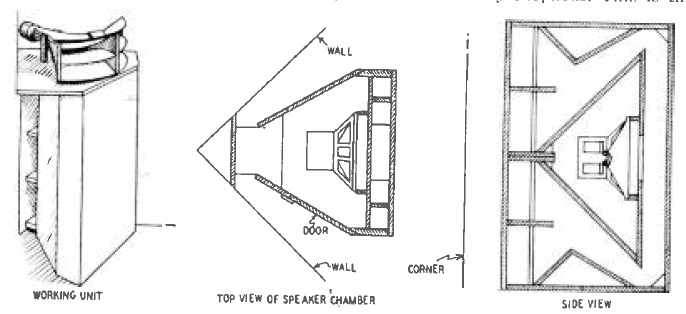
Looks robust and will probably ensure a good solid platform for the decks, which are, almost inevitably, Technics SL1200s.  Unfortunately tonight, with the room being so busy, it wasn't possible to get up close to the decks to check out the details - they are though, fitted with some kind of straight tone arm, so not the standard kit.  In between there is a mixer and behind the DJ on a shelf, there appeared to be a very large power amp that I didn't recognise, but it looked to be solid state.  Sound is delivered by the Klipsch corner horns which are a classic design, apparently still in production.  They're super efficient and can go very loud on a very small power input, whilst maintaining good quality.  There are some pictures and diagrams here from wikipedia.


Image from soundandvision.com


Image from wikipedia


The walls and ceiling of the room have been treated with acoustic panels - clearly some thought has gone into how the system is going to sound in this room.

Well it's sounding good tonight, doing justice to the Mogadisco delivered African dance tunes - there is good but unforced bass and smooth refined treble.  They're not playing loud, yet the sound is pervading the room and cutting through the chatter.  Being loud enough to hear throughout the room but without drowning out the converstion is a good move and partially down to having 4 speakers rather than the more traditional 2.  This is one area where I think Brilliant Corners scores over Spiritland.

Part way through the visit I pay an essential visit to the Gents.  This was not such a pleasant experience and something Brilliant Corners could do with focussing some effort in this area - a real down side.

The music being played was great - really enjoyed hearing the mix of Afican beats - mostly melodic and danceable, then followed up by some jazz funk.  The DJ's could do with an album cover stand on their booth so we can see what's playing.  Mogadisco can be sampled on Mix Cloud.


Feeling a bit out of place, and not wanting to tackle the bar again, I leave after about 50 minutes.  Overall, I really enjoyed the venue and the music on offer - there are some areas for improvement in the venue and the bar offering (maybe I just got unlucky tonight), but the main focus - the lounge and music offering - are absolutely spot on. And to be packed out on a mid-week January evening demonstrates that Brilliant Corners is doing the right thing for its cleintele.

Spiritland feels slightly more relax and certainly is operating in a more upmarket environment but with a limited range of booked evenings, Brilliant Corners seems to have the better sound system and a wider range of booked nights in the months ahead.  So its great to be able to choose and that's a massive step forward in this concept to only 18 months ago and both bars deserve to be supported and to succeed.  Lets hope they're the tip of the iceberg and the movement continues to flourish within London and further afield across the UK.

Saturday, 9 January 2016

Is The Kudos Super 20 a Neat Solution?

Audiophile Musing's system has been "active" for about 18 years.  In Linn style, this means a set of active crossover cards - one per speaker drive unit and one power amp channel to deliver to that drive unit.  This was how the Keilidhs were when they retired and were replaced by an actively powered pair of Majik 140s.

About 8 months ago, I heard a comparison of active 140s using Majik power amps (Linn's lowest rung), just like my own set up, against the same pair of speakers returned to passive crossovers and a pair of Linn's top of the range Klimax Solo/Dynamik mono power amps.  There was no comparison. The passive Solos were not streets ahead, more of a complete city ahead.  They remain an ambition. However, about 4 months ago one of Linn's top of the range stereo power amps (the Klimax 500 Chakra Twin/Dynamik) came available ex-dem and at a very attractive price. And it was black. So the Majik 140 speakers were converted back to passive and in came the Twin.  Its not at Solo level, but it is a significant step up from active Majik.

So what has this got to do with the Kudos Super 20?  Well, its quite straightforward really.  Once the system is no longer active, then the range of speaker choices opens up to pretty much everything out there.  No longer "limited" to Linn.  Of course, Linn speakers are still of interest (particularly the Akubarik, my favourite of the current range), but why not listen around to see what else is possible? My local Naimist, Richard (you'll have read about him before in some of the comparison tests and for his help at Scalford etc), has a pair of Kudos Super 20s.  In an act of some considerable generosity, Richard offered up the loan of the Kudos speakers for a week (which turned into 2 weeks, due to schedules and an extremely long period of wet weather when it wouldn't have been good to be moving the speakers between houses).

Let the fun begin.

Well, it wasn't too much fun to begin with.  The Kudos's had to come down the narrow tight cornered stairs from the loft conversion and then into the car. To make sure the 140s went back in their correct place (and the Super 20s back in their home), positions were marked on the floors with masking tape. Then there was the lifting of the M140s out of the room - I'd forgotten how heavy they are with their solid metal bases.  The Kudos stands slightly shorter, is slightly more shallow and somewhat lighter. They're beautifully built and finished, a real credit to the team from the North East.  I had high expectations for these as they do work well for Richard and I've found Kudos's T-808s a thoroughly enjoyable (if rather expensive) pair of boxes.

Left speaker installed.  Masking tape showing position of the M140s
Starting with the 20s in the exact same position as the M140s, Linn SPACE was disabled (due to the need to start from scratch) and the messing about with speaker positions began.  Listened for about 30 mins in this position and then shuffled the speakers about, playing tracks for 10-15 mins between each position.  Ended up with the speakers about 15cms further out from the wall.  Toe-in was best at the same angle as the 140s.

Then the tuning using SPACE began, and that proved to be much more of a faff than I was expecting. SPACE comes with the Super 20 as one of the listed speakers, so that was easy enough. Measurements were taken of where the speakers are in the room and SPACE calculation run.  It was awful.  All life sucked out of everything, speakers sounding over bright.  I re-checked all the measures.  I then worked through the SPACE instructions on how to tweak the deep notches.  It took a long time before something came back to the system.  I left it like this for a few days, found the system difficult to listen to.  It was edge of the seat stuff all the time, even with music that's supposed to be chilled and relaxing.

I reported back to Richard and he suggested we swap out the speaker cables.  I'm using Linn K200 (which is split K400).  Richard is using Naim SuperLumina.  This had a marked effect on the system - it brings a level of refinement and "care" to the sound.  Its not over smooth, but it removes some rough edges and brings an extra level of tiny details.  Bass got a little tighter and much more subtley textured.  A quite remarkable bit of wire.  Tried it later with the M140s and it did similar things there too.  Impressive.  Enough of a change to necessitate switching SPACE off and to mess about with positioning again.  This resulted in the speakers being about 12-13cms further from the wall compared to the Linns.  A small change from the initial 15cms, but worthwhile.

And then all the messing with SPACE again.  This time I ended up taking nearly all of the SPACE notches out.  The lowest frequency notch went from -29dB to -6dB and the other 2 smaller notches dropped from around -9dB to -2dB.  I also let in -1dB of treble shelf to tame the top end.  This was another 2 or 3 days of messing about to get to this position.  So that was the set up done.  At last.

General view, but before the speakers were moved to their best position
So how did it sound with the SuperLumina and with SPACE dialled in to its best?  Well I'm going to write about this in reference back to the Linns I'm afraid - a comparative review rather than in absolute terms.  I think that's because that's what I'm looking for - something that's an improvement on the 140s.  Its worth saying, at this point, that they didn't work well with the Linn speaker cable and therefore something different would be a requirement.  SuperLumina might be the thing, but others might be as good or better (or worse of course).

Here's what the Kudos Super 20s do better than the Linns - instrument separation, speed (they sound like they respond to inputs from the amp a little quicker) and they image better too - not so much left to right, but certainly back behind the speakers.  So they're an exciting listen.  Attack is great, the music is pacey and the instruments are easily picked out.  The Linns are good at instrument differentiation, but the Kudos moves this on a notch.  They go reasonably deep too, when the content is there in the music.  Female vocals are a particular forte, just as they are in their home Naim system.

What do they not do so well?  There's a few things really.  I still never really relaxed into any music whilst they were in the house for 2 weeks (although it was so much better with the SuperLumina in place).  The speed I found a little distracting.  I notched the treble shelf down another 0.5dB and that helped a little, but I didn't really get settled with them.  This, and they sound a little out of breath in my room.  Back in their home system, they're in a 12ft x12ft (ish) area of an L shaped loft room, which has part sloping roofs.  The listening seat is closer to the speakers too.  In my room they're in a 19ft x 12ft full ceiling height room and that might be just a touch too big for them.

So its a mixed bag.  I really understand why they're a good seller and why their owners enjoy them so much - I get the appeal of the etched instruments, I get the speed, I get the way they do female vocals. If I was in the market for speakers at this price point, I would say that they could be on a short list. But I need to relax into my music.  I like chilled out music to wash into the room and give a warm feeling as I sit back after work and wind down. When a system doesn't let me do this, its not right for me.  Others will have a different view.

As such, these aren't the right speakers for me or my room.  They're different to the M140s, but they're not the right mix of abilities to justify a change to the Super 20s.  I'm looking for a bigger difference, but perhaps, more of what I have, rather than a different direction.

Must get around to trying the SuperLumina again and compare it with other options.  Its capabilities are impressive - far more of a change than a bit of wire has any right to deliver.

A huge thanks to Richard for trusting me with his expensive and highly valued speakers.  They're back in their home now, and the brand new Naim 250DR is probably warmed up enough now for him to get thoroughly back into enjoying his music.

Thursday, 19 November 2015

Listening In A Meadow? Exaktly.

I quite like pizza.  And red wine.  Generally, these are consumed indoors – either at home, or in a restaurant.  Occasionally (it would be summertime), it might be on a terrace overlooking the Med, or perched on a stool outside a tent.  It’s not normal to be consuming these treats in a field, but that might’ve been what was happening the other night, accompanied by Dire Straits playing in the background on a pair of Linn Exakt 350s. Maybe I just have an over-fertile imagination.  It’s strange though, as in reality, we seemed to be sat in a large top-floor room which was as real as the pizzas, and the red wine.

What is this opening ramble?  What does it mean? Was the wine too strong?  Were there too many glasses consumed?  Let’s start back at the beginning and work through to what that opening paragraph is all about.  Maybe.

Cards on the table.  I’ve heard lots of Linn 350 speakers.  And Linn Exakt systems.  Some were combined together.  I tend to like Exakt systems, when they’ve been set up properly (not a given), but tend not to like 350s.  When I’ve heard them both together, they’ve been in inappropriate locations, like a massive double storey hard surfaced furniture shop (not a great approach to showing off your systems Linn), or in the factory in a ballroom with 200 people, etc.  So Exakt and 350s have not been a great experience so far, but then they’ve not had much of a chance either, with the best I've heard them being in the main dem room at HoL - my preference still being for the Akubariks or Komris.

One of the more enjoyable systems featuring 350s belong to Linn Forum member (let’s call him “A”) and uses a Renew DS/0, Akurate Kontrol/0 and a non-Dynamik Twin.  That system still features their special feature – a slightly “disconnected” bass.  A and I meet up from time to time with music and hifi always the excuse – be it at shows, dealer demos or in the listening room.  A lives down South, I don’t.  So we get together when it makes sense.  Through A, I met P, also a forum member and living down South, and we tend to meet up at either of their houses when there’s a good excuse to listen to some music, or compare the effects of software changes and other bits n pieces of new kit.

The 2 guys down South have recently added another member into this happily sceptical band of middle aged music listening blokes.  For simplicity, this new bloke, also a forum contributor, will be called N.  This week was the first time I’ve had a chance to join in, with another trip to London being necessary for work purposes.  Logistics sorted, pizza orders confirmed for the 3rd time (sorry P) and all was set for a bit of Exakt 350 listening.  It even all went to plan.  Decent pizzas, great red wine and we settled into the listening room to munch over the background Dire Straits.

And what a listening room.  Perched on the top (2nd floor) of a substantial place, approx. 6m by 4m and with a sloping wall / ceiling down one long side as it tucks under the roofline.  A pair of rather tasty looking Linn Exakt integrated 350s in piano black stand guard either side of powered grey screen on one of the shorter walls, with a TAG MacLaren centre speaker stood on a pedestal stand.  A venerable Linn Melodik and associated Exaktbox sub are in one front corner. That’s all you see from the listening seat – side / rear speakers are multi-driver MK units flush fitted into the side walls.  There’s a large L-shaped sofa for 5 or 6 and a vast footstool big enough for all.  This is a very comfortable place to settle into for tunes and movies.  Across the back wall there are 2 built-in cupboards.  One houses the very large SIM2 projector (watching movies with all the lights on is no problem), the other the equipment rack.


Piano Black Linn 350 Exakt.  Tasty. And old skool Linn Melodik sub


And what a rack this is.  Much of what’s in there will be on the wish list of many an audiophile / music lover.  Perched on traditional Quadraspire are (from top to bottom): an SME 30 turntable equipped with series V arm and Koetsu Red; Linn Klimax Exakt DSM; Tom Evans Audio Design phono stage, Anthem processor and multi-channel TAG MacLaren power amp (for centre and rears).  Music is normally held on a 4 bay QNAP NAS, but with some currently stored on a Melco N1A and some on a Melco N1Z whilst the resident A is being compared to a demo Z.  All connectivity to the main stereo system is with standard Cat 5 ethernet cables.  Exakt links included, with one cable from the KEDSM to each speaker and the sub daisy-chained from the right hand 350.

Main Quadraspire Rack,  Untidy Cables Due to Experimenting with NAS Storage (see later pic below)
SME 30 / Series V / Koetsu Red

It’s gonna be good, right?  

The 350s are stood very close to the front wall, to enable them to be positioned either side of the off-centre screen (off-centre due to the sloping ceiling).  This is possible due to Linn’s SPACE Optimisation+ feature.  During set up, the room is measured, the speakers are manoeuvred until they’re at the point they sound best in the room (the ‘ideal’ position measurement), then their position is also measured.  The speakers are then moved to their practical position and measured in this position, relative to nearby walls.  All this data is then entered into Linn’s Konfig software, algorithms are crunched and the signals sent to each speaker allow for their compromised position in the room.  I’ve heard this demo’d a few times and its very impressive.  It doesn’t perfectly recreate the sound generated in the “ideal” position, but its very close, considering what it allows in terms of much more physically discrete speaker locations.

What about the sub?  Well Linn have just added subwoofers to their Exakt system with the Exaktbox Sub which is designed to take the Exakt signal to a sub with built-in power amps.  N had just hefted the sub into the room a couple of days before (his and his mate’s back are probably still recovering – its not exactly lightweight), and it hadn’t been set up.  We had it powered up to start with, but then chose to shut it down and come back to it later.
Pizzas done, music was loaded up into a playlist on the iPad Mini (or the iPad, or the Macbook!) and we got on with some listening.  It was very quickly clear that there’s only one sweet spot in the room – the intended listening seat.  Being elsewhere in the room was a real compromise – even just one seat to the right of the hotspot.  Not to worry, that’s not at all unusual.  We listened to some classical organ music (vague, sorry about that, it’s not something I know much about), some Clapton on video and some Seal.  We settle into focused listening with something we’re all very familiar with – Daft Punk’s Georgio Moroder from the Random Access Memories album.  It has an interesting opening with a narrative by Georgio, underpinned by background chatter and some bass meanderings.  Then of course it kicks in with some driving bass lines and electronic tuneage.  It’s very good for understanding system resolution and tunefulness.  Tune dem anyone?  We don’t discuss that, as everyone has their own way of listening for what they like, but we all do try to figure out if we’re just enjoying the flow of the music and if it’s causing foot tapping or not.

It was difficult to establish what’s going on away from the hot seat, so we take turns to try it out.  For me the sound was OK, but not overwhelming.  I suppose I was expecting something special, and to hear that from the off.  We mess about a bit more with some more material – including a great scene in the film Fifth Element.  I’d forgotten just how quirky and amusing that film is – must get around to watching it again sometime very soon.  Having got used to the sound, we start thinking about tweaking a few things and start with the QNAP and Melco options.  Various combinations were tried – each Melco on its own, then with the QNAP fed through one of them.  I think I heard some small differences, with a very slight preference for the N1A Melco, but there was nothing there that was making the system sing, nor were any changes (real or imagined) very significant.  Another aspect was a serious lack of imaging – there was no single point for the singer’s voice and London Grammar’s album just didn’t shimmer and fill the space in the room.

To the left, QNAP NAS main storage and a couple of Melco NAS boxes, the N1A being resident, the N1Z being a demo unit

I think it was P who finally bit the bullet and we cranked up Konfig on the Macbook.  We switched SPACE Optimisation on and off a few times, but I really couldn’t hear it making any real difference.  Strange, it’s normally very obvious.  We checked the SPACE filter graph and found a straight line.  Those familiar with looking at what SPACE does, will know that this is unusual.  Essentially, the software calculates where the room is likely to give bass humps (due to the dimensions of the room) and then feeds a signal to the system that has very narrow, often quite deep, notched attenuation filters – the idea being that the deep notches in the signal cancel out the humps created by the room.  Most rooms have 2 to 4 nodes.  Yet here we have a completely flat profile.  And a room map with no speakers or furniture identified.  Now, there have been some recent software updates that have had odd effects in Konfig, such as completely shutting down one speaker, forgetting which speaker models are in use etc., all fixable by restarting the software and the system, although forgetting the speaker model did actually need the model to be re-input.  So maybe a software bug has caused the problem, but it’s not really possible to track down what’s happened here.  The cause of the lack of filtering was soon obvious and I hope it’s been down to an error somewhere along the line as N clarified that there had been notches on the graph previously.  Perhaps a software or hardware change had caused the problem.  One for owners to check back on from time to time (rather like I discovered that my speaker model had been dropped from the standard SPACE config in my own system – noticed one day after a software upgrade seemed to have degraded the sound a bit).

Anyway, thinking back to some stuff I’ve read on the Linn forum, the problem was soon identified.  The room dimensions are supposed to be entered into Konfig in metres.  Here they had been entered in cms.  So a 6.3m long room becomes a 630m long room, as far as the calculations are concerned.  And when that room is also recorded as being 410m wide and 255m high, the speakers imagine they are living in a field.  And when a set of speakers live in a field, they don’t create any bass humps as their field is too big to have bass humps.  So SPACE sets a correctly flat profile.  Except we weren’t in a field, we were definitely in a room.  The measurements were quickly corrected to metres, and we entered a rough position for the subwoofer.  But when we did this by roughly guessing its distance from the room boundaries, the Konfig diagram showed the subwoofer was half outside the room. Hmmm.  Something not right there.  A quick run of the optimisation software delivered 4 notches and we were clearly starting to head in the right direction.

N quickly dug out the laser measure and we got to work stepping through Konfig’s measurement requirements.  Even when converted from cms to metres, some of the dimensions were out – the room width was recorded as 4.1m, but turned out to be 3.66m – an error of 0.5m is quite significant.  About 15 minutes of measuring, checking and entering the data and we had a new optimisation ready, with 3 notched filters – the lowest frequency notched to about -29dB with the other 2 much further up the frequency range and much shallower.  Due to time restrictions, we just converted the speaker’s “ideal” location from the cms already in the system.  With much more time it would be worth revisiting the ideal position data too, but that involves removing speaker spikes and shuffling the speakers about in the room – there wasn’t time this evening.

Daft Punk went back on, Leonard Cohen, Seal and some London Grammar.  Some listening, some small tweaks on the depth of the optimisation notches.  We dial in a +1.5dB treble shelf to compensate for the heavy soft furnishings between speakers and listening position.  I think we ended up with the notches back to the SPACE recommended settings in the end – quite unusual.  This was quite some improvement.  Bass lines are now tuneful, and there’s real imaging going on – still a little shallow front to back (possibly an effect of being so close to the front wall of the room), but very wide left to right and instruments and voices easily pinpointed as individual parts of the whole.  The opening to the Georgio track had a stable, central voice, the background noise was recognisable as chatter and the quiet underlying bass line is playing a clearly distinguishable tune. Excellent.  What a difference a few measurements can make (although, to be fair, changing from cms to metres isn’t exactly a subtle tweak).  Next we mess about with some cables and the system really starts to sing.  Now, we’re listening to the best pair of 350s I’ve heard.  The bass lines are even in time with the rest of the music, which is not a 350 forte – Exakt must be doing its stuff, and perhaps the latest 4th order bass roll-off changes have been really fundamental to getting the best from the 350s.  This system is now really enjoyable – something quite special, given my previous challenge with enjoying 350s.  Sitting position in the room is now much less critical, although still best from the hot seat of course.
N then played Porgy and Bess Summertime, Procol Harum performing A Whiter Shade of Pale with the Danish National Concert Orchestra, Eva Cassidy Fields of Gold and some of his other favourites (he has a very extensive and eclectic music collection) which all sounded very engaging.

There’s probably more to come.  Given that we have relied here upon the “ideal” speaker positions that were existing in Konfig (but converted to metres), there’s probably scope to go right back to the beginning and determine the “ideal” speaker position again.  If that’s not right then the SPACE Optimization+ facility for positioning the speaker into the practical position will be based on some incorrect calculations.  If that is the case, then this system really could move on from excellent to truly stunning.  That’s the work of at least half a day.

Now I’m hoping to get back again soon (probably in early 2016) to spend the evening listening to music, to give that SME a good listen and to put that fantastic screen and projector to good use. Hopefully, over the next few days and weeks, N can enjoy settling into some serious music listening too.  Thanks for your hospitality N, a very enjoyable evening.

(with thanks to P for a contribution on the tracks played and correction of some of the details).