"What a refreshingly honest blog about listening to music through hi-fi. So happy to see views based upon the enjoyment of music rather than so-called sound 'quality'." - Peter Comeau, Director of Acoustic Design at Mission / Wharfedale

Monday, 25 February 2019

The Bristol Show 2019 - Report and Photos


Bristol.  A place of docks, colourful houses, churches boats, a famous bridge, round windows, cider, one of Britain's largest caravan manufacturers and quite a few concrete buildings.  One of these concrete buildings is a Marriott Hotel and each year it plays host to the UK's largest / busiest hifi shows. That's a mixed blessing of course - at least for those attending the show.  There's the benefit of many manufacturers and systems all in one place.  Then there's the downside of all the punters wanting to listen to all that stuff, all being assembled in one place.


A view from the Mud Dock cafe


Normally the show is very well organised with signs, people who know what they're doing on the ticket desk, assistant dotted about the place etc.  This year was no exception, but the usually inadequate lift system couldn't cope at all this time, with only one of three running on Friday afternoon.  So the stairwells were even busier than usual.  That's a fairly minor gripe, or at least it is if you're lucky enough to be able to make use of the stairs.  For others, I imagine a lot of time will have been wasted waiting for the lift.  Has the event outgrown the venue?  Or is the venue just too old to cope with modern needs?

At 15 minutes before opening, a substantial queue.  I've only ever attended on the Friday and this year was the busiest I've experienced

Butties, soup and a small range of hot dishes were available at not unreasonable prices (soup and roll just under £3) - the main bar area on the mezzanine floor being excessively crowded, but the restaurant area offered a haven from the bustle of the show.  So let's get started.

Malvern Audio


Valves, horns, reel to reel.  This is going to sound soft and "old skool" isn't it?  Well, I can't comment on the effectiveness of valves in the Lampizator DAC because we were treated to the TEAC reel to reel in this room, playing through a passive pre amp and £9k a pair valve power amps into the attractively finished hORNS speakers.  The unit on the floor is s mains power conditioner who's voltage output was reading around 225-226V so perhaps all that audio gear in the building was putting some strain on the supply.
Anyway, inevitably - the volume of material on this media is very limited and very expensive - the R2R played some jazz.  Fortunately it was pretty complex material and therefore didn't give the system an easy time and it was very easy to listen to - dynamic, controlled, believable.

Harbeth Compact 7 ES-3 AE

Helpful information. Or subliminal messaging?  ;)


Mr Shaw was explaining some stuff about edge diffraction when I entered the room.  Once the music started (played from a DAP into an Hegel amp) it was safe old jazz stuff.  The speakers sounded OK, but they weren't being pushed, other than for some level of detail.  They have that characteristic safeness and a feeling of being a little over damped.  Would liked to have heard more but it was nearly show closing time and I needed to get back to one of the other rooms just to check out what I thought was the best sound of the day.

Revel Speakers on Static Display


Chord Electronics


Chord were playing some combination of the above boxes.  By Chord standards these are quite subtly designed bits of kit. There was an M-Scaler, Hugo and TToby in amongst that lot.  The speakers were B&W 805D3 standmounts.  There was no clue as to which boxes were playing (why is it so hard to tell the punters what's going on?), the music was too quiet and the room host was chatting away in the middle of the seating area with some friends or colleagues.  I sat for a couple of minutes on the front row to try an listen to what was playing, but then gave up.

Dynaudio


A selection of speakers on display in the corridor and then those below playing music in a room with Naim electronics.  A decent enough sound - nothing outstanding, nothing particularly poor either.  So a nicely balanced system.


Mark Levinson and JBL


The JBL K2 S9900 is a bit "legendary" in Japan.  Linn even have Exakt filters for it.  Its a £20k speaker (each) but didn't sound anything like that kind of price today.  Poorly controlled bass and fizz and tizz from this system.  Not for me.

PROAC K6 Signature


Its a tricky room this one - quite large with a high curved ceiling.  It always seems tough for anyone exhibiting here.  And so it proved today.  The K6 sounded OK, but not really £20k of OK.  Beautifully finished, I'd like to have heard these in a different room and with a digital source.

Focal and Naim


Another awkward room and usually filled with boomy bass, but this year Naim / Focal did the sensible thing for this room and brought some small standmounts - the Kanta 1.  Fed by NDX2 / 282 / 200 this system did a reasonable job, the Focals being smoother in the treble than they normally are.

Audiolab and Wharfedale


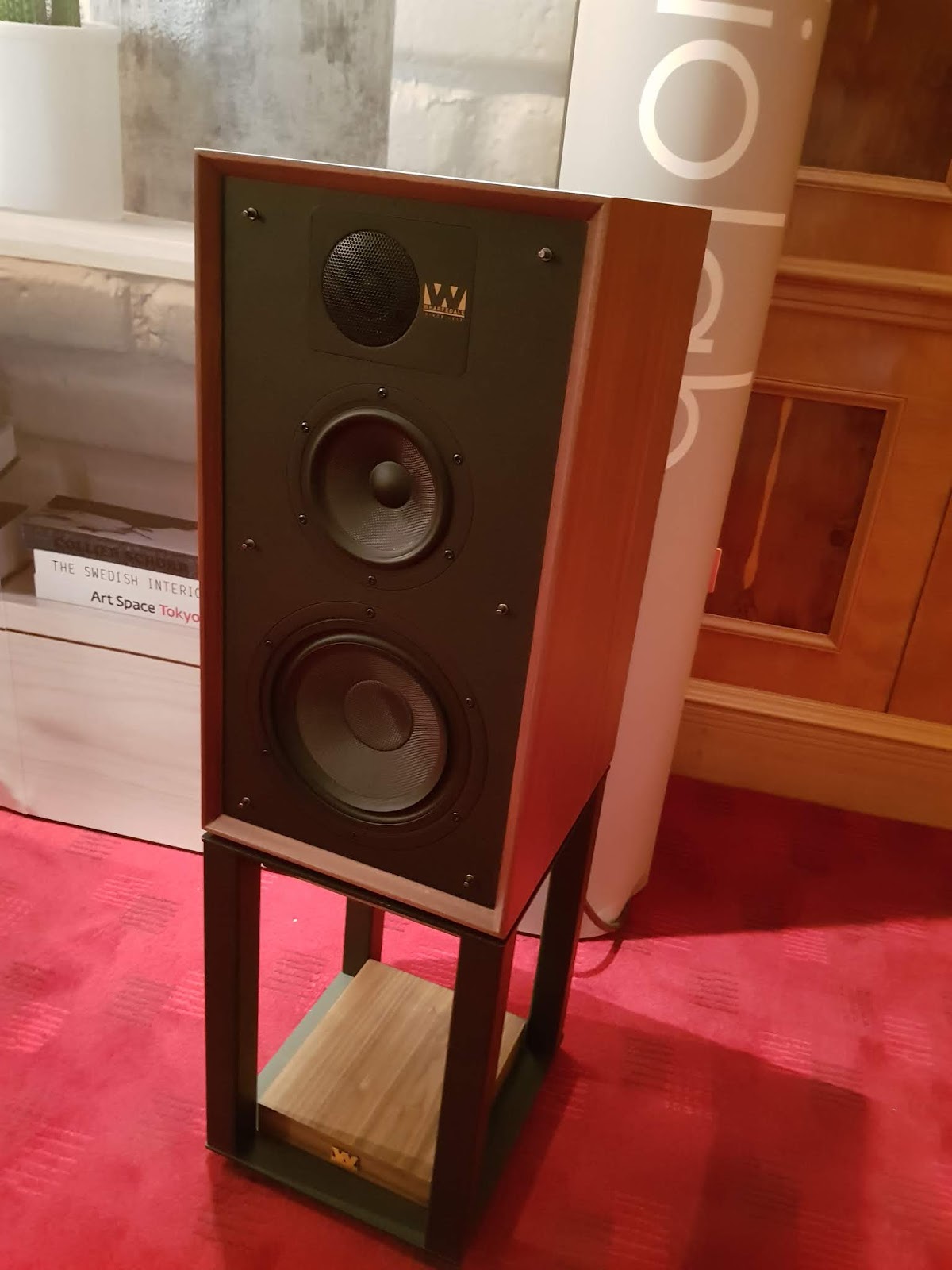
Wharfedale are on a celebratory kick at the moment, using this as a good reason to update some classics such as the Denton but with more up to date technology in the old skool box.  The larger pair were playing using the Audiolab gear - I believe a streamer into the DAC in the integrated amp.  At just over £2k for the whole system this sounded decent.  Nothing stunning, but decent enough, and managing to fill a quite large room.

PMC


PMC were listed in the show booklet as playing a Dolby Atmos movie system, which I was very much looking forward to.  Unfortunately for us, that was in the morning, in the afternoon they were playing stereo music.  I'm not sure if this was clearly advised anywhere, but so be it.  A Bryston digital file player and DAC were playing into PMC's own Cor integrated amplifer, feeding a pair of Twenty5.24 speakers.  This is a big room and the 24s weren't struggling at all.  They were doing a good job and the room was busy with people listening to several tracks rather than moving on quickly - a good sign.  Interesting to contrast the Audiolab / Wharfedale system over the corridor with this one at probably 3 or 4 times the price.  VFM is, of course, a personal measure, but there is no doubt that this one was a few steps up in terms of quality.  First time hearing the Cor and it was doing a good job.

Wilson Benesch / CH Electronics

Just sat on the shelf, a very large CH amp

Banner should be banned - WB declaring the new Precision P3.0 at around 1.5m high a "standmount" speaker  :)

WB go back to their roots


WB took up their customary position in the large conservatory, which they, again according to their custom, lined with curtains to keep the room under some kind of control.  They had 2 systems set up and the one shown above was playing.  A live Frank Sinatra concert as it happens.  The TT was in play and we were advised that it was WB's first turntable and had been pressed back into action to celebrate an anniversary.  Also, interesting to note, is that the turntable was their first ever product - before venturing into loudspeakers.  Playing into the CH integrated amp and the Precision 3.0 speakers this was a fun listen.  Whilst it's nice not to have to look at the back of the drivers like some of WB's more recent models, the Precisions don't have that sophisticated shape or finish that we usually see from WB.  They look somewhat ordinary in comparison.  Enjoyed the music though.

Accessories and Stuff

As usual there was an accessories section with the likes of Townsend, MCRU, some of the magazines, vinyl sellers present.


DALI


Dali were playing their very realistically priced Oberon speakers (I think it was the model 5, see the pictures above).  They did OK for their price and made a decent fist of the music.

CYRUS


Cyrus were running a couple of demos during the day - splitting their time between 2 combinations.  A laptop fed both systems.  First time out for the new QX-R DAC board inside the amp over on the right hand side of the table - it was playing through the white Dali floorstanders.  It was a decent enough sound.  Later in the day it was the turn of the entry level One HD amp (also with its own DAC) playing into the Cyrus Linear One standmounts.  This was a fun system to listen to and, on show day, the combination could be had for £999.  Very good VFM as the music bounced along without getting unruly nor harsh - good to listen too and much better than many more expensive systems at the show and significantly better than those in a similar price bracket.

ATC


ATC were playing their new amp into a passive pair of SCM40 speakers.  I've heard these speakers a few times now, passive and active.  I have to say that here, in passive form, they did a decent job.  But I very much preferred how I heard them last time with a single box Auralic streamer into the active version - that was a great simple mid-priced system.

ELAC


I didn't quite catch what was going on here from a source perspective but the combination of the ELAC amp and the little standmounts was very engaging.  Being very substantial with their bass output was the main surprise here.  I see that Andrew Jones is now bringing the concentric mid / tweeter into more and more of the ELAC range.  Thinking back, I can't recall an AJ designed speaker that I didn't like...

Creek


A reasonable sounding system here.  I was running short of time by this point, so didn't get the chance to give this system a real listen.

Rega


Reassuringly honest.  That's what usually strikes me about Rega system at shows. They get on with the job, they're reasonably priced, well made and there's no marketing bling or extravagant claims.  This one was no exception with a sound that draws you in and makes you feel comfortable, yet without being bland nor boring.

Amphion with Hegel


Normally I like both of these products, but here, today, it was a bit lacklustre.

Escape Speakers


Something a bit different from new speaker company Escape.  These are designed for the garden / patio / poolside.  Being a pretty substantial and heavy column its wrapped in grille mesh that's also used for outdoor garden furniture.  The handle is aluminium.  There's a bunch of controls on the top that are sealed so the whole thing is said to be weatherproof.  Each side has a speaker then there's a downward firing woofer too.  They can operate stand alone mono or can be paired for stereo.  Input is by Bluetooth  - combined with 3 hours charging time gives 8 hours of playing time so there's no need for cables at all.  Sound quality is pretty good for the type of use it is intended.  A fun thing that would be nice to have.  £999 each.

PROAC D2R


I rather enjoyed what I heard in this room.  The D2R is detailed, smooth, lacks aggression but doesn't lack in dynamics nor weight.  Being fed with Naim's low end separates did them no harm at all.  For me, this system proved that getting the mix right is more important than price alone.

Exposure / Kudos

Exposure were showcasing their new venture in collaboration with Kudos - an active crossover for the Titan range of speakers.  Being a PSU and crossover in separate boxes and at £1800 combined they can be used with 2 or 3 way Titans.  This is a prototype and the only one in existence.  It will be possible to add Super 10 and Super 20 to the range if / when Kudos share the configuration data.  But that's getting ahead of ourselves a bit.
An attempt to try and show the connections for the active crossover


Today a stack of 4 mono amps followed from the active crossover to feed a pair of Titan 606s.  But something was amiss.  We learned later that their had been a set up issue with the components in the crossover and they weren't properly matched to the 606's requirements. A shame, as I was hoping to hear what would seem to be a great collaboration at work.  Maybe another day.

KUDOS


Kudos were playing the Titan 505 (£7750 with stands) using a Linn Selekt equipped with the Katalyst DAC and the integrated class D amplifier kartridge.  An Innuos server provided the digital files.
Its been a whole year, but I think this combination was a little brighter but more detailed than the Naim Uniti Nova used at the last Bristol show.  However, the Naim seemed to have a bit more heft and musical momentum.

Russell K


I think these are the speakers we heard at the Chester show last spring, in prototype form.  I didn't like them at all  on that occasion.  That was in combination with Naim electronics.  Here, with a Melco source and the PMC Cor integrated amp, plus quite a bit of room treatment, they sounded far smoother and more engaging.  Maybe it was the production version of the speaker, maybe it was better system synergy.  £6.5k a pair though? Hmmmm.

Audioquest


Here Audioquest were demoing some mains distribution blocks and cables.  Electronics hidden away (possibly Rega?), I thought the Kudos Titan 505s were sounding better than they were with the Linn Selekt.  We didn't stay in here long as the demo was similar to last years cable changing offering.

Fyne Audio


Formed after the Tannoy factory closed, Scottish company Fyne seem to have built a good reputation very quickly indeed.  Last year they played their top end speakers which underwhelmed.  This year it was the turn of the F702 mid-price floorstander.  It has a very fluid sound - mellifluous yet not dull.  Lots of detail, fine female vocals, the tune is easy to follow with this combination of electronics fronted by a Rega CDP.  But rather lacking in the low end again.  Probably worth another listen in a different setting.

Astin Trew / Graham Audio


A lovely sounding system when fed by the reel to reel deck (not heard with the other sources).  The Graham LS6F floorstanders were playing.  Fantastic flow to the music, a sense of ease to the presentation, lovely clear vocals and tight tuneful bass lines.  I enjoyed spending some time in this room - perhaps the lack of seating and hence bodies in the room gave it the space to breathe?


REL


I'm not sure what electronics were in use at Bristol, but REL were partnering their sub with a pair of Dynaudio floorstanders.  The choral music was good - the sub probably adding to the sense of scale of the venue. But AC/DC's Thunder was hard, harsh and unlistenable.  We had to leave the room sharpish.

AVID


I have to say that I rather admire AVID turntables, I can't recall ever hearing a bad one.  And perhaps, today, I still haven't heard a bad one, but there was something very odd about this system.  I'm not sure if it was the electronics or the set up.  Regarding the set up, I would question the way that the speakers were toed-in so severely that an imaginary line through the centre of each speaker would have crossed well in front of the first row of seats.  Odd.  So if this was a contributor or not I don't know, but we listened to 3 tracks here on 2 different LPs and the effect was always the same.  It felt like there was a major issue with phase in the mid-range that was sucking the music away in the mid frequencies.  There was tight bass and detailed treble but a curious hole in the middle, coupled with a sense that there was a phase issue in the room, which manifests as a slightly uncomfortable feeling.

Acoustic Energy


Playing the new little white standmounts when we were in the room.  A bit shouty and relentless.


The LS3/5a Club


Companies such as Harbeth, Rogers and Falcon were all playing variations on the theme of the tiny BBC LS3/5a monitors.  I've never got on with them, nor the Linn Kan and, despite some eye watering prices for these little boxes, I didn't get on with them at all today either.  Nice vocals, but they sound rigid to me, lacking in musical flow, and there's just too much of the frequency spectrum missing.  I know some people love them.  I quiet enjoy Marmite too.

ATI


Decent cinema sound in this room, loud, but not ridiculously loud like some demos.

DECENT AUDIO


Across 3 rooms Decent Audio presented Scansonic speakers, Dual turntables, Ayre electronics and a number of other products.  All sounding OK.

Totem


I like the Totem Sky standmount and floorstanding speakers.  Last time they were heard with a Rega turntable and were underwhelming, but came to life with a digital source.  Here, the new KIN active speaker was being fed by a Rega turntable and sounded a little underwhelming, so perhaps not a fair outing for them, but no source comparison was available on our visit to this room.

TUK


Playing the little white active standmounts without sub-woofer, this system was pretty enjoyable, particularly as the price is £700 the pair.  Lots of other small and tiny speaker options in this room, all very modestly priced.


LEEMA and Brigadier


This system was full of life and dynamics, driving a tune along very well.  Lots of information coming through the £5k Australian speakers.  Occasionally, when louder, there was a touch of hardness.  So one worth a listen, but probably best over a longer term home dem to make sure that all the excitement doesn't get too much over time.

Mellow Acoustics


An interesting new speaker here, being fed by a TT, Tidsbury passive pre-amp and valve power amp.  The FrontRo speaker is a 12" electrostatic with support from a 5.25" bass driver.  Intended to be small and discreet in the home.  This system was pretty much the opposite to the Leema system above - polite, easy going but no musical enthusiasm.  Its a nice concept and will work for some.

Klipsh


Both rooms sounding fine in terms of detail, but not much get up and go.

Mission


I'm an admirer of Mission's earlier work - in the 80s and 90s they produced some great budget speakers that punched well above their price point.  But now I'm not so sure.  First heard at the Indugence Show in late 2017, the smallest QX sounded quite reaonable at the price.  Here the £400 satndmount was playing.  It was a disappointing flat sound lacking in any emotional content.  I hope this wasn't representative.

CANTON


When there's limited time to get around all the rooms at a show, sometimes choices have to be made.  Sometimes that could be based on previous experiences but its always best to give everything a chance if possible (see comments above about LS3/5a for example), and sometimes that bears fruit.  Canton is a case in point.  I've heard them many times in different guises, always found them pleasant enough but not something I'd buy with my own cash.  However, today was different.  They were playing a new active standmount, the Smart Vento 3.  Inputs go to one speaker and it feeds the other speaker wirelessly.  The DACs are 24/96, as is the wireless connection and a pair of class D amplifiers drive each drive unit from an active crossover.
And these little boxes do a great job.  They only need a source / pre-amp to partner them and Canton were using a £6k AVM all-in-one today, but using the digital output, so most of the sound processing and the DAC was coming from the speakers, not from the electronics. Punchy, tuneful, sweet, no harshness, nice vocals, deep bass for the enclosure size, there really was nothing to criticise here at the price.  A simple, elegant, very good sounding system.

Ophidian


Using modest Marantz electronics, Ophidian were making a decent but restrained sound.  These floorstanders don't have the "wow" factor of the tiny speakers this brand is known for.


LINN


Linn returned to the show for the first time in 12 years - so a marketing change in direction.  We bumped into MD Gilad Tiefenbrun later in the day, gave him some feedback on the loss of the forum but also discussed Linn's presence at the show. It was largely driven by the new Selekt product - Linn see this as more suitable to a show of this type, whereas dealer demos are seen as being better for the "enthusiast" customer wanting to choose from a range of separates products.  Static Selekts were on display in the show area with their lids off to show how the kartridges fit into the box.  At the moment all the options are stereo - Selekt can be a streamer / pre-amp only, you can upgrade the DAC to Katalyst, add a stereo power amp and later there will be surround options too (but not clear today if the surround modules will have the option of a standard or Katlyst DAC.

The unit is very well made, the look itself for me is OK, but everyone will have their own opinion on that front. In the dem room there were 3 Selekt units lined up, along with a pair of B&W 804D3 speakers - choosen by Linn to "prove" that an all-Linn system is not a given.  The first dem was a very brief piece of music on a Selekt equipped with a standard DAC and the built-in stereo (Class D) power amps.  Feeding the B&Ws this sounded pretty good, but then it should for well over £5k.  We listened again to the same clip then moved over to the second Selekt which was equipped with the better Katalyst DAC.  The difference was immediately noticable bring greater clarity, control, much more emotional vocals etc.

The 3rd Selekt was a streamer / pre-amp which fed a Linn Akurate 2200 amplifier.  Here we listened to some Christine and the Queens without any SPACE room optimisation.  Then we heard the same clip again with SPACE v2 optimisation.  The improvement in the clarity and tunefulness of the bass was very obvious, as was the way in which the vocals cleaned up.  So is Selekt a success?  I would say that this dem was effective in demonstrating the differences of the unit here, but it was really far too short to get an appreciation of the unit's musical capabilities.  Selekt was in use elsewhere, so I'll cover that in the notes on Kudos Titan 505.

Audio Note


Displaying a fair variety of products, and very proud of not using any fancy equipment racks, Audio Note's CD One CD Transport, DAC 2 (£2150 each) and Meishu Mk II integrated (8 watts per channel) amp (£6290) were playing into Type J speakers (£4600) set up in the usual-for-Audio-Note heavily toed-in and pushed into the corner arrangement.  The CDP was playing whilst we were in there. There's a consistency to the way AN gear presents the music - if its simple and well recorded then it tends to sound fantastic - natural, flowing, very enjoyable.  But once it gets complex it just get a bit hashy and difficult to listen to, and so it was today.

Von Gaylord


Using an mbl CD player, VG were exhibiting valve electronics throughout and a pair of large standmount speakers - trapeziodal in shape.  A very good sound here, but is it worth the several 10s of thousands of £s involved?  I notice that the veneer on the speakers from the top enclosure to the bottom enclosure doesn't match.  It might just be me, but that would be annoying to notice every time you sit down to listen, and doesn't sit well at this price level.

Spendor and Auralic


Well, I'm not usually a fan of Spendor speakers - there have been one or 2 that have been enjoyable, but normally they're just too safe sounding and don't drive foot-tapping for me.

Today was not one of those days.  Using a streamer, clock, DAC / pre and power amps from Auralic, they were showing off the new £8.5k Classic 100 speaker.  I've enjoyed the Auralic electronics at other shows and they did a great job again here at Bristol.  The big Spendors have a slightly unusual configuration with a 5" or so mid-range driver above what looks like their usual tweeter design which is itself above a large bass driver and a pair of smallish ports.  They look "classic" in a kind of 70s / 80s kind of way and have a lovely veneer finish.  But what they don't do is sound like a British 70s / 80s speaker - they are thoroughly up to date and sound fantastic.  Fast, solid bass (choose your position in the room carefully because there was a little boom if sat in the wrong row), very well articulated vocals and a sweetly detailed treble with no sign of harshness or forcefulness.

Song after song displayed this system's dynamic and musical ability, across all genres, including very realistic piano tone and scale. This was one of those rooms where lots of variety of music was being played as the system did well with all genres.  When the room host is playing a bit of everything, its usually because they're confident of the system's capability - and rightly so here.  Its worth noting that Spendor had a decent sized room for these big speakers to breath in - probably twice the size of most of the bedroom dem rooms.  So a very enjoyable listen here - I went back twice more during the day to make sure that the variety of music and the capability to deliver was consistent.  And it was - consistently very enjoyable.


Neat Acoustics


Neat were playing their new £3k floorstander.  It looks good in a modern interiors kind of way and features downward firing isobaric bass drivers.  Plenty of detail and dynamics, but a somewhat boxy sounding bass.


SUMMARY

I didn't get around every room unfortuately, some by choice, others due to a lack of time.  The show is big enough to need a couple of days really.  A few thoughts: active standmounts are now proliferating and are no longer the preserve of PC desktop use cases; prices continue to go up in leaps and bounds, but not necessarily with performance improvements; there wasn't so much room treatment as I remember from last year; there's still plenty of choice of products available, offering different solutions; a worthwhile day out.


Tuesday, 12 February 2019

Kudos and Exposure Collaborate on Active Crossovers

Its a long saga...

Kudos have been enthusiastic about active electronics to drive their "Super" and "Titan" range speakers for around 3 years.  There are Linn Exakt digital crossover configurations for their speakers and a Devialet option too.

In parallel, a project was underway to develop a Naim SNAXO active crossover too.  It rumbled on for a couple of years, with previews at a number of shows that proved the solution to be a good idea.  it would, of course, have encouraged existing Naim amplifier owners to not only buy a SNAXO, but also to buy extra amplifiers.  You'd think that Naim would be keen on that.  But, for whatever reason, Naim have chosen to shelve the project for the foreseeable future.  There are some Naim dealers that will modify existing SNAXOs for Kudos use, but that's not exactly mainstream.

But now the news, for non-Linn and non-Devialet users, is much better.  Kudos and Exposure have announced a collaboration to produce an active crossover for Kudos speakers.  This will be a stand-alone unit that will allow the customer to choose any pre-amp and any power amp combination.  Excellent. I look forward to hearing the prototype at the 2019 Bristol Hifi Show.

https://www.stereonet.co.uk/news/exposure-launch-xm-cd-player-and-preview-vxn-crossover

Monday, 11 February 2019

Audiophile Musings at The Hifi Wigwam Show, 17 March 2019 at Kegworth, UK

The Wam Show is like no other.  Just enthusiasts playing their systems to other enthusiasts.  Perhaps a couple of commercial rooms, but well over 30 rooms of amateurs playing music on their system.

I'll be playing music on Linn Akurate Exakt streamer with Katalyst, 3x Lejonklou Tundra power amps and Gauder Akustik Isophon Corvara speakers, converted for Exakt active operation.

If you're visiting the show, please call in and choose a track from the playlist. Nearly all of it is here, so you can choose something in advance from this Tidal playlist: 

https://tidal.com/playlist/ee329131-84ad-4f20-95e9-c7f983d0765e

Friday, 11 January 2019

The Bristol Hifi Show 2019

Not yet sure if AudiophileMusings will make it this year or not, but The Bristol Hifi Show (formerly the Sound and Vision Show) takes place 22nd to 24th February.

Its the biggest commercial show in the UK and therefore attracts a large number of visitors and exhibitors.

Interesting to note that Linn are attending with the Selekt product - a departure from their usual low profile marketing:

http://www.bristolshow.co.uk/news_detail.lasso?newsid=10311#.XDhmxlz7S1t

General show website here:

http://www.bristolshow.co.uk/

Last year's show report here, to give you a flavour of what to expect:

https://audiophilemusings.blogspot.com/2018/02/bristol-sound-and-vision-show-report.html

Friday, 2 November 2018

Being A Dance Test Dummy - Pitch Black, London, October 2018


Did you ever go to a gig not quite knowing what to expect?

Better than you'd hoped for?  Worse than you could've imagined? So bland as to not be worth the bother?

All possible outcomes.  So how was it when Audiophile Musings was subjected to 3 hours of electronic sounds in London, imported for one night only from New Zealand?  Did the experience of being one of Pitch's Dance Test Dummies turn out to be pleasant, euphoric, painful, uplifting or just meh?

There's something about a venue that works. Or it doesn't. And it works or it doesn't, depending on who's playing there and who's in the crowd.  Pete Tong and the orchestra playing Ibiza classics needs a vast space and a few thousand party animals to make the gig work - put it in a venue where the orchestra might outnumber the audience clearly isn't going to work.  But equally, put a solo female singer songwriter in a venue of just a few hundred people doesn't work either, if the audience are only interested in the sounds of their own voices.  So a venue has to work for the gig, and the gig has to work within the venue.  And yet it must be so difficult to know what's going to work.  A while back I went to see/hear Kiasmos at The Royal Festival Hall - a very large venue more commonly known as a classical venue.  But for a duo playing keyboards - that just didn't seem right, yet by the 3rd track in the place was on its feet and it felt more like an superclub in Ibiza.  But without the bar prices.

What's that go to do with being a Dance Test Dummy?  Its about the contrast.  The last duo twiddling knobs and standing behind keyboards I saw live was that Kiasmos gig.  This time around it was the turn of Pitch Black - another duo twiddling knobs and standing behind keyboards playing live.  They formed in New Zealand just over 20 years ago, so I don't know why its taken until 2018 for me to discover their music, which is very much my kind of stuff.  Rather in the manner of PB being from the Southern Hemisphere and Kiasmos originating in the very northern parts of the Northern Hemisphere, so their London venues came from the opposite ends of the spectrum.  PB were choosing a live London gig in October as a chance to run some new tunes past the critics (their audience) and the basement at the Sebright Arms, in the oh-so-cool Northern part of the capital's heart, stretches to an audience of about 160.  That's intimate.  And dark.  A small room with a low ceiling, a small step up about 2/3 of the way back from the stage and a bar with just the essentials across the rear.  The stage is only about 18 inches high.  Very friendly folks at the Sebright Arms, much friendlier than the usual London grumpy pub staff.  The pub's OK, the food was OK, but all the trad ales were off for the evening, which was a bit of a downer.  So I tried the local craft lager which was acceptable, nothing spectacular.

Don't know much about Pitch Black?  Me neither, or at least not up until earlier this year.  I heard about them through one of the forums - in one of those "if you like that you'll like this" kind of threads.  I mention Kiasmos above and I'll mention Yello now too - because if you like either or both of them, then PB are worth a listen.  Take care on the likes of Tidal though, as you might run across their US namesakes who are gangster rap-ish and very different indeed.  You can sample some PB over on Soundcloud too.  A quick chat with Michael Hodgson (the local) and Paddy Free (from NZ), who make up Pitch Black, before the gig proved how easy they are to chat to, both of them also being Yello fans.  Paddy is very easy to talk to and genuinely interested in their audience, and very good at predicting their behaviour.  His prediction: "They'll come in after the gig has started and then gradually fill up the room from the back" was spot-on.


The set was broadly split into 3x 45-50 minute sets.  No support. The first set was the "chill" session, and that was exactly how the audience gently and politely settled into it.  The room gradually filled up, but the space between the stage and the step up filled up in a very relaxed way - almost everyone cross-legged on the floor.  As Paddy put it "welcome to the great Pitch Black sit-in".  Apart from one or two lines like that, the boys just got on with the chill play out for the first 50 minutes.  And its probably about as laid back as it gets.  This isn't ambient as such, there's more direction to the set than that - its possibly better described as ambient sounds but with a beat - sometimes a little dubby, other times trancey, other times rather like a slowed down house style.  And what a fantastic sound system for this kind of music, in such a modest venue.  The PB sound is very reliant upon waves of bass lines and rhythms - something that could very easily have been a massive wallowy mess of sound from a poor sound system.  But this little unassuming venue in London did PB proud.  The bass was massive but decently controlled and filled the venue with waves of sound.  But it didn't drown out the rest of the music, which is essential to the structure of the sounds - there are so many little short sharp chords, injections of quirks, cracks, sparks and subtleties that make the music what it is.

The guys are animated behind their keyboards, pads, screens and other gizmos.  But they're clearly very comfortable working together on whatever it is they're doing with all the gear.  In line with the vibe of the laid back first set, everything was quite calm up on the stage.  The audience swayed along, some with their eyes closed, some chatting quietly.  Perhaps those who have seen PB before already knew that the chill session was the prelude, the amuse bouche rather than anything like a substantial starter, never mind the main course.  As it happens, there were 2 main courses tonight, although I'm pretty sure the first of those could've left a bad taste in the mouth as it was dubbed as the "Dance Test Dummies" set  - essentially all new tunes for 50 minutes, unreleased material, and still not finalised.  A risky business for PB and the audience.

But there was nothing to worry about here. Introduced by a short video, now Hodgson and Free are getting truly animated behind their gear, and you can see that there are tweaks and adjustments going on throughout the set. The backdrop is a mezmerizing set of loop-style visuals. The pace steps up several gears, the audience gets to its feet and I realise that the place is now packed, starting to feel like a sweaty nightclub.  And boy does the pace ramp up - BPM and sheer energy in the room.  Did the Dummies in the audience crash like those in the video?  No, they seemed to love every minute of this set like it was all familiar and favourite stuff.  The tracks rise and fall, build and break, push forward hard but not relentlessly.  There's always a new twist just around the corner and the amount of twiddling and crossing of arms across the gear hinted at the amount of work being put in - there's clearly a mutual trust and spark between Free and Hodgson as they energetically drove the set along.  It feels like this is a new album ready to go - just bottle up that set from Sebright and stick it straight onto a music carrier format of your choice.  Apparently there is more work to finalise some stuff, but it really didn't feel that way - and the whole place was in tune with the new material.  Bring on the new album asap.

And onto the third set - essentially the "greatest hits" portion of the gig, modestly introduced as "some stuff you'll be more familiar with", or words along those lines.  Unfortunately, due to some complex travel plans I had to dip out about 20 minutes in, much to my annoyance (I had apologised for my early departure to the boys before the gig, so they knew my walking out early wasn't an expression of the quality of the gig!).  As I tore myself away (I did, for a short while contemplate missing the train, but the consequence would be a £70 Uber fare so that got the upper hand in the decision making) the place was still bouncing, lost in the moments, feeling the bass lines and full of positive energy.

One further comment on the sound system (as that's the main theme of the blog) - I did notice the physical impact of the bass lines in my stomach and the movement of my clothing, yet on leaving the venue there was no ringing at all in my ears, and impressive achievement.

So a great combination - venue, crowd, atomsphere, sound quality and, of course, superb musical content from Pitch Black.  Bring on the new album.  Bring on the next gig!


Thursday, 1 November 2018

North West Audio Show - 2019 Dates Announced

The North West Audio Show for 2019 continues to be at Cranage Hall in Cheshire and is set to run over 2 days on the weekend of 29/30 June.

Audiophile Musings considers this to be the best of the UK commercial shows.

Here are some of the reports from previous years:

2017

2014 starts here but there are many more reviews - just open the twisties for 2014/June in the menu on the right of the pages

Show website HERE

Sunday, 23 September 2018

The 4th Generation – Can Less Really Be More When You’re Learning To Drive? Linn vs Lejonklou


What makes us interested in hifi?  

I’m sure there are many reasonable responses to that question but for me it goes back to when I was in my early teen years, that time when many of us began to listen to music that captured our imagination or encouraged to think differently or, for some, to be rebellious.  At that time I was fortunate enough that there was a decent stereo system in our house – nothing particularly fancy, it was a Marconiphone branded Thorn EMI radiogram – but it had a Garrard turntable, Goldring cartridge and separate speakers that were big enough to stand on the floor.  My brother and I played lots of stuff on that equipment – Yes, Sabbath, Floyd, Steely Dan and more.  But I didn’t appreciate that the record player made a difference.  Until, one day, I took an album around to my mate’s home where it was played on a Fidelity UA4 – a plastic box with plastic speakers not much bigger than a hardback book, a BSR turntable and probably a ceramic cart.  It sounded terrible.  And so, for me, there was a realization that the kit could make a difference.

So from there, the possibilities became of interest.  There was a mate of my brother’s who had a Sony music centre that did a better job than our Marconi, and so it went on.  In our small town there were 2 hifi shops (no, really!) and it was a simple transition from looking at Hornby trains in toy shop windows to looking at electronics with lots of controls, VU meters, lights etc.  Then I got a part-time job when I was 16 and the saving started.  Enough to one day venture into one of the hifi shops to see what was what.  I went for the smaller shop, which, I was to learn later, was far more focused on music playing systems, the other being focused on the latest shiny far eastern products.  In there was playing a Linn LP12 turntable (I forget the arm and cart, probably something like a Grace 707 and whatever was flavour of the day) feeding into a Nytech amplifier and on to Heybrook HB3s. Wow, that was an ear opening moment when I first realized what was possible, given the budget.

I’ll get to the point.  Soon.  Ish.

But supermarket Saturday jobs don’t feed LP12 and Heybrook habits. So the budget meant looking at Sony / Pioneer turntables, Pioneer / JVC / Technics entry level amps and speakers at that level seemed to be ubiquitously Wharfedale.  But there was also a thriving specialist press at the time, with lots of black and white magazines with glossy covers seeking attention.  And there I discovered a few things about what was available from dealers and how not everything with flashy finishes, impressive sounding technologies and lots of lights were necessarily the best thing around.  Examples from the speaker world were the AR18s and the original Mission 700 – simple designs, but ones with music in mind.  I also began to understand that a used decent turntable might be more worthy than a brand new plastic model from Japan.  So, cutting the long story a little bit shorter, the first system was a used Thorens TD160 with a Mayware arm and a pair of Mission 700s.

So what sat between source and speakers?  Many of you will probably have worked out where this is going.  In the one shop we have JVC shiny amps with slider controls, sat alongside Technics SUV-something-or-others with the Super Class A circuitry.  Amplifiers with 0.0001% distortion, 50 watts per channel, the ability to connect 2 pairs of speakers, lovely needle or fluorescent VU meters.  In the other shop, a dowdy looking, drab little box with just a set of tone controls and a meagre 20 watts per channel.  Yet the magazines were praising this little box so further investigation was necessary.  Well, as it turns out, and I’m not sure that the same can be said very often today, the magazines were right.  The Japanese amplifiers sounded slow, lacking in sparkle, flat, they played notes not music and they didn’t engage you when you listened.  Yet the little NAD 3020, for all its build quality faults, its slightly over-warm upper bass, a mere 20W per channel and dull looks was full of life, got you involved and created the heart of a system that I wanted to listen to for hours.  Fantastic value for money.

And so, eventually we kind of get to the point.  In the above example, the simple, “less is more” amplifier did a great job of playing music rather than being led by technology claims and objective measurements.  Is that relevant today?  After my visit to an audio dealer in Lisburn, NI, I decided to find out in my own system.  Might be worth a quick look at the report from Lisburn, as it’s a kind of prelude to this post.

So where are we today, in the Musings system?

Source is a combination of the following, in order of where the information starts to where it ends up:
-          Dell laptop with Exact Audio Copy creates FLAC rips of CDs OR purchased downloads from sites like Junodownload, Qobuz, etc.
-          This data is loaded on a Melco N1ZH which is the HDD version
-          The database and media server is MinimServer which runs with the 24-bit WAV up conversion
-          Chord Ethernet cable
-          Linn Akurate Exakt DSM pre-amp / streamer (this adds internet radio and Tidal options to the data from the Melco)
-          Meicord Ethernet cable
-          Linn Akurate Exaktbox6/1 DSP/multi-channel Katalyst equipped DAC

So that lot then sends 3 signals (treble, mid-range and bass) per channel to a pair of Linn Akurate 4200/1 power amps – via Linn Silver interconnects – one channel per driver in the speakers.  Using 6x channels of the 8x available in these amps, I run treble and bass in one amp and mid-range in the other – I’m not sure if this is a general rule, or if its down to the PMCs which have the mid-range at ear height, but I’ve found in this system that any possible improvement should be applied to the mid-range first, hence the amp doing the least work gets to drive the mids. The spare 2x channels then run the centre channel speaker in passive bi-amp mode, which is only used for TV and movies.  A mix of Linn and Naim speaker cables – which will eventually all be Naim - take the signal out to PMC Twenty.26 speakers.  The PMCs have been converted to work in active mode (no passive crossovers in the speakers) and they stand on IsoAcoustics Gaia feet. All equipment is mounted on Mission/Cyrus Isoplats on 2 flavours of Quadraspire.  Linn’s SPACE is used to deal with room modes in a mildly adjusted form, only applied after making sure that the speakers are in their best position in the room to start with.

A while I go I toyed with the idea of trying 3x stereo Naim NAP250DR amps in the system – I’ve heard this amp sound very good in systems that don’t include other Naim stuff and considered it might be worth a try. But what else might be worth a try and would it bring enough improvement without spending very silly money?  Linn’s Klimax Twin would be worth considering, but I’ve been there before and whilst it is a very good amplifier – it does just sound like a more powerful Akurate amp rather than a major step forward.  Linn’s own Solo amps would also be worth a try, but when you need 6 of them, the price and space required becomes a VERY real issue.  I suppose there is a very long list of options, and possibly Audionet should be on that list too.  Finding dealers (or friends) who have 3x amps on demo or available to borrow is a challenge too. One thing I didn’t want to do is leave Exakt behind and go back to a conventional system – I hear too many benefits to think about going in that direction.

So if you’ve read the post about the visitto Lisburn then you’ll have guessed already the path I wanted to explore further.  The Lejonklou (say Lay-on-cloo) Tundra Stereo 2.5 impressed in a Linn Exakt system, with Kudos Titan 707s, but that was just whetting the appetite – there’s no compensation for trying changes in your own system, in your own room.  The room is an intrinsic part of the system, and can’t be ignored.  But 3x amps?  Who was going to be able to help with a demo like that? Well, Kantata-Audio stepped up to the mark – they already have 2x demo amps of their own, but John put the effort in to get a third one lined up and the plan was hatched.  Great service too – amps delivered to home in Wales from over the water in NI.  I guess John would prefer to come along to install the gear, but maybe he felt it was safe enough to let me get on with it on my own, especially this far from base!

Remarkably, despite the best efforts of the couriers, the amps turned up safe and sound, packaged in their very simple, unassuming cardboard boxes.  No box branding as such, just Lejonklou branded sealing tape.  One by one the amps were unboxed and in each box we find an amp, a simple instruction leaflet, a Lejonklou branded box containing the power lead and a multimeter – more of which later.

Simple cartons

A smart box for the power cable

Instructions on setting up using the supplied multimeter


Once all were unboxed, I listened again for a good hour or so to the system as-is (it had being playing quietly for at least 30 mins beforehand), just to get a good feel for what it sounds like, trying to keep that in my most recent memory.  It might not have helped much, but I felt I should try and make the comparison as fair as possible.  Given that it was about to take about 1.5 to 2 hours to disconnect cabling, change over the amps, re-cable, test etc., then this wasn’t a comparison that was going to be of the A to B variety.  In the limitations of the amount of rack space I have, it just wasn’t possible to do this the most ideal way, with all the amps set up ready to just change cables – I don’t have that kind of space.  Even with this last listen, given the set-up procedure for the Tundras, it probably made only a small difference, given it was going to be 30 hours or so before serious listening could be undertaken -  more on set-up soon.

Physically, because 2x 4200s are being swapped out for 3x stereo amps, there was a re-shuffle on the centre rack.  Previously the Exaktbox had a dedicated shelf and sat central with the amps next to each other on the shelf below.  Once done, the Exaktbox was off to one side with a Tundra alongside and two futher Tundras side by side on the shelf below.  Another Isoplat was extracted from the loft too, to keep changes between the systems to a minimum by making sure all the amps were isolated equally.  I normally use ClearerAudio Copper Alpha shielded mains cables for the Linn amps, but stuck with the supplied (very unassuming) mains cables provided with the Tundras, as their designer has strong views on this, so I thought best to stick with the recommendation – if there was any experimenting to be done, that could wait a while.  There’s another significant difference between the Linn and Lejonklou amps – Linn offering 200W per channel (into 4 ohms, but to be fair to the industry norm, most manufacturers would call this 100W into 8 ohms) whereas the Tundra makes do with a seemingly very modest 25W per channel – echoes of those NAD 3020 specs.  In my active system, this means a total of 75W per channel and each amp only has to deal with a direct connection to the speaker drive units with no passive crossover to consume power.

The Exaktbox moved to the left to accomodate the first Tundra.  Linn amps still in place on the bottom shelf

Back to what came out of the boxes.  3x of the latest iteration of the Lejonklou Tundra Stereo 2.5.  v2.5 is probably about the 7th or 8th iteration of the amp, the history of which can be found here.  It was Fredrik Lejonklou’s first amplifier product.  Interestingly it reminds me, at least in the way it looks, of a combination of Linn LK range (the Klout of that range also had twin blue LEDs on the front panel) and the no-nonsense solid engineering of the Naim amps.  These boxes are not heavy (they use SMPS power supplies, not big heavy transformer PSUs like many amps) but they do feel very well built from quality materials.  Everything is black with a nice matt finish that feels like it will be robust – the front features the central company logo flanked by the aforementioned blue LEDs.  One of my favourite non-audio features (probably the amps’ only non-audio feature) is the ability to turn these LEDs off using a simple back panel toggle switch – the less distractions in the room the better when focusing on enjoying the music.

Unassuming, but seems to be well built

 On the underside we find a myriad of allen bolt heads presumably holding boards, components and earth straps in place.  I don’t take a look inside for 2 reasons – first these are not my amps and that would be inappropriate, but secondly because Lejonklou are fastidious about their fasteners – each and every one has been adjusted to a particular torque level where it sounds best to the designer.  I find this fascinating, have no experience of the difference a torque setting for an amp board mounting can make, but I’m quite happy to accept that every little change added up can make for a big change overall.  Other than that there are 4 rubber feet of everyday appearance, each mounted on a metal washer.

Around the back the action doesn’t get any more exciting.  Functional is the approach.  The LED on-off switch, the mains on-off switch, 4 phono socket connections, 4x 4mm speaker output sockets and that’s almost your lot.  Fredrik has tested the amp and signed off on a small label.  The only thing here that’s somewhat unusual is a 3.5mm trim port and a small rubber knob next door. That’s your lot.  The 4x phono connectors are in pairs – a pair for each channel – one is the input, the other an output that can be used to pass the signal along to another amp for passive multi-amping of speakers by duplicating the input signal.  In my system, just the input connections are required. The top plate is even simpler – just a flat panel with a narrow row of cooling vents running just along the back edge.
Connecting up took a while, but I did take the opportunity to do a bit of dusting along the way J.  The usual power-up sequence for an active system was used, music was played and the bass amp powered up first.  Then the mid-range, then the treble.  This sequence means that if, for example, what I expected to be the bass amp was actually outputting treble, the bass driver would have no issue.  Try that the other way around and the tweeters would soon be smoke.  And then was the patient bit.  How patient?  Well, 30 hours or so.  But I managed to do it.  The Tundra has a lower gain compared to the Linn amps – over the weekend it correlated with what I’d read – the pre-amp needs to be 9 or 10 units higher than with the Linn amps to get the same kind of listening level.  So a very quiet 40 volume level with the Akurates is a very quiet 50 with the Tundras.  And so they played for an hour or so before it was time to take a break and get some kip – turning the rig down to a barely audible level 35 to keep things ticking over, but not disturbing the household.

Simple rear panel with the LED toggle far left and the trim port next to that

Underside

Next morning they’re back up to 50 to play away to themselves, apart from the essential break for a cuppa when I’d head back into the room and listen for 30 mins or so, just to hear what was going on.  So back to that trim control and port.  That’s where the multimeter comes in too – each amp is supplied with one which is labelled up on the back with the correct mV reading for the amp.  The idea here is that the amp’s idling current can be adjusted to suit it’s set up to make the best of the temperatures that arise from its working location.  This has to be adjusted after the first 24 hours, then again an hour later, one month after installation and then annually there after.  Unless you re-locate the amp to a new environment, when the 24 hour/1 hour process should be repeated.  An amp for the enthusiast audience rather than the mass-market then.

First amp connected up.  Trim port and trim knob just this side of the speaker cables

Well, I said I managed to be patient – but its confession time!  I actually lasted 20 hours of running before I got down to the first adjustment – I figure these are demo amps and have probably had a good few hours running already.  Turning off the Exaktbox meant there is no signal going into the amps – they’re idling. Plugging in the multi-meter and turning to the mV setting the trim knob is adjusted until the correct value is showing.  Very simple, very straightforward, no specialist knowledge required.  I did one amp, then ran some music again for about 15 minutes before going silent and adjusting the next one – hopefully this kept the temperature closest to normal operating.  I repeated this for the third amp.  Two amps needed just a small tweak, the third quite a bit more – it must have been operating in a fairly different type of rack previously.  So then I put in about 2 hours of listening at a modest 50 to 55 listening level, but didn’t make the second trim adjustment until the next morning – another 9 hours of running.  So after breakfast on the Sunday, the final adjustments were made (just one amp actually needed a tweak) and at last, some proper listening can be done.
Sometimes, when listen to music in order to work out what a component is doing in a system (or a complete system, as is usually the case at hifi shows), its difficult to get the words right to describe what’s being heard. And more often than not, they’re questioned, mis-interpreted, inadequate, or need to describe things in terms of characteristics when you’d rather be talking about the way the music is playing or feeling.  Whilst there are “technical” characteristics to what’s heard, they’re a small part of what matters – its what the music does for you rather than the way its presented that’s key.  If it doesn’t stir emotions, then there seems little point in using anything other than the basics and using music as a background rather than a priority.  I’ll try to give a flavour of both technical and musical here, to try and cover the bases.

All 3 Lejonklous in place.  Here with the LEDs switched on - I prefer them off to reduce distractions

So the technical – well, what I’ve noticed, and I found it a little difficult to understand when reading this elsewhere, these amps need 15 to 20 minutes warm-up time.  And by that I don’t mean switched on, that’s not enough, they need 15 to 20 minutes of actual music playing.  At the start they sound very good, but the imaging is flat and there’s nothing particularly special about them. But then, after that time, they wake up significantly.  The left to right imaging opens up enormously, spreading across the full width of the room, and those phase effects used extensively in electronica, where the sound seems to come from beside and sometimes behind, are very effectively delivered.  Depth front to back comes in too, but perhaps never gets quite as deep as with the Linn amps, even after a full warm up.  Bass lines are just a touch softer on the leading edges than with the Linns, as noted in the Lisburn system, yet it has more believable textures and timing.  Goes just as deep, is just as substantial but yet more stable on the Tundra compared to the Akurate. Running with SPACE in my home system to deal with room modes helps to reveal just how good the timing is on the Tundra, in addition to opening up their mid-range clarity.  The rest of the frequency range is handled extremely well, but it’s the treble that has a delicacy almost absent in the 4200.  Spashiness is much reduced, sibilance takes a further step back and there’s yet another level of detail in terms of hearing how a struck cymbal’s note changes as it decays, or the ability to differentiate between the different areas the instrument has been struck.

In the mid-range, I find that instruments take another step towards being clearly defined as individual sounds.  Some tracks reveal multiple instruments taking the lead where before there had been a single, less well defined, tune line.  Notes also last longer – they decay away convincingly and add to the sense of the venue on live recordings.  Vocals are easier to follow, but also carry so much more emotion and expression.  At the end of tracks as the notes fade away, they do so into a much quieter background.

And what about the music? After the initial 15 to 20 minute running time, this is the area that demonstrates a great deal of superiority to the Dynamik power supplied Linns.  Its also the most difficult to describe in words.  The thing that really stands out for me is their timing.  It seems completely counter-intuitive that timing should be a “thing” that might be a challenge for a modern amplifier.  I mentioned it when listening in Lisburn, its about the musicians playing together. On every beat. Every time.  Of course, the Lejonklou’s probably still don’t get it completely right, but there’s a definite sense of the removal of a layer of complexity in the music – note, I don’t say a layer of detail, that’s something completely different.  For example, the 2 guitars on Dire Straits’ “Six Blade Knife” around 2:30 into the track and onwards – what was previously 2 different instrument lines is now an interplay making a complete tune together, yet the 2 instruments are still clearly distinguished.  Another example being the clicks and tricks on Tunng’s “Jenny Again” – they no longer feel like add-ons, but a part of the music.  This integration of “special effects” into the feel and flow of the music, I notice time and time again – another example would be something that sounds like sheets of metal being tapped on Pitch Black’s “Filtered Senses” – the way they impact into the music and then fade away is no longer rather incongruous to the tune.  This track also has some interesting bass depth that rumbles underneath – but now with a sense of tune and flow, not just a rumble.  The complex percussion (finger cymbals, castanets etc.) contribution to Massive Attack’s “Unfinished Sympathy” as an integrated part, not as a seemingly unnecessary distraction.  The bass line in Leftfield’s “Afro Left” introduction kicks solid and stable, building a sense of anticipation of what might be to come.

Kiki Dee’s live rendition of “Don’t Go Breaking My Heart” from the “Almost Naked” album is a great track.  I’ve enjoyed it on most good systems I’ve had but now we have more emotion in her voice, a greater sense of the venue and something that flows between her vocals and the backing track. Its easier to hear the message Dee wants to put across.  On Yello’s album “Toy”, there are 2 guest female vocalists who have quite a different contribution to make to these tracks.  Malia’s smokey smooth jazz style is contrasted with Fifi Rong’s lighter, mysterious vocals.  Now this contrast is greater still – Malia’s out to convince through gentle persuasion, Rong seems to be out to unsettle, disturb and put doubts in your head.  And talking of unsettling, Mary Gauthier’s seriously unhappy on “Falling Out of Love”, its already pretty obvious really, but here her vocals grab you and almost force you to take notice of just how unhappy she is.  Gripping stuff.

All of this got me thinking about how to describe the effect of the Tundra 2.5s in my Exakt system.  The above kind of tries to get the experience across, but then probably not adequately enough.  So how about comparing the 2 amps to learning to drive?  When you first pass your driving test, its because you are competent and safe on the road.  You know what to do, when to do it and how to do it.  But that’s all.  It still takes a great deal of concentration and it doesn’t come naturally.  You have to think through what you’re doing and you do it sequentially, as per the instructor's directions.  But then, as you get more and more competent as a driver, things start to flow – actions gel together, you start to anticipate traffic, you get smoother with gear changes and clutch engagement, you gradually stop thinking about the mechanics of what you’re doing.  The stuff you have to do all the time almost become subconscious and you can flow into the traffic and start to enjoy the actual journey, perhaps placing the car on the road to get the best out of a corner, to feel the way the car reacts to your inputs etc. Driving is no longer a set of individual motions, actions and set pieces, it becomes a continual flow and blends together as one journey.  Yet you’re still controlling individual functions such as the throttle, steering, gears etc. – they’re still distinct actions.

So that’s what I think the Tundras are doing over and above the Linn Akurate amps.  They give that flow, that sense of an easy to follow musical experience, rather than a set of individually processed notes and voices.  Its also interesting to note, although source first is still true because you can never recover what’s lost at source, there’s a good deal here to learn about how much components further down the line can lose and waste what the source is doing and prevent the musical side getting through to the listener.  A fantastic source can be wasted by not giving it good enough support.

Linn DSM / Exaktbox Source, Lejonklou Amps, PMC Twenty.26 Speakers

So after NAD, Rotel and Linn amplifier generations, a new generation takes over the reins in the system and a seemingly simple amp brings greater enjoyment of the music.  They’re here to stay.