"What a refreshingly honest blog about listening to music through hi-fi. So happy to see views based upon the enjoyment of music rather than so-called sound 'quality'." - Peter Comeau, Director of Acoustic Design at Mission / Wharfedale

Monday, 25 May 2020

Building a Nindex Speaker - Part 2 The Build

PART 1 OF 3 HERE
PART 3 OF 3 HERE

The choice of drivers and the basic layout having been decided, time to cut holes in the scrap pine as practice with the router is required - this project is the first time I've ever used a router.  Plus, it will give some ideas about what the 2 dome array will look like once in the baffle as there's a need to then design a chamber to cover the rear of the array from the bass driver's energy inside the cabinet.  Another couple of elements I wanted to cover - getting the baffle thicker than standard in most commercial speakers (18mm) but without the huge left over material there would be if I purchased a complete sheet of 25mm mdf - and my idea about "through bolting" the baffle to the rear panel of the cabinet.

I haven't mentioned crossover requirements as yet, because they're not important until the end of the build - I'll be using Linn's digital Exakt crossover system to develop digital filters, meaning no need for a traditional passive crossover inside the speaker. It makes a 3-way easier to design as their passive crossovers are usually very complex, but no need to worry about that here.

So this is where we are:

Former Linn Index II cabinet, with the baffle removed
Linn 040/2 bass drivers
HiVi TM1A dual dome mid / treble array
Thicker front baffle
Through-bolt design from front baffle to rear panel
Infinite baffle design (no port)
Internal chamber to protect the treble and mid drivers from internal bass energy
Linn Exakt digital crossover and actively driven only
Visually, I've decided to just spray paint the new baffle, to keep it simple

Here's a side view of the relative positioning of the drivers:


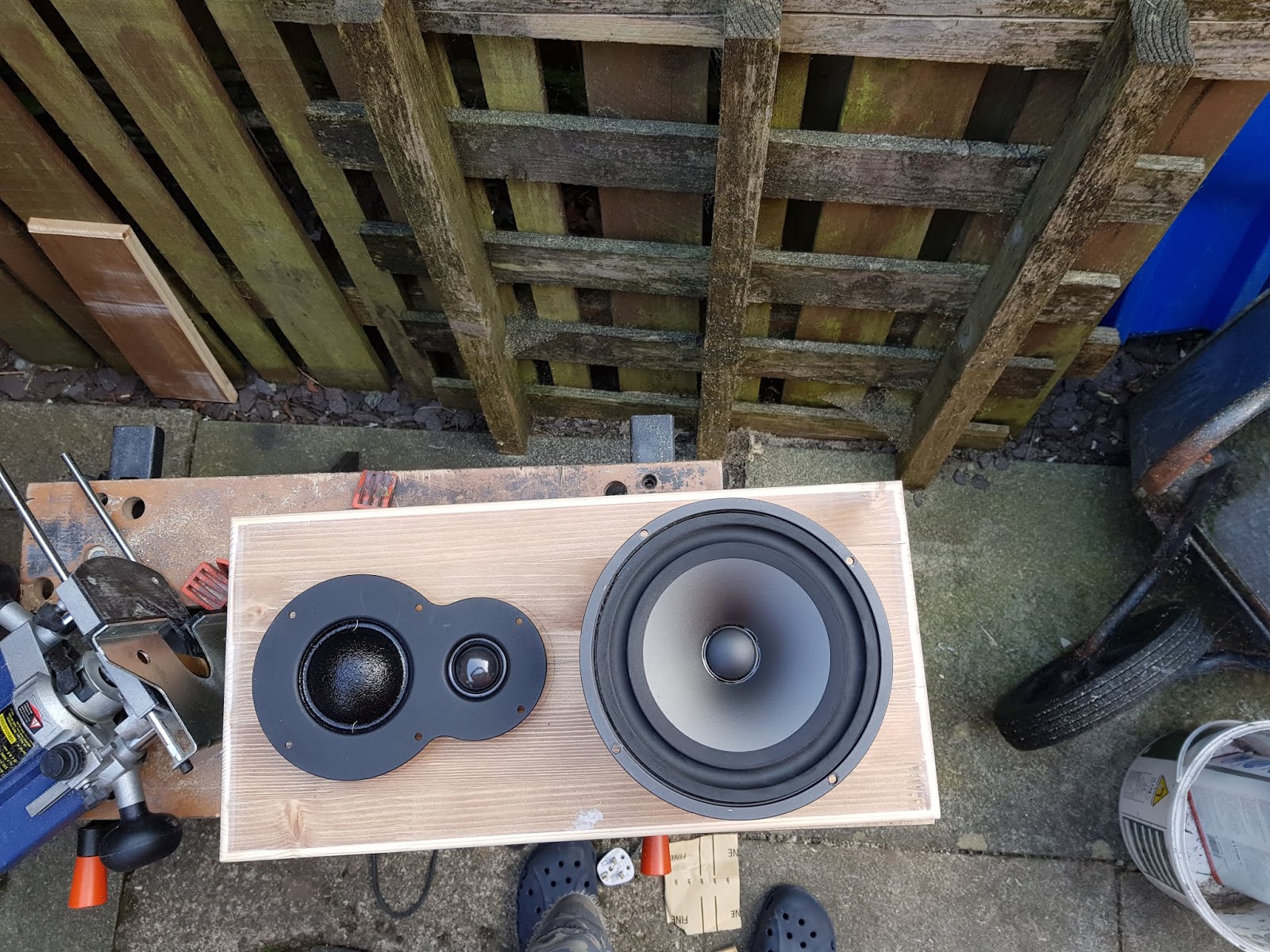
Here's the first baffle with cutouts, then trial fitting to the cabinet.  The only significant change from this practice attempt was the position of the mid-bass driver.  It was moved up on the baffle to give better alignment with the array but also to move the lower mounting bolts to better clear the inner strengthening board to allow for the through bolts to the back panel. Due to the thinness of this practice baffle, it wasn't possible to rebate the bass driver enough to allow the fitting of the rubber trim ring from the Ninka - something that was fixed in the final baffle design.


Everything just resting in place - no fixings at this point


Trial fixings with stainless steel bolts. This picture prompted the decision to find some black finished dome headed allen bolts
Final Baffle Build

The baffle isn't thick enough for a few reasons - the bass driver needs to be rebated more to allow for the rubber trim ring, its not really rigid enough as there's a lot of material removed to allow the driver install and the thickness of the material where the drivers mount mean it looks unlikely to be strong enough to support through bolting the chassis without the material tearing away.

In order to solve the above, but to avoid buying a full sheet of 25mm, I bought a half sheet of 12 mm mdf with the idea of sandwiching 2 layers together. If I was in the marketing department of a loudspeaker manufacturer, I might describe this design feature as "a multi-layer resin damped rigid absorption system" or something. But really its just 2 layers of mdf glued together...

So then the routing plan was somewhat more complex with the outer front layer of the baffle needing different machining to the inner layer.

Pictures of routing both baffle panels:


Perhaps choosing the complex shape of the combined tweeter - mid range wasn't the best idea for the first router project


The "outer" front baffle - here the holes are big enough for the bass driver and trim ring, but nothing to mount it on - that comes with the "inner" front baffle layer


The back edge of the inner baffle panel was chamfered to help smooth the airflow inside the cabinet.  Not chamfered all the way around though, need to leave strength for the mounting bolts.


Internal Chamber

With a tweeter, its normal just to make sure that the rear of the driver is protected from the internal energy of the bass driver inside the cabinet and its usually just a sealed moulding on the back of the driver that achieves this. Of course, much more expensive designs such as the B&W diamond series or the PMC Finestra go to a lot of effort to deal with radition from the rear of the tweeter with some very fancy cabinet design work. In case you hadn't noticed yet, this isn't a fancy nor expensive design...
With a traditional cone driver, a mid would need a sensibly sized enclosure.  But with a dome driver, it would seem to be best to treat it like the dome tweeter and just protect it from the energy of the bass driver.
Even with the double layered baffle adding up to 24mm, the 2 dome array still protruded into the inner cabinet space.  So it wasn't possible to just fit a covering board to protect from internal energy, but to use something thicker and machine an inner cavity into the material.  Also needed is a way of passing the mounting bolts and cables through whilst maintaining an airtight seal.

So my routing skills pushed further and resulted in probably the messiest part of the build, but at least its not visible on the completed speaker.  Here is the machined chamber:

The pretty rough machining of the internal chamber - rubber grommets for the cables to pass through. Later they'll have silicone sealant added to give a much more effective seal

The back, or inner, face of the chamber behind the 2 dome array
Glue ready to accept the inner chamber panel.  The notches in the main baffle are to allow for the cables to get to the terminals which are located on each side of the drivers

Gluing the baffle layers and the internal chamber.


Completed inner chamber

Here you can see the edge chamfering of the front baffle panel

Bolting

The idea for mounting the baffle was to use 4 of the driver mounting bolts to through-bolt to the rear panel to locate the baffle but also to add rigidity to the whole structure.  The original idea was just to use M4 stainless steel threaded rods.  But visually, I didn't like this idea, as it means nuts on the front rather than bolt heads.  So I added female threaded hexagonal nuts to the back of the 4 mounting bolts which couple the bolt to the threaded rod. Locknuts prevent the rods coming loose from the bolts.  The remaining 6 driver mountings rely upon M4 bolts into captive nuts.  This means the all the drivers and bolts need to be mounted prior to fitting the whole assembly to the cabinet.

Through bolting of the 2 lower bass driver mounts and the middle pair of the array mounts


Captive nuts

Captive nuts at the top, female threaded hex nuts

Mounting points for the bass driver - captive nuts at the top, female hex nuts for the threaded rods a the bottom


Trial fit of drivers into the baffle, including the female threaded hex nuts and using the black painted dome head allen bolts

Trial fitting of the through bolts. Large washers spread the load.  Note the additional pair of bolts and washers used to blank the excess number of binding post holes


Internal Damping, Anti-vibration and Connections

More pseudo-science here, based on nothing more than seeing inside of other speaker designs and a little bit from the portable project I put together some years back.

All panels have a natural resonance frequency.  This can manifest itsself as peaks and troughs in the frequency response of a speaker and often is described by reviewers as a "boxy" sound. So would it be a good idea to add damping material to counteract this? Possibly - the cabinet walls are pretty thin, so I gave it a go. As with the portable project, I've used self-adhesive panel damping from the car industry. But if I treat all the panels the same (for example the side panels probably have identical resonance frequencies as each other) then it will just move the resonance frequency to a different value but still adding each other together to up the output levels of that particular frequency. So, rather unscientifically and purely based on a dodgy theory, the opposite panels were treated with differing sized pieces of damping - hopefully meaning the resonance frequencies are spread out more and therefore less intrusive. Maybe.

I've also seen fairly dense foam used on back panels in a number of speakers - presumably to absorb some energy or disperse standing waves. So a layer of that is added to the back panel of the cabinet.

The silver material is the self-adhesive dampening material.


Below you can see the inside end of the binding posts - as there are now 3 drivers rather than the original 2, 6 terminals are required. You can also see the dense foam on the back panel


Above you can see the inner ends of the connection terminals - they have be upcycled from a pair of Linn 104 speakers that had some faulty drivers and that have contributed to another project underway.

For the chamber at the back of the 2 dome array, an arrangement of small chunks of foam are added - to either absorb any energy coming from the backs of the domes, or to help with protecting them from the bass energy in the cabinet, or a bit of both.  Again, the science may be a bit less than robust.

Damping foam in the 2 dome array inner chamber - first attempt

Second attempt with better shaping and room for the cables

Gasketty

A good seal between drivers and baffle is essential to a sealed infinite baffle design such as this. So some sheets of fishing fly material were obtained - its essentially a very thin sheet of dense foam.  Quite delicate though, so care is needed in handling and cutting.

Card templates were made and trial fitted before cutting the actual material.

Creating the bass driver gaskets

Creating the array gaskets

An array gasket - this was the first attempt. Attempts 2 and 3 were much better, but I didn't take photos
Trial fitting the array gasket


Bass driver gasket in place
A further gasket was put together around the perimeter of the cabinet to seal against the front baffle.


First Trial Build

A few lessons were learned along the way during the trial build.  For example, the spade terminal cable connections on the back of the array had to go and be replaced by soldering the cables directly - there wasn't clearance for the spades.
Also, it became pretty clear why through bolting might not be popular with manufacturers.  Putting aside that it might not be a particularly sound mechanical approach, getting the bolts through the internal wadding of the cabinet, aligned into the holes in the back panel and then getting the baffle lined up with the cabinet is, what could be called "a bit of a faff" and very time consuming.

Originally the array cables were fitted with spades, but these were soon swapped to soldered connections due to restricted space.


The cables have to be connected before threading the bolts through to the back panel. In the final build step the rubber grommets havea silicone sealant added to make them fully effective

 In the above image you can see the initial polyester wadding in the cabinet - this is re-using the quantity from the original Index II.  It turned out to be in adequate in the first listening tests, resulting in a some what loose overblown bass sound.  Later the entire internal space was filled with rolled wadding. A huge improvement in the sound - shown below.

Here the painting of the front edge of the main cabinet can be seen - required because of the construction method - this edge can be seen from a side view of the cabinet.  Also visible here is the baffle sealing gasket (stapled in place, just for alignment purposes).  The final quantity of wadding can also be seen.


First trial build completed

At last, after 9 months of elapsed time, a pair of speakers are ready to test

Here you can see the through-bolt approach.  The extra length does help with assembly to get the bolts to thread through the back panel. Once the project is complete, they'll be cut down to a more sensible length. Also the ex-Linn 104 binding posts can be seen

 
It's taken a while...


Finishing Off

Initial measurements were taken and Exakt crossovers designed, but there was an issue with a loose overblown bass. From some work I did on my "portable" project, I knew this was down to the volume of wadding inside the cabinet, so a partial dismantling took place and more wadding added.  This means re-measuring the electrical characteristics of the bass speakers and re-listening.  It had done the job nicely.

To finish off the front edge of the main cabinet was treated to primer paint and then the baffles sanded with 400, then 800 grit papers.  Three more layers of spray primer, another 800 rub down, 2 more layers of primer and a 1000 grit rub down. Then two layers of matt black spray paint, 1000 grit and 2 more layers of black.
I think a lot more time could've been put into getting a better finish - particularly on the edges.  Maybe some epoxy filler before sanding would have helped. The machined mdf edges are still a bit rought. But they're not meant to be for sale so these some elements, for me, are less important than the resulting sound.


A completed baffle, including the rubber trim ring for the bass driver

Here you can see the extra wadding inside the cabinet - now packed quite tightly. Also the black painting of the exposed chipboard on the front cabinet edge and the baffle to cabinet gasket


Happy enough with the result


PART 3 OF 3 HERE

Friday, 22 May 2020

Building a Nindex Speaker - Part 1 The Idea

At AudiophileMusings there is an almost constant turnover of speakers passing through the place. Sometimes for review, sometimes to consider retro products to find out if they're as good now as they were then, but often due to designing Exakt digital filters for them as part of SpeakerFilters activities.

There's a fair amount of cannibalisation going on too. Pick up some tatty but working speakers, a pair of equivalent, immaculate, but not working speakers and create an immaculate working pair, to keep them going - upcycling perhaps? So sometimes that produces empty but OK cabinets, spare drivers etc.  Usually these are sold as spares, but sometimes a daft idea comes along and a project is born. One of those has been in the making for over 2 years so far...but that one is for another day, month or even year!

This one, however, has been particularly speedy in comparison, with a gestation period of just over 12 months.  There's always something else to listen to, a show to go to, another Exakt design commission to enjoy to delay progress.

Over 3 parts I'll take you through the timeline of this, my first ever completed speaker build and the results.  There's the back of a fag packet involved, some kinda cheating (my woodworking skills are atrocious), the application of some ideas I've had for a while and some drivers that are familiar to many but very familiar to me.  I've chucked some ideas at this that I've not really understood why they're not used more extensively, until I tried to achieve them, and there's some very traditional elements too. And some bodging along the way - so don't expect this to be ultra precise, nor particularly pretty.

Starting Point

A need for some drivers to fix a pair of Linn speakers lead to the purchase of a pair of Linn Index II speakers that were extremely good value for money - being in decent condition and fully working. The mid-bass drivers went to the repair job and the tweeters and crossovers went off to a new home, leaving me with a pair of Kustone stands and a pair of empty Index II cabinets.  Given the relatively low quality of the cabinets themselves - chipboard shells, mdf baffle, vinyl wrap and essentially nothing more, they languished in the corner for a while, under threat of a trip to the local recycling centre.  A different project had left me with some Linn Ninka (040/2) mid-bass drivers in stock too and it seemed a shame not to bring the two together to see if something could be created.

Linn Index II as Standard (library picture)

Tweeter Pair Went To A New Home


Driver Selection

The Index II is around 20 litres in internal volume.  The Ninka, which has 2x mid-bass drivers, is around 40 litres in internal volume. So the availability of a single Ninka driver, with some kind of back of a fag packet logic, in half the volume of the pair of drivers, seemed as though it might just work. Not a sophisticated way of making a decision, but this is a pretty low budget build, so not exactly a lot at risk.

Also sitting around in stock are a pair of Linn 3K arrays - initially I thought about putting these in the mix, but laying the drivers out on cardboard roughly the size of the baffle showed up a couple of things - there wasn't really space, and the traditional way of a 3K overlapping an upper bass or bass driver just isn't possible with the Ninka driver. I was trying to convince myself that the 3K would work, so an extra 4 binding post holes were drilled in the back of each cabinet, but no worries, even though eventually only an extra 2 were required. The obvious thing would be to go with Ninka tweeters - the 038/2 Linn unit is sweet enough, but it didn't seem very adventurous.

So something else would need to be found. Shortly afterwards I saw a post on a forum somewhere about a 2 dome driver array - mid and tweeter - that was extremely good value for money, and remember hearing them in a pair of large floor standing speakers at the Cranage Show a couple of years back.  I remember them being full of detail but without being harsh, edgy nor shouty. A bit of further research revealled that they're not that easy to find, but a pair was soon on its way from Germany to the UK. The HiVi Swan TM1-A is ridiculously good value for money - a couple of sophistcated looking drivers on a very solid all metal chassis.  They come with plenty of information too on their Thiel-Small parameters, recommended crossover points etc.  One thing that appealled was their independence from each other - although they're in the same chassis, they don't have any crossover, they're electrically independent.

Baffled

Back to the donor cabinets. Now the drivers are chosen, it was pretty obvious that the (pretty substantial) original mdf baffles are no longer of use.  But the Index II is essentially a sealed box, from a cabinet construction point of view - everything being glued together.  So onto the circular table saw they went and the baffle was sliced off, revealling the contruction of the cabinets, which includes a ring type stiffening element. The baffle is rebated and sits partially within the cabinet, partially proud. So the circular saw took away a few millimeters of the side and top panels too.

Cabinet with baffle still in place

Cabinets with baffles removed, the strengthening element clear to see

So this is the basis of the cheating in the project - no need to build the main cabinet element, which, with my very rudimentary woodworking skills, meant a much greater chance of success.  I'm going to play the upcycling card again too! More environmentally friendly this way.

Standard crossover removed and additional binding post holes drilled

 Also lying around in the garage were some pine scraps that were cut down to the correct size and the drivers were laid on to check alignment / positioning.  Plus, I needed to practice with the router - an implement that I've not wielded before, so something new to get to grips with.

Checking baffle for dimensions - this is the practice pinewood

First attempt with the router - radius corners around the baffle edges

Laying the drivers out on the baffle. The practice baffle was cut like this, but the final baffle brings the dome array and bass drivers closer together
So that's the starting point - in part 2 the build gets underway and some of the construction ideas are put into action

PART 2 OF 3 HERE
PART 3 OF 3 HERE


Wednesday, 20 May 2020

Inside Linn's Sneaky DS

A few photos with the lid off Linn's Sneaky DS.

Pictures taken when the covers were removed for refinishing in a subtle new shade :)

General Overview, including the power amp monolithics towards the left, bolted to heatsinks which align to the cooling slots


Xlinx FPGAs for upsampling, applying SPACE Optimisation etc. Probably.


What looks like the amp stage with the monolithic power amps at the top of the picture
Re-assembled Sneaky

Monday, 24 February 2020

Bristol Hifi Show 2020 - Highly Commended Award - Wharfedale and Audiolab

I was really looking forward to Wharfedale's newly launched Elysian range at Bristol - their move significantly up market.  The static large standmount on display shows the finish is both an interesting shape and extremely well executed - from that aspect alone they're very impressive.

The 85th Anniversay Lintons were being demonstrated and you can read thoughts about them from the 2019 show on this blog.  So of much more interest were the (also newly launched) top of the range Evo4.4 floor stander, retailing at just under £1200.  On the face of it this is a lot of speaker for that money - the AMT tweeter and dome mid range drivers are typically not budget units.  Partnered with Audiolab's equally VFM 6000 series electronics this system did a fine job of filling this largish room with style. And music. There was lots to admire here at this price level, trouncing some much more expensive systems. I wish I'd had more time to spend with this system.


Bristol Hifi Show 2020 - Sound of the Show Award - Kudos Audio (with Naim)


A new product and a new approach from Kudos this year at the Bristol show.  Fittingly highlighted in green in keeping with the Naim electronics, Kudos brought their Titan 707 for us to enjoy.

As is now the norm for Kudos show demos, the Titans were running active. Sometimes its Linn Exakt, sometimes Devialet Pro but more often its Naim with the SNAXO active crossover dedicated to the Kudos range. But this time there was a twist.  Normally we would see Streamer to Pre-Amp to SNAXO to power amps to speakers.  But Kudos have spotted an interesting opportunity in the way that Naim cabling works.  They presented a system here that used an NDX2 streamer, a SuperNait 3 integrated amplifier and a 250DR power amplifier. I'm not quite au fait with the way that this is strung together, but its suffice to say that its possible to split out the pre and power sections of the SuperNait so that it acts as a full range pre-amp but the power amp is only looking after, for example, the bass output (as it was here) from the SNAXO whilst the 250DR gets on with looking after the treble drivers.

This is pretty significant as it reduces the cost of entry to an active system and brings SN3 owners into the equation in terms of upgrading to active - they no longer have to move on from the SN3 to a new pre-amp and 2 new power amps - adding the SNAXO and one more amp is enough - and that could even be a used 180 or 200 to keep the costs down further.

Music was coming from the local Innuos Zenith server or from the Tidal streaming service.

Enough of that - how did it sound?  Well, great. Very very easy to sit and listen to all sorts of genres - which of course Kudos were confident enough to deliver.  The audience being encouraged to request tracks too.  All of this musicality meant that it was often difficult to get into the room as many visitors will have been happy to absorb the tunes for longer than in other rooms. Sitting in the front row made the system sound a touch light and in the second row a touch boomy so clearly this was a room effect and the best seat would've been midway between the 2 rows. Its difficult to write much more about this system, it just got on with delivering the music without any obvious issues nor with any outstanding areas - other than the outstandingness of its total confidence in delivering the goods.


For those of you who are Naim cabling aficionados, you might be able to work out the signal from SuperNait 3 to the SN3's HiCap PSU to the SNAXO and its HiCap PSU and then to the SN3's Power Amp section and the 250DR Power Amp. For those of us who are mere mortals, just be sure that it works and that someone else could probably get it to work for us!


Newly (quietly) announced at the show from Kudos is their own brand of speaker cables.  They're 18 strand silver plated copper and derive directly from the cables chosen by Kudos for the inside of their products.  No news on price at this point.


So, sound of the show for Kudos this year, and an honourable mention in the "music of the show" category too - a good variety being played and the audience being asked if there was anything they'd like to hear - the way the music should be at shows.

Bristol Hifi Show 2020 - Highly Commended Award - Totem (with Chord)


The performance per $ and per sq m of floorspace occupied is Totem's new compact standmount speaker, the Skylight's target.  Presumably derived from the very well received and very musical Sky standmount, Totem have done a great job again.  It was good to see these partnered with the very compact Chord Hugo electronics and the whole thing was lively without being shouty, punching above its size in terms of bass output and musical enjoyment.  Very much worth a listen at this price point and this level of space efficiency - electronics and speakers.


Bristol Hifi Show 2020 - Best Cinema System - KEF (with Arcam)


KEF focussed on home cinema in this room - it was dark so I don't have pictures of the speaker set up, just the rack of Arcam electronics.
The room was showcasing the latest R series speakers in a Dolby Atmos configuration.  The main speakers were the floorstanding R5 supplemented by a centre, 2x subs and 4x Atmos height speakers.  A couple of demo tracks were played from a demo disc.  The sound was extremely well controlled in every sense of the word - deep, powerful bass from a music perspective, substantial and controlled thuds where appropriate to the content and the steering was superbly smooth and seamless around the room.  Its a system that does all this without any sense of harshness nor compression that's often an issue - and they didn't play it "loud to impress" but loud enough to be very enjoyable. Deeply impressive stuff, which is should be at a total of £35k. Great demo.

Bristol Hifi Show 2020 - Highly Commended Award - PMC Twenty5.26i and Bryston

PMC have taken on distribution of Martin Logan so they were added to the demonstrations scheduled by PMC and in their static displays.  I liked the idea that PMC had listed their demonstration schedule on the door outside the room - so you could choose which product you wanted to hear and slot it into your tour of the hotel - even better would be to publish this beforehand :)


So I visited the room at a fortuitous time as the top of the line in the latest in the Twenty5 series iteration was playing.  The new Twenty5.xxi range is a development of the popular Twenty5.xx.  There's a new tweeter based on the FACT design, some tweaks to the crossover and some work to reduce cabinet resonances. Without the benefit of direct comparison with the previous range, its fair to say that they Twenty.26i was sounding good in what is a pretty large room. The front end was a Bryston digital player and large integrated amplifier.  The music was engaging, well controlled and the sound was even across the frequency range.  Also on show, see below, was the rest of the "i" version of the Twenty5 range.


Bristol Hifi Show 2020 - Highly Commended Award - Hegel and Amphion


Keep it real with Hegel and Amphion.

Most people don't have room for an enormous hifi system.  Its great to see and hear those systems at this kind of show, but its great to also find a system that's being presented as a real and achievable solution for the majority. So here we have the compact Hegel 120 streamer / DAC / amplifier and the small but very well built Amphion Argon 1 speakers. And that's it. But sensibly they were displayed in a real World scenario - a compact furniture unit with room for the hifi, a disc player / TV box / gaming console, a TV and a few homely touches.

Did it sound good? Absolutely. Very good indeed.  Even using this kind of furniture you can see how it would work as its not that dissimilar to a regular hifi rack / speaker stand structure, but it looks like furniture, designed for the average room and use case. Opposite was a comfy sofa so we settled down to some tunes. A few different genres were played and all of them rendered very enjoyably. Then we switched over to the Yello Live in Berlin concert Blu-Ray disc and enjoyed that too. Good stuff at a sensible price.

Thanks Hegel / Amphion for showing how to sell hifi without scaring away the punters.

Yello Live in Berlin

Bristol Hifi Show 2020 - Best Value For Money Award - Rega Research


There's always something reasurringly down to earth and straightforward about the Rega approach to playing music at home.  Their rooms are always simply presented - and I mean this in a complementary way - they have reasonably priced equipment on which they play a good range of music genres.  This year was an exception though - they've really outdone themselves this time with the great wall graphics but more importantly, with the system on demonstration.

Featuring, of course, a turntable at its heart, Rega have clearly grasped a few things that are needed to catch the attention of a new audience, a new generation. 1 - make it simple - here we have a turntable - arm - cartridge - amplifier - speakers - cables all in one package; 2 - show it in a realistic setting with ordinary furniture with no bling nor high priced accessories; 3 - make it compact to fit in with most young people's living space; 4 - make sure its cool (turntable) and sounds great; 5 - price it at a very attractive level and that's the big news here, without the stands Rega have fitted this right under the magic £1k level at £999.  No price on the stands yet, but they look to be made from MDF so shouldn't be too expensive.

So that's the story here. A full, cool and vinyl based system - the P1, IO amp and new Kyte speakers for under a grand. And it sounded fine. No harshness, plenty of information, tuneful. Great.
Well done Rega for understanding what's needed for a new generation. System One - go and have a listen.


Bristol Hifi Show 2020 - Highly Commended Award - Canton Smart System


The team at Canton were using a seriously expensive AVM CDP / streamer / DAC / pre-amp unit to feed their very compact little Smart Amp feeding the standmount speakers.  All-in the amp and speakers amount to a very reasonable £1450.  The system was detailed, punchy, lacking in harshness, but most of all musically engaging.  Stayed for a while listening to this one on both visits - great value for money.  The second year in a row when Canton have collected an award based on the sheer value for money of their offering.


Bristol Hifi Show 2020 - Best Music Choice Award - Leema Acoustics and Brigadier


Riffing on the South Wales origin of the Leema Electronics (sheep on the right) and the New South Wales origin of the Brigadier MU.2 speakers (inflatable kangaroo just out of shot on the left) the Leema team brought a bit of fun to Bristol.  But they also brought a couple of other things - a seriously good sounding system whether using the Leema Sirius streamer / library or the turntable and a wide range of music choices.  This system has lots of get up and go yet without giving the impression that it would be tiring to listen to over a longer period. The Tucana II anniversary edition amp had plenty of grip on the little standmounts that are very dynamic yet deliver plenty of nuances in the music. I have to say that the room host was mixing it up with the music too - I went into this room 3 times and not once was there plinky plonky jazz.  I first heard the album "Eyes Closed" by Haevn in this room - it featured in a couple of other rooms too - decent chill out electronica with a hint of London Grammar. On one occasion U2's Zoo Station was to be enjoyed - not a "hifi" track at all - and that demonstrates the confidence in this room - it was the music that took centre stage. U2 was followed up by the Cambridge King's Singers delivering an accapella version of Good Vibrations. Variety.  Leema clearly knew that their system was musical and had the confidence to demonstrate is abilities.


Bristol Hifi Show 2020 - Turntable of the Show Award - Kuzma and Living Voice


The Stobi R turntable from Kuzma was playing through valve based electronics into Living Voice Auditorium speakers. For these ears, this was the best sounding turntable at the show, and possibly the best sounding valve electronics too.  The LV Auditoriums are a perennial favourite but they don't always seem to get the front end they deserve. But here today it all came together very well - it's one of those buttery smooth systems, but without the lack of dynamics that description normally implies. A very enjoyable system and one I could've listened to for a good while.

In the background can be seen Living Voice's Pure Music battery power supply - this converts AC mains to DC into the batteries and then re-generates the AC mains from those batteries, essentially an attempt to isolate the system from mains bound noise and instability.


Bristol Hifi Show 2020 - Highly Commended Award - Linn Products / Fyne Audio

LINN PRODUCTS / FYNE AUDIO


Scottish Linn Products were back again this year - after their re-appearance in 2019 was preceded by a long absence from Bristol.  It was possible to book in advance for their scheduled demos - with a choice of 25 mins of streaming or 25 mins spent with the long lived LP12 turntable in various iterations.  Musings spent time at the streaming demo and an exclusive play of the new Series 3 wifi speaker in stereo operation.  Thanks for that extra time Linn.
First a bit of news on Sondek LP12.  In 3 years time it will be Linn's 50th anniversary, along with the LP12. A remarkably long standing product, but one which has continued to evolve over that time.  Launched at Bristol is a new range of finishes - RAL colours are now available along with gloss finishes for colours and natural woods.  Nice to have so much choice.  Also, there will be more product developments later in 2020, but no further details just now.
On to streaming - initially a Series 3 speaker was playing quietly and was introduced, but then straight on to the Selekt.  This one box modular solution is streamer, pre-amp, DAC, Exakt hub, power amplifiers and more.  Now it receives signals over wifi and bluetooth too.  The demo was between 2 versions - one with the "entry" level DAC, the other with the "Katalyst" DAC option.  A couple of tracks were played and the difference was quickly obvious - the standard DAC is good, the Katalyst is very good - there's no point in listing what's better about it - its just everything. Simple.
Worth noting that Linn were making the room an all Scottish affair - Atlas cables (yes, Linn were using third party cable upgrade products) and Fyne loudspeakers - all of these made in the Glasgow area. The Fynes are the floorstanding F502 in SP guise which has upgraded drivers over the standard model.  These have been measured for Linn's "SPACE" room optimisation software and the next demo was a track played with and without the optimisation.  Again the benefits were clear, literally, in the way the boominess of the room was tackled, letting the music play more clearly - across the full range.  I'd really like to see Fyne and Linn collaborate together and produce an Exakt version of this speaker - it sounds extremely good for its price bracket with a good strong, taught and deep bass line, something that has been lacking in some other Fyne speaker designs.

Finally there was a chance for musings to hear the new Series 3 standalone speaker in stereo mode.  The primary unit is £3k and does the control work - partnering it with the £2.5k auxilary speaker is but a moment's work.  Whilst the speaker itself is capable of streaming from ethernet or wifi, when in a pair they use a Cat 5 cable to transfer Linn's proprietary Exaktlink communications.  They're designed to be used in kitchens, dining rooms and bedrooms really, not as a main system, but to do so in the highest quality possible in such a compact package. A couple of things help with these less than ideal placements - the cabinet is very inert, constructed from something rather like corian, plus, of course, Linn's SPACE Optmisation capabilities.  In single speaker mode the sound from this wine glass shaped unit is very enjoyable - musical.  It doesn't go particularly deep, but its impressively deep for such a compact design.  Pair it up with its auxiliary partner and the sound fills the room very well - its tuneful and works very well with music and speech that are probably suitable for the intended locations.  Only when we wound up the volume with some bass heavy Yello did things feel compromised.  So its good for the job its intended for, and it might make an interesting rear and side speaker in a Linn Exakt surround system too.